Munich: history and things to do
The recorded history of Munich dates to a document from 1158. Following the division of Bavaria in 1255, Munich became the residence of Duke Ludwig the Severe, ruler of Upper Bavaria.
Things to do in Munich
A self-guided WWII spy game walking tour in Munich Old Town lasts 1 hour and 55 minutes. It includes access to a mobile game with clues and story chapters, GPS directions between tour locations and a professionally written historical spy story.
The Munich self-guided walking tour with a scavenger hunt and sights lasts 2 hours. It includes smartphone tour access, riddles and scavenger hunt clues, content in English and German, and historical and cultural information at the stops.
A self-guided walking tour in Munich with audio commentary lasts 3 hours. Included are access to the audio tour app, 21 commentaries in French, English and Spanish, an interactive 3D map with live geolocation, offline use and sharing across devices for groups and families.
Marienplatz
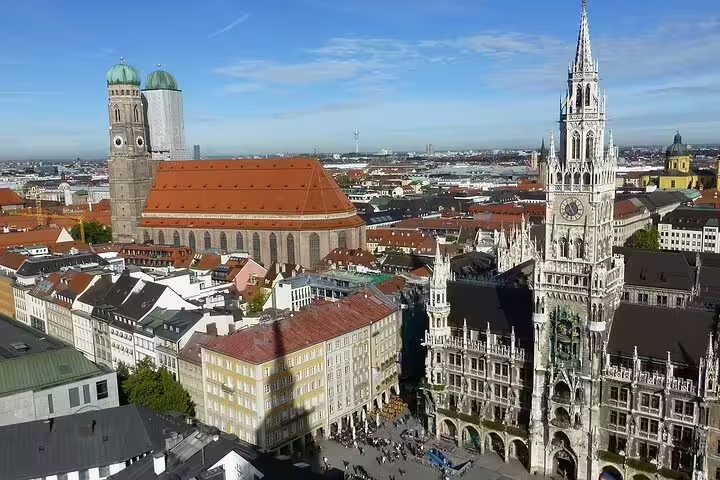
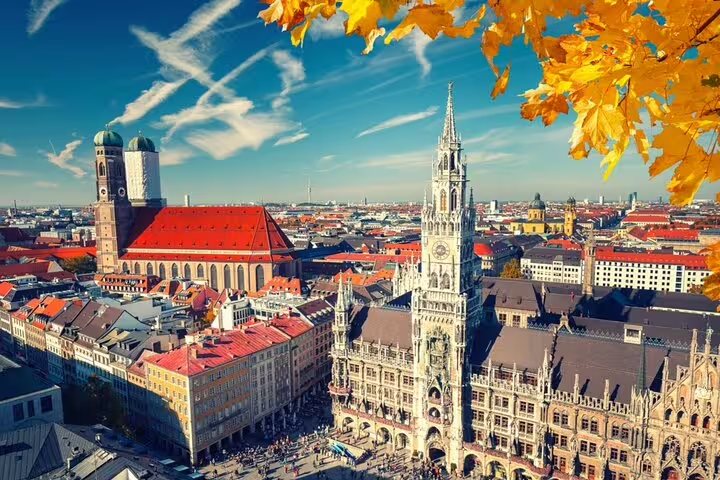
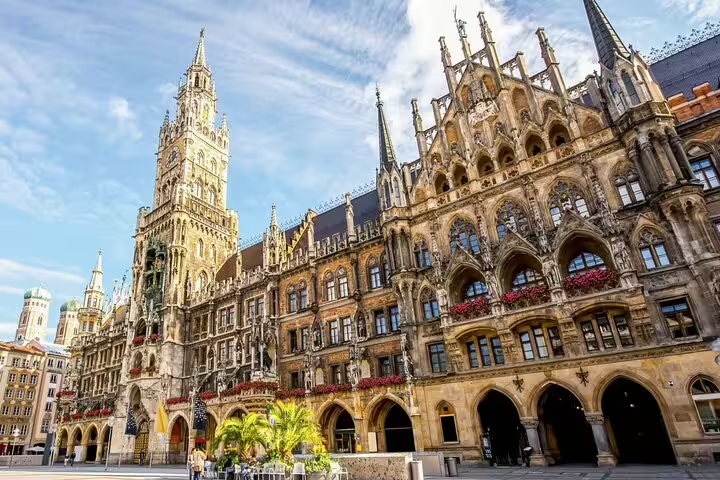
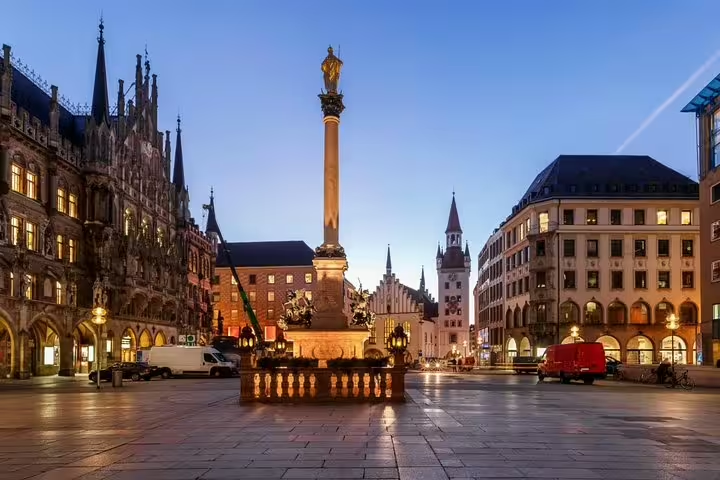
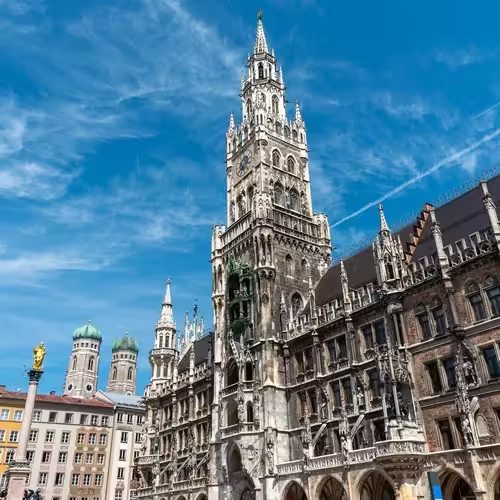
Marienplatz received its current name in 1854, following the relocation of the market. Georg von Hauberrisser designed the neo-Gothic Neues Rathaus on the square, built in stages between 1867 and 1909. Its Glockenspiel combines 43 bells with 32 figures.
The Munich Residence and Frauenkirche
Construction of a small castle surrounded by a moat started in 1385 where the Munich Residence later developed. The Wittelsbach dynasty lived and governed at the Residence for four centuries, ending in 1918. The complex is grouped around several courtyards. François Cuvilliés the Elder designed its Ornate Rooms and, with Joseph Effner, the Ancestral Gallery.
The Frauenkirche became the cathedral for the newly established Archdiocese of Munich and Freising in 1821. Its south tower stands 98.45 metres high, while the north tower reaches 98.57 metres.
The English Garden
The English Garden extends over 376 hectares; the figure rises to 411 hectares when the Maximilian Park and the Court and Finance Gardens are counted. Its Chinese Tower is a pagoda building standing 25 metres high, based on a design dating to 1789. The round, temple-like Monopteros and its hill were added to the southern area in 1836 and 1837. The Japanese Teahouse was built in 1972 to mark the Munich Summer Olympics.
Nymphenburg Palace and its park
Building work at Nymphenburg Palace started in 1664, following plans drawn up by Agostino Barelli, an architect from northern Italy. Work on the pavilions began in 1701, with galleries connecting them to the central building. Max Emanuel commissioned the French garden designer Dominique Girard to create a Baroque park in 1715. Friedrich Ludwig von Sckell later transformed the formal park into a landscape garden. Karl Theodor made the palace park accessible to the public in 1792.
The Bavarian State Library and Viktualienmarkt
The Bavarian State Library began in 1558 as a library serving the Wittelsbach court. Its holdings total about 40.5 million media units, with more than 5.3 million digitised objects. The market tradition at Viktualienmarkt entered Bavaria's state list of intangible cultural heritage in 2017. The market has been a pedestrian area since 6 November 1975.
Frequently asked questions
When does Munich's recorded history begin?
The documentary record of Munich begins in 1158.
When did Marienplatz get its name?
The square was named Marienplatz in 1854, after the market moved.
How many courtyards does the Munich Residence have?
The complex is grouped around several courtyards.
How large is the English Garden?
It covers 376 hectares, or 411 hectares when the Maximilian Park and the Court and Finance Gardens are included.
When was Nymphenburg Palace started?
Construction began in 1664 using plans by Agostino Barelli.