Last updated:
The Hague grew up around a hunting lodge built in the 13th century, on the spot where the Binnenhof stands today beside the Hofvijver. This page follows the city's registered monuments outwards from there: the Binnenhof and its Ridderzaal, the Gevangenpoort and the Mauritshuis on either side, the Grote Kerk and the Passage a little further west, and the Peace Palace further out. The walks and city games that link them come at the end.
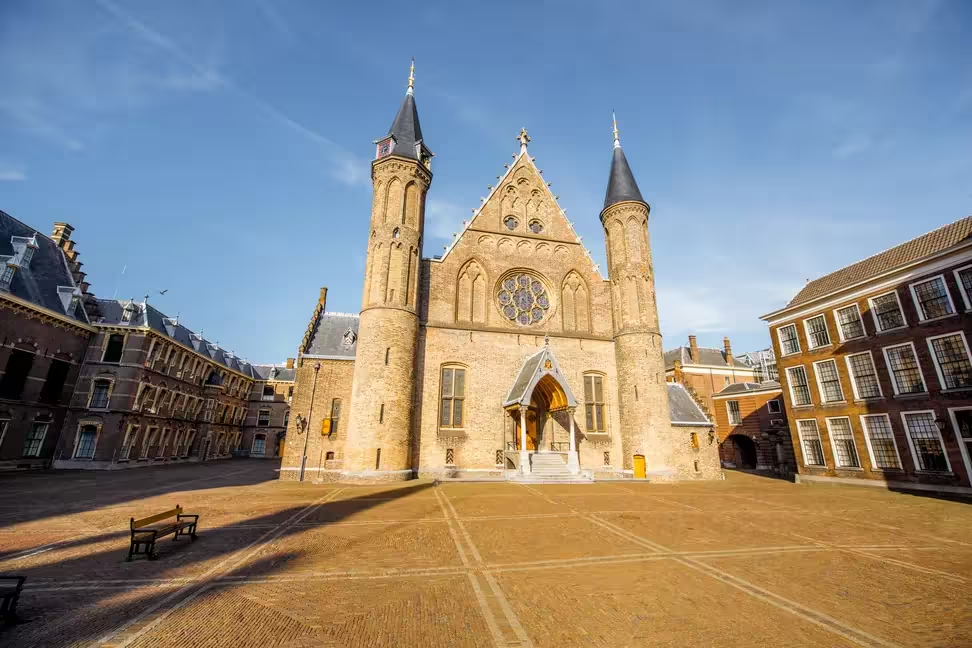
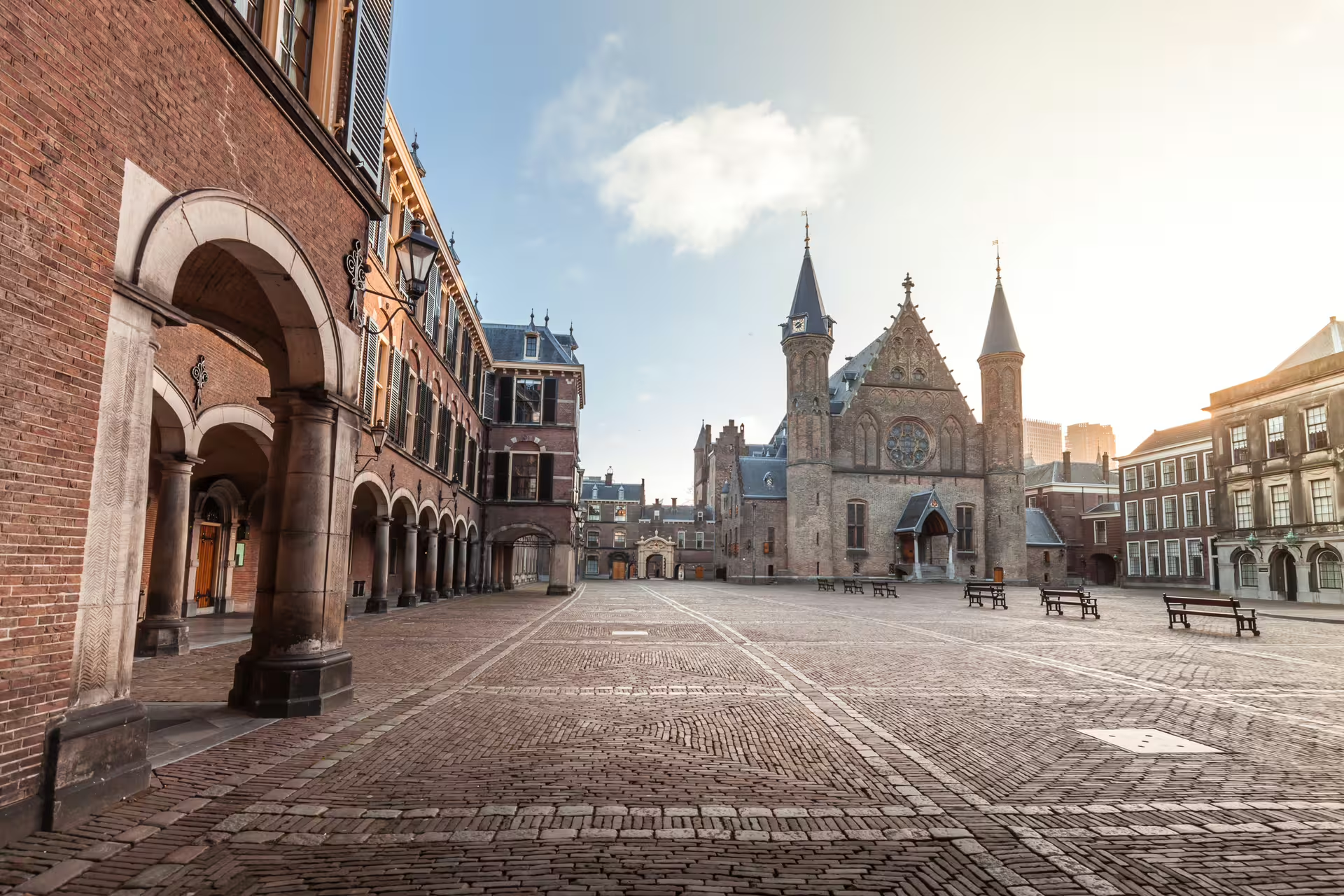
The story of the Binnenhof goes back to the third decade of the 13th century, when a hunting lodge went up here. Over time it turned into a centre of government, home in turn to the Counts of Holland, to the stadholders and then to the councils that governed the country.
The oldest part of the counts' palace dates from around 1250 and still keeps a cellar from that time, with the Rolzaal above it. The Ridderzaal, the Hall of Knights, belongs to the second half of the 13th century. Its two round towers are the result of a thorough restoration, inside and out, carried out around 1900, when its roof, almost 18 m (59 ft) wide, was also rebuilt. To the east, a wing that once held the civil chamber of the Court of Holland took its present form in 1668, the year seven wall paintings on canvas by Gerard de Lairesse were put in place.
Three gates lead into the courtyard: the Hofpoort of the late 18th century, the Grenadierspoort of 1634 and the Stadhouderspoort, a copy of a gate first built in 1550. Among the other parts that the register singles out are a small tower, probably from 1479, the meeting hall of the States General, fitted out again in 1697 to a design by Daniel Marot, and a fountain by Cuypers dated 1885.
On the Buitenhof side, the Gevangenpoort is a gatehouse of the 14th century to which a prison was added in the 15th century, and it was once the only way into the Binnenhof from the north. The brothers De Witt were held inside shortly before their death in 1672. The gate also marks where the boundary used to run between the closed grounds of the Binnenhof and those of the Buitenhof.
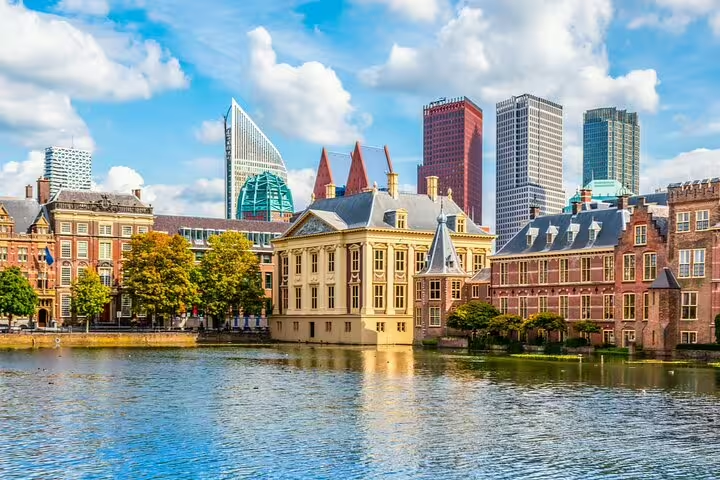
At the eastern end, by the Hofvijver, the Mauritshuis was built from 1636 onwards for Johan Maurits van Nassau, to a design by Jacob van Campen working with Pieter Post. It is a large brick building faced with stone across three bays at the front and at the back, under a triangular pediment, and the register counts it among the best examples of the giant pilaster order. The building burned out in 1704; inside, a double staircase, wood panelling and chimneypieces from around 1710 follow the manner of Daniel Marot.
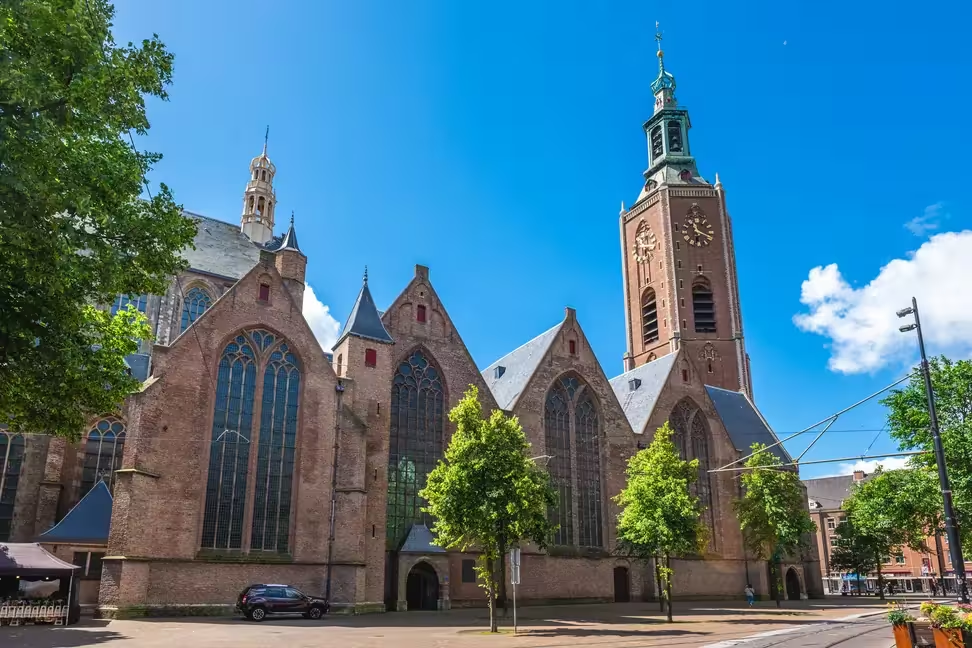
A few streets to the west, the Grote or St. Jacobskerk is a late Gothic church with a six-sided tower, a nave flanked by chapels set crosswise and a tall basilican choir. Its pulpit of 1550 is richly carved, and inside hang 34 panels with the coats of arms of knights of the Golden Fleece, each with his name. The carillon includes 15 bells that M. de Haze cast in 1686 and 1687.
Close to the Buitenhof, the Passage is a covered arcade built between 1882 and 1885 to designs by J.C. van Wijk and H. Wesstra. Four passages of this kind once stood in the Netherlands, and the one in The Hague is the only survivor. Its third arm, towards the Hofweg, followed in 1928 and 1929, designed by Jos. Duynstee.
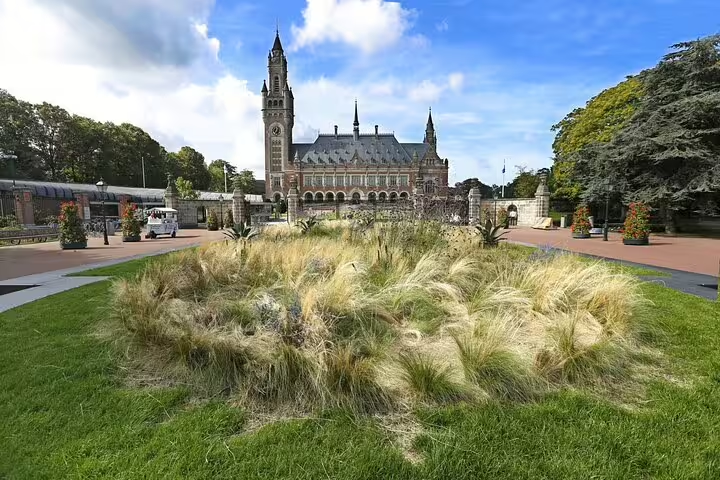
North-west of the old centre, the Peace Palace was founded on the initiative of Andrew Carnegie, originally to house the Permanent Court of Arbitration and its library. L.M. Cordonnier, who had won the competition for its design, worked on it with J.A.G. van der Steur, and it went up between 1907 and 1913 in a neo-Renaissance style that borrows partly from French châteaux and partly from Dutch models. Four wings stand round a courtyard, and of the park laid out by Thomas Mawson, the northern side remains.
Every country that took part in the Second Peace Conference of 1907 contributed something to the building or its park: granite, marble, cedar, mahogany or teak, stained glass windows or bronze doors. In the middle of the courtyard there is a fountain of Copenhagen porcelain decorated with animals, a gift from Denmark in 1920 that was set up in 1922.
A self-guided walk with an audio guide tells its stories on your phone, from the historic centre to the Binnenhof and the streets with royal connections, and a guided walk for small groups begins where The Hague itself began, around the Binnenhof, and later reaches the Passage.
Two games take you through the centre without a guide: a scavenger hunt in an app, with questions to answer around the Binnenhof and the nearby squares, and a game of clues that goes from the Grote Kerk to the Gevangenpoort, the Mauritshuis and the Binnenhof. From Amsterdam, a private day trip spends the morning in Rotterdam and Delft and then, in The Hague, stops at the Peace Palace and the Binnenhof.
All trips that include the city are also on the destination page for The Hague.
Jacob van Campen, together with Pieter Post. Johan Maurits van Nassau had it built from 1636.
It was at first the single northern entrance to the Binnenhof, and later it served as a prison, where the De Witt brothers spent their last days in 1672.
Work ran from 1907 to 1913, after L.M. Cordonnier won the design competition.
Of the four covered arcades of this type in the Netherlands, it is the only one still standing. Its main part dates from 1882 to 1885.
Sources: Rijksdienst voor het Cultureel Erfgoed, Rijksmonumentenregister, CC BY 4.0, text translated and summarised: 24352, 18660, 20943, 36568, 13998, 30674.