Last updated:
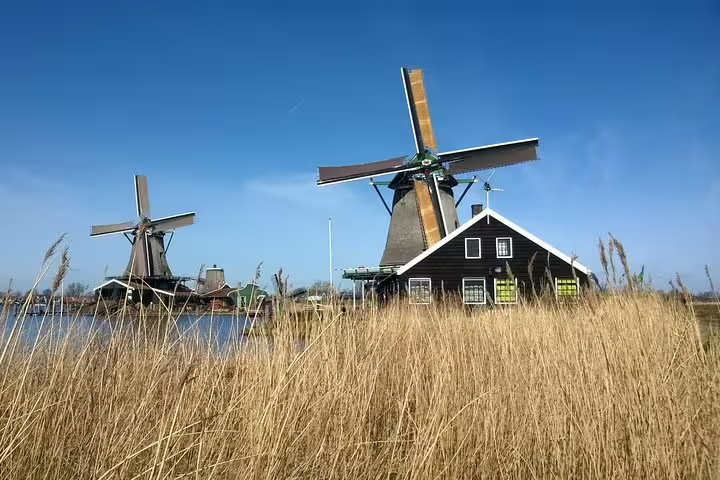
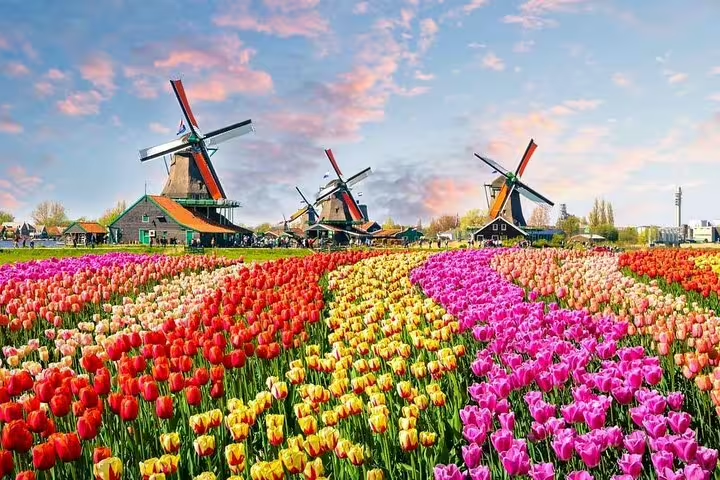
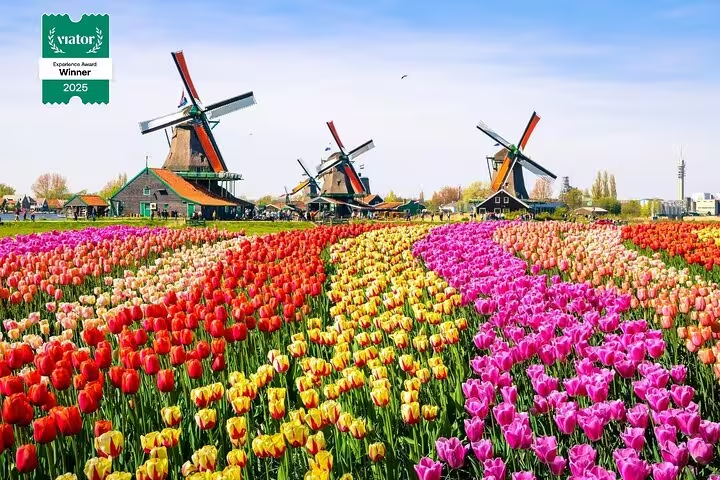
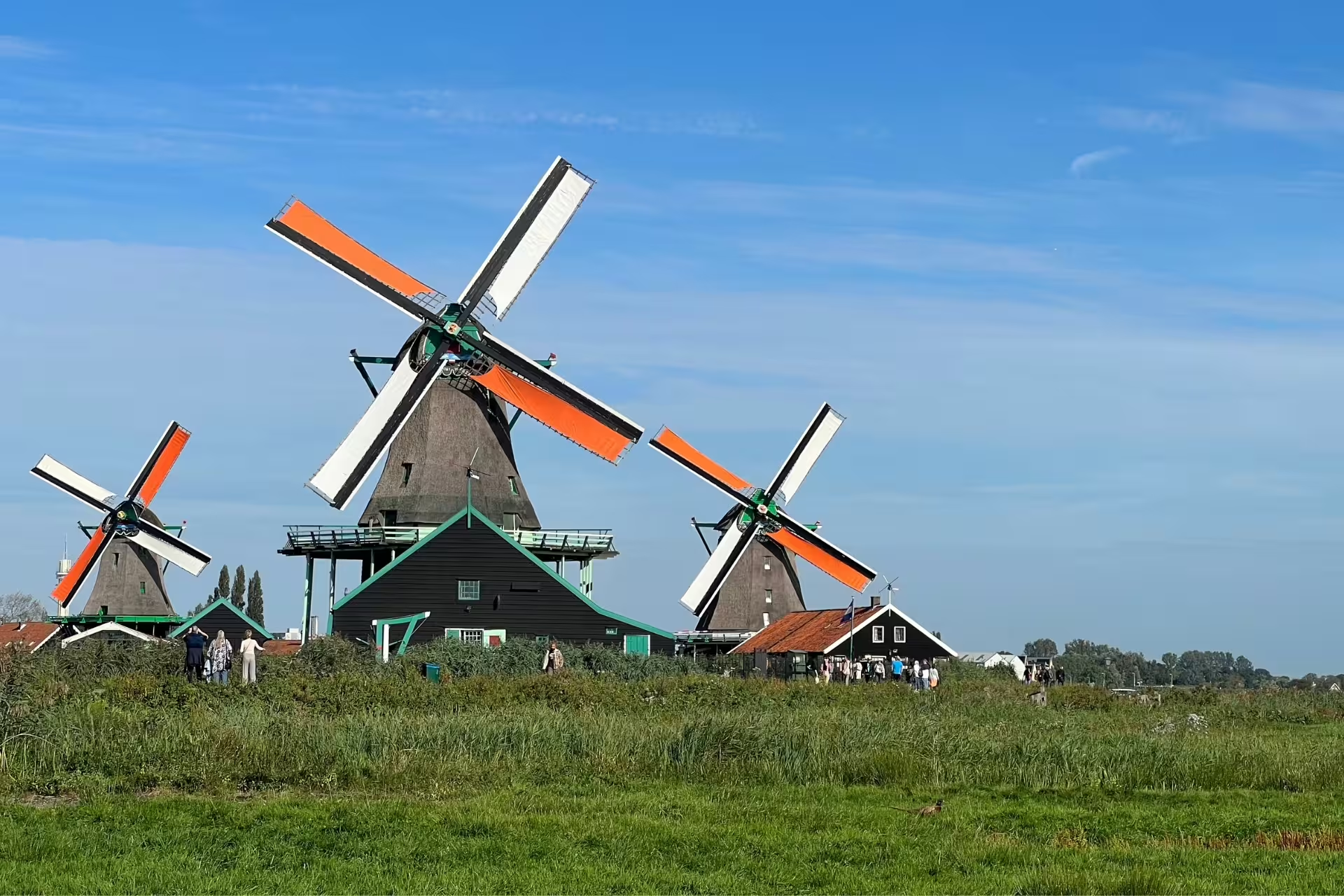
The Zaanse Schans lies on the east bank of the Zaan in Zaandam, part of the municipality of Zaanstad, north of Amsterdam. A row of wooden mills stands there outside the dike, with the wooden houses of the Kalverringdijk behind it. This page visits the mills one by one, then turns to the houses, and closes with the trips from Amsterdam that stop here.
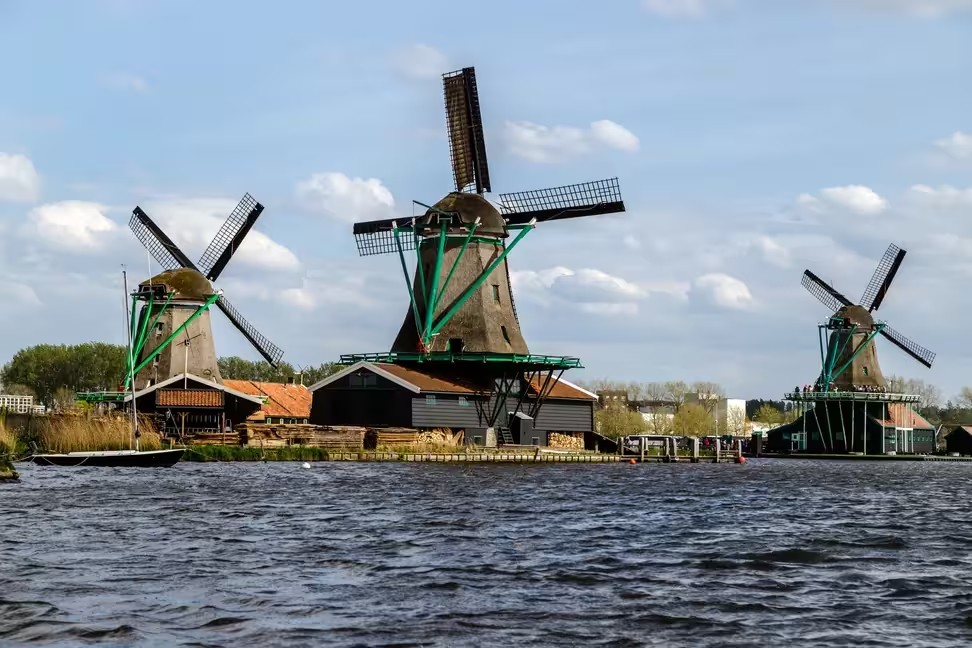
Between about 1600 and 1900 the windmill shaped the Zaan region: at one point at least 600 industrial mills of every kind were working there at the same time. Pressing oil from seeds grew into a major trade after 1600, and over the centuries some 200 mills pressed oil there. Only four wind oil mills are left today, and De Bonte Hen is one of them.
Nowhere else does a short row of these mills still stand close together outside the dike. Behind them, the open polder runs right down to the Zaan, something you will see only here.
De Bonte Hen sits on a strip of land in the Zaan, outside the dike and north of the Schans, and closes the row. It has never left its original site. Its lower octagon, made of pine, goes back to around 1693 and holds two original brick oil cellars with wooden pumps. From 1891 it served as a test mill: samples were pressed here to learn how much oil the raw materials bought for the steam oil factory would give. The upper part was rebuilt in the 1970s with parts of De Koperslager, an oil mill nearby that burned down in 1964, among them its sail stocks, its windshaft and its oil presses.
De Os is an octagonal mill with a stage, first mentioned in writing in 1663. In 1916 it lost its cap and sails, and from then on a motor drove the machinery. Its wooden mill shed stands to the southeast: the loft held the seed, the ground floor stored the oil cakes, and the oil cellar is split into four compartments of 9 cubic metres each. De Zoeker, another oil mill, dates from 1676, and nearby De Huisman is a spice mill built on top of a seed warehouse.
Not every mill here grew up on this spot. De Gekroonde Poelenburg, a paltrok mill of 1868, was brought to the Zaanse Schans in 1963 and set up where the hulling mill De Grootvorst had stood until it burned down in 1928. The dye mill De Kat rests on the base of an earlier De Kat, pulled down in 1904; until 1961 this mill stood as the dye mill De Duinjager.
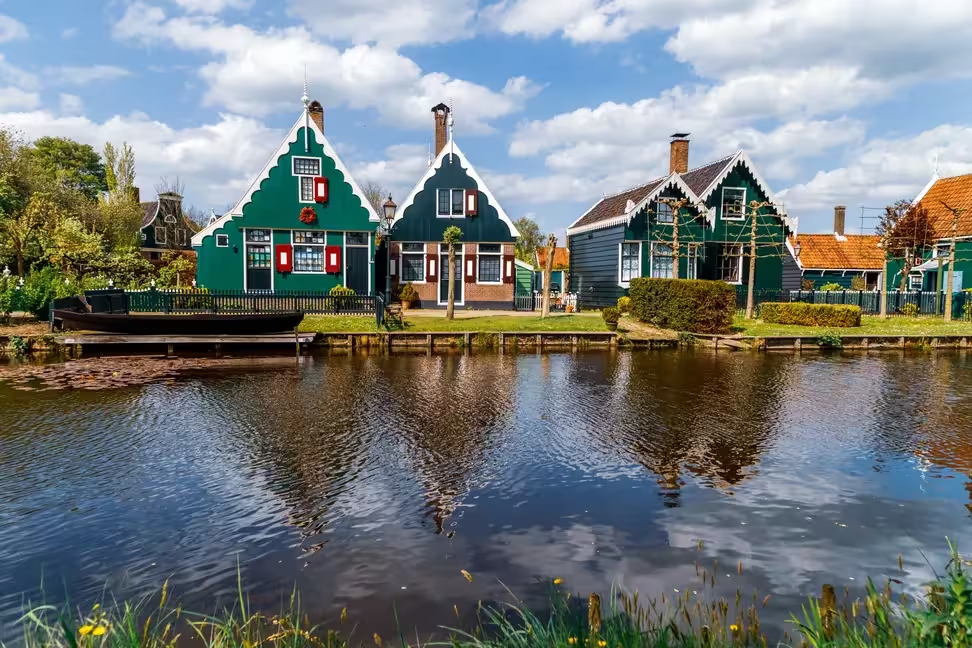
The merchant's house D'Mol is built largely of wood, on an L plan, and its main wing was put up in 1795 by Samuel Daesdonck. The entrance has Ionic pilasters and carving in Louis XVI style, the carved dormer above it has carried a beehive since 1853, and in the kitchen painted whaling scenes from 1744 and 1752 hang over the doors.
The house next door has a carved door and fanlight in the same style, with three painted coats of arms and the words Van Ouds Het Noorder Huis above them. Further along, a 17th century wooden house has a gable with scalloped bargeboards and a twisted finial, and its projecting shop window was added in the early 19th century. Another wooden house, with a door lintel dated 1743, was brought here from Westzaan. Close by stands an 18th century garden pavilion of brick and wood, with shell motifs in Louis XIV style; inside are panelling, a fireplace and a stucco ceiling in the same style.
The trips from Amsterdam pair the Zaanse Schans with other places north of the city. Three private tours pick you up in Amsterdam with a driver who also guides, and after the mills they drive on to Volendam: one of them ends with a boat crossing to Marken, another also takes in the former island of Marken, and a third adds a stop in Edam.
Two small group day trips go much further. The first continues to Volendam and then to Giethoorn, the village of canals, while the second heads from the mills straight to Giethoorn for a boat trip on its waterways.
All trips that stop here are also on the Zaanse Schans destination page.
No. De Bonte Hen is still where it was built, but De Gekroonde Poelenburg only arrived in 1963.
It measured the oil yield of seed before the seed went to the steam oil factory; De Bonte Hen did this work from 1891.
Four, out of some 200 that pressed oil there over the centuries.
Samuel Daesdonck, who completed its main wing in 1795.
Sources: Rijksdienst voor het Cultureel Erfgoed, Rijksmonumentenregister, CC BY 4.0, text translated and summarised: 21299, 28025, 22336, 40153, 54102, 40524, 36936, 20563, 51836, 13125.