
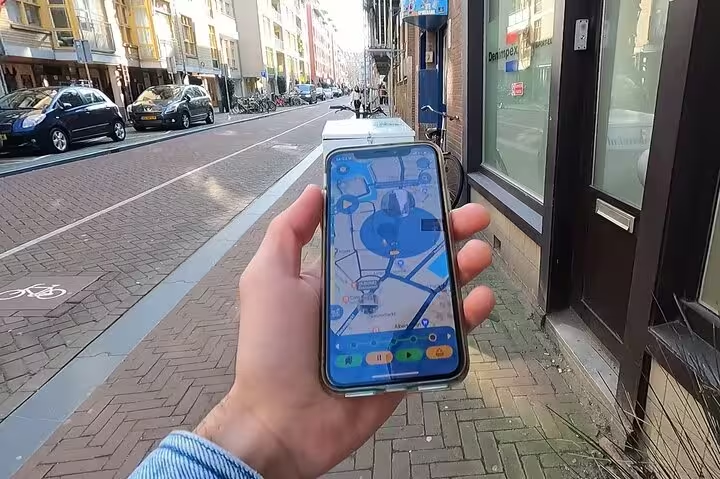

Amsterdam Smartphone App Self-Guided GPS Walking Tour
Trace seven centuries of Amsterdam history at your own pace, guided by nothing but curiosity and your smartphone.
This Amsterdam self-guided walking tour combines GPS navigation, storytelling, and interactive puzzles to guide you through the Dutch capital's most layered neighborhoods. From the original dam on the Amstel River to the Golden Age canal belt, each stop reveals a city that has always balanced commerce, culture, and contradiction. The experience takes roughly two and a half hours and is graded easy, making it accessible to most visitors.
Amsterdam grew from a modest fishing settlement in the 13th century into one of the wealthiest trading cities on earth within just a few hundred years. The 17th-century Golden Age left behind a dense architectural legacy that you can read like a book once you know what to look for: hoisting beams, gable stones, tilting facades, and hidden courtyards all tell stories that guided tours often rush past.
This route weaves through the medieval core, the Red Light District, Chinatown, the Rembrandt quarter, and the historic market streets of the city center. Along the way you will encounter religious landmarks that reflect centuries of tolerance and tension, canal houses that defy gravity on waterlogged foundations, and public squares that have served as stages for everything from butter markets to wartime commemoration.
The scavenger-hunt format adds a layer of active engagement that turns passive sightseeing into genuine discovery. You will solve puzzles tied to real architectural details and historical clues, which means you are unlikely to walk past the most interesting elements without noticing them.
Tour Highlights
Stand at Dam Square beside the National Monument and understand its role as the country's central World War Two memorial.
Visit the Oude Kerk, Amsterdam's oldest standing building, and explore the unlikely coexistence of a 14th-century church with the surrounding Red Light District.
Locate the hidden church along the canal, a clandestine Catholic place of worship disguised as an ordinary residential building.
Explore Amsterdam's Chinatown and admire the largest Buddhist temple in Europe, opened by Queen Beatrix in 2000 and built in classical Chinese palace style.
Browse the floating flower market, a floating row of vendor barges rooted in the Dutch tulip trade and open daily along the Singel canal.
Pass Rembrandt House on Jodenbreestraat, where the painter lived and worked during the height of his career from 1639 to 1658.
Engage with GPS-triggered puzzles and clues that connect architectural details to real historical events throughout the route.
Route Overview
The tour begins at Amsterdam's central square, where the National Monument stands as the country's primary World War Two memorial. The square has served as a gathering point for national ceremonies, including the annual Remembrance Day commemoration held on the 4th of May.
The Oude Kerk, completed in 1306 and dedicated to Saint Nicholas, rises 70 meters above the surrounding streets and sits at the heart of the Red Light District. A short distance away, the Ons' Lieve Heer op Solder hidden church occupies the upper floors of a canal house, its plain exterior designed to conceal its religious function during the period of Catholic suppression.
The Zeedijk follows the line of a 13th-century sea dike and sits 1.7 meters above sea level, its houses still fitted with the original hoisting beams used to move goods directly from the street. The route continues through Chinatown to the Sint Anthonis Gate, a medieval defensive structure that was later converted into a weighing house and guild meeting hall.
Jodenbreestraat holds two significant 17th-century landmarks: Rembrandt's former home, now a museum with a fully restored interior, and the Zuiderkerk, the first purpose-built Protestant church in Amsterdam, whose 80-meter tower once served as a temporary mortuary during the Second World War. Claude Monet painted the Zuiderkerk during his visits to Amsterdam.
The Munttoren tower dates from 1480, originally serving as a city gate before being rebuilt by architect Hendrick de Keyser; its gable stone is said to encode clues about the city's origins. Nearby, the floating flower market on the Singel offers a direct connection to the Dutch tulip trade, while Rembrandt Square marks the former site of the Butter Market, now a center of Amsterdam's nightlife.
The Begijnhof is a walled courtyard dating from 1346 that originally sheltered Beguine nuns and now houses 104 women residents; the tombstone of Cornelia Arens, a nun buried face-down as a penance, has been maintained since 1654. The tour ends on Kalverstraat, a shopping street that functioned as an ox market until the 17th century and is now lined with 150 stores housed in historic buildings.
What Is Included
Included
- Smartphone app access with GPS navigation
- Audio and text commentary at each stop
- Interactive puzzles and scavenger-hunt challenges
- Route map accessible offline
- Self-paced itinerary with no fixed schedule
Not Included
- Entry to Rembrandt House Museum
- Entry to Ons' Lieve Heer op Solder hidden church
- Food, drinks, and personal purchases
- Public transport costs
- Smartphone or data connection
Important Information
Explore Amsterdam on Your Own Terms
This GPS-guided walking tour gives you the freedom to discover Amsterdam's medieval core, Golden Age waterways, and cultural landmarks without a fixed schedule or a group to keep pace with. Start when you are ready and go at whatever speed suits you.
Book Now