Heraklion, Crete: what to see and do
Crete's capital, Heraklion, occupies a central position on the island's north coast. Its history includes fortifications dating back to the First Byzantine Period (330-828 AD). The surviving medieval defences took more than a century to build, from 1462.
Things to do in Heraklion
Heraklion's Venetian walls have seven bastions, named Sabbionara, Vitturi, Jesus, Martinengo, Bethlehem, Pantocrator and St. Andrew. Four gates served the Venetian fortification: Molos, St. George, also called Lazaretto, Jesus and Pantocrator. Chanioporta bears the lion of St Mark and dates to 1570, while the Jesus Gate, also called Porta Nuova (Kainouria Porta), was completed in 1587.
At Koules fortress, marble carvings of the winged Venetian lion decorate the exterior on the north-east, west and south sides. Its exterior walls are up to 8.7 metres thick, and some sections of the interior walls reach 3 metres. An earthquake in 1303 badly damaged the earlier harbour fortress. Storm damage brought down part of Koules' north-west side in 1719, followed by prompt repairs.
Saracen occupation of Crete began in 828 AD and ended in 961 AD when the Byzantine Empire drove the occupiers out. Following the Fourth Crusade's capture of Constantinople in 1204 and conflict with the Genoese, Venice secured control over Crete in 1211. During the Second World War, German bombing destroyed much of Heraklion and inflicted further damage on the Venetian walls.
The first Agios Titos church is thought to date from 961 and was rebuilt after the 1856 earthquake. The Heraklion Archaeological Museum's collection spans from the Neolithic to Roman times.
Knossos and Heraklion
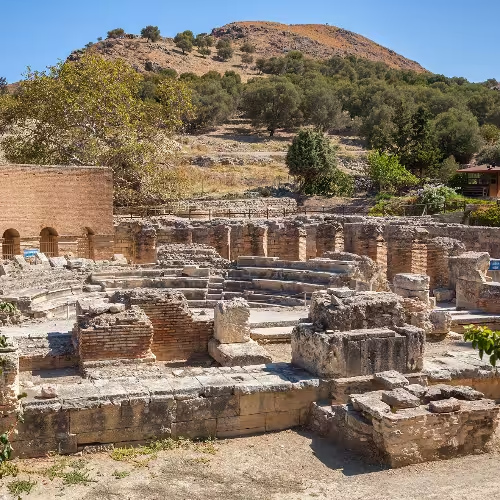
Knossos is an archaeological site about 5 km south of Heraklion's centre. People lived there without interruption from the Neolithic, dated 7000 to 3000 BC, through late Antiquity. The Minoan period is named after the mythical King Minos, who by tradition ruled at Knossos.
The first palace at Knossos (around 1900 BC) was destroyed around 1700 BC, probably by an earthquake. The Cretan palaces suffered destruction in 1450 BC, although researchers disagree about what caused it. Fire destroyed the Knossos palace again around the middle of the 14th century BC. Linear B tablets from the 14th century BC are the earliest written Greek from Knossos. Quintus Caecilius Metellus (Creticus) took Knossos during the Roman conquest of 69 to 67 BC; Octavian later settled a Roman colony there (around 36 BC).
The private tour of Knossos Palace and Heraklion Museum lasts 7 hours and 30 minutes. It includes a licensed private guide throughout, guided visits to the palace and the Heraklion Archaeological Museum, and a walk covering city landmarks.
The Heraklion guided tour of Knossos Palace and the Archaeological Museum lasts 4 hours and 30 minutes. Included are guided visits to the museum and palace, a guided Boutari Winery tour, a vineyard and cellar walkthrough, and a tasting of five wine labels with an amuse bouche.
Frequently asked questions
Where is Heraklion in Crete?
Heraklion is Crete's capital, midway along the island's northern coast.
How far is Knossos from Heraklion?
The Knossos archaeological site is about 5 km south of Heraklion's centre.
What period does the Heraklion Archaeological Museum cover?
Its collection extends from the Neolithic to Roman times.
What decorates the outside of Koules fortress?
Marble reliefs showing the winged lion of Venice appear on its north-east, west and south sides.
Where does the name of the Minoan period come from?
It comes from the mythical King Minos, who by tradition ruled at Knossos.