Assisi: what to see and do
Assisi offers a visit shaped by Franciscan churches, Roman remains and Mount Subasio, in the central-eastern part of Umbria, Italy.
What is there to do in Assisi?
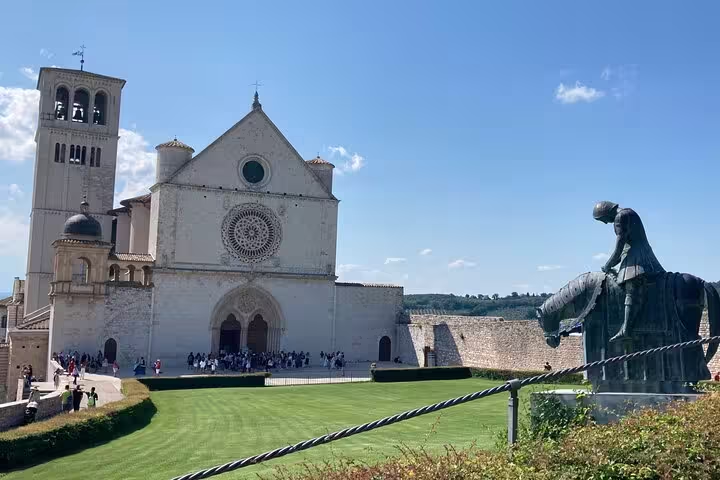
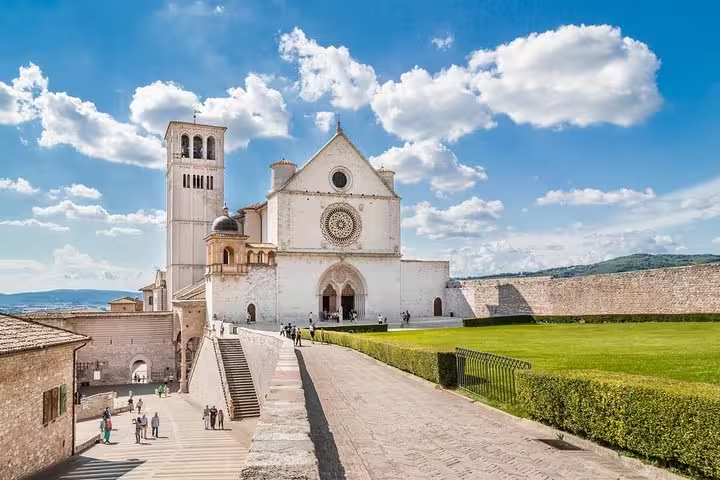
A visit centred on San Francesco, Santa Chiara and the Roman remains gives you both religious art and an earlier layer of Assisi. At San Francesco, allow time for both the Lower Basilica and the Upper Basilica, where Giotto painted 28 scenes from the life of Saint Francis. The basilica also holds the remains of Saint Francis.
Santa Chiara offers a different detail to look for: its white and pink building stone comes from Mount Subasio. For Roman history, the Temple of Minerva has six grooved columns topped with Corinthian capitals, while the remains of the Roman Forum are below Piazza del Comune. Art can also shape the visit at the Pinacoteca Comunale, whose collection includes medieval and Renaissance frescoes alongside paintings on wood panels and canvas.
For a break focused on wine, a guided wine tasting and vineyard walk near Assisi lasts 1 hour and 30 minutes. It includes a guided tasting of 4 organic wines, local cold cuts and cheeses, fruit juice for underage participants, a guided walk through vineyards and olive groves, and a visit to a valley viewpoint.
How many days should you spend in Assisi?
Two days is a reasonable plan if you want churches and Roman remains on one day, then San Damiano and Mount Subasio on the other. On the first day, pair San Francesco and Santa Chiara with the Temple of Minerva and the Roman Forum. On the second, give San Damiano a place in the plan because Saint Francis composed the Canticle of the Creatures there. The historic centre is included within Monte Subasio Regional Park, and the summit area of Mount Subasio has karst hollows called dolines. For a nature focus, Mortaro Grande is a sinkhole reaching roughly 60 metres deep.
A day trip is another format: the full-day private minivan tour to Assisi from Rome lasts 9 hours and 30 minutes. It includes return private minivan transport, a professional driver throughout, visits to San Francesco and Santa Chiara, and free time in the historic centre. The full-day private trip to Assisi and Cortona from Florence lasts 10 hours and includes a private chauffeur for the day and an air-conditioned private vehicle.
When should you visit Assisi?
May suits a trip planned around Calendimaggio, while August suits a visit for the Perdono di Assisi. Calendimaggio runs for four days, beginning on the first Wednesday after 1 May and ending that Saturday. The Perdono di Assisi takes place on 2 August at the Porziuncola in Santa Maria degli Angeli. July is the driest month in Assisi: the municipal climate analysis records a minimum of about 35 millimetres of precipitation for July, using the 1981 to 2010 reference period.
How can you get around Assisi?
Bus line C, the Assisi Link, is an option for the journey from the railway station to the historic centre. For planning the rail leg, Assisi station is on the line between Foligno and Terontola. For an airport connection, Umbria Airlink provides public transport between Assisi and Umbria International Airport San Francesco d'Assisi.
Frequently asked questions
Is Assisi a UNESCO World Heritage destination?
Yes, UNESCO added Assisi, the Basilica of San Francesco and the other Franciscan sites to its World Heritage List in 2000.
How far is the airport from Assisi?
18 kilometres separate Assisi from Umbria International Airport, named San Francesco d'Assisi.
What sweet should you try in Assisi?
Rocciata is a traditional option, with apples and dried fruit inside a pastry casing.
What is pancaciato?
A savoury bread traditional in Assisi, pancaciato combines cheese pieces with pepper and walnuts.
Were Saint Francis and Saint Clare baptised at San Rufino?
According to local legend, yes: the font kept in the Cathedral of San Rufino is associated with both baptisms.