Florence in Italy: what to see and do
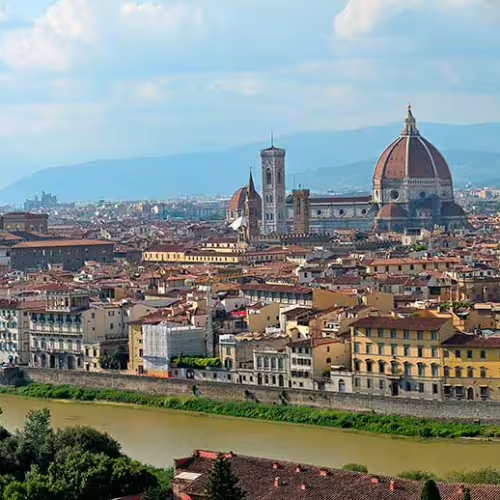
Between 1865 and 1871, Florence served as Italy's capital. The city is split into unequal parts by the river Arno. Its Roman settlement developed along the Via Cassia at the point where the Mugnone stream then joined the Arno.
Things to do in Florence
A private guided day trip to Florence from Rome lasts 12 hours and includes a professional English-speaking driver, a guided tour of the historic centre, a visit to the Accademia Gallery with Michelangelo's David, and a visit to Basilica di Santa Croce.
The full-day Florence tour from Livorno with Tuscan food tasting lasts 8 hours and includes an English-speaking tour leader, return transport, a tasting of Tuscan products and free time in the city centre.
Florence Duomo and the Uffizi
Giotto designed the bell tower next to Florence Cathedral between 1334 and 1337. The cathedral is 153 metres long; the nave is 38 metres wide and the transept 90 metres across. Below its floor is the Crypt of Santa Reparata. The eight round stained-glass windows in the dome's drum date from 1434 to 1445.
Giorgio Vasari and Federico Zuccari painted frescoes inside the cathedral dome between 1572 and 1579. The dome reaches 91 metres at the base of the lantern and 116 metres at the top. After his death in 1446, Filippo Brunelleschi was buried below his dome.
Construction of the Uffizi building followed Giorgio Vasari's design between 1560 and 1580. Its collection of self-portraits began with Cardinal Leopoldo de' Medici in the 17th century.
Ponte Vecchio and the Vasari Corridor
The rebuilding of Ponte Vecchio in 1345 gave it three arches. During the Second World War, it escaped demolition by the Germans. Duke Cosimo I de' Medici ordered the Vasari Corridor in 1565, and construction took five months. There are 73 windows along the corridor. Following its closure for safety work in 2016, the corridor underwent a full restoration.
Churches, squares and gardens
Building work on the Dominican church of Santa Maria Novella started in 1279 and finished in the mid-14th century. The Florence Baptistery is a Romanesque building whose main construction is traditionally dated to the 11th and 12th centuries. At Palazzo Vecchio, the Salone dei Cinquecento dates from 1494 to 1495 and houses Michelangelo's marble group, the Genius of Victory.
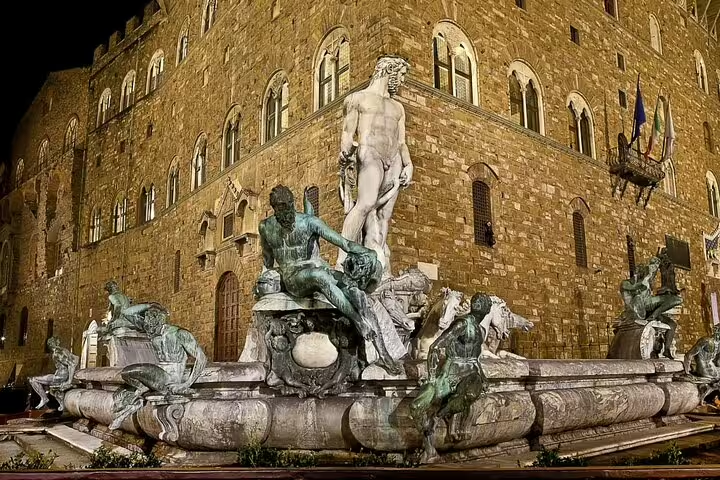
Florentines call the Neptune Fountain in Piazza della Signoria the Biancone. Bernardo Buontalenti's work on the Grotta Grande in the Boboli Gardens ran from 1583 to 1593. Construction of Piazzale Michelangelo started in 1873, with its inauguration following two years later.
Wine tasting in Florence
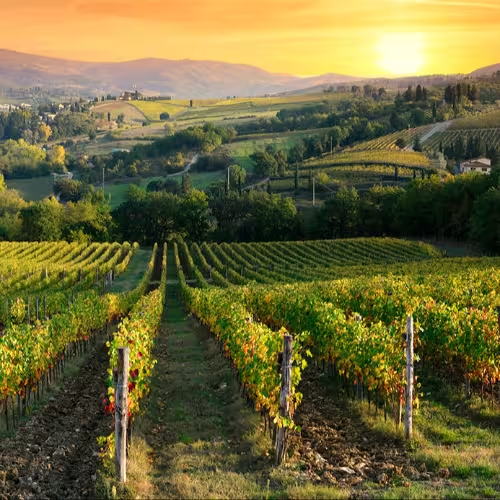
The wine tasting in Florence with cured meats and cheeses lasts 1 hour and includes Tuscan wines, regional cured meats, aged cheeses, a tasting led by an expert host and guidance on pairing the food and wine.
Local traditions
Calcio Storico involves four teams representing Florence's four historic districts, with 27 players on each team. During the Scoppio del Carro on Easter Sunday, the colombina, a rocket shaped like a dove, departs from the cathedral's high altar.
Climate
The annual mean is about 15.5 degrees Celsius, January averages about 6.5 degrees Celsius, and rainfall totals about 870 millimetres a year.
Frequently asked questions
Was Florence once the capital of Italy?
Italy's capital was Florence between 1865 and 1871.
Who designed the cathedral bell tower?
Giotto drew up the design between 1334 and 1337.
Who designed the Uffizi building?
Giorgio Vasari supplied the design for the building, constructed between 1560 and 1580.
How long is the wine tasting in Florence?
The tasting with cured meats and cheeses lasts 1 hour.
What is Florence's average annual temperature?
The annual mean is about 15.5 degrees Celsius, January averages about 6.5 degrees Celsius, and rainfall totals about 870 millimetres a year.