




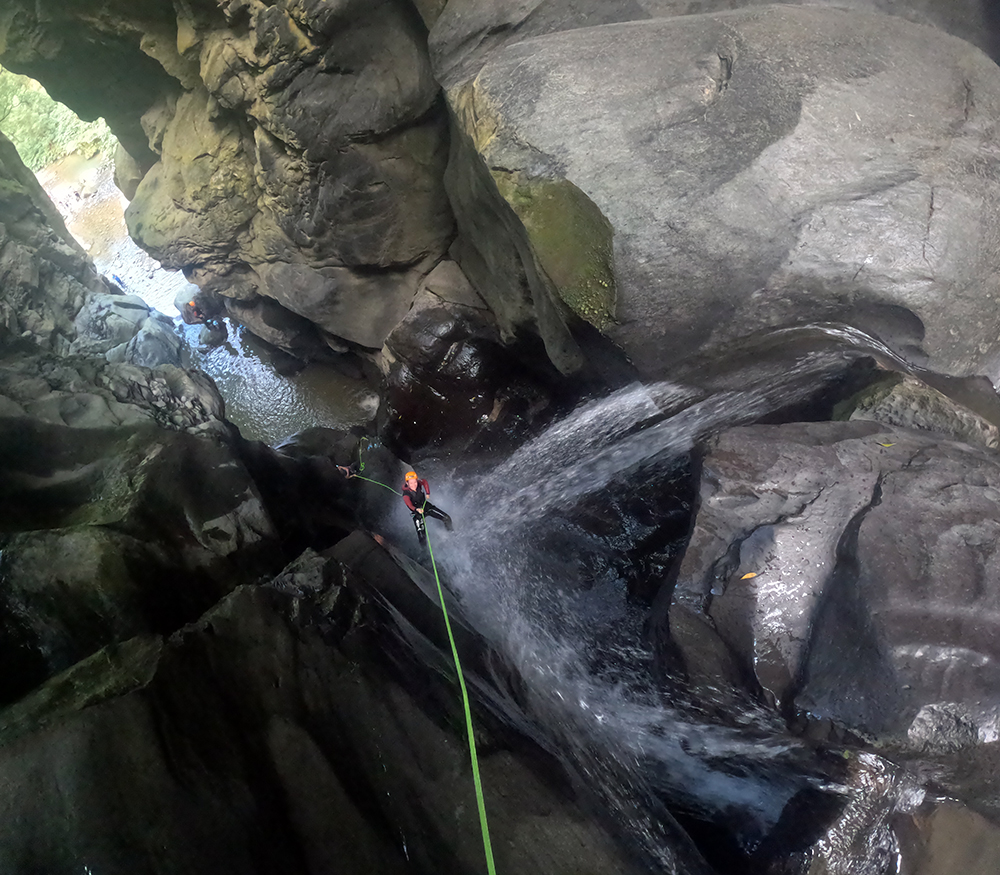
A canyoneer descends a fern-lined gorge near Salto do Cabrito — one of São Miguel's most vertical half-day routes.
Adrenaline in the Atlantic
Waterfalls, Volcanoes, and Giants: The Thrill-Seeker's Guide to São Miguel Island
Rappel into rainforest ravines, track sperm whales across open ocean, and push into volcanic craters by 4x4 — São Miguel is not a place to observe from a distance.
Most visitors to São Miguel arrive expecting scenery. The green hills, the crater lakes, the hydrangea-lined roads — all of it is real, and all of it is precisely the backdrop against which the island's more physical side plays out. The gorges behind those hills are cold, dark, and vertical. The ocean off the coast holds creatures that dwarf every other animal on the planet. The dirt tracks winding toward volcanic rims are rough enough to rattle your teeth. São Miguel does not reward passive attention. It rewards motion.
The island sits in the middle of the North Atlantic, shaped by volcanic activity that is, in geological terms, still very recent. That restless geology is the engine behind nearly every adventure on offer here. Canyoning routes follow rivers that have cut deep through lava fields over millennia, creating a series of waterfalls and plunge pools that demand rope and nerve. Off-road tracks climb the outer flanks of calderas that last erupted in living memory. And the same deep, nutrient-rich waters that surround the island support one of the densest concentrations of cetaceans in the Atlantic — a fact that has turned São Miguel into one of Europe's most consistent destinations for whale watching from small, fast boats.
"The cold hits you a second before the freefall does. By the time you register both, you're already in the pool below — and the guide is already unclipping your harness for the next drop."
Canyoning: Into the Gorges
The canyons of São Miguel do not announce themselves from the road. You park at a trailhead, follow a guide through a stand of tree ferns and laurel, and then the ground simply drops away. Salto do Cabrito, on the island's western flank, is the most-visited descent for a reason: a clean vertical drop of roughly 20 metres into a dark pool, flanked by walls dense with moss and maidenhair fern. The geology here is basalt, which means sharp edges where the water hasn't polished them smooth, and surfaces that demand you trust the rope rather than your footholds. In the northeast, Ribeira dos Caldeirões runs through a protected natural park — the descent there is technically gentler, but the corridor of old-growth vegetation makes it feel like moving through a place where the 21st century has no jurisdiction.
Canyoning Experiences — São Miguel
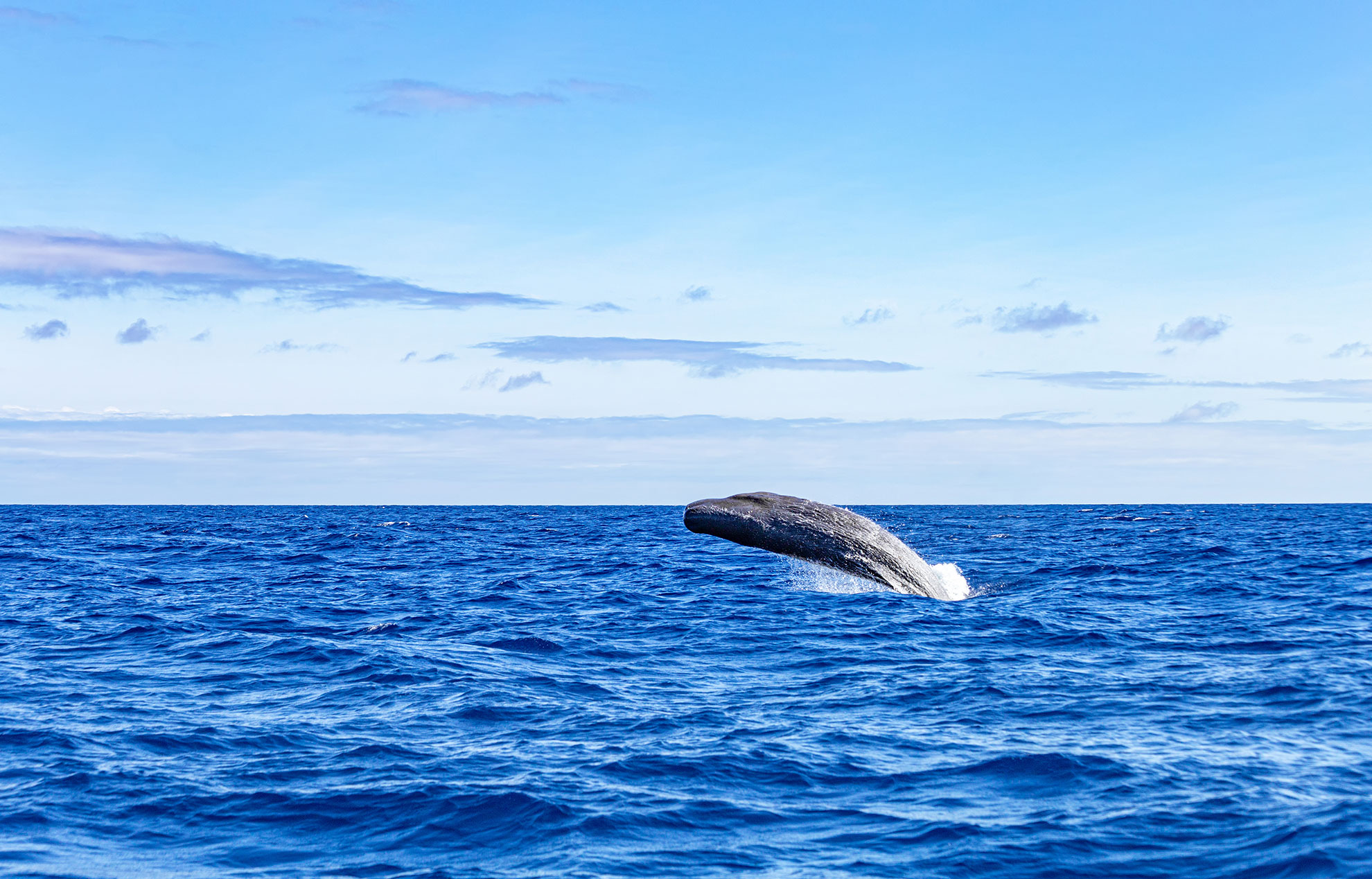
A sperm whale surfaces to breathe roughly 1.5 km off São Miguel's southern coast — a standard sighting distance on RIB-based tours.
Marine Safari: Whales, Dolphins, and Open Water
The channel south of São Miguel sits above a deep-water trench where sperm whales come to dive for giant squid. The vigias — old stone watchtowers originally built for the whaling industry — still dot the clifftops, though today the spotters use radio to direct boats toward surfacing animals rather than harpoons. A RIB in open Atlantic swell is a physical experience in itself: the hull slaps hard over chop, spray comes over the bow, and then the engine cuts and there is silence except for wind and the distant exhalation of something the size of a school bus. Dolphins are a near-daily encounter off São Miguel — common, bottlenose, striped, and Risso's all pass through regularly, and several operators offer in-water encounters that require nothing more than a snorkel and a willingness to enter deep ocean.
"When a sperm whale dives, the flukes rise slowly, then hang for a moment against the sky before sliding under without a sound. The stillness that follows is complete."
Ocean & Wildlife Experiences
Canyoning, whale watching, jeep safaris, and kayak — browse the full range of adventure experiences available across São Miguel and filter by activity, duration, or group size.
Browse All São Miguel Adventures →Jeep Safaris: The Rim Roads
The tour buses that circle São Miguel's main roads cannot follow a 4x4 up the service tracks that cut across the outer flanks of Sete Cidades or up to the rim of the Furnas caldera. Those tracks are where the island changes character — the manicured hedgerows give way to gorse and bracken, the road surface degrades from tarmac to compacted earth to loose basalt gravel, and the horizon opens. Furnas is the most geologically active corner of the island, with fumaroles venting along the crater floor and the thermal lake still registering seismic tremors. A jeep tour there is not a soft nature walk; it is a direct confrontation with the processes that built the island. Sete Cidades, on the western tip, rewards the approach by 4x4 with access to viewpoints above both the green and blue crater lakes that cannot be reached on foot from the main visitor areas.
Jeep Safari & 4x4 Experiences
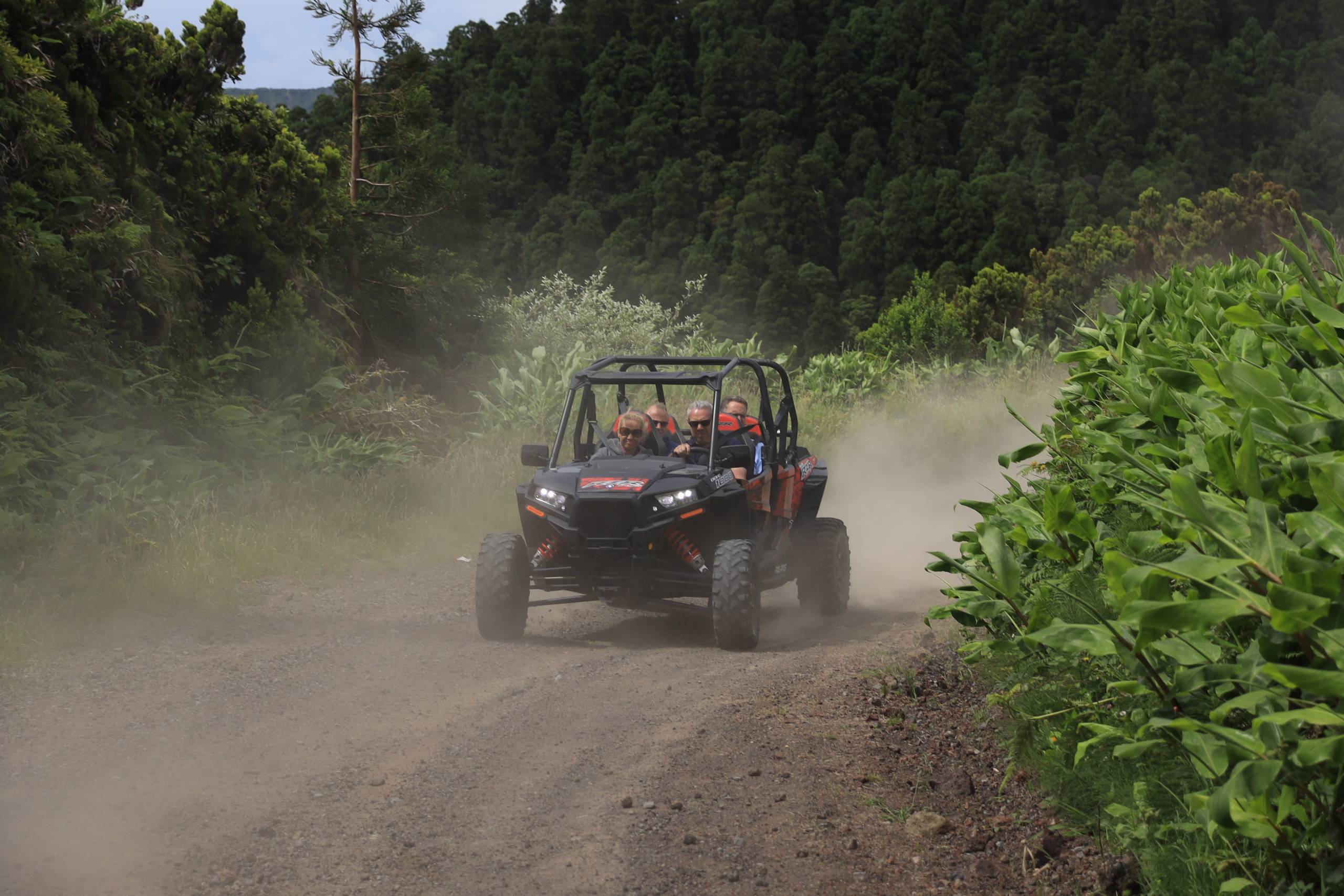
A 4x4 negotiates a basalt-gravel track above the Sete Cidades caldera — a route inaccessible to standard tourist vehicles.
After the Descent: Thermal Recovery
São Miguel's volcanic activity is not only a backdrop for adventure — it is also a functional recovery tool. After a day of rappelling, ocean swells, or rough-road driving, the thermal pools at Poça da Dona Beija in Furnas offer water heated to around 40°C by the same geothermal system responsible for the valley's fumaroles. The pools are open after dark, and arriving there tired and salt-stiff, with the steam rising against the night sky, is a reliable way to consolidate the day's physical output. It is one of the few places where the line between geological spectacle and genuine physical relief runs exactly down the middle.
Planning Your Time on the Ground
São Miguel is compact enough — roughly 65 kilometres end to end — that multiple activity types are achievable within a single trip without significant travel time between them. A working structure might be: canyoning in the morning, a thermal soak in the afternoon, a whale watching departure the following dawn. The jeep safaris pair well with days when sea conditions push the marine operators to cancel; operators on the island are accustomed to weather-driven rescheduling and most carry flexible cancellation terms. The island's infrastructure is small, and popular slots — particularly whale watching and private 4x4 tours — fill during the peak May-to-September window. Booking ahead by at least a week during high season is the practical move.
From canyoning at Salto do Cabrito to private crater-rim tours and open-ocean dolphin encounters — find and book the full range of São Miguel adventure experiences in one place.
See All Adventures on São Miguel →Frequently Asked Questions
Do I need prior experience for canyoning on São Miguel?
No prior technical experience is required for the half-day introductory routes at Salto do Cabrito or Ribeira dos Caldeirões. Guides brief participants fully on rope technique and safety protocols at the start. Confident swimmers who are comfortable in cold water (typically 16–18°C) will find the experience manageable.
What is the best time of year for whale watching?
Sperm whales are present year-round but most reliably encountered between April and October. Blue whales pass through the Azores channel in spring (March to May), while sei and fin whales are more commonly spotted in early summer. Dolphin species, including common, bottlenose, and striped, are present throughout the year.
How long does a typical canyoning tour take?
Half-day tours at Salto do Cabrito and Ribeira dos Caldeirões typically run four to five hours including transport from the meeting point, briefing, the descent itself, and return. Full-day multi-canyon options extend to seven or eight hours with a break for lunch on the trail.
Are the jeep safari routes suitable for people with limited mobility?
Standard 4x4 jeep tours involve getting in and out of a raised vehicle over rough terrain, but do not require any hiking or physical exertion beyond that. Private 4x4 tours can be adapted for passengers with limited mobility — it is worth communicating specific requirements directly to the operator when booking.
Can I swim with dolphins without a guided tour?
Free encounters with wild dolphins in open Atlantic water are only possible from a boat. The in-water experiences offered by operators on São Miguel involve entering the water from a small vessel once dolphins have been located by lookout spotters. Independent swimmers cannot access the encounter zones without a licensed operator.
Where are the thermal pools located and when are they open?
Poça da Dona Beija in Furnas is the most accessible public thermal pool complex on São Miguel, open daily including evenings. Water temperature holds at approximately 40°C. The pools are reached via the Furnas village in the island's eastern caldera and are a standard add-on to any Furnas jeep tour itinerary.