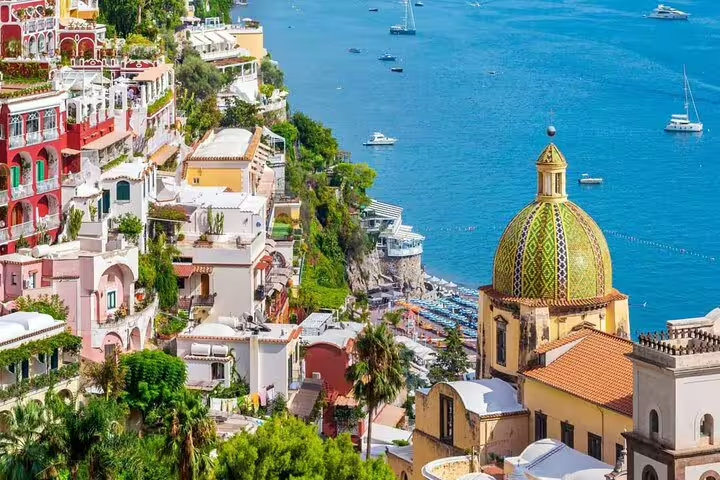
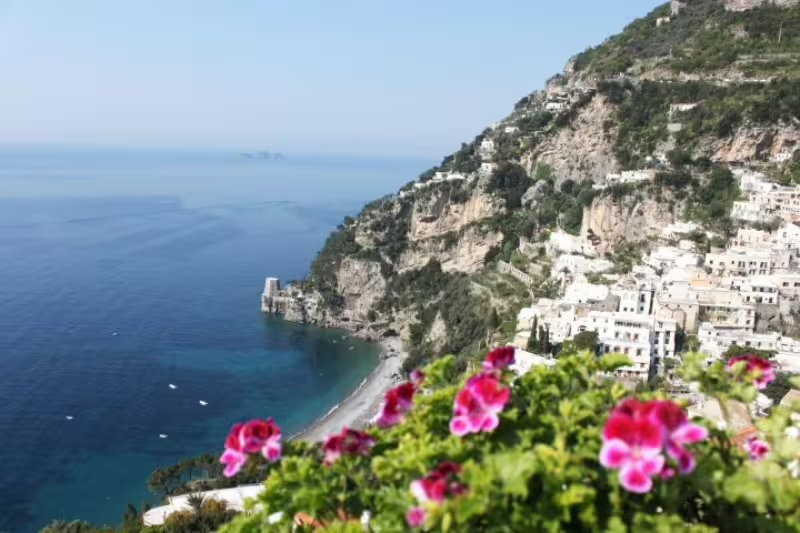
Positano climbs from its beach up a steep valley, and most visitors see it from below: houses stacked on the slope and a tiled dome close to the sea. This page goes further, from the Roman villa hidden beneath the town to the quieter beaches nearby and the two hamlets high on the mountain, Montepertuso and Nocelle. It ends with the day trips and boat tours that call at Positano. The other towns of the coast, one by one, are on the Amalfi Coast page.
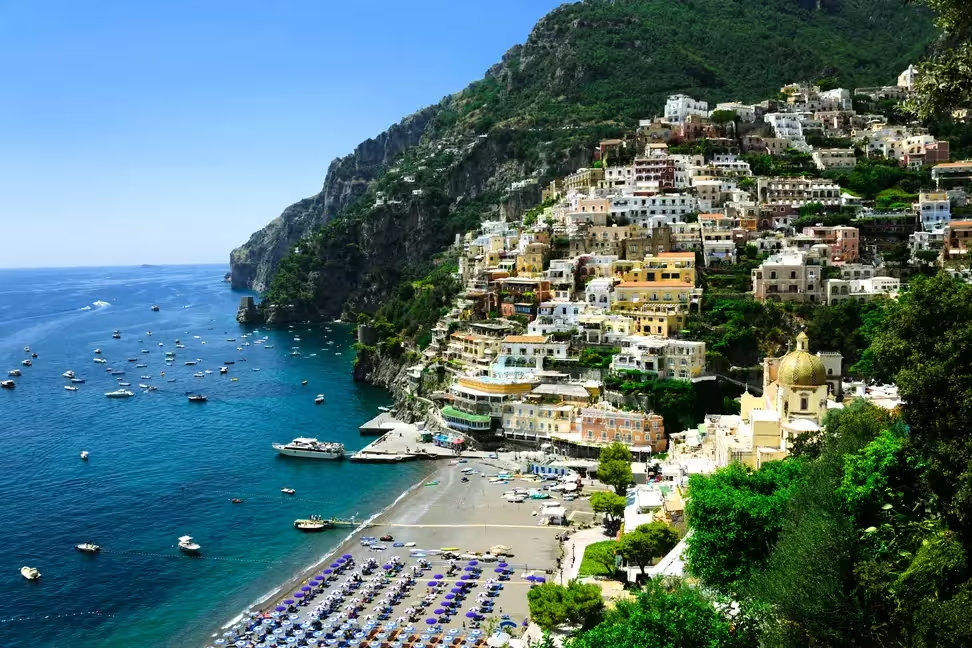
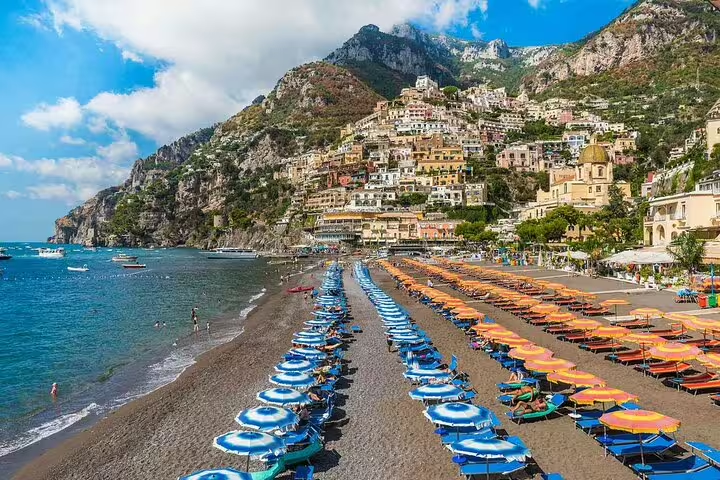
The main beach, Spiaggia Grande, sits at the very centre of Positano and gives the widest view of it. Out to sea, the small island of Li Galli marks the horizon and the coastline stretches away; behind you, the houses climb one above another, and the majolica dome of Santa Maria Assunta stands out above the beach. Arriving by sea is easy, as the beach has its own pier: ferries call here from Salerno, Naples, Sorrento, Capri, Ischia and Amalfi.
Long before the holiday crowds, the bay of Positano was chosen, between the 1st century BC and the 1st century AD, for a lavish Roman villa built purely for leisure. It stepped down to the sea in terraces and spread onto the beach, with frescoed halls and colonnades looking over gardens. The villa was no secret: in 1758 Karl Weber, a member of the Bourbon excavation team, noted frescoed and mosaic-covered structures under Santa Maria Assunta and its bell tower. According to the scholar Matteo della Corte, it was the villa of Posides, an influential freedman of the emperor Claudius, and the town's name may come from him.
Around the middle of the 1st century AD the house was under repair after the earthquake of AD 62, and the rebuilding gave its grand reception rooms a rich new decoration. The finest of them is the triclinium, the dining room brought to light in recent excavations: its walls are painted throughout, and the frescoes, in the so-called Fourth Style, stand out for both their detail and their state of preservation. Life in the villa ended with the eruption of Vesuvius in AD 79, when a thin veil of ash settled first and a dense fall of pumice then buried it under almost two metres. Most of the villa still lies sealed under the old centre of Positano, awaiting future digs. The excavated part, now the Museo Archeologico Romano, is seen on a guided visit; it is kept cool to protect the paintings, so bring a light jacket or dress in layers.
A walk of about ten minutes from the seafront leads to Fornillo, the bay of the district of the same name. Stretches of the beach are free to use, and Fornillo has received both the Green Flag for families and the Blue Flag for the quality of its water.
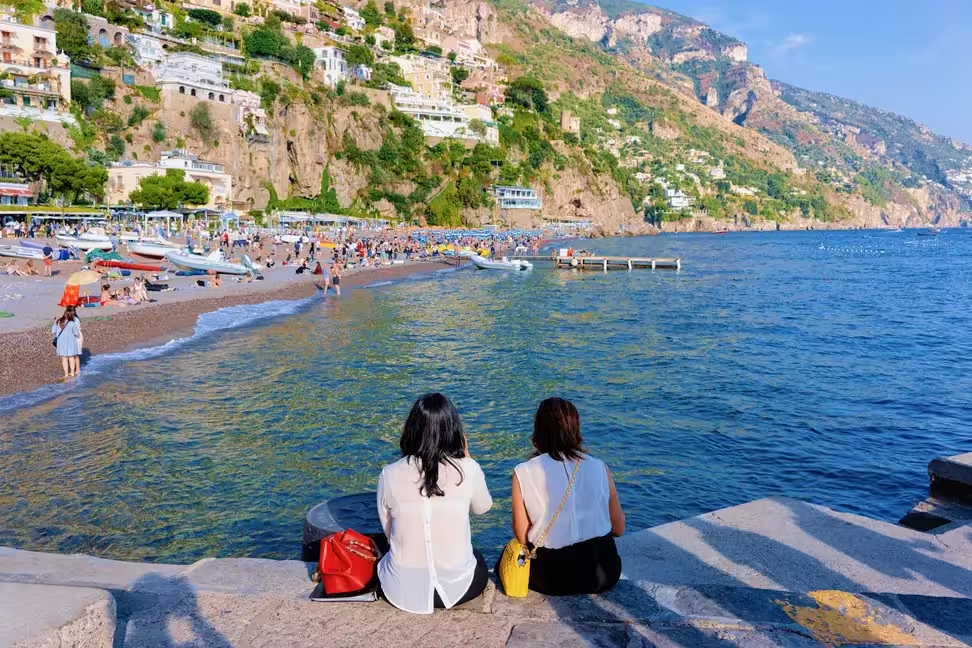
On the road from Positano towards Praiano, Arienzo beach lies tucked between two high cliffs. It is known as the beach of 300 steps, since a long stairway links it with the main road above. The effort pays off with a small cove that keeps the sun until late in the evening.
Above the town, two hamlets look down on the coast from the mountain. Montepertuso, the most populous hamlet of Positano, is named after the pierced mountain that rises above its houses. Every year on 2 July the village honours its protector, the Madonna delle Grazie, and keeps alive the legend of the Virgin's struggle with the devil: there is a religious service, then fireworks and lights blaze inside the hole. Its church, Santa Maria delle Grazie, has three naves and still keeps the shape it took in 1531, when Bishop Miccù had the interior enlarged.
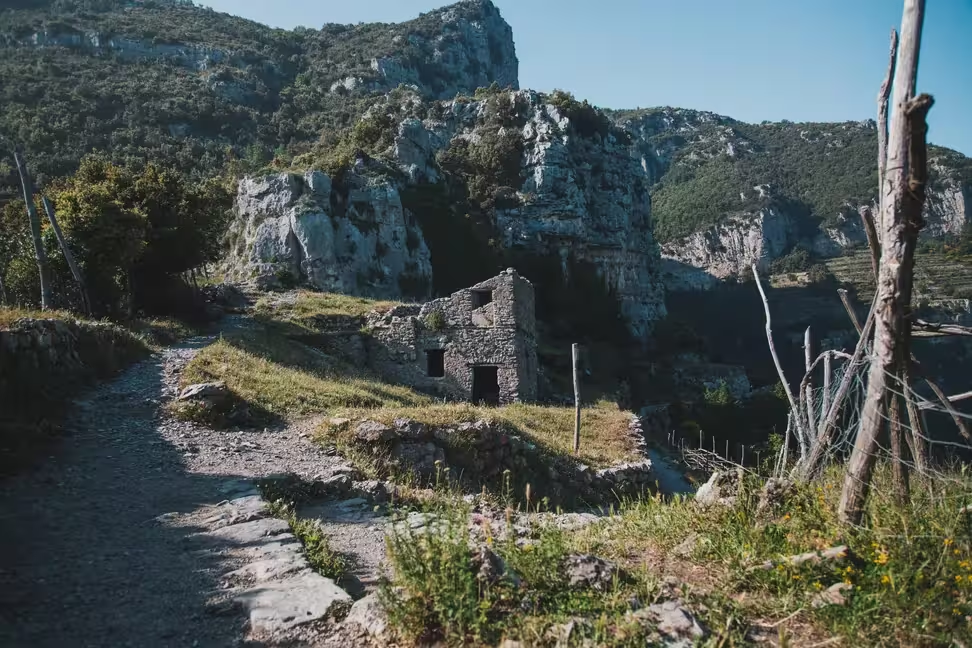
Nocelle is the oldest of Positano's hamlets and sits highest of all. Its name was long linked to hazelnuts, but it really comes from the Latin nova cella, a new dwelling. About 1,700 steps climb from Positano to Nocelle, and walkers come for the mountains: the Lattari Mountains and the Path of the Gods are close by. The church of Santa Croce, set on the slope above the sea, is neoclassical, with a single nave and an apse, and its sacristy houses a small museum of religious and ethnographic art. The square in front of it, shaded by trees and edged by dry-stone terraces, opens to the south like a broad balcony with a lovely view.
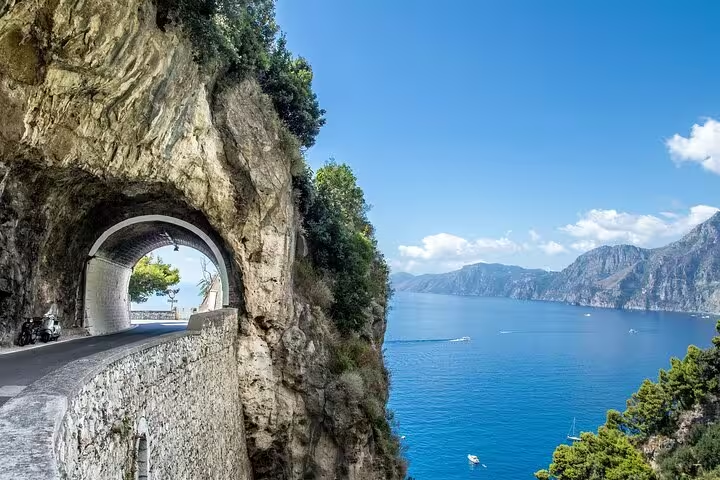
Most day trips reach Positano by road, along the coast from Naples or Sorrento. From Naples, there is a private day trip devoted to Positano; a private day that pairs Sorrento with Positano; and a guided group tour that also takes in Sorrento, Amalfi and Ravello. From Sorrento, you can join a small-group day through Positano, Amalfi and Ravello or a guided minivan tour of the same three towns. If you also want to see Pompeii, a private day from Naples with Sorrento, Positano and Pompeii fits both into one trip.
Positano looks its best from the water. A private boat trip from Sorrento along the Amalfi Coast to Positano and a private cruise from Sorrento to Positano and Amalfi both show the town rising straight from the sea.
Every trip that starts or stops here is also listed on the destination page.
Yes. The excavated rooms of the Museo Archeologico Romano are shown on guided visits, and as the site is kept cool, a light jacket is useful.
Fornillo, roughly ten minutes on foot from the seafront, and Arienzo, on the way to Praiano, which you reach by a long stairway.
About 1,700. Nocelle is also a short way from the Path of the Gods.
From the hole that pierces the mountain above the village. During the feast of the Madonna delle Grazie, on 2 July, fireworks light it up.
Yes. Spiaggia Grande has a pier where ferries from along the coast and from the islands of Capri and Ischia dock.
Sources: Comune di Positano (CC BY 4.0): museo-archeologico-romano-di-positano, spiaggia-di-marina-grande, spiaggia-di-fornillo, spiaggia-di-arienzo, frazione-di-nocelle, chiesa-della-santa-croce, frazione-di-montepertuso, chiesa-s-maria-delle-grazie.