Few cities in Spain hold as much history in so small a space as Toledo. On a rocky height wrapped in a broad loop of the River Tagus, Christians, Muslims and Jews raised churches, mosques and synagogues a few streets apart, and Toledo is still known as the city of three cultures. The Historic City of Toledo has been on the World Heritage List since 1986. This page goes through the monuments that make up that ensemble: the Cathedral and the Alcázar, the monastery of San Juan de los Reyes, the mosque known as Cristo de la Luz, the synagogues of Santa María la Blanca and El Tránsito, and the walls, gates and bridges around the old town.
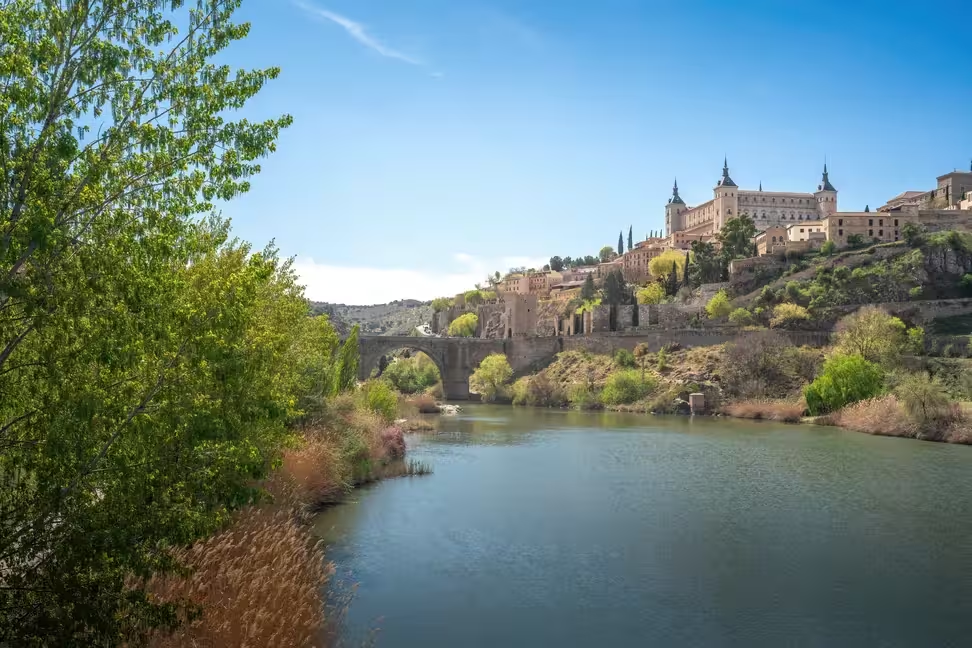
People already lived on this rock in prehistoric times, but the first written mention of the city is Roman, when it was called Toletum. Toledo went on to be a Roman municipium, the capital that King Leovigild chose for the Visigothic kingdom, the seat of a bishop and, later, a city of the Emirate of Córdoba. Muslim rule took away its rank as a capital, yet its cultural, social and religious life reached remarkable heights.
Alfonso VI reconquered Toledo, and the royal court stayed here for a time. In the 13th century Alfonso X founded the Toledo School of Translators, a fine measure of the exchange of ideas in the city. Under Emperor Charles V, whose court also settled here for periods, Toledo lived one of its most brilliant moments, but once Philip II fixed the capital of the kingdom in Madrid, it went through a period of some decline. The townscape you walk through today is the result of all these layers, Jewish, Islamic and Christian, laid one over another.
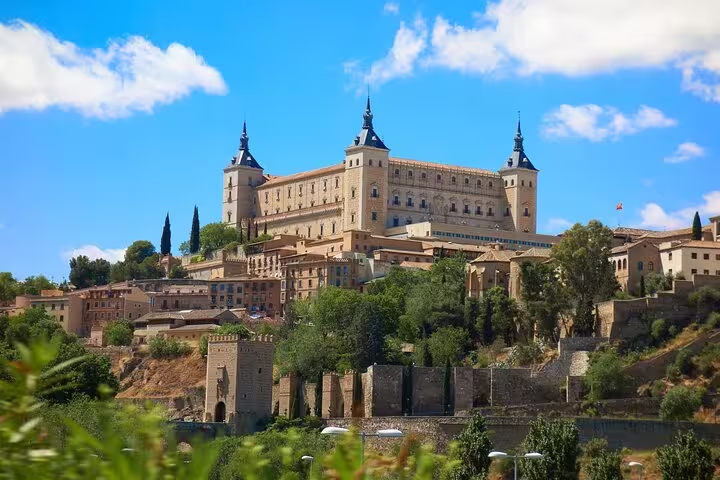
Among the buildings of Christian Toledo, the Cathedral of Santa María and the Alcázar stand out, and both appear as National Monuments on the City Council's list of protected heritage. So does San Juan de los Reyes, a monastery whose church, cloister and entrance hall are listed together. Around them rise many more churches, convents and monasteries; counting the city itself, the council's tally of Bienes de Interés Cultural reaches 110.
Toledo also drew great artists. Domenikos Theotokopoulos, better known as El Greco, had worked in his native Crete, in the Venice of Titian's last years and in Rome before he settled in Toledo in 1577, and he stayed until his death. Much later, after 1898, the city and its painter became points of reference for the Generation of '98.
The centuries of Islamic rule gave Toledo its maze of narrow, winding streets, which still shapes the old town. The mosque of Cristo de la Luz shows how those builders worked: brick and rubble masonry, interlaced arches and wooden ceilings.
That period left its mark on the defences as well. In 2021, during emergency work to shore up a stretch of the walls, three towers and some 30 m (98 ft) of wall base came to light after being hidden. The Institute of Cultural Heritage of Spain links them to the Al-Hizam, the works that Abd al-Rahman III carried out in Toledo in the first third of the 10th century, and their ashlar masonry belongs to the official architecture of the Umayyad Caliphate.
Toledo's Jewish past is easiest to trace in two synagogues. El Tránsito, properly the Synagogue of Samuel ha-Leví, was built in the 14th century at the behest of Samuel ha-Leví, a prominent figure at the court of King Pedro I of Castile, where his posts included that of royal treasurer. After the expulsion of the Jews in 1492 the Catholic Monarchs handed it to the Order of Calatrava, and the great prayer hall became a church. It took its popular name in the 17th century from a painting of the Death of the Virgin by Juan Correa de Vivar that adorned the Plateresque altar; the canvas now belongs to the Museo Nacional del Prado.
The building was declared a National Monument in 1877. A decree of 1964 created the Sephardic Museum inside it, and the museum opened to the public in 1971; the Ministry of Culture describes the synagogue as the most important Hispano-Jewish building in Spain, in the very heart of the old Jewish quarter. Santa María la Blanca, the other synagogue, is protected as a National Monument too.
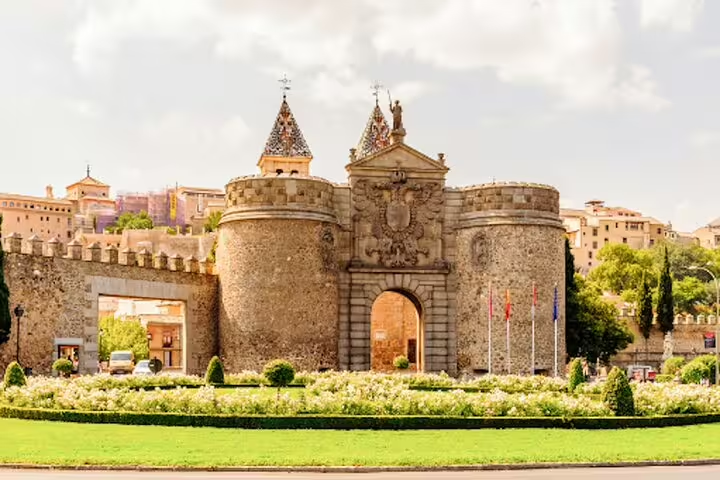
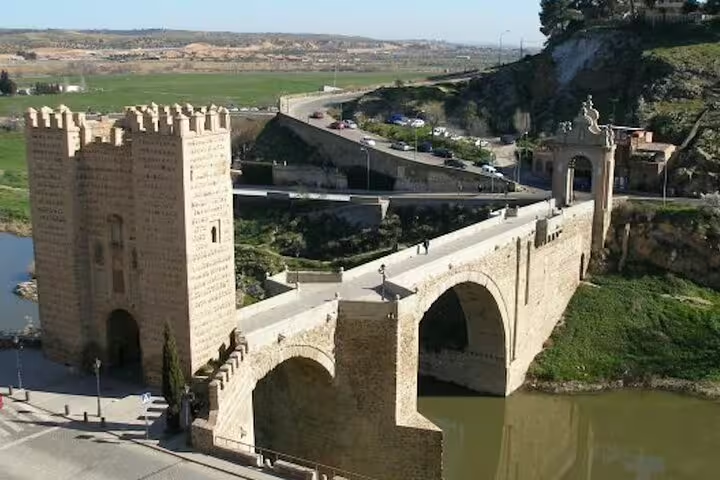
The council's heritage list groups the walls, towers, gates and bridges under one National Monument entry, and names several of them separately. The Alcántara and San Martín bridges are National Monuments in their own right, and so are the Puerta Nueva de Bisagra, the Puerta del Sol and the Puerta del Cambrón. The old Bisagra gate goes by another name, the Gate of Alfonso VI. The list also reaches beyond stone: in 2015 Toledo's patios were declared a Bien de Interés Cultural as intangible heritage.
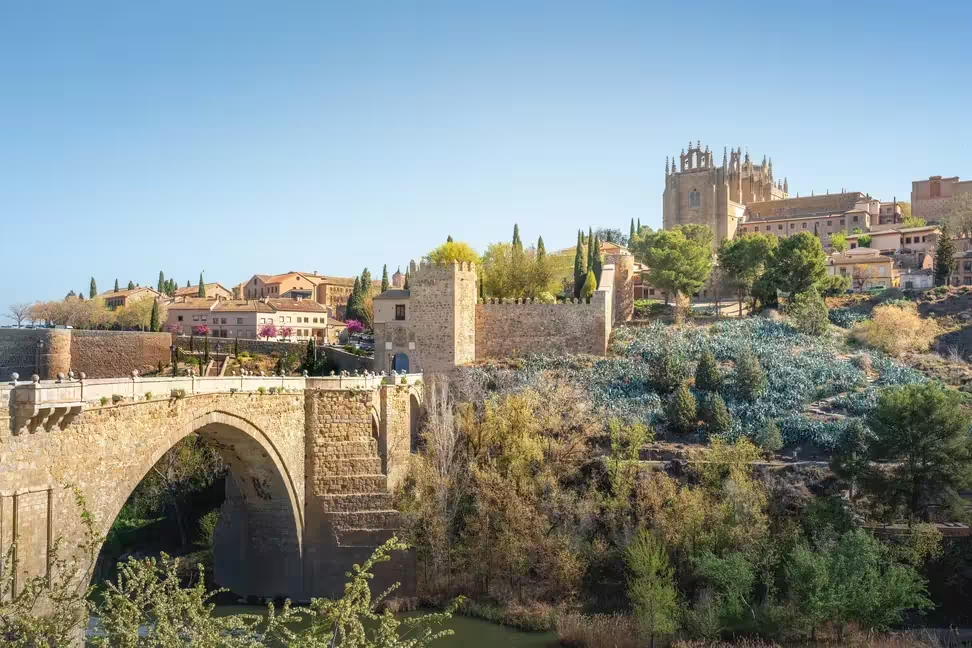
Most visitors arrive from Madrid. A private half-day tour by minivan and a private day trip by minivan both take in the Cathedral and the old Jewish quarter, and if you are already in town, a private walking tour with a local guide covers the Cathedral, the Jewish quarter and a medieval bridge over the Tagus. Toledo is also a stop on longer journeys: a private transfer from Lisbon to Madrid that can pause here, a two-day coach tour from the Costa del Sol to Madrid via Granada, guided tours of Andalusia from Madrid that end with a visit to Toledo, over four days or five days, and a five-day guided tour from Lisbon to Madrid through Andalusia.
Every trip that starts or stops here is also listed on the destination page.
Because Jews, Muslims and Christians lived side by side here, and each community left buildings that still shape the city.
Yes. Its historic city was inscribed on the list in 1986.
He settled there in 1577 and lived in the city for the rest of his life.
The Sephardic Museum, created by decree in 1964 and opened in 1971.
The City Council counts 110 Bienes de Interés Cultural, including the city as a whole.
Sources: Origen de los datos: Ministerio de Cultura (Ley 37/2007); Ayuntamiento de Toledo (reutilización libre citando la fuente).