In Palermo, builders of very different origins left behind a group of monuments that still stand in the city and in two towns nearby. This page follows the Arab-Norman route through Palermo, from the Royal Palace to the Cathedral and San Giovanni degli Eremiti; climbs to the abbey town of Monreale; and ends in Cefalù, at the foot of its Rocca. At the end you will find the tours that link all three places from Palermo.
What makes these buildings special is the way they blend traditions. They bear witness to peoples of different historical and geographical backgrounds living and working side by side, and out of that exchange came a style of its own, in which Byzantine, Islamic and Romanesque elements merge. The monuments were also chosen together because they are so well preserved: unlike most buildings of their time, they never sank to the state of archaeological ruins.
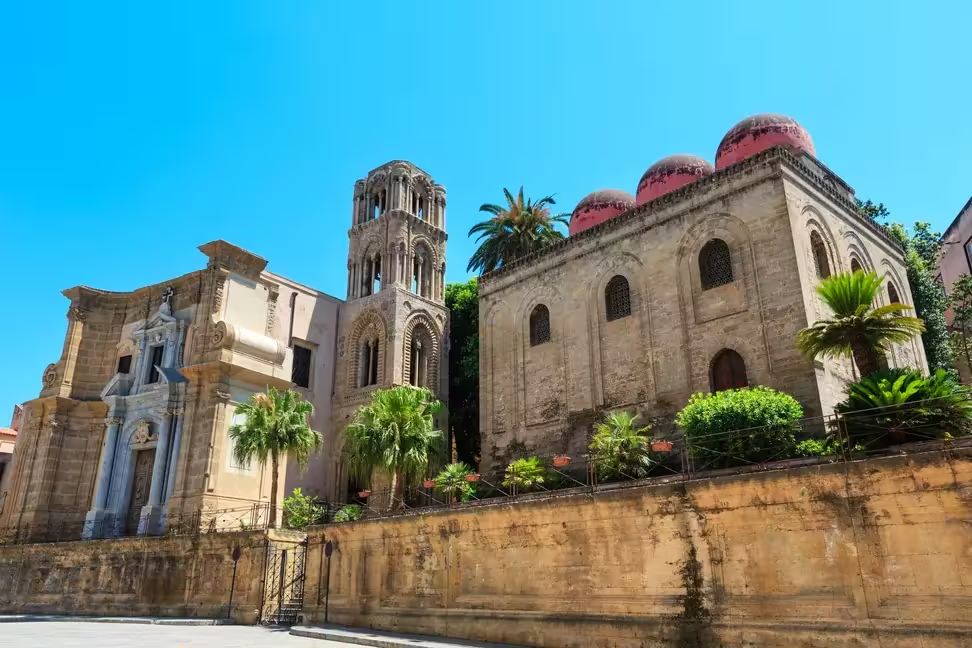
In Palermo, the route takes in the Royal Palace with its Palatine Chapel; the Cathedral; the churches of San Giovanni degli Eremiti, San Cataldo and Santa Maria dell'Ammiraglio, better known as the Martorana; the Zisa palace; and the Ponte dell'Ammiraglio. Beyond the city, it carries on to the cathedrals and cloisters of Monreale and Cefalù.
The heart of the route is the Royal Palace, also known as the Palazzo dei Normanni. Arab emirs first built it around the 10th century. The Norman kings then made it their home, a fortress that was also a residence of rare splendour, and they relied on the technical mastery of Muslim craftsmen; from that meeting came what we now call Arab-Norman art.
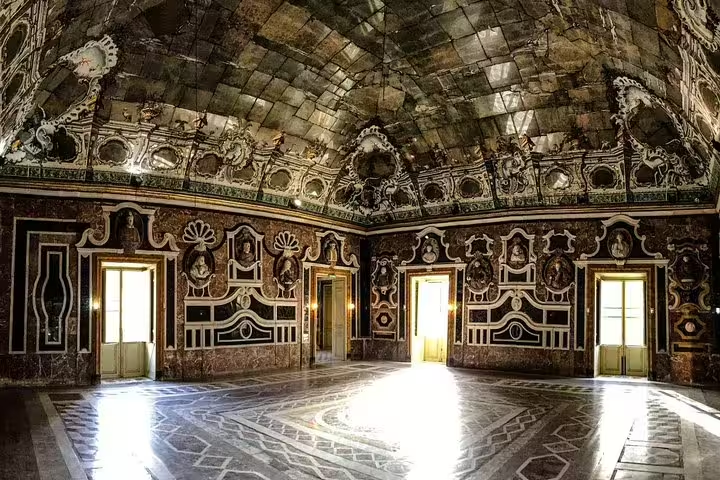
Inside is the Palatine Chapel, which Guy de Maupassant described as the most beautiful in the world. The palace also holds the Hall of Hercules, built in 1560, and King Roger's Hall, where mosaics with motifs from nature shine against a gold background on the walls and vaults.
The building has never stopped working. Its Torre Pisana has been home to the Astronomical Observatory since 1791, and since 1946 the palace has hosted the Sicilian Regional Assembly. That parliament, set up by King Roger in 1140, is proud to call itself the oldest in Europe.
The church of San Giovanni degli Eremiti went up in the Norman period, between 1130 and 1148, during the reign of Roger II, and Giuseppe Patricolo restored it thoroughly in 1882. Inside, the same unit appears five times, a cube crowned by a dome: twice along the single nave and three times across the transept. Pairing the square, a symbol of the earth, with the circle, a symbol of the sky, is an idea found in both Fatimid Islamic and Byzantine culture. Next to the church lies a rectangular cloister with pointed arches, probably from the 13th century.
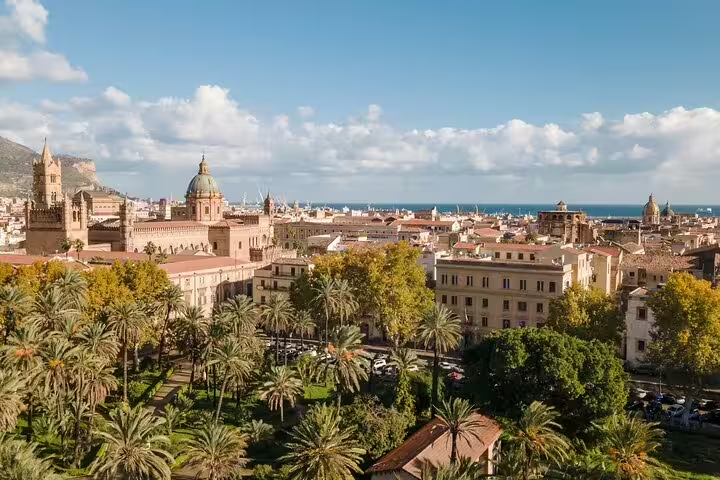
Palermo Cathedral is often called the history book of the city. Its south front opens onto a portico from 1453, a masterpiece of florid Gothic with a Catalan touch. A marble balustrade by Vincenzo Gagini, dating from 1574, runs around the square in front, and statues of Sicilian saints were later set on top of it.
Monreale sits 8 km (5 miles) south-west of Palermo, on the slopes of Monte Caputo, on a spur that looks out over the Oreto valley and the Conca d'Oro. Its fame rests above all on its glittering cathedral. The town grew in the 12th century around a Benedictine abbey, and by the end of that century high walls with towers protected the abbey buildings. The young Norman king William II, called the Good, built the abbey complex, which today bears his name as the Complesso Monumentale Guglielmo II.
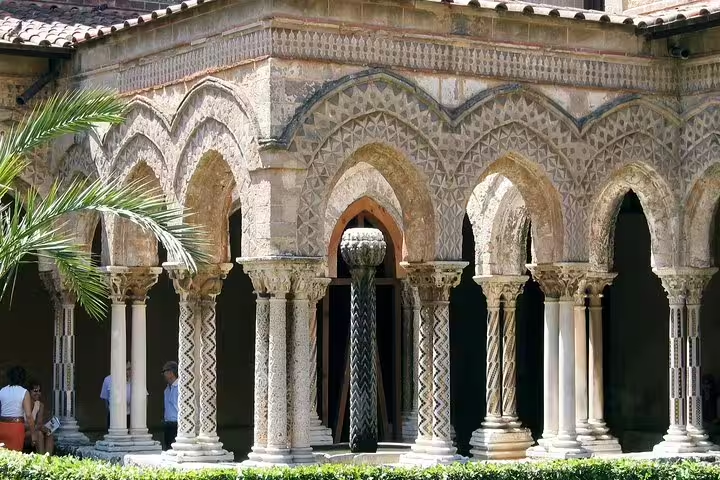
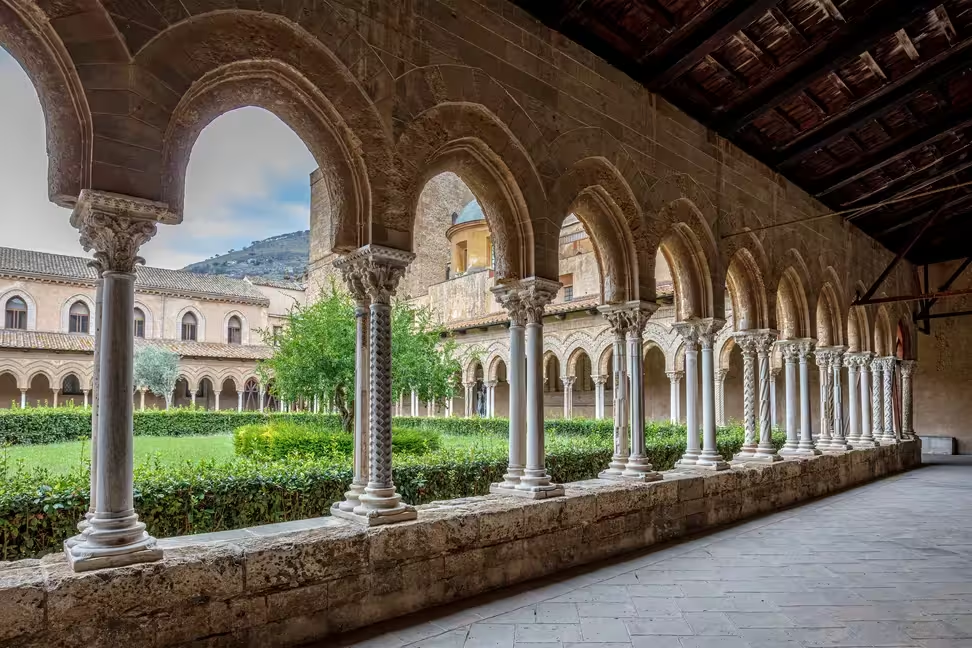
The Benedictine cloister has come down to us intact. Square in plan, it keeps its original arches resting on slender paired columns, and its size and richness bring to mind the courtyards of the Islamic world. Through the large courtyard of the complex you reach the Belvedere, a public garden with a sweeping view over the Conca d'Oro and Palermo.
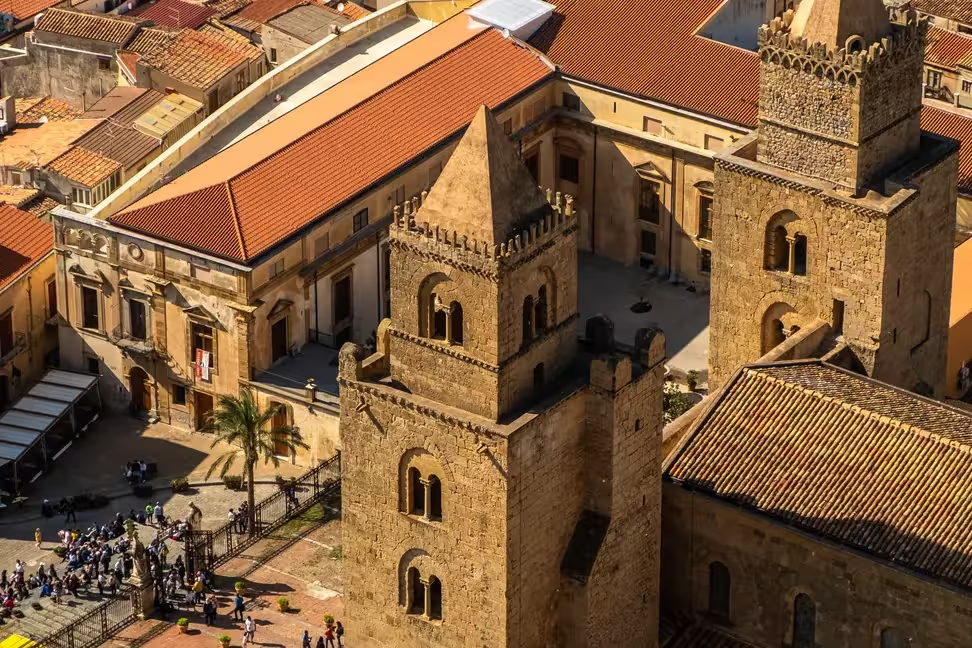
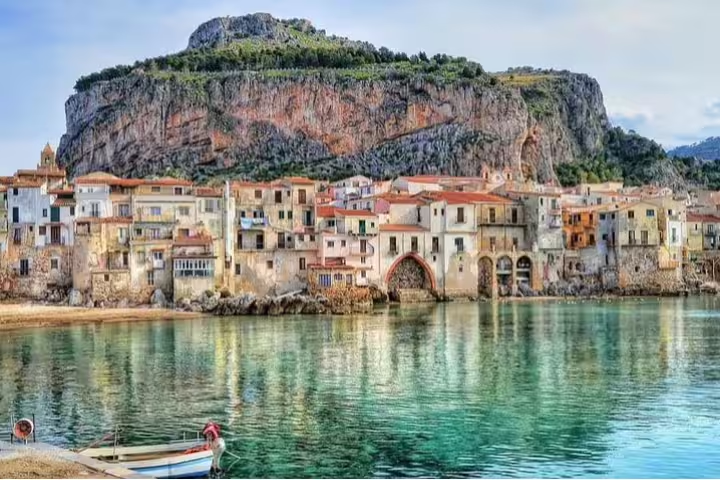
Cefalù is overlooked by the Rocca, a limestone crag that rises 270 m (886 ft) above the sea. The town's name changed with every new power: the Greeks called it Kephaloidion, the Romans Cephaledium and the Arabs Gafludi.
In Byzantine times, people left the shore and moved up onto the headland to defend themselves. Only with Roger II did the town come back down to the coast: that return marked its refoundation and the start of work on the cathedral, and work also began on the town walls, which run for more than 2 km (1.2 miles).
All the tours below start from Palermo. Inside the city, a private guided tour of Palermo's main landmarks and markets passes the Palazzo dei Normanni, the Cathedral, the Martorana and San Cataldo. For a full day, the Palermo tour with Monreale, the markets and Mondello adds the Palatine Chapel and the cathedral of Monreale, and ends by the sea.
If Monreale is your priority, choose a private half day at Monreale cathedral and the beach of Mondello or a private tour of Monreale and Mondello from Palermo. To see both cathedrals in one day, there is a private day trip to Monreale, Cefalù and Castelbuono or a private day in Monreale, Bagheria and Cefalù.
Every trip that starts or stops here is also listed on the destination page.
It is the style that grew up in Norman Sicily, when the kings drew on the skills of Muslim craftsmen; in Palermo, Monreale and Cefalù it combines Byzantine, Islamic and Romanesque elements.
The Royal Palace with the Palatine Chapel; the Cathedral; San Cataldo; San Giovanni degli Eremiti; the Martorana; the Ponte dell'Ammiraglio; and the Zisa.
About 8 km (5 miles) from the city, on a spur of Monte Caputo to the south-west.
King William II, the young Norman ruler known as the Good, in the 12th century.
The limestone crag above the town reaches 270 m (886 ft) above sea level.
Sources: Comune di Palermo (CC BY 4.0): notte-bianca-venerd-4-luglio-dalle-20-alle-24, notte-bianca, palazzo-reale-o-dei-normanni, chiesa-di-san-giovanni-degli-eremiti, cattedrale-2; Comune di Monreale (CC BY 4.0): monreale-e-la-sua-storia, complesso-monumentale-guglielmo-ii; Comune di Cefalù (CC BY 4.0): rocca-di-cefalu.