Last updated:
Amsterdam's canal ring wraps around the oldest part of the city, where the Dam, the Oude Kerk and the Nieuwe Kerk stand. This page follows the Prinsengracht to the Westerkerk, stops at two houses of the 17th century, crosses the Dam to the Royal Palace and the Nieuwe Kerk, visits the Oude Kerk, then a church hidden in an attic, and ends with the towers of the old town. The walks and city games that cover these streets come last.
The Westerkerk went up between 1620 and 1631 to a design by Hendrick de Keyser. Inside, it is a basilica with three aisles on a rectangular plan, crossed by two transepts. Its tower, the Westertoren, was begun in 1620 to De Keyser's design but finished in a changed form in 1638: a very tall stack of square storeys, each lower and narrower than the one below, with an imperial crown at the top.
The tower holds a carillon that still includes 14 bells that François Hemony cast in 1658. Inside the church, the organ was built in 1686 by R.B. and J. Duyschot, and C. Vater enlarged it in 1727. Further along the Prinsengracht, the house registered under the Anne Frank Stichting dates from 1635; its rear house was added around 1740, and the front was given a straight cornice around 1840.
On the Keizersgracht stands a double house completed in 1622, in the manner of Hendrick de Keyser and perhaps to his own design. Its front rises to a rich central gable, and carved busts rest against the piers between the windows. On the Kloveniersburgwal, in the old centre, the Trippenhuis was built between 1660 and 1662 by Justus Vingboons. Its richly carved sandstone front is seven windows wide under a pediment, and two carved chimneys stand on the roof.
The Royal Palace on the Dam was built as the town hall. Work began in 1648 to a design by Jacob van Campen, and its carillon still includes 9 bells cast by François and Pieter Hemony in 1664. Six cast iron lanterns surround the building, four on the Dam side and two at the back. They were put up in 1844 to a design by M.G. Tetar van Elven, and each one is crowned by a royal crown.
Next to the palace, the Nieuwe Kerk is a Gothic cruciform basilica of the 15th and 16th centuries, with a ring of chapels around the choir. A fragment of its west tower, started in the mid 17th century and never finished, still stands. The main organ was built in 1652 by H.W. Schonat of Kitzingen, enlarged by J. van Hagerbeer in 1668 and restored between 1975 and 1981. On the south transept there are two sundials, one of them a large round marble plate set in the gable.
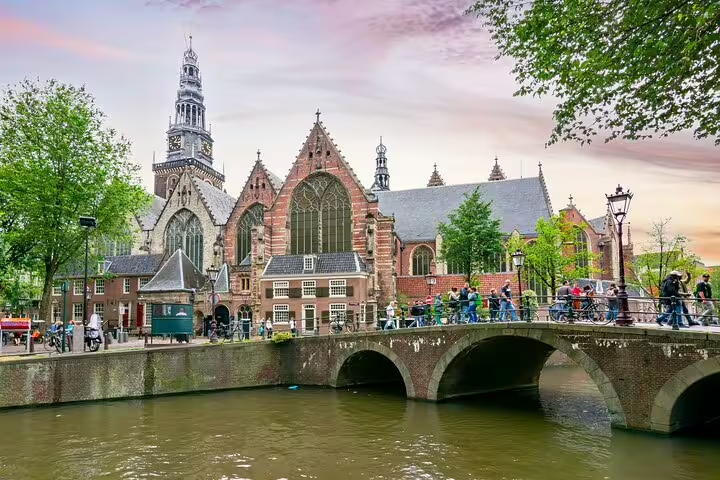
The Oude Kerk is a Gothic church built between the 14th and 16th centuries. Over that time it grew from a pseudo-basilica into a hall church and finally into a basilica, and its high side chapels each carry a gable of their own. The tower goes back to the 14th century and was raised in the 16th century; J. Bilhamer gave it its spire in 1565, and among the bells of its carillon are 14 that François Hemony made in 1656.
On the Oudezijds Voorburgwal, a corner house hides a Roman Catholic church under its roof: Ons' Lieve Heer op Solder. The house was built between 1661 and 1663 and altered in the second quarter of the 18th century. The hidden church has a one-manual organ made by H. Meijer in 1794.
The Schreierstoren is a tower of the city wall of 1481. It is half round on the side that faced the open country and flat on the town side; it was rebuilt many times, and its top and spire came later. Further south, the Munttoren is what remains of the Regulierspoort, a city gate of the second half of the 15th century. Hendrick de Keyser rebuilt and raised it in 1620, and its open wooden lantern holds a carillon with 13 bells by François and Pieter Hemony.
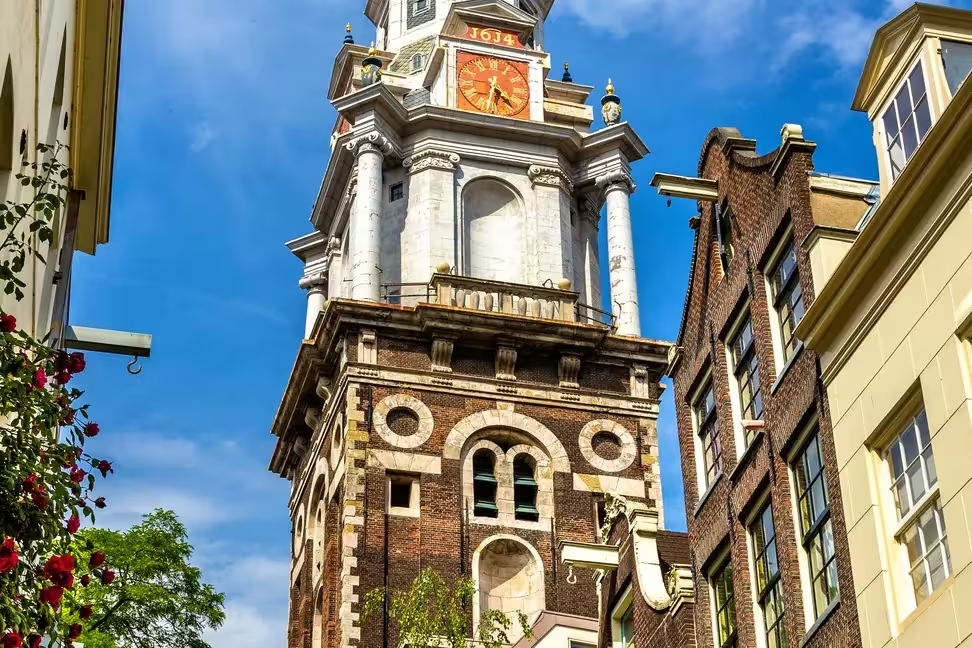
De Keyser also built the Zuiderkerk, between 1603 and 1611. Its tower stands off centre against the church, with a sandstone octagon ringed by free-standing columns and a wooden top with a lantern, completed in 1614. Not far away, the Mozes- en Aäronkerk is a neoclassical church built between 1837 and 1841 by Tieleman Franciscus Suys. Its sandstone front has two wooden towers and an Ionic portico crowned by statues, and its altars of around 1700 come from the earlier hidden church.
Five of the walks are private tours with a guide. One of them, with hotel pickup, takes in the Begijnhof, the palace and the Nieuwe Kerk on the Dam, and the Jordaan. A walk through the Jordaan stops at the Noorderkerk and the Westerkerk, and another private walk follows the canal ring into the old harbour quarter before it reaches the palace on the Dam. The oldest streets, around the Nieuwmarkt and the Waag, are the subject of a private walk through the old city, while a walk about the Dutch painters reads the same streets through the work of Rembrandt, Frans Hals and Jan Steen.
Two walks are for small groups: an open route that wanders along the canal ring and into the old waterfront district, and a guided walk about Amsterdam in the Second World War, with entry to the museums of the old Jewish quarter. Three more are games you follow on your phone, without a guide: a mystery walk through the Jordaan and along the Prinsengracht, a treasure hunt that passes the Schreierstoren, the Montelbaanstoren and the church in the attic, and a romantic puzzle trail that goes past the Rembrandt House and across the Amstel.
All trips that include the city are also on the Amsterdam destination page.
Hendrick de Keyser. Building lasted from 1620 to 1631, and the tower was completed in 1638.
No. It began life as the town hall, with work starting in 1648 to plans by Jacob van Campen.
Its building spans the 14th to the 16th century, and the spire of its tower dates from 1565.
A Roman Catholic church tucked into a corner house on the Oudezijds Voorburgwal, from the years 1661 to 1663.
Sources: Rijksdienst voor het Cultureel Erfgoed, Rijksmonumentenregister, CC BY 4.0, text translated and summarised: 20360, 40950, 47910, 31230, 29803, 37841, 20365, 36898, 55284, 31678, 40290, 31178, 25682, 27331.