Montepulciano: what to see and do
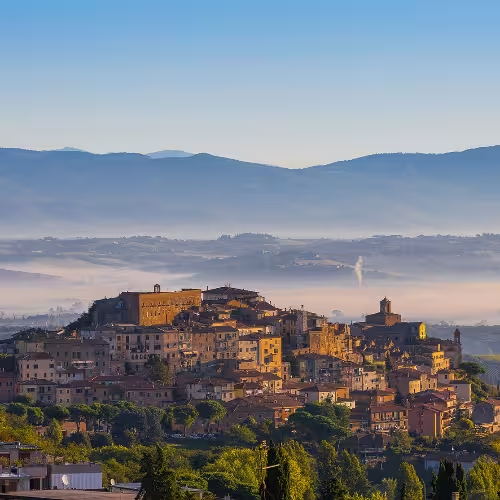
Medieval and Renaissance heritage characterises the hill town of Montepulciano. Its setting is a limestone ridge rising to 605 metres.
Things to do in Montepulciano
The main street links Porta al Prato with Piazza Grande. Piazza Grande contains the cathedral and its forecourt. Ippolito Scalza's design for Santa Maria Assunta Cathedral, also called the Duomo, was chosen in 1594, and the building was finished in 1680.
Michelozzo designed the façade of the Palazzo Comunale, which recalls Palazzo Vecchio in Florence. Below the town walls stands the Temple of San Biagio, built between 1518 and 1545, a Renaissance sanctuary designed by Antonio da Sangallo the Elder. Palazzo Contucci is attributed to the same architect. The Fortezza Medicea is also attributed to him.
Montepulciano in Tuscany
The municipal territory stretches between the Valdichiana and the Val d'Orcia. Below the town lies the Valdichiana, formerly an area of marshland. Pienza lies about 13 kilometres west of Montepulciano. UNESCO inscribed the Val d'Orcia as a World Heritage Site in 2004.
The town's origins go back to the fourth century BC. A founding legend names Lars Porsena, the Etruscan king of Clusium, as its founder. Both Florence and Siena took an interest in the town. During the twelfth century, the Republic of Siena launched repeated attacks against Montepulciano. Florence's annexation of Siena's territory in 1559 ended Montepulciano's role as a border stronghold.
The private Brunello and Nobile wine tour in Val d'Orcia lasts 8 hours and includes a private driver and environmental guide, guided underground cellar visits and wine tasting in Montepulciano, a traditional Tuscan cellar lunch, a guided Pienza visit with Pecorino tasting, a guided Brunello winery cellar visit in Montalcino, six wines including Brunello Riserva, and stops at film locations in the Val d'Orcia.
The Rome to Florence day trip with a Montepulciano wine and village stop lasts 5 hours and includes a vehicle with a professional driver throughout the route and two hours in the town centre.
Vino Nobile di Montepulciano
Vino Nobile di Montepulciano has held DOCG protection since 1980, with a consortium overseeing it. Sangiovese must account for at least 70 percent of the wine and is locally called Prugnolo gentile. Ageing lasts at least two years, with at least one year in wooden casks.
The guided winery tour and wine tasting in Montepulciano lasts 1 hour and 30 minutes and includes a guided winery and vineyard visit, four wines from the estate menu, a platter of local cured meats and Pienza Pecorino cheese, and apple juice for underage guests.
The stone cellar wine tasting and food pairing in Montepulciano lasts 1 hour and includes local wines, regional food pairings, a guided experience in a historic stone cellar and commentary about Montepulciano wines and local traditions.
Food and local traditions
Pici comes from the province of Siena and consists of thick pasta rolled by hand. Pecorino Toscano is made from sheep's milk and is sold both fresh and aged. Its protected designation of origin dates to 1996.
Each year, Montepulciano's eight contrade compete in the Bravio delle Botti. This barrel race passes through the town on the final Sunday in August.
Frequently asked questions
Where does the main street lead?
The main street links Porta al Prato with Piazza Grande.
When was the cathedral built?
Ippolito Scalza's design for Santa Maria Assunta Cathedral, also called the Duomo, was chosen in 1594, and the building was finished in 1680.
Which valleys border the municipal territory?
The municipal territory stretches between the Valdichiana and the Val d'Orcia.
Which grape is used for Vino Nobile di Montepulciano?
Sangiovese must account for at least 70 percent of the wine and is locally called Prugnolo gentile.
What is the Bravio delle Botti?
Each year, Montepulciano's eight contrade compete in the Bravio delle Botti. This barrel race passes through the town on the final Sunday in August.