




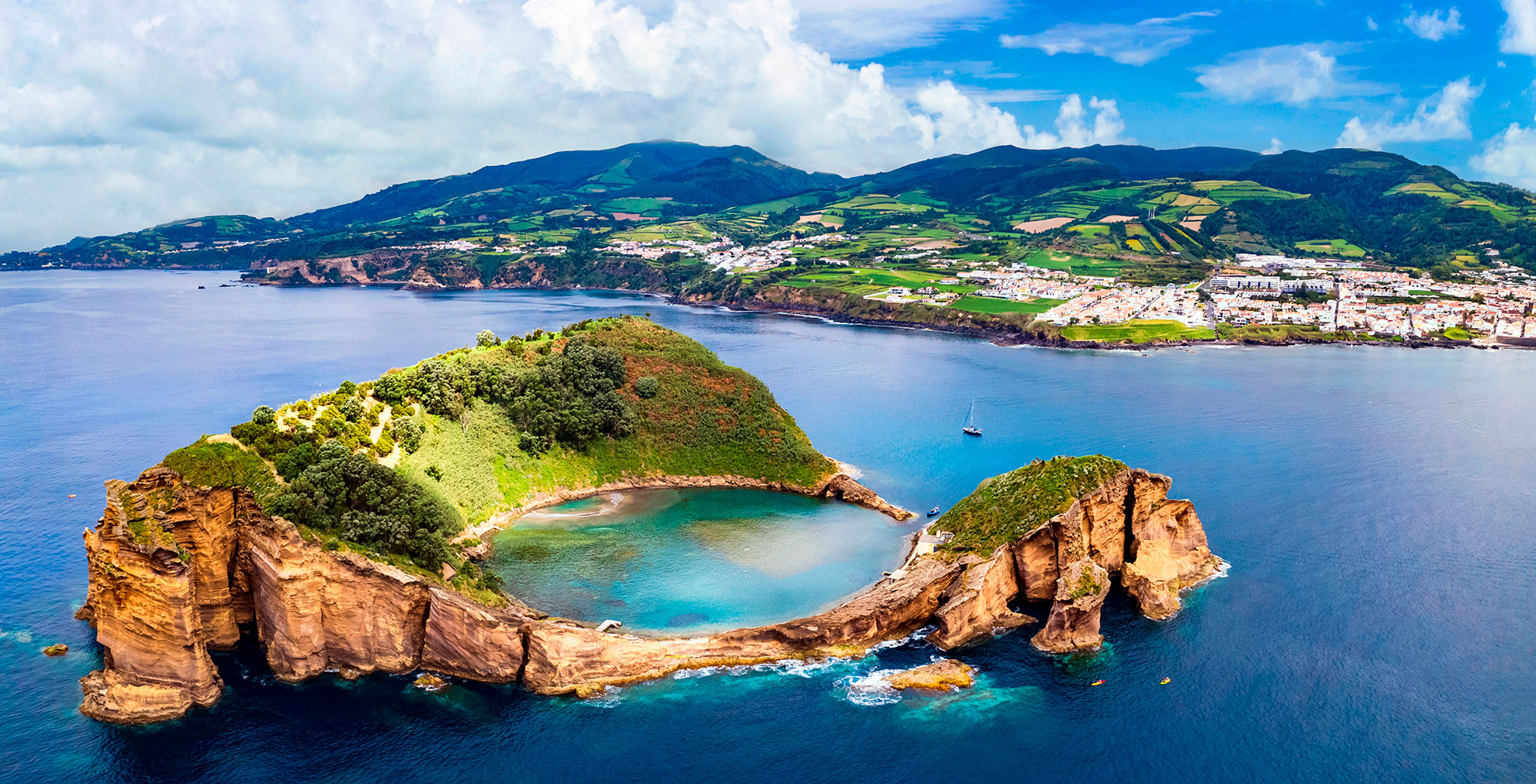
The Ilhéu de Vila Franca do Campo — a submerged volcanic crater whose near-perfect circular lagoon is visible only from the air or from the hilltop sanctuary above town.
The Volcanic Lagoon
Nature's Masterpiece: A Day in the Paradise of Vila Franca do Campo
Where a dormant crater became an emerald lagoon, and a quiet southern town holds five centuries of maritime legacy.
A short ferry crossing from the marina of Vila Franca do Campo lands you on a pristine refuge that geology took tens of thousands of years to build. The Ilhéu de Vila Franca — a partially submerged volcanic cone off the southern coast of São Miguel — encloses a near-perfectly circular lagoon of crystalline water, sheltered from the open Atlantic and tightly controlled in terms of daily visitor access. It is, by most measures, a singular natural formation in the Azores.
The town itself occupies a quiet chapter in Azorean history that most visitors overlook. Vila Franca do Campo was the first capital of São Miguel island until the catastrophic earthquake of 1522 reshaped both the coastline and the seat of power. What remains today is a compact fishing town with handsome baroque churches, a working marina, and a culinary tradition anchored in the queijada da vila — a small conventual sweet made from fresh cheese, sugar, and cinnamon, produced here for centuries and found nowhere else in quite the same form. The combination of geological spectacle, historical texture, and accessible marine adventure makes this one of the most complete day destinations on the island.
"The lagoon sits inside the crater like a held breath — the water so still and clear on a calm morning that you can read the volcanic rock formations six metres below the surface."
On the Water: The Islet and Beyond
The marine environment around Vila Franca do Campo is defined by the islet's volcanic foundations. Underwater lava formations, warm current channels, and the relative shelter of the southern coast create conditions suited to everything from first-time snorkelers to certified technical divers. The same waters host year-round cetacean populations — sperm whales, common and bottlenose dolphins — accessible on dedicated offshore excursions that depart from the marina in the early morning hours. Visibility regularly exceeds fifteen metres in summer, and the presence of manta rays in specific dive sites has made the area a recognised destination among the regional dive community.
Boat & Wildlife Experiences
Diving Experiences
Coastal Exploration
Vila Franca do Campo offers one of the most varied marine itineraries on São Miguel — from first-time snorkeling inside the lagoon to offshore whale watching and night dives. Browse the full list of available experiences and check real-time availability.
Explore all Vila Franca do Campo tours →The View That Frames Everything
Before or after a morning on the water, the walk — or short drive — up to the Nossa Senhora da Paz Sanctuary provides the image that most visitors carry home. The hilltop chapel, set among hydrangea-lined paths and a mosaic-tiled staircase, looks directly down over the town's terracotta rooftops and out to the islet, whose circular lagoon is only fully legible from this elevation. The geometry of the volcanic formation — a near-perfect circle of dark rock enclosing turquoise water against the open Atlantic — is visible from here in a way that no boat or beach position can replicate. It is a practical vantage point as much as a scenic one: on arrival in Vila Franca, the sanctuary gives immediate spatial orientation to a geography that can otherwise feel confusing at sea level.
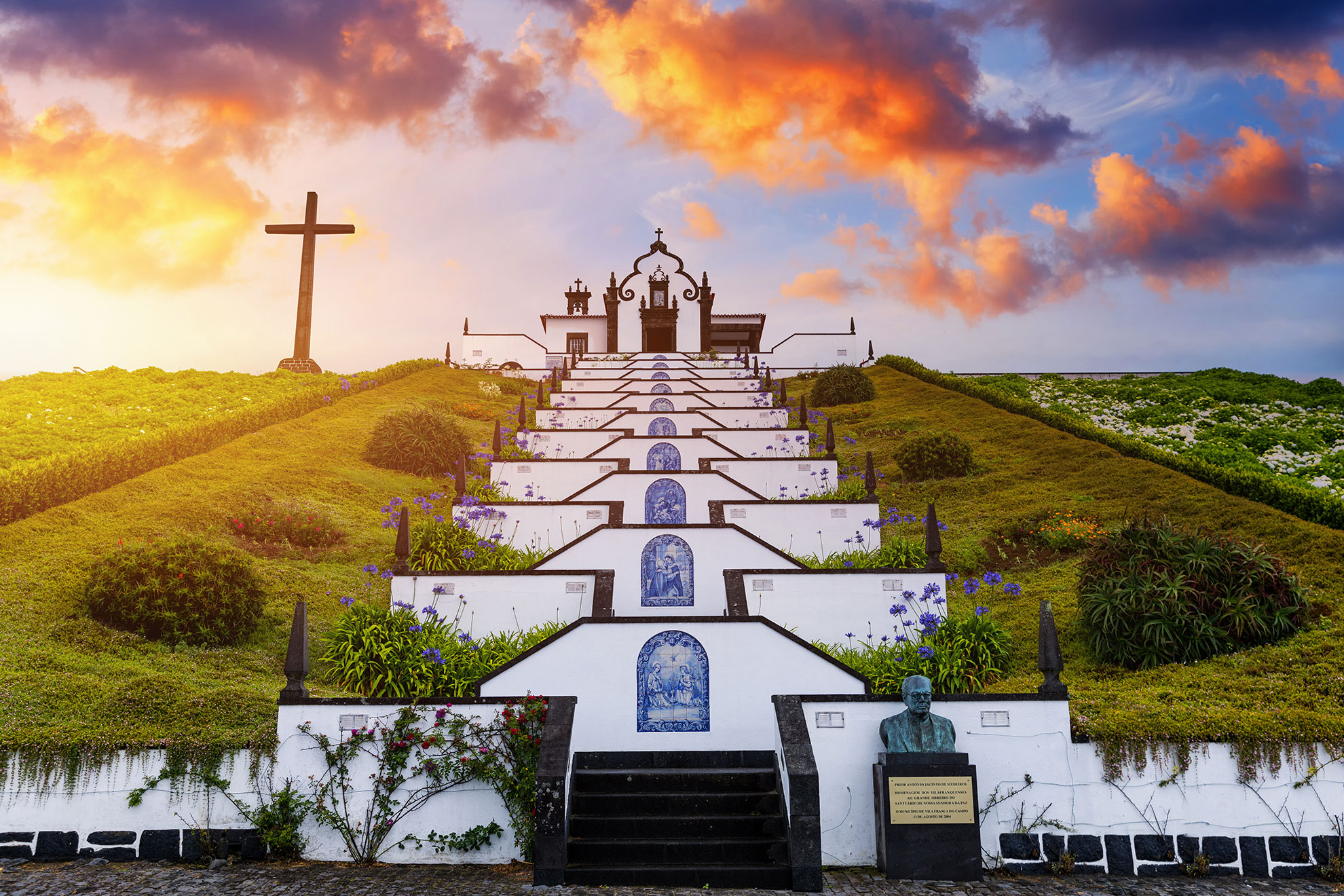
The Nossa Senhora da Paz Sanctuary sits above the town on a hydrangea-lined hillside, offering the clearest view of the islet's volcanic geometry.
History, Sweet Pastry, and the First Capital
The 1522 Azorean earthquake — one of the most destructive in the archipelago's recorded history — is the single event that most shaped Vila Franca do Campo's place in the island's story. Before it, the town was the administrative and ecclesiastical centre of São Miguel. After, Ponta Delgada assumed that role. What survived, and what was rebuilt over the following centuries, is still visible in the Igreja de São Miguel Arcanjo and the surrounding streets, where the scale of the original settlement is still legible in the urban fabric. The town's identity has long since settled into fishing, small-scale agriculture, and a quiet pride in its traditional crafts — chief among them the queijada da vila. These small tarts of fresh local cheese, sugar, cinnamon, and lemon zest were originally produced in convents and are now made in a handful of local bakeries. They are dense, subtly sweet, and distinct from the mainland Portuguese equivalent. Leaving Vila Franca without a box is, by local consensus, an oversight worth correcting.
"The queijada da vila is not a souvenir — it is an argument. Locals will tell you, with some justification, that no other place in the Azores makes them correctly."
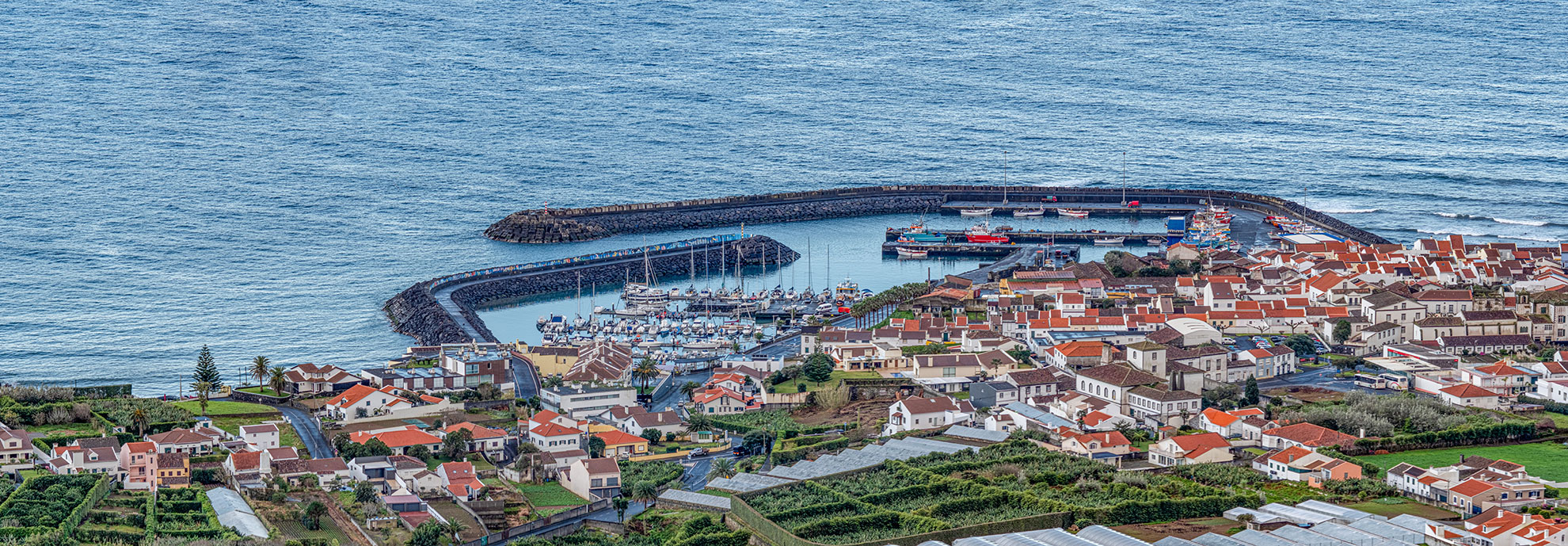
The town's working marina serves as the departure point for all islet and offshore excursions, with ferries running on a timed schedule throughout the day.
Planning Your Day in Vila Franca do Campo
The most efficient itinerary places a morning water activity — snorkeling, a boat tour, or a dive — first, when sea conditions are typically calmest and the islet is least crowded. The afternoon then opens up for the Nossa Senhora da Paz walk, a circuit of the town's historic churches, and time at a local café. The distance between the marina, the town centre, and the sanctuary is walkable, though the climb to the hilltop chapel is moderate and takes around twenty minutes from the seafront. Most guided marine experiences depart between 9 and 10 a.m. and return by early afternoon, which aligns well with this structure. From Ponta Delgada, Vila Franca do Campo is approximately 18 kilometres east along the EN1-1A coastal road — a straightforward 25-minute drive, or reachable by island bus service.
Whether you're planning a half-day snorkeling trip inside the volcanic lagoon or a full-day programme combining whale watching and coastal kayaking, all bookable experiences in Vila Franca do Campo are listed in one place.
See all available tours →Frequently Asked Questions
How do I get to the Ilhéu de Vila Franca do Campo?
Access is exclusively by ferry from the Vila Franca do Campo marina. The crossing takes approximately five minutes. Tickets are sold at the marina and are subject to a daily visitor limit set by the nature reserve authority. In July and August, early arrival is strongly advised as capacity fills quickly on fair-weather days.
What is the best time of year for diving and snorkeling here?
June through October offers the warmest water temperatures (22–25°C) and highest visibility. Manta ray sightings are most frequent in late summer. Winter diving is possible and undertaken by experienced divers, though surface conditions are less predictable and guided tour availability is reduced.
Do I need diving certification to join the scuba experiences?
The Baptism at Sea experience is designed for beginners with no prior certification — instruction is provided on the day and dives are conducted in shallow, supervised conditions. The Manta Ray and Night Diving tours require at least an open-water certification from a recognised agency (PADI, SSI, or equivalent).
Is Vila Franca do Campo suitable as a day trip from Ponta Delgada?
Yes. The town is 18 kilometres east of Ponta Delgada and easily reached by car in under 30 minutes. A morning water activity, lunch in town, and an afternoon visit to the Nossa Senhora da Paz Sanctuary makes for a well-paced day. Bus connections to Ponta Delgada operate regularly if you prefer not to drive.
Where can I try the queijada da vila?
Several bakeries and cafés in the town centre sell them, often still warm. The queijadas are small enough to bring home in a box — they keep for several days. They are also sometimes available at the Ponta Delgada market, but the freshest versions are found in Vila Franca itself.
What is the Red Bull Cliff Diving connection to the islet?
The Ilhéu de Vila Franca do Campo has hosted stages of the Red Bull Cliff Diving World Series on multiple occasions. Athletes dive from platforms set on the crater walls above the lagoon. The event typically takes place in summer, though dates vary by year — the islet's enclosed water and vertical rock faces make it one of the most distinctive venues on the international circuit.