Last updated:
In 2025 UNESCO added the Minoan Palatial Centres, in Greece, to the World Heritage List, under criteria (ii), (iii), (iv) and (vi). UNESCO's World Heritage List entry for the Minoan Palatial Centres explains why.
The listing joins six sites on Crete: Knossos, Phaistos, Malia, Zakros, Zominthos and Kydonia. They date from about 1900 to 1100 BCE. Kydonia lies under the modern streets of Chania, and nobody yet knows how far it reaches.
Each palace was far more than a royal home. UNESCO describes them as the administrative, economic, religious and cultural centres of Minoan life.
Crete sat between Europe, Africa and Asia, and that position made the island a bridge for goods and ideas. The palaces show contacts with the Egyptian and Mycenaean worlds.
Some of the most precious finds are written. The palaces hold traces of Cretan Hieroglyphic and Linear A, which UNESCO calls the two earliest writing systems in Europe, together with the later Linear B.
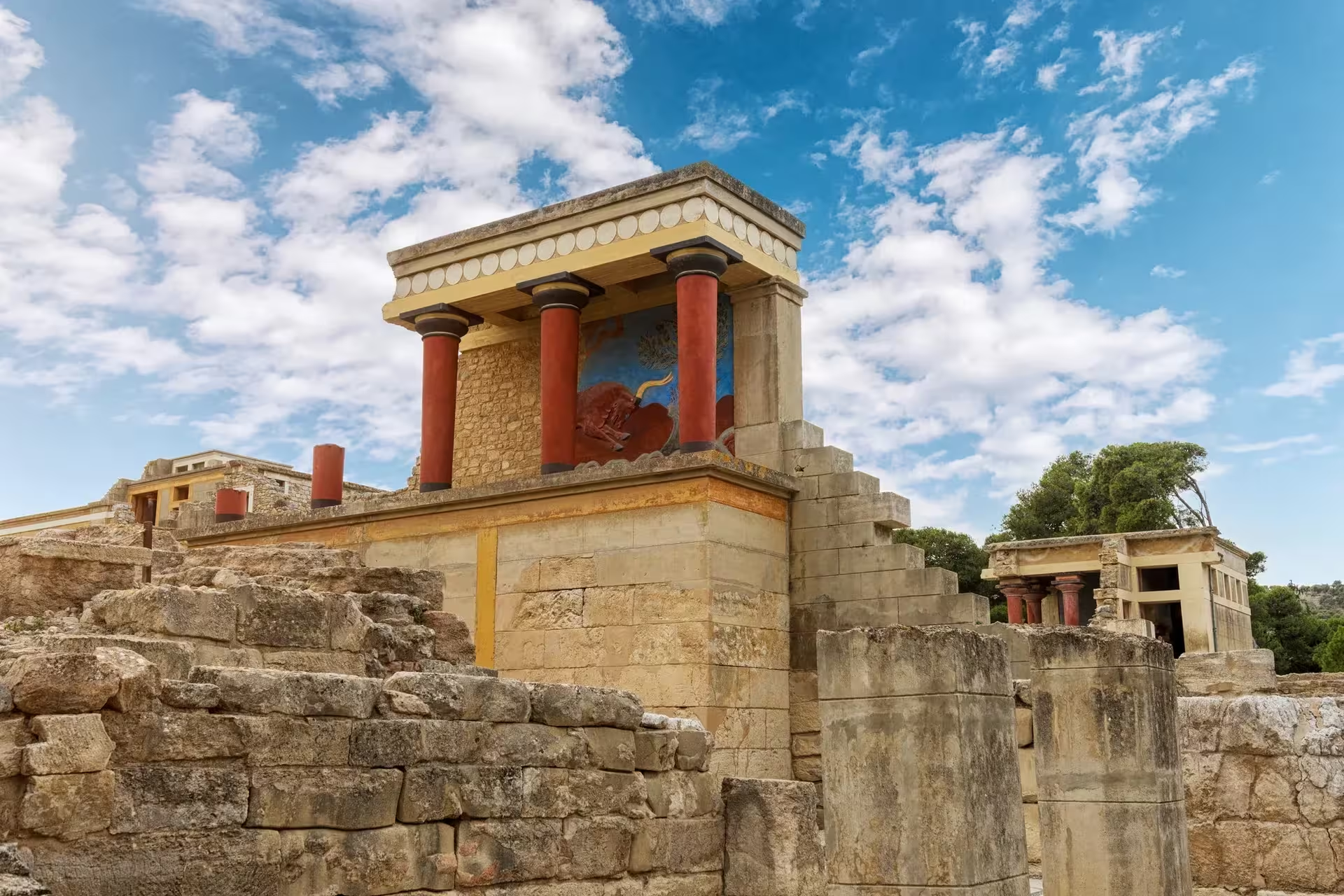
Walk through Knossos and the plan still feels like a maze of rooms, courtyards and storerooms, with clever systems for water. UNESCO links the legend of the Minotaur and the Labyrinth directly to these palaces.
At Knossos you will also see parts rebuilt in the early twentieth century. UNESCO notes that these reconstructions are a challenge, but that much of the site is authentic and every rebuilt part is documented.
With a group, the Heraklion Guided Tour: Knossos Palace & Archaeological Museum is a guided day, says its operator, that pairs the palace with the archaeological museum in Heraklion.
For more freedom, the Private Guided Tour to Knossos Palace from Heraklion is a private guided visit from Heraklion, according to its operator, so you set the pace around the ruins.
If you like to move, the Guided Tour of Knossos Palace and Heraklion City by Bike combines a guided walk through the palace with a ride on an eco bike through the streets of Heraklion, says its operator.
Yes. It is one of six Minoan sites UNESCO listed together in 2025.
The listed palace sites date from roughly 1900 to 1100 BCE.
UNESCO links the myth of the Labyrinth to the Minoan palaces.
Yes. Several operators run guided visits from the city, as described above.