Last updated:
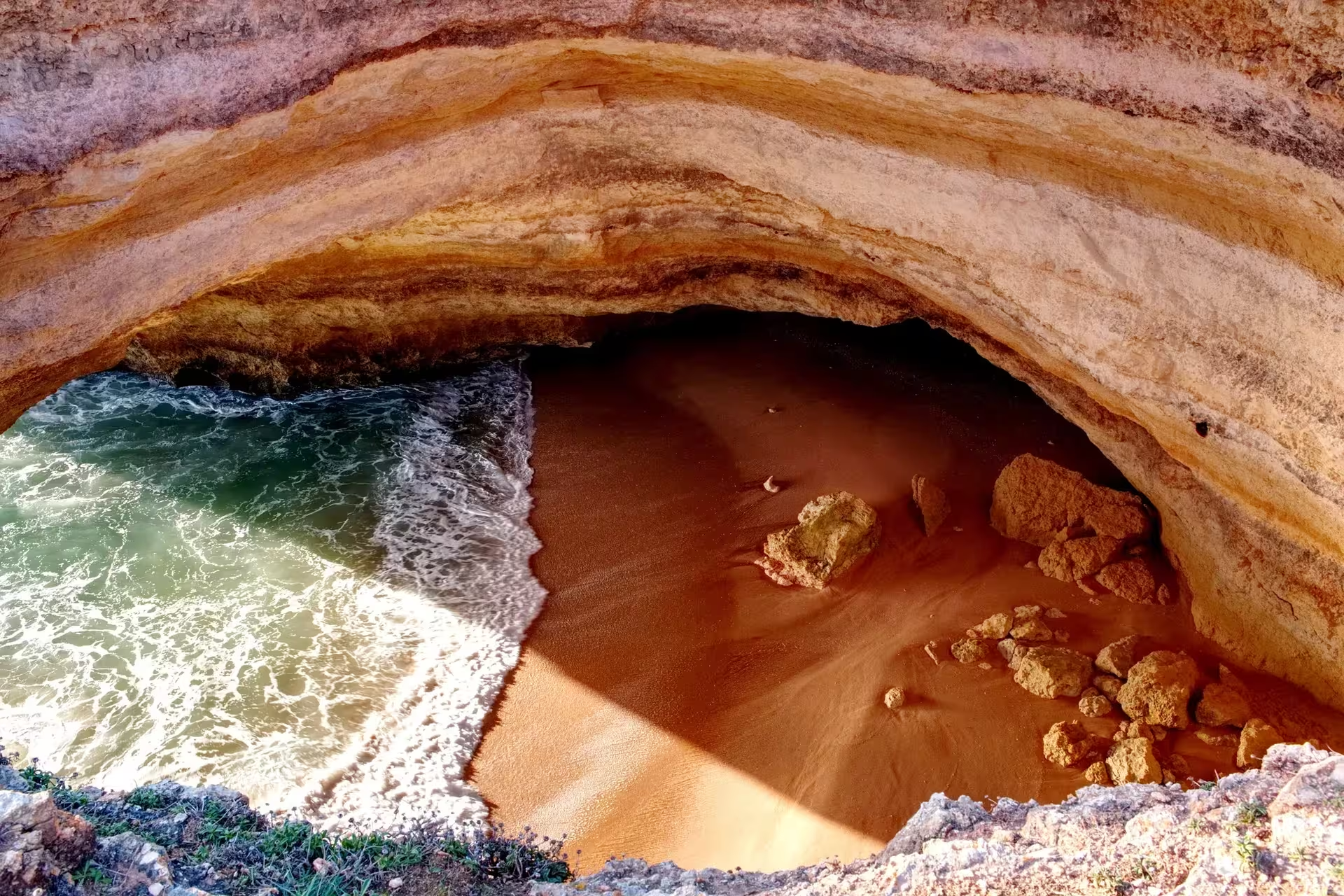
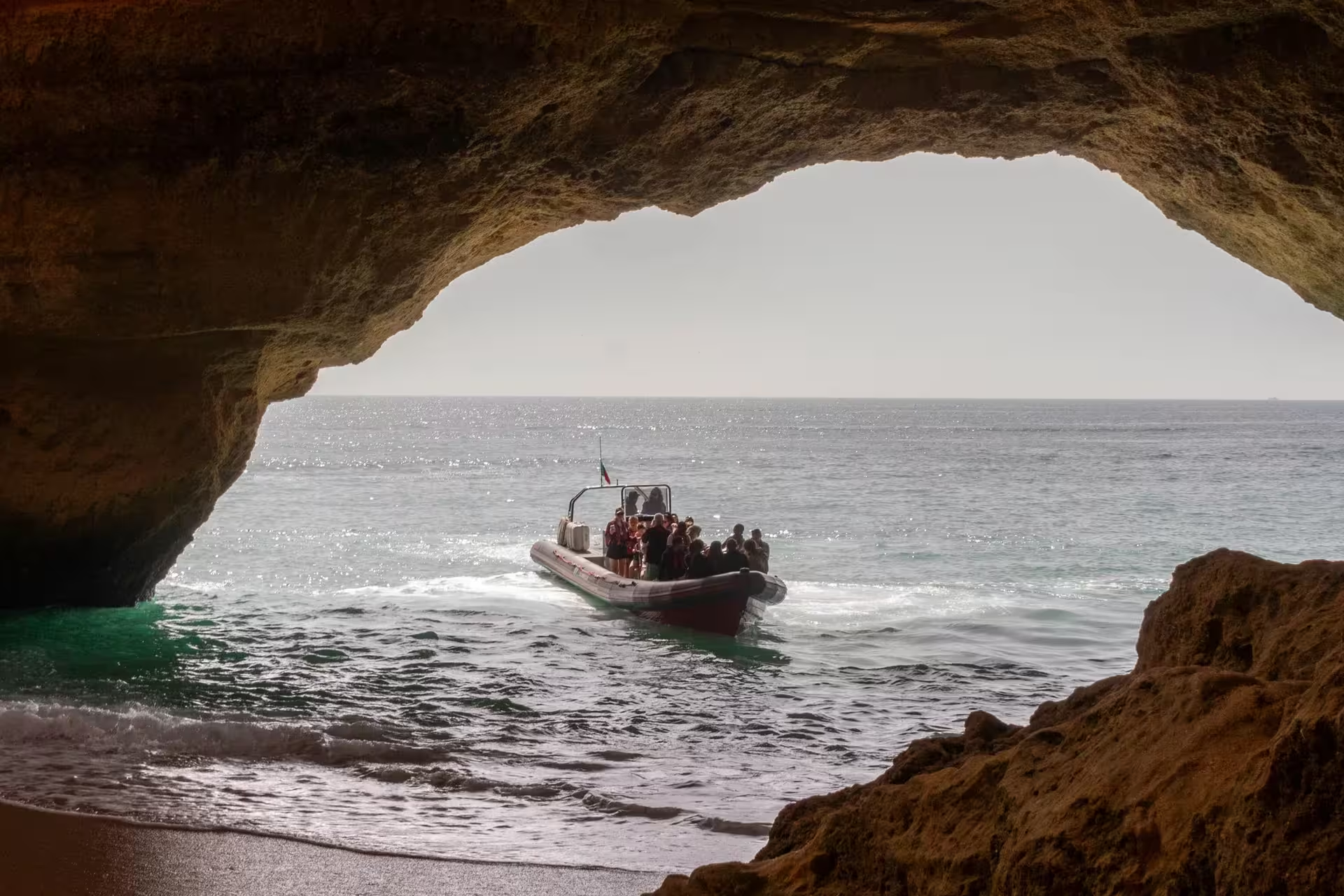
Benagil Cave is a sea cave on the coast of Lagoa, and you see it from the water: by boat, or on a guided kayak or paddleboard trip. The Benagil algar is known as O Templo, The Temple, and daylight pours in through the round gap in its roof.
The tide matters less than most people expect. It rises and falls on a timetable you can look up months ahead, while the things that really cancel a trip are the state of the sea, poor visibility and the clock: nobody enters after dark. For weather, the warm, dry months from June to September are the easiest.
High tides follow each other about every 12 hours 25 minutes on average, the next low tide comes about 6 hours 13 minutes after a high tide, and the tide runs about 50 minutes later each day.
The Moon sets the size of the tide. The big spring tides come at the new and full moon, the small neap tides at the first and last quarter, twice each in a lunar month. Tidal heights and ranges vary by port and date; check the Instituto Hidrográfico tables for the departure you are planning.
Water level changes what you see at the foot of the cliffs: at low water more rock and sand show, at high water the sea reaches further in. That makes a difference to photographs, not to whether you are allowed in. The sand inside is for looking at only, whatever the tide.
What the forecast cannot tell you is the weather's share. The weather also moves the water level: low pressure, often with storms, raises it, high pressure lowers it, and wind blowing from the sea towards the land raises it. Treat the tide table as a guide to the scenery, and the sea forecast as the thing that decides your day.
The Instituto Hidrográfico publishes the official Tabela de Marés every year, with the times and heights of high and low water for the main ports and the phases of the moon. Start at the Instituto Hidrográfico's tide tables page, note the high and low water times for your dates, and compare them with the departure times of the trips you are looking at.
If two departures suit you, pick the one closer to low water for a little more beach in your photos, and keep a spare day in case the sea says no.
The cave has had its own maritime rules since 13 August 2024, set by the Portimão Harbour Master under Edital 019/2024 and updated by Edital 009/2025 of 2 July 2025. Two of them shape the timing of any visit: boats and paddlers may not go in between sunset and sunrise, nor when visibility drops below 1,000 m (3,281 ft).
The open Atlantic adds its own limits. GOV.UK points out that waves here can change without warning, that some beaches pull strongly seawards, and that rip currents can drown swimmers. Operators watch the forecast for the same reasons, so a trip moved for swell is the system working as it should.
However you arrive, your time inside is short and rationed. Boats use only the west entrance of the cave, and at most 5 boats may be inside at the same time. A boat gets 2 minutes inside, a guided paddling group up to 8 minutes. Kayaks and paddleboards go in with a guide or not at all, a rule since July 2025, and life jackets stay on from start to finish. To weigh up the two ways in, read our comparison of kayak and boat tours; for the boats themselves, see our guide to choosing between a RIB and a catamaran.
Most trips to the cave start from the towns along this coast, and many add dolphin watching on the same outing. The Guided Boat Tour: Caves & Dolphin Watching in Algarve sails from the marina in Albufeira and, according to its operator, follows the cliffs west as far as Carvoeiro; if the maritime police keep boats out of the caves because of the sea, the cave is shown from a safe distance instead.
From the western end of the coast, the Private Boat Tour to Benagil Caves from Lagos Algarve leaves from Lagos with a captain and a local guide for your group alone. On the Benagil Cave & Dolphin Watching Boat Tour in Algarve, the operator chooses the boat, a RIB or a catamaran, to suit the sea and the size of the group.
If you would rather paddle, the Benagil Kayak Tour From Benagil Beach starts on Benagil beach itself, and its operator says the extra caves are visited depending on the sea conditions, and that the outing is rescheduled or refunded if the sea is unsafe. That is the kind of call the tide table cannot make for you. For the paddling trip in detail, read our guide to kayaking into Benagil Cave.
The climate averages below are IPMA's normals for 1991 to 2020 at its Faro station, on the same south coast of the Algarve. At Faro the average maximum is 26.8 °C (80 °F) in June, 29.4 °C (85 °F) in July, 29.2 °C (85 °F) in August and 26.4 °C (80 °F) in September. The average maximum is 20.7 °C (69 °F) in April, 23.5 °C (74 °F) in May and 23.3 °C (74 °F) in October, and 16.3 °C (61 °F) in January. July is the driest month of the year at Faro, and December the wettest.
Summer brings the crowds as well as the sun. In 2025 Lagoa council reported repeated problems on the coast between Praia de Albandeira and Praia de Benagil, including traffic, disorderly parking, people on sensitive areas such as the cliffs, minor accidents and overcrowded beaches. If crowds put you off, the warm shoulder months of May and October are worth a look.
Out of season, check the booking calendar before you build a day around the cave: some operators open their dates only a few months ahead.
Benagil beach was once home to fishing families, and today the boats that leave it are mostly busy taking visitors to the caves. Above it, the cliffs wear away through sudden rockfalls, and the Portuguese Environment Agency puts up risk signs on beaches with marked cliff danger strips, Praia de Benagil included.
GOV.UK singles out the Algarve for falling rocks and notes that people who ignore cliff warning signs can be fined. On guarded beaches, a red flag means stay out of the sea and a yellow one means paddling at the edge only. Read GOV.UK safety advice for Portugal before you travel.
Low water shows a little more rock and sand, but the rules for entering say nothing about the tide. Sea state, visibility and daylight decide.
Use the tables of the Instituto Hidrográfico, which publishes Portugal's official tide predictions each year, port by port.
No. Nobody may land there, whether they arrive by boat, kayak or paddleboard.
For warm, dry weather, June to September, going by IPMA's figures for Faro. For a quieter coast with mild days, consider May or October.