Salerno looks out across its gulf towards the Amalfi Coast, and many travellers only pass through it on their way along the shore. This page stops in the city itself: the castle on the hill, a medieval garden of medicinal plants, the Lombard and Norman buildings of the old town, an aqueduct with a legend of its own and the long seafront. At the end you will find the day trips that spend time in Salerno. The towns of the coast, one by one, are on the Amalfi Coast page.
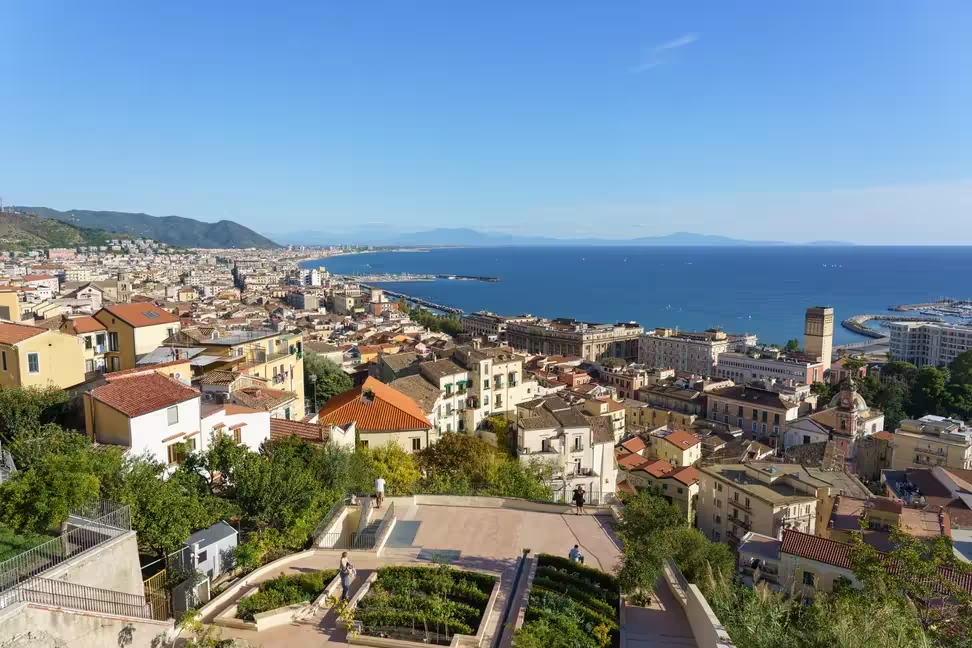
The Castello di Arechi stands high above the city on the Bonadies hill. The Byzantines built it, probably by enlarging an ancient Roman fort, and the Lombard noble Arechi II later drew the mighty city walls out from the castle to hold back the threat of the Franks. The fortress was never taken by force: in 1077 Gisulf II, the last Lombard prince of Salerno, who had taken refuge there, surrendered to the Norman Robert Guiscard, the husband of his sister Sichelgaita.
What you see today dates mainly from the 16th century. Built of blocks of dark local stone, the castle stretches along the crest of the hill, and it lost its role as a fortress in the early 19th century. From its terraces the view takes in the whole gulf, and the old stables now hold a display of ceramics and finds unearthed within the castle walls.
In the upper part of the old town, the Giardino della Minerva is what remains of the medicinal garden of Matteo Silvatico, a master of the Salerno Medical School whose family owned the land from the 12th century. Around 1317 Silvatico wrote a collection on the plants used to make remedies, and here he created the first botanical garden of the Western world. Its layout was later taken up by the botanical gardens of Padua, Pisa, Florence, Pavia and Bologna.
The garden climbs in terraces, and each level has its own pools and fountains fed by an old water system. A 17th-century stairway built on the ancient walls links the terraces and leads up to a pergola viewpoint over the port and the old town.
Prince Arechi II had the Palatine Chapel of San Pietro a Corte built between 758 and 787, over the hall of a Roman bath complex that was in use from the 1st to the 3rd century. In the 13th century the church hosted public ceremonies, among them the conferring of degrees of the Salerno Medical School, and its lower room keeps paintings from the late 12th century with a strong Byzantine influence.
Under the Normans, Salerno became the capital of a domain that stretched across the whole of southern Italy. Robert Guiscard wanted a royal palace to match: Castel Terracena, the seat of Norman rule, went up between 1076 and 1080, close to the cathedral he had also wanted to build. Only a few of its towers remain, decorated with inlays of yellow and grey tuff.
Local tradition calls the medieval aqueduct the Devil's Bridges, and its arches are among the symbols of Salerno. Benedictine monks built it in the 10th century to carry water from the hills north of the city to the Monastery of San Benedetto. Legend tells a darker story: the Salerno magician Berliario is said to have raised it in a single stormy night, helped by evil forces.
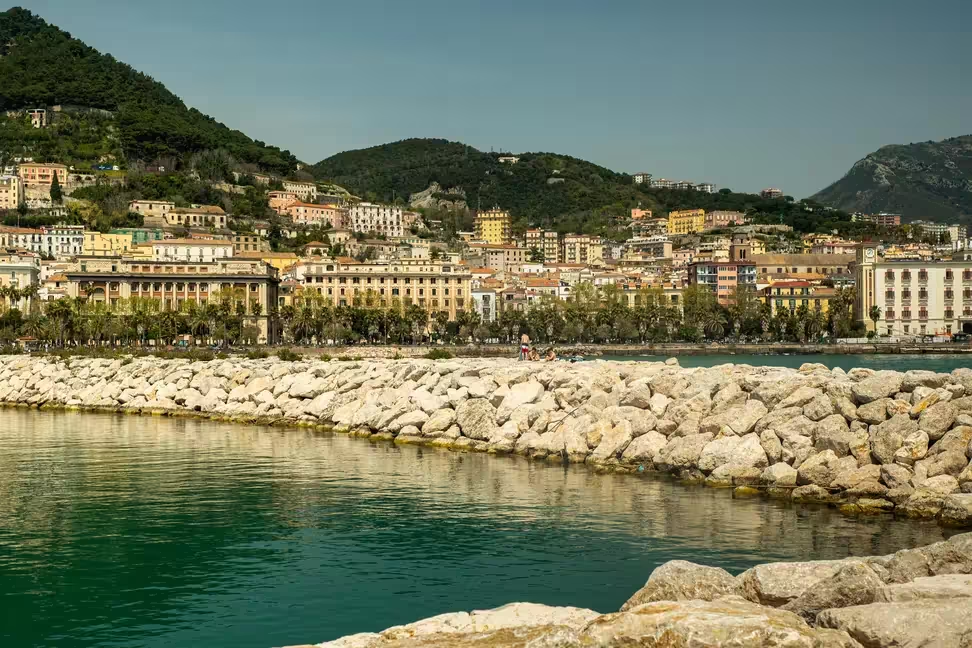
The seafront is a walk among gardens and palm trees a few metres from the city centre, with a wide view of the Amalfi Coast. Work on the promenade and on the buildings that face it began in 1920, after the beach was reshaped to protect the city from the erosion of the waves. It runs on for kilometres, mostly on foot, past bathing establishments and free beaches, and it is also where you can begin a fuller visit to the historic and commercial centre.
The tours that stop in Salerno leave from Naples or the coast and combine the city with other places nearby. To pair Salerno with the fishing village of Cetara, there is a private day trip from Naples to Salerno and Cetara, a private full day in Salerno and Cetara and a guided day on the Amalfi Coast with Salerno and Cetara. The tour of Ravello, Salerno and Cetara adds the gardens of Ravello.
If you also want to see Pompeii, choose the day trip from Naples to Pompeii, Cetara and Salerno or the private tour of Pompeii, Sorrento, Amalfi and Salerno. The day trip from Naples to Sorrento, Positano, Amalfi and Salerno takes in the best known towns of the coast, and the private day trip to Vietri sul Mare and Salerno pairs the city with its neighbour Vietri sul Mare.
Every trip that starts or stops here is also listed on the destination page.
The Byzantines, who probably reused a Roman stronghold; later the Lombard Arechi II extended the town walls from there.
Matteo Silvatico grew his healing plants there, and it is counted as the earliest botanical garden in the West.
Prince Arechi II's palace chapel, raised from 758 to 787 on top of Roman baths.
Because of a legend: Berliario, a local magician, supposedly put it up overnight during a storm, aided by dark powers.
In 1920, when the shore was remodelled as a defence against erosion by the sea.
Sources: Comune di Salerno (CC BY 4.0): castello-di-arechi, giardino-della-minerva, lungomare-trieste, complesso-di-san-pietro-corte, acquedotto-medievale, castel-terracena.