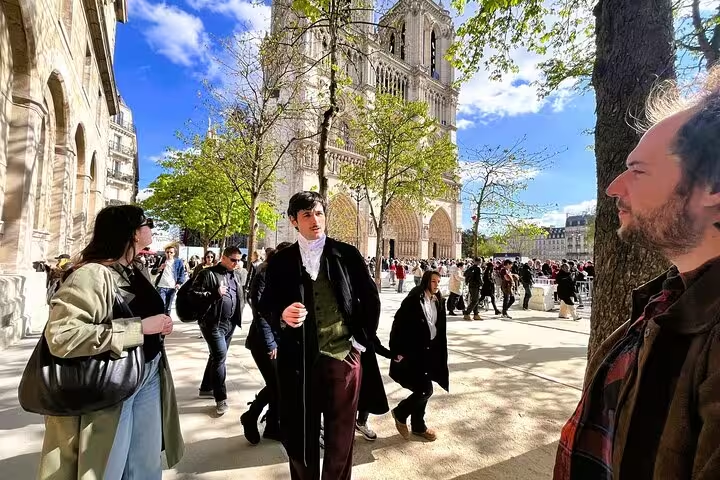
Notre-Dame de Paris stands on the Île de la Cité, the island where Paris began in ancient times, on a spot where other buildings had already risen from the 4th century onwards. Maurice de Sully, Bishop of Paris, laid its first stone in 1163, with Pope Alexander III present. This page follows the cathedral from the Middle Ages to Viollet-le-Duc, through the fire of 2019 and the restoration that let it welcome worshippers and visitors again in December 2024, and points out what is worth looking at inside.
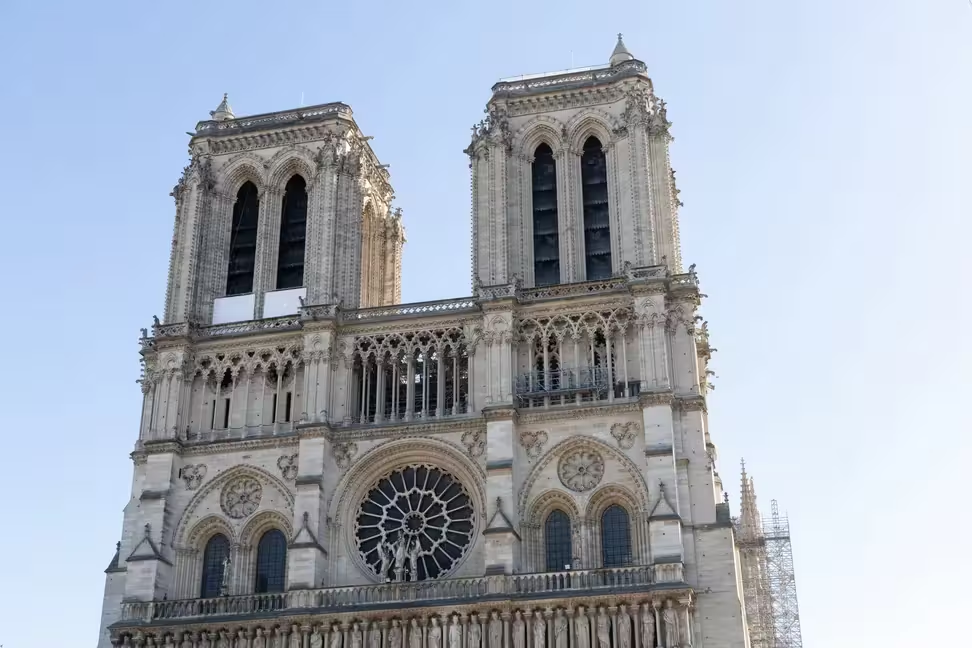
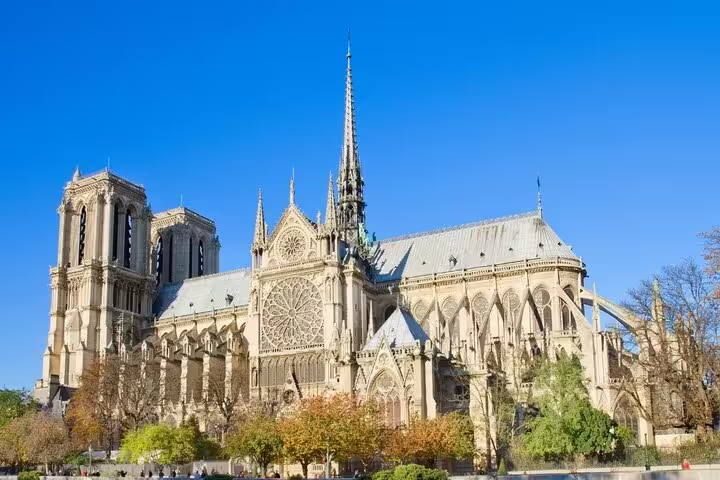
The building went up in campaigns. The choir with its ambulatory, the nave and the aisles came first, between 1163 and 1225; the upper galleries, the spire and the two towers followed between 1225 and 1250.
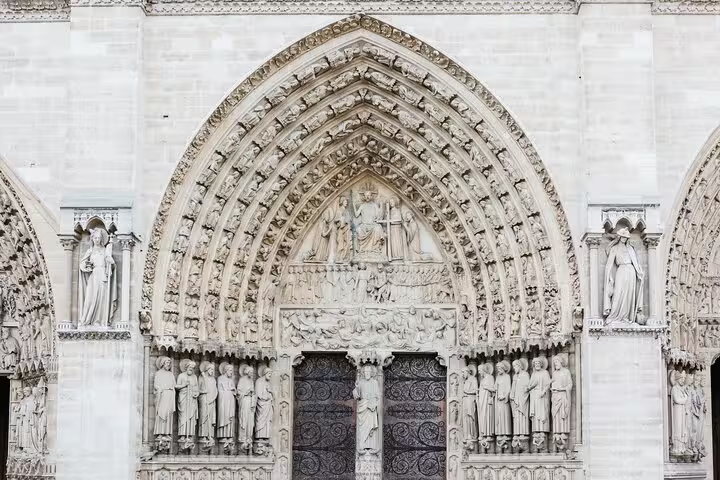
The Revolution was hard on the cathedral, which became State property. Part of its treasury was melted down, the spire was pulled down and the statues of the gallery of the kings of Israel were taken off the façade. In 1793 the church was turned into a Temple of Reason, later into a warehouse, and it was left badly neglected.
Catholic worship returned in 1802 after the Concordat, and the cathedral regained an official role when Napoleon chose it for his coronation as emperor on 2 December 1804. Victor Hugo's novel Notre-Dame de Paris then made the public and the authorities notice how poor its condition had become.
In 1844 a general restoration was decided and handed to two architects, Eugène Viollet-le-Duc and Jean-Baptiste Lassus. Viollet-le-Duc put back the spire that had been pulled down in 1792 and dreamed up the chimeras of the gallery between the towers. The works officially ended on 3 January 1865, and unlike many French cathedrals, Notre-Dame came through both World Wars unharmed.
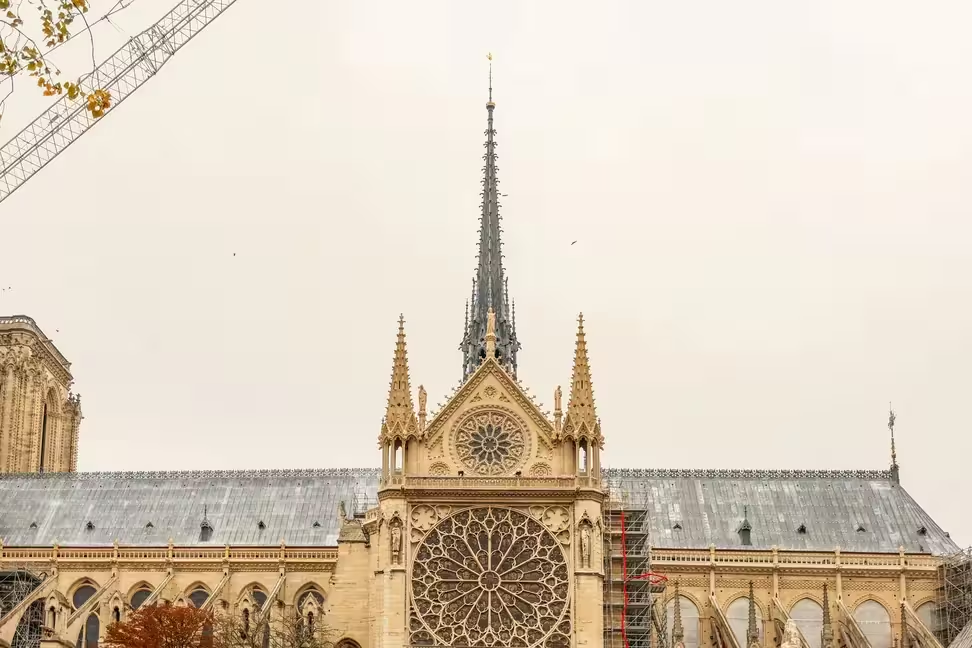
On 15 April 2019 a fire broke out in the cathedral. It destroyed the timber roof frame, known as the forest, and brought down Viollet-le-Duc's spire, but the Paris firefighters kept the flames off the two towers and so saved the structure and the outline of the building. Some 340,000 donors, in France and in more than 150 countries, gave to the national subscription that followed.
Viollet-le-Duc had designed his spire in 1857, and it was built between 1858 and 1861. Architects and craftsmen of the 21st century rebuilt it identically, with 1,000 oaks for the spire and the transept, given by their owners from public and private forests all over mainland France. The tip of its needle rises to 96 m (315 ft), and the cross and the rooster were set on top on 16 December 2023. Philippe Villeneuve, chief architect of historic monuments, updated the rooster, whose wings recall that the cathedral can rise from its ashes like the phoenix.
Light comes in through more than 120 stained-glass windows made between the 13th and the 20th century; during the fire the vault acted as a shield and protected more than 3,000 m² of glass. The great organ's 8,000 pipes, covered in lead dust, were taken down at the end of 2020, cleaned by organ builders and put back in 2024.
Look out too for the Mays, paintings by artists such as Charles Le Brun and Laurent de La Hyre that the Paris goldsmiths' guild offered to the cathedral each May between 1630 and 1707; 13 of them were still in Notre-Dame in 2019. The Crown of Thorns is kept in the axial chapel, in a reliquary designed by Sylvain Dubuisson, and is not on show all the time. The new furniture is the work of Guillaume Bardet, and the seating was designed by Ionna Vautrin. Excavations at the transept crossing also brought to light more than 1,000 sculpted fragments of the 13th-century rood screen, destroyed in the 18th century, and 650 of them still have their original colours.
To see the cathedral with a guide, there is an in-depth private guided tour of Notre-Dame, a guided visit to the cathedral and the Île de la Cité and a guided tour of Notre-Dame with a cruise on the Seine, also offered in Spanish. On foot, you can pair the cathedral with the Latin Quarter, follow the dark legends of medieval Paris, take a medieval walk around the Île de la Cité or taste French food on a walk across the Île Saint-Louis. For a wider look at the city, there is a tour with a boat cruise, the Louvre and Notre-Dame and a private tour of the Louvre, Notre-Dame and the Eiffel Tower.
Every trip that starts or stops here is also listed on the destination page.
Work began in 1163, and the two towers belong to the campaign that ran from 1225 to 1250.
Viollet-le-Duc and Lassus, the two architects chosen in 1844; the work officially ended in 1865.
The roof frame and the spire, while the firefighters saved the two towers.
Yes: it was rebuilt identically, and its needle reaches 96 m (315 ft).
In Sylvain Dubuisson's reliquary in the axial chapel, though it is not always on display.
On 8 December 2024, to worshippers and the public alike.
Sources: Ministère de la Culture, Plateforme ouverte du patrimoine (POP) (Licence Ouverte Etalab 2.0); Ministère de la Culture (culture.gouv.fr) (CC BY-SA 3.0 FR).