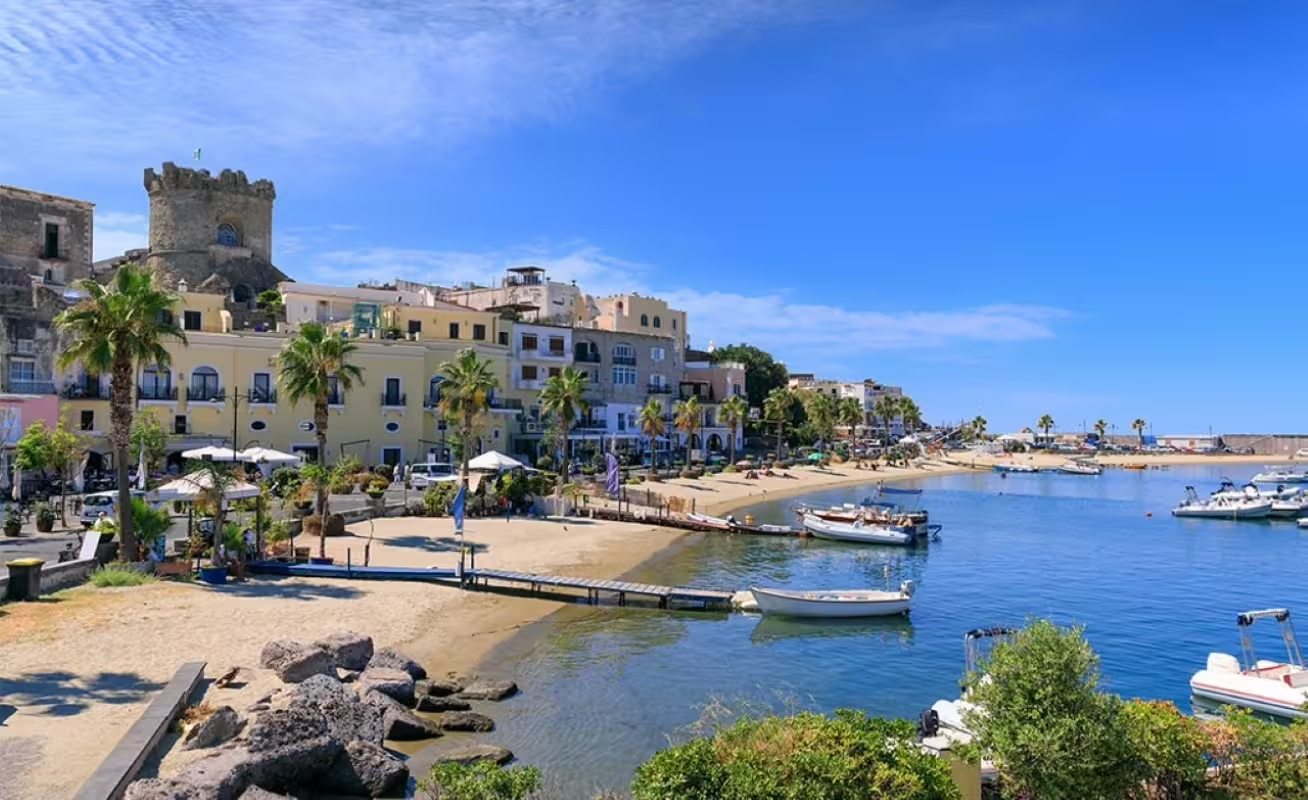
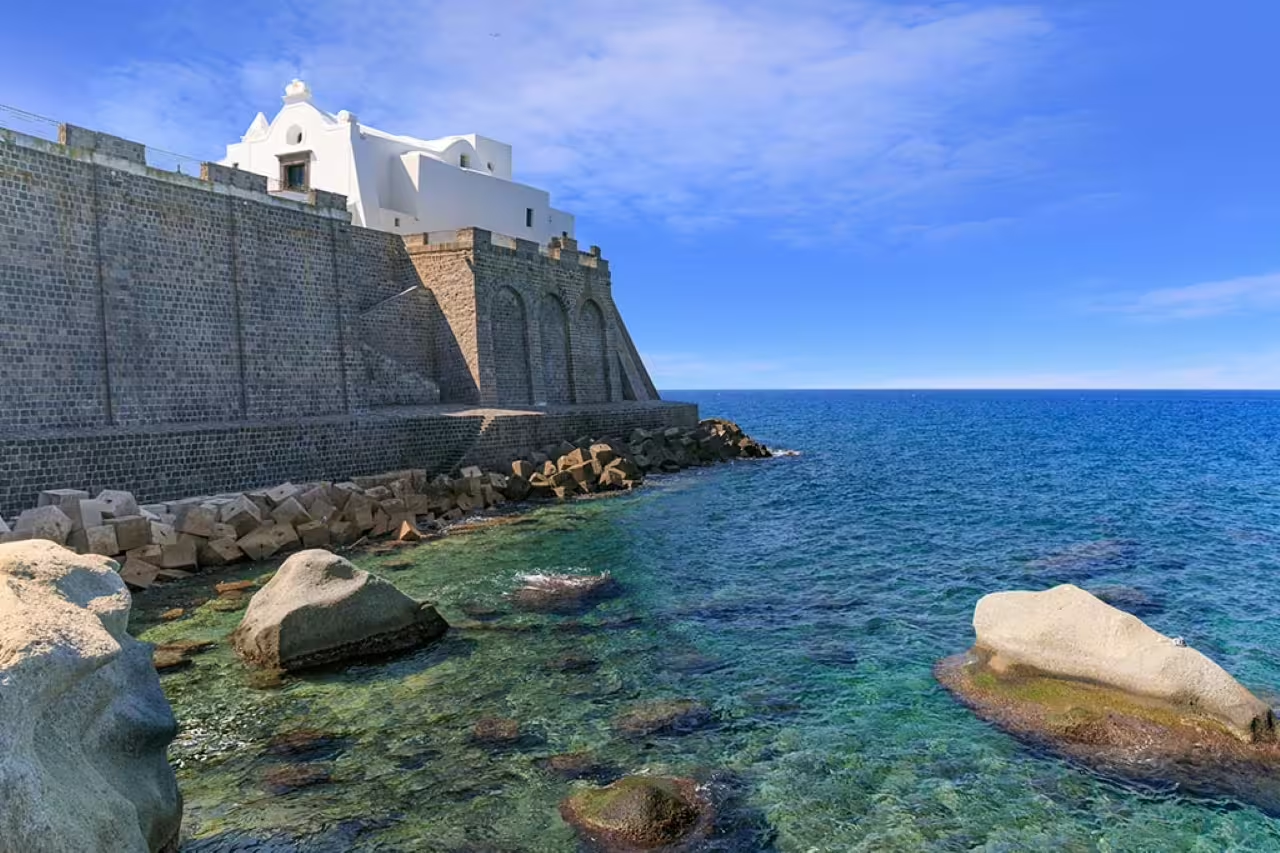
Ischia is famous for its warm springs and green slopes, yet the sight that greets many visitors first is the Aragonese Castle, a fortress that fills a small island of its own just off the old village of Ischia Ponte. This page covers the castle and the climb through the rock; the lanes of Ischia Ponte; the bay of Cartaromana, with its tower and sunken Roman town; the port and pine woods of Ischia Porto; and the trips that take you round the island by boat, by bus or on a day out from Naples.
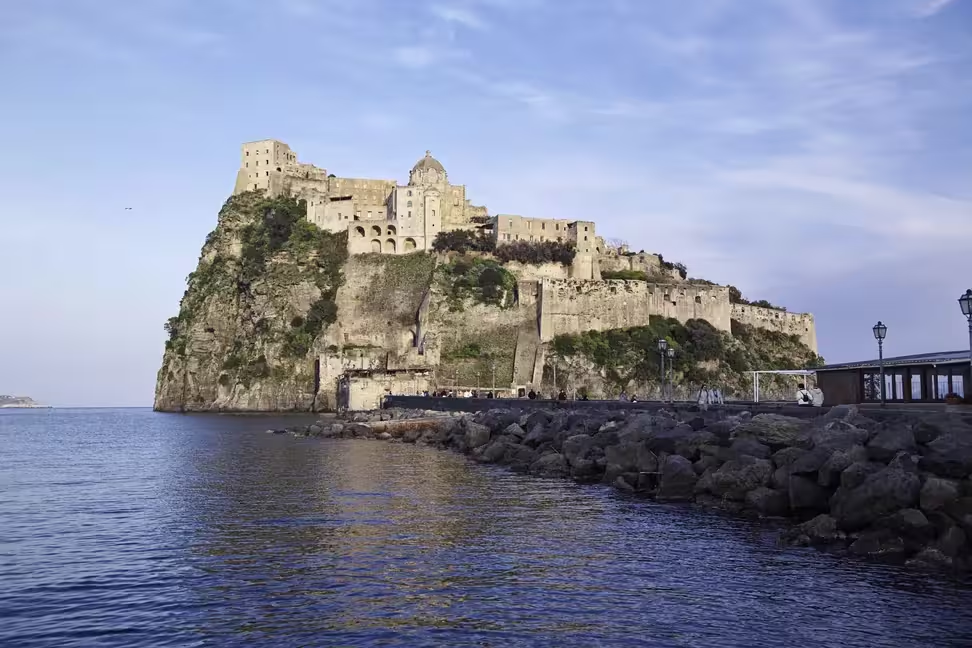
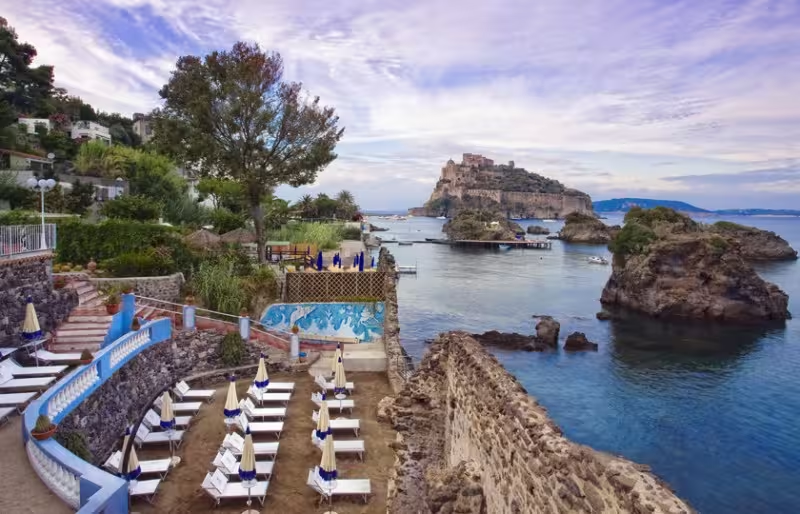
The castle rises from a tidal islet of trachyte on the eastern shore of Ischia, and a masonry bridge 220 m (722 ft) long ties it to the old Borgo di Celsa, better known today as Ischia Ponte. The rock was born in an eruption over 300,000 years ago. It climbs to 113 m (371 ft) above the sea and spreads across roughly 56,000 square metres.
Until the middle of the 15th century, the only way in was by sea, up a stairway on the north side of the islet. Alfonso V of Aragon then had a passage dug through the rock. The tunnel runs for 400 m (1,312 ft), lit by tall shafts in the roof that once doubled as murder holes, through which defenders poured boiling oil and dropped stones on attackers. Beyond it, a mule track winds up in the open air to the summit, and side paths lead off to the buildings and gardens. Since the 1970s, a lift carved inside the rock has made the climb easier, rising to 60 m (197 ft) above sea level.
Who built the first fortress is still debated. A few writers attribute it to Hiero, tyrant of Syracuse, in 474 BC, but the most credited theory holds that it started out around the 5th century as a Byzantine military post, the castrum Gironis. The great change came from 1433, when Alfonso of Aragon, known as the Magnanimous, had the outer walls and the inner buildings restored and swapped the wooden bridge for the masonry one that still joins the islet to Ischia Ponte.
The castle then became a centre of court life, a refuge for the nobility in wartime and a shelter able to hold thousands of people. In 1509 it hosted the wedding of Ferrante d'Avalos and Vittoria Colonna, who after her husband's death composed on the island the love sonnets for which she is remembered. Decline set in during the 18th century, as the noble families moved away. A bombardment destroyed the castle in 1809, and it later passed into private hands.
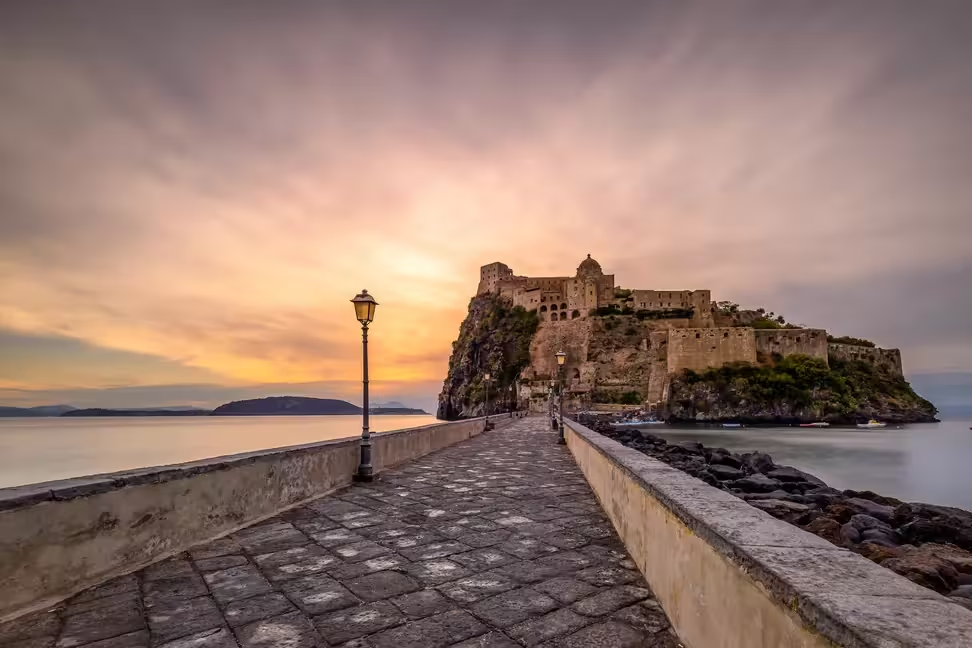
On the shore side of the bridge, Ischia Ponte also goes by the name Borgo di Celsa, after its mulberry trees. Records of this village of sailors and fishermen reach back to the 13th century, and its plan has hardly changed: narrow lanes where grand palazzi stand between small, low houses. The Cathedral of the Assunta went up in 1301 and was shelled by the English in 1809; its crypt, painted with frescoes from the school of Giotto, keeps the remains of the old noble families of Ischia.
Between the port and Ischia Ponte runs the Spiaggia dei Pescatori, a long beach of fine sand that once belonged to the fishermen's quarter of the old village.
South of the castle, the bay of Cartaromana has a beach framed by black volcanic rocks shaped by the sea. It is one of the few places where hot springs rise straight into the sea, so you can bathe in warm water even in the middle of winter. Beneath the bay lie the remains of Aenaria, a prosperous Roman town from the 1st century BC to the 4th century AD.
On the same stretch of coast stands the Torre del Guevara, which many also call the Torre di Michelangelo: tradition says that the artist lived there for years to be close to Vittoria Colonna, then a resident of the castle.
Ischia Porto is younger than it looks. In 1853 Ferdinand II of Bourbon had an old volcanic lake turned into a harbour; the royal steamship Delfino sailed into it in July 1854, and the official opening followed that September. In the centre of Ischia, three small pine woods now shade the bare ground left by the Arso eruption of 1302. The court botanist Giovanni Gussone brought green back to the lava in 1850, choosing above all stone pines for their umbrella-shaped crowns.
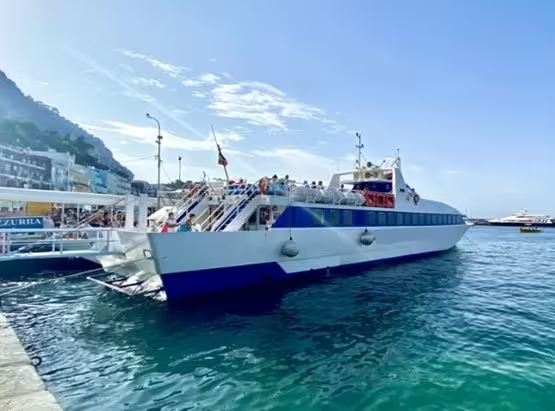
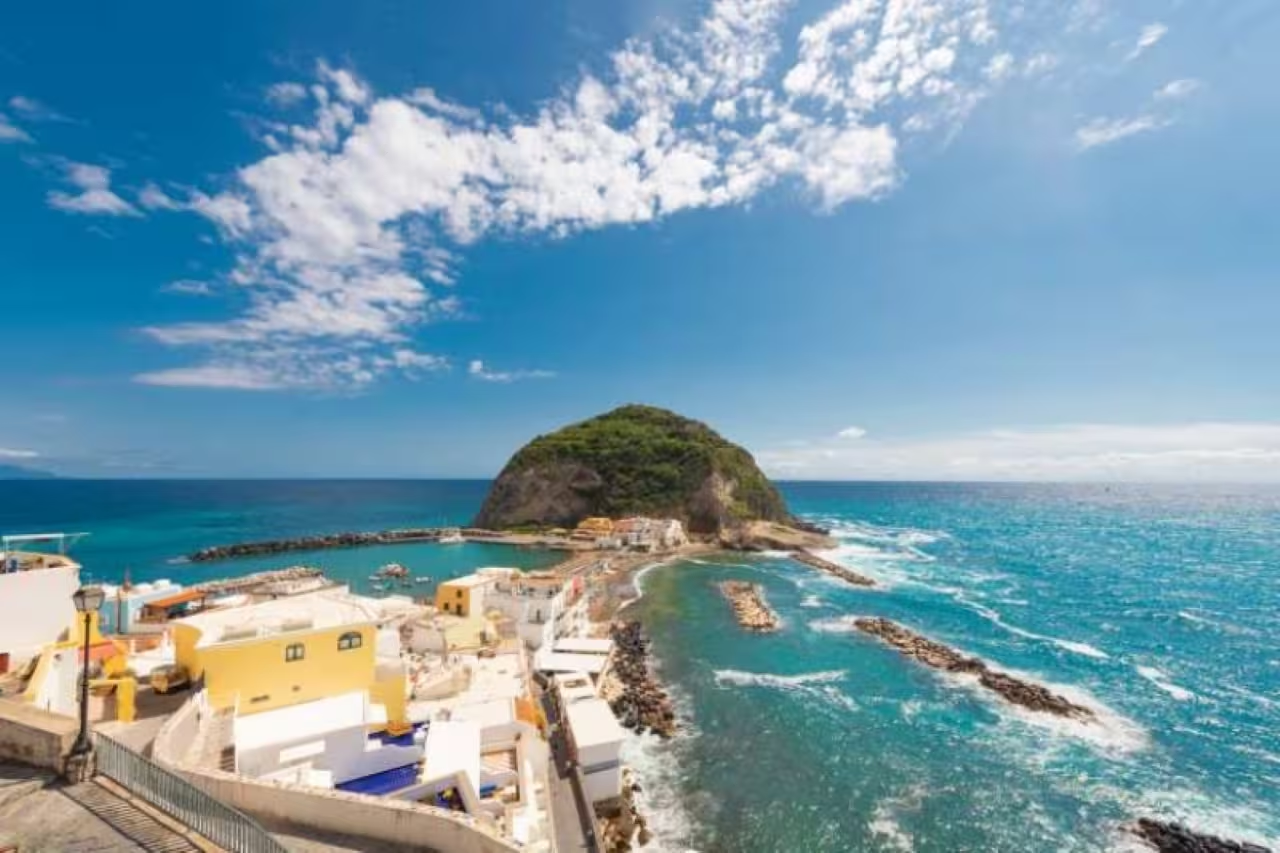
Above the whole island rises Monte Epomeo, 787 m (2,582 ft) high, whose summit offers a 360-degree view of Ischia. To see the coast and the villages beyond the town, an organised trip is the easiest option. From the water, you can join a boat tour along the coastline with a stop in the village of Sant'Angelo or a boat trip round the wild coast with swimming stops in quiet bays. On land, a guided bus tour that circles the island and stops in Sant'Angelo passes through every municipality of Ischia.
Coming from Naples, there is a round-trip hydrofoil day trip with free time on the island, a day in Forio with the hydrofoil crossing and lunch included or a Forio day trip by hydrofoil with a taxi transfer. If you would rather spend the day in warm water, choose a day at one of the island's thermal pool complexes with transfers from Naples or a full-day trip from Naples to a garden of thermal pools by the sea.
Every trip that starts or stops here is also listed on the destination page.
Walk across the bridge from Ischia Ponte, then through the tunnel cut in the rock and up the mule track; a lift inside the rock also covers part of the climb.
Its islet reaches 113 m (371 ft) above sea level.
According to local tradition, Michelangelo stayed in the tower for a long time so that he could be near Vittoria Colonna, who lived in the castle.
Yes. At Cartaromana, near Ischia Ponte, hot springs flow into the sea, and the water stays warm even in winter.
It is first recorded in 813, in a letter that Pope Leo III sent to Charlemagne. Before that, the island was called Pithecusa and, under the Romans, Aenaria.
Sources: Comune di Ischia (CC BY 4.0): castello-aragonese, etimologia-del-nome, il-mare-647a96aa-81c7-48da-b007-278b643f29c4, la-natura.