



Last updated:


A Paphos trip can balance mosaics and harbour history with a separate outing to the sanctuary of Aphrodite at Kouklia. Keeping those visits separate makes sense: Palaipafos, where the sanctuary stood, lies about 16 km east of present-day Pafos.
Three days would give this history-focused itinerary room: a day for Kato Pafos, another for the harbour castle and Tombs of the Kings, and a day for Kouklia. This is a suggested split, with the outlying visits kept apart from the Kato Pafos sights.
For a heritage option, the private half-day Paphos heritage and mythology tour lasts 6 hours and includes a private English-speaking driver throughout, a fully customisable itinerary and transport between sites.
Kato Pafos suits a day centred on mosaics and religious buildings. At the House of Dionysos, mosaics fill 556 square metres of a building covering 2,000 square metres. Look for the sea monster Scylla, depicted in white, black and brown pebbles in a mosaic dating from the late 4th or early 3rd century BC.
For a change from mosaic floors, the Agia Solomoni Christian Catacomb has five chambers cut into rock around an open court. Agia Kyriaki Chrysopolitissa adds another layer of history: the 13th-century church was built over the remains of an Early Byzantine basilica.
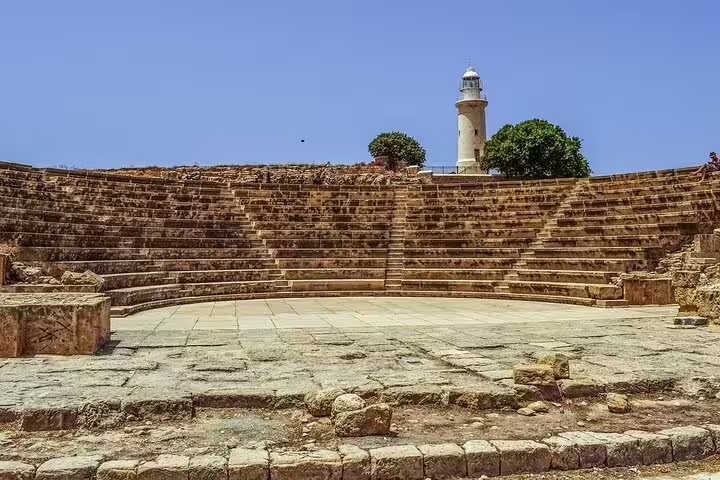
Treat the harbour castle and Tombs of the Kings as separate stops rather than one site. The tombs occupy a 4th-century BC necropolis about 2 km north of Paphos harbour. On the harbour's western side, the Lusignans built the medieval castle in the mid-13th century to replace Saranta Kolones, about 600 metres to the northeast.
Kouklia fits the history theme; the Akamas Peninsula offers a nature-focused alternative. At Kouklia, the Sanctuary of Aphrodite at Palaipafos dates to the 12th century BC and drew pilgrims in the ancient Greek world. The archaeological museum there occupies a Lusignan manor.
For a wider coastal outing, the private southern coast of Cyprus tour from Paphos lasts 8 hours and includes private transport for the full day, an English-speaking driver, a flexible itinerary and 8 hours of guided road touring.
For the nature alternative, the Baths of Aphrodite lie on the Akamas Peninsula near Polis, 48 km north of Pafos. Around 530 plant species have been recorded on the peninsula, including more than 30 that grow only in Cyprus. That gives a visit here a different focus from the mosaics and churches.
April and the first half of May are sensible months to favour for a walking-focused trip: they come before Cyprus's long, dry summer, which runs from mid-May to mid-October, and after the wetter winter months. Over the six summer months the island averages about 11.5 hours of sunshine a day. Mid-May to mid-October suits travellers prepared for summer heat; December to February calls for plans that allow for rain.
An airport bus or shuttle is an option for reaching city centres. These services connect Pafos and Larnaka International Airports with the island's city centres.
Kato Pafos is worth considering as a base if mosaics and religious sites lead your plans. The House of Dionysos, Agia Solomoni Christian Catacomb and Agia Kyriaki Chrysopolitissa are all in Kato Pafos.
How many days do you need in Paphos?
Three days is the suggested split: Kato Pafos, the harbour castle and tombs, then Kouklia.
When should you visit Paphos for walking?
April and early May are sensible choices, before the hot summer and after the wetter winter months.
How can you reach the city from the airport?
By bus or shuttle: services connect Pafos and Larnaka International Airports with city centres.
Which day trips can you take from Paphos?
Kouklia suits a history outing; the Akamas Peninsula offers a nature-focused alternative.
Where should you stay for a sightseeing trip?
Kato Pafos is worth considering for the House of Dionysos, Agia Solomoni Christian Catacomb and Agia Kyriaki Chrysopolitissa.