




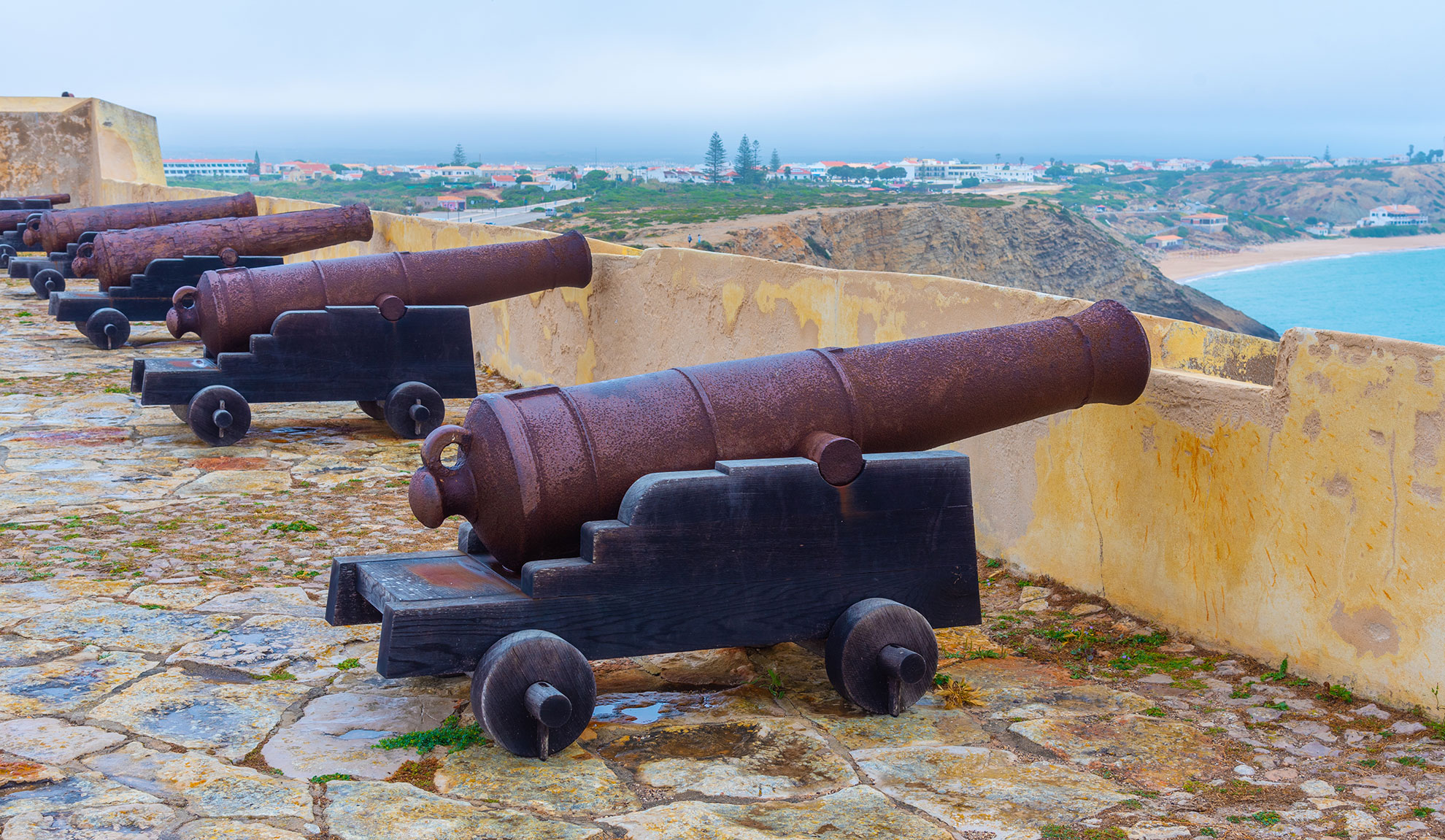
The fortified promontory of Sagres, where the Algarve meets the open Atlantic — and Europe gives way to ocean.
The Edge of Europe
Beyond the Horizon: Why Sagres Remains Portugal's Ultimate Wild Frontier
Where the windswept cliffs of the Vicentine Coast drop into the Atlantic, and the weight of maritime history settles over every lighthouse beam at dusk.
There is a particular quality to the light at Sagres. It arrives sideways, filtered through salt and wind, and it illuminates the limestone clifftops with a clarity that makes the world feel simultaneously ancient and immediate. This is the southwestern tip of continental Europe — a place that cartographers once marked with the phrase nec plus ultra, meaning there is nothing beyond. Standing at Cape St. Vincent on a November afternoon, with the swells rolling in from the open Atlantic and the last migrating raptors drifting south overhead, you understand precisely what they meant.
Sagres is not a resort town. It has a single main street, a handful of surf schools, and a fishing harbour where the working boats still outnumber the leisure craft. What it offers instead is something rarer in the modern Algarve: genuine wildness. The Natural Park of the Southwest Alentejo and Vicentine Coast protects the coastline from large-scale development, preserving an ecosystem of sea lavender, rock samphire, and endemic cistus species that crowds the clifftop paths between October and May. The beaches here — Praia do Beliche, Praia do Tonel, Praia da Mareta — face the Atlantic directly, and the swell they receive reflects that exposure. On the right day, they are some of the most consistent surf breaks in Europe.
"Cape St. Vincent is the place where the sea has always been the sea — not a backdrop for leisure, but a force that shaped the course of empires and the limits of the known world."
The Fortress and the Cape: A History Written in Stone
The Sagres Fortress occupies a flat-topped promontory above the sea, its sixteenth-century walls enclosing a space so exposed to the prevailing Atlantic wind that the few trees planted within them grow horizontally. Inside stands a large wind compass — the Rosa dos Ventos — a circular stone mosaic of uncertain age that scholars have debated for decades. Whether it dates to the era of Prince Henry the Navigator or was laid in a later period of romantic reconstruction is still contested, but the questions it raises are part of its character. The fortress was a working military and navigational outpost, not a monument, and it reads that way: spare, functional, oriented entirely toward the sea.
Three kilometres north along the coast, Cape St. Vincent (Cabo de São Vicente) is marked by a nineteenth-century lighthouse that still operates. The cliffs below it descend 75 metres to the water, and at their base the Atlantic churns against fractured limestone in a continuous low percussion. The evening ritual here is well-established: travellers gather on the clifftop roughly an hour before sunset, facing west, and watch the sun descend into open ocean. On clear days in winter, the quality of the light is such that the shadow of the cape itself appears on the water, stretching eastward like a long dark finger.
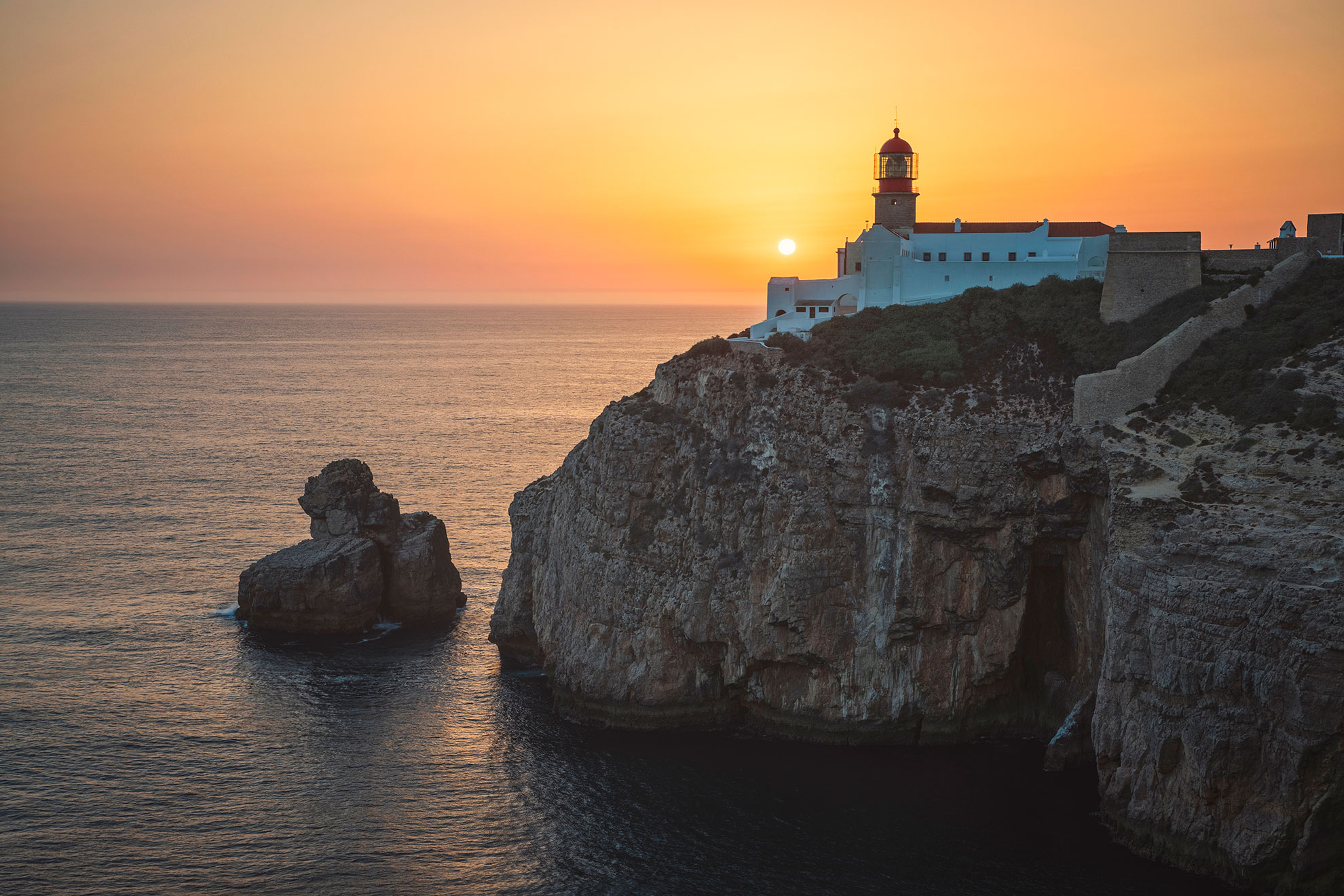
The lighthouse at Cape St. Vincent — still operational, still marking the southwestern limit of the European landmass.
Sunset & Coastal Road Tours
Private Full-Day Tours from Lagos & Lisbon
Sagres rewards slow travel. Whether you're arriving from Lagos for a day or spending a week based in the village itself, the range of guided experiences — from boat trips to off-road coastal routes — gives you meaningful access to a landscape that resists casual inspection.
Browse all Sagres tours →On the Water: Dolphins, Sea Caves, and the Open Atlantic
The waters off the Sagres promontory are among the most biologically productive in the eastern Atlantic, sitting at the convergence of two distinct oceanic systems. Common dolphins (Delphinus delphis) are resident year-round and are frequently encountered on morning departures, often in groups of thirty or more animals. Bottlenose dolphins are less predictable but appear regularly close to the cliffs. The same coastline features an extensive network of sea caves and grottos carved into the limestone base of the cliffs — accessible only by small boat or kayak, and best navigated with someone who knows the tidal rhythms and which passages open at what water levels.
"The dolphins appear without announcement — a ripple ahead of the bow, then a dozen fins, then the sound of exhalations in the early morning quiet before anyone has spoken a word."
Marine Wildlife & Boat Experiences
The Migration Corridor: Birdwatching at the Cape
Cape St. Vincent occupies a position of singular importance in European bird migration. Each autumn, as temperatures drop across the continent, hundreds of thousands of birds — raptors, storks, swallows, warblers, and a long list of seabirds — funnel south toward Africa, and many of them pass directly over or around the cape. The concentration of raptors in October can be exceptional: honey buzzards, Montagu's harriers, black kites, ospreys, and — in smaller numbers — Eleonora's falcons are all recorded regularly. Experienced birders arrive from across northern Europe specifically for the October window, setting up telescopes on the clifftop before dawn and logging species through the morning light.
The Vicentine Coast also supports resident populations of blue rock thrushes, black redstarts, and peregrine falcons that nest in the cliff faces year-round. The coastal scrubland behind the cliffs hosts Dartford warblers and Iberian grey shrikes, while the sea itself produces regular sightings of Cory's shearwaters, northern gannets, and — in deeper waters to the south — occasional great skuas. For a traveller unfamiliar with European birding, the sheer visibility of the migration at the cape in October — raptors drifting past eye level, visible against the ocean — is a genuine introduction to the spectacle of long-distance migration.
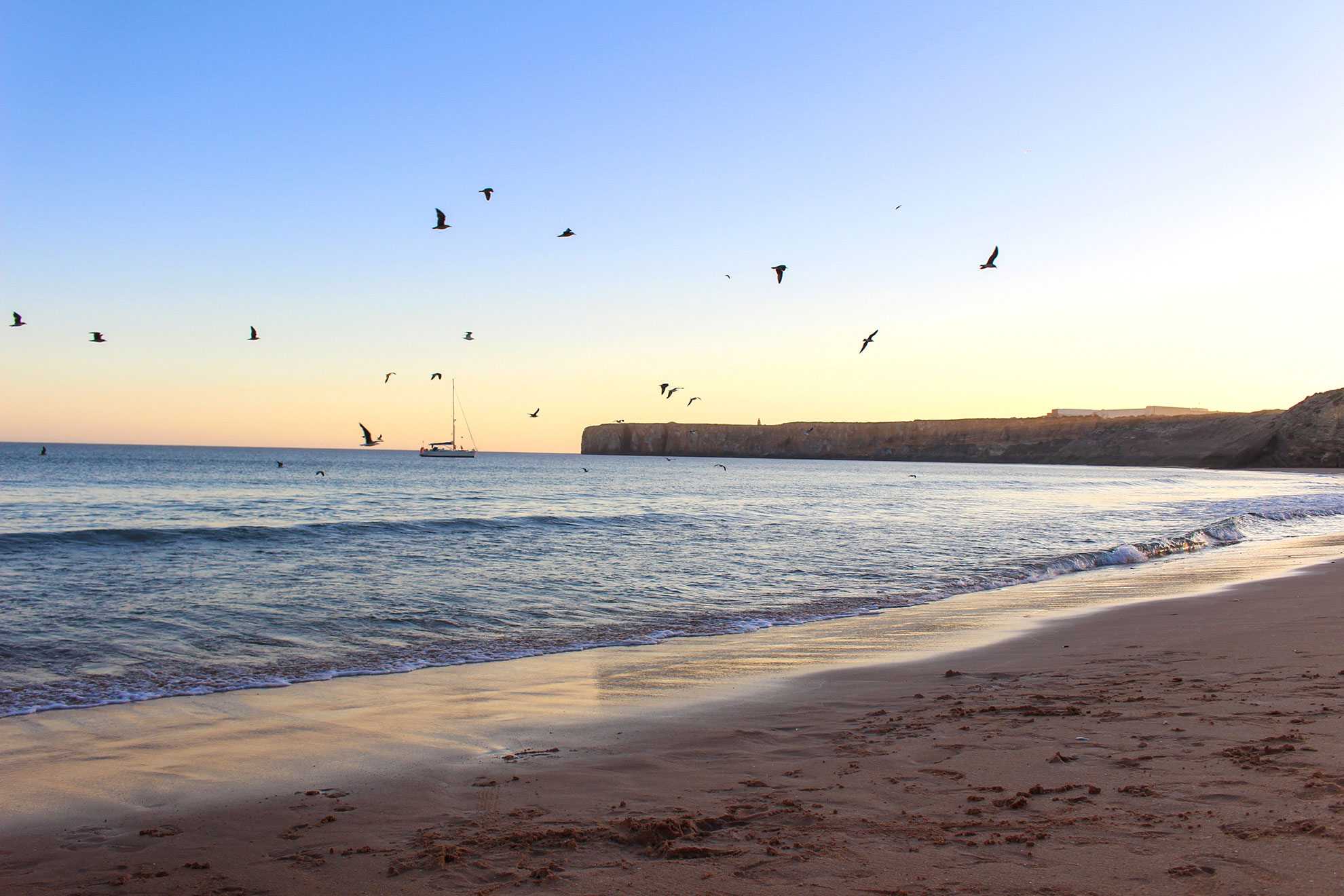
The Sagres coastline during the autumn migration window, when raptors and seabirds funnel south toward the African continent.
Nature & Birdwatching Tours
Whether you're drawn by the landscape's historical resonance, the marine life in the waters below the cliffs, or the autumn spectacle of migration over the cape, Sagres has more structured guided options than its quiet exterior suggests. All tours listed here are bookable directly, with confirmed availability shown in real time.
See all available dates →Frequently Asked Questions
When is the best time of year to visit Sagres?
The shoulder seasons — March to May and September to November — offer the best balance of mild weather, manageable visitor numbers, and wildlife activity. Autumn is particularly significant for birdwatching, when the migration is at its peak. Summer is warm and dry but brings more crowds to the beaches; winter is quiet and often clear, with dramatic swells along the coast.
How do I get to Sagres from Lisbon or Faro?
Sagres is approximately three hours by car from Lisbon (via the A2 motorway and EN125) and around one hour from Faro. There is no direct train service; the nearest train station is Lagos, from which a regional bus runs to Sagres several times daily. Several tour operators offer private transfers from Lisbon or Faro as part of full-day itineraries.
Are dolphin watching tours reliable — will I actually see dolphins?
Common dolphins are resident in these waters year-round and are encountered on the majority of departures. Operators typically report sighting success rates above 90% in summer and autumn. No encounter can be guaranteed in wild conditions, but the Sagres area is among the more reliable dolphin watching locations in southern Portugal, owing to the productivity of the surrounding waters.
Is Sagres suitable for travellers who don't surf?
Entirely. While Sagres has a well-established surf culture, the town and its surrounding landscape offer plenty for non-surfers: the fortress, the cape, cliff walks, birdwatching, boat trips, and the fishing harbour all reward unhurried exploration. The pace of the village is quiet and the infrastructure caters to independent travellers of all kinds.
What should I wear and bring for boat tours in Sagres?
Layering is advised even in summer, as the wind off the cape can be considerably colder on the water than on shore. Bring a waterproof jacket, sunscreen, and sunglasses. Motion-sensitive travellers should take precautions before departure — the waters off the cape can carry a residual swell even on calm days. Operators usually provide life jackets and basic safety equipment.
Can I combine a visit to Lagos with Sagres in a single day?
Yes — Lagos is approximately 30 kilometres east of Sagres and the two are commonly combined on private full-day tours. Lagos offers a contrasting experience: an historic walled town with a rich maritime museum, the Ponta da Piedade sea stacks, and a more developed range of restaurants and accommodation. The combination makes for a full but coherent day along the western Algarve coast.