





Blue Whales in the Azores: When and Where to See the Largest Animal on Earth
A specialist 2026 guide to the spring migration window, the best departure islands, and what to look for when the ocean's titan surfaces.
Every April, the North Atlantic becomes a corridor for the largest animal ever to have lived on Earth. Balaenoptera musculus, the blue whale, pauses its transoceanic marathon in the waters around the Azores, drawn by cold, nutrient-rich upwellings that support explosive spring blooms of krill and plankton. The resulting congregation gives travellers a narrow but remarkably reliable window to witness a creature whose heart alone weighs roughly 180 kilograms.
Why Do Blue Whales Stop in the Azores at All?
The Azores sit at a biogeographic crossroads in the mid-Atlantic, approximately 1,500 kilometres west of Lisbon. The archipelago's nine islands rise from submarine ridges and seamounts that force cold, deep water upward toward the surface — a process oceanographers call coastal upwelling. Each spring, these nutrient-rich corridors trigger blooms of phytoplankton, which in turn sustain dense concentrations of euphausiid shrimp (krill) and copepods. For a blue whale consuming up to four tonnes of krill daily, this stretch of ocean functions as a critical fuelling station.
Think of it as the world's largest drive-through, positioned midway along the blue whale's annual migratory marathon between lower-latitude winter waters and northern summer feeding areas. The whales do not simply pass through the Azores. They linger, sometimes for weeks, in abyssal waters that plunge to more than 2,000 metres just a few kilometres from the islands of Pico and Faial.
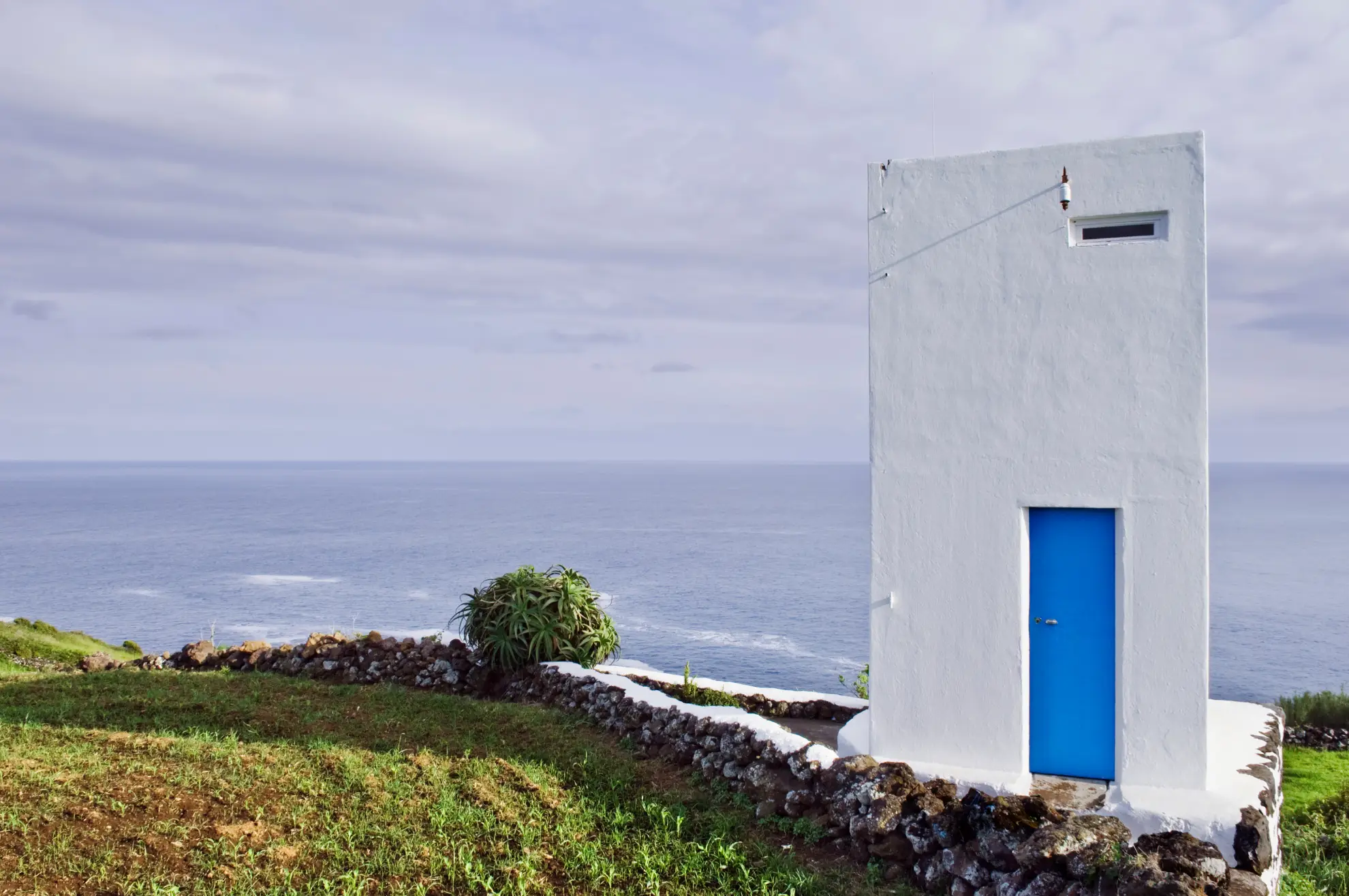
Those land-based lookouts, known locally as vigias, were originally constructed in the eighteenth and nineteenth centuries by sperm-whale hunters who needed elevated vantage points to spot distant spouts. Today the same stone huts serve a very different purpose: trained vigia spotters radio precise GPS coordinates to boat crews below, dramatically improving sighting success rates. On São Miguel, this network of coastal vigias means whale watching tours departing from Ponta Delgada can navigate directly to an animal rather than searching open water.
When Is the Best Time to See Blue Whales in the Azores?
Blue whales use Azorean waters during spring migration and may pause to feed. The timing of encounters varies by island, year and sea conditions; a fixed weekly window does not guarantee a sighting.
Blue whales may continue north towards feeding areas, but sightings also occur into summer. Timing varies, so confirm recent local observations rather than assume a fixed departure deadline. Outside this window, sperm whales (Physeter macrocephalus) are present year-round in deep Azorean waters, and at least nine other cetacean species, including common dolphins (Delphinus delphis), striped dolphins (Stenella coeruleoalba), and Risso's dolphins (Grampus griseus), visit across all seasons.
For 2026 planning purposes, ToursXplorer recommends booking whale watching tours azores departures for mid-April through mid-May. This central portion of the season can offer opportunities for sightings, but sea conditions and local whale presence still vary.
Where Are the Best Departure Points for Blue Whale Sightings?
Not all Azorean islands offer equal access to blue whale habitat, and choosing the right base matters considerably.
Pico and Faial: The Triangle Zone. The waters between Pico, Faial, and São Jorge form what cetacean researchers informally call "the Triangle," an area of exceptional bathymetric complexity. The seabed drops from less than 100 metres in the inter-island channel to more than 1,000 metres within a 5-kilometre radius of Pico's south coast. This abrupt topographic plunge concentrates krill and draws blue whales closer to shore than almost anywhere else in the Atlantic. Departures from Madalena (Pico's main ferry and boat terminal) can reach productive blue whale habitat in under 20 minutes. Horta, on Faial, offers similarly rapid access.
São Miguel: Ponta Delgada and the Vigia Network. São Miguel is the archipelago's largest and most accessible island, with direct international flights from Lisbon, London, and Boston. Whale watching tours Ponta Delgada benefit from the densest concentration of operational vigias on any Azorean island. The lookout at Ferraria, on São Miguel's northwest tip, has an unobstructed 180-degree ocean view and has documented blue whale spouts as close as three kilometres offshore during peak season. Sighting rates from São Miguel are competitive with those from Pico, making it a practical choice for travellers with limited island-hopping time.
Terceira. Less frequently cited than Pico or São Miguel for blue whales specifically, Terceira nonetheless lies within reach of the same migratory corridor. Its deeper offshore waters can produce sightings, particularly in May when the whales begin dispersing northward and may pass closer to Terceira's latitude.
ToursXplorer lists departures from multiple islands, allowing travellers to compare schedules and select the option that fits their itinerary without compromising on access to blue whale habitat.
How Do You Identify a Blue Whale at Sea?
Encounter probability means nothing without preparation. Blue whales are visually distinctive, but the ocean offers few reference points for scale, and the animal's behaviour can be subtle despite its colossal dimensions.
The blow. The single most reliable identification feature is the spout. Blue whales produce a near-vertical columnar blow reaching up to nine metres in height — roughly three times the height of a standard room ceiling. The blow is narrow and pencil-straight compared to the bushy, angled spouts of humpback whales (Megaptera novaeangliae) or the forward-angled blow of sperm whales. In calm April conditions, a blue whale blow is visible from several kilometres.
Body length and skin pattern. Adult blue whales in the North Atlantic measure between 24 and 27 metres in length. The dorsal surface shows mottled blue-grey pigmentation, a pattern as individual as a fingerprint and used by researchers for photo-identification. When the animal is close to the surface and sunlight penetrates clearly, the skin takes on a luminous turquoise quality in the surrounding water — a visual effect caused by light refraction rather than the animal's actual coloration.
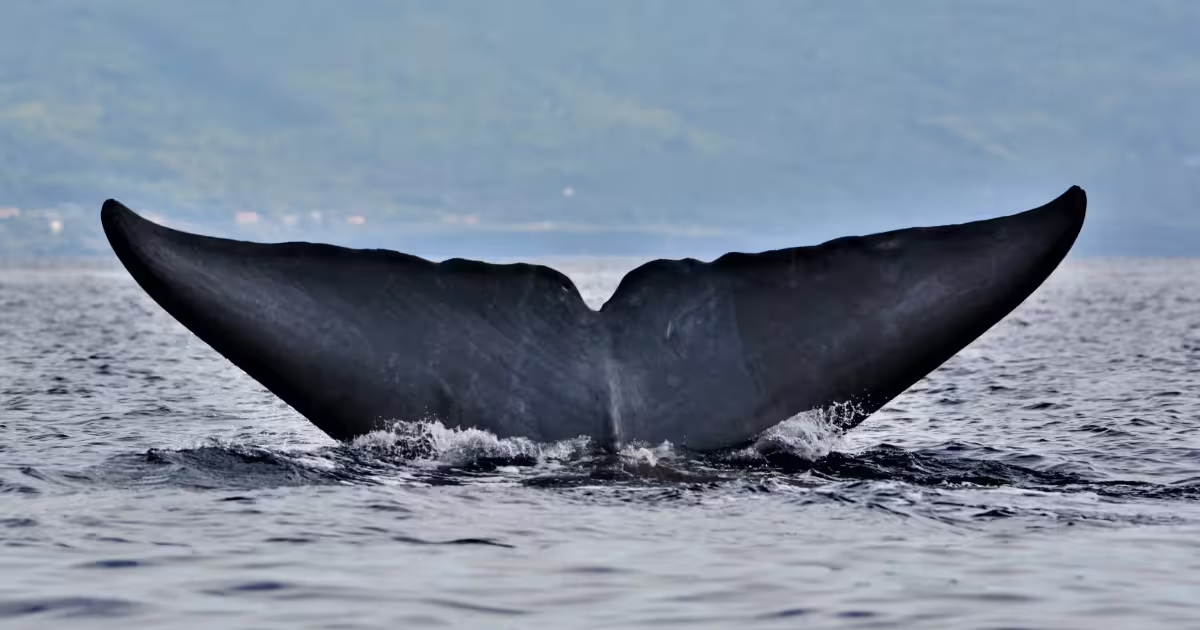
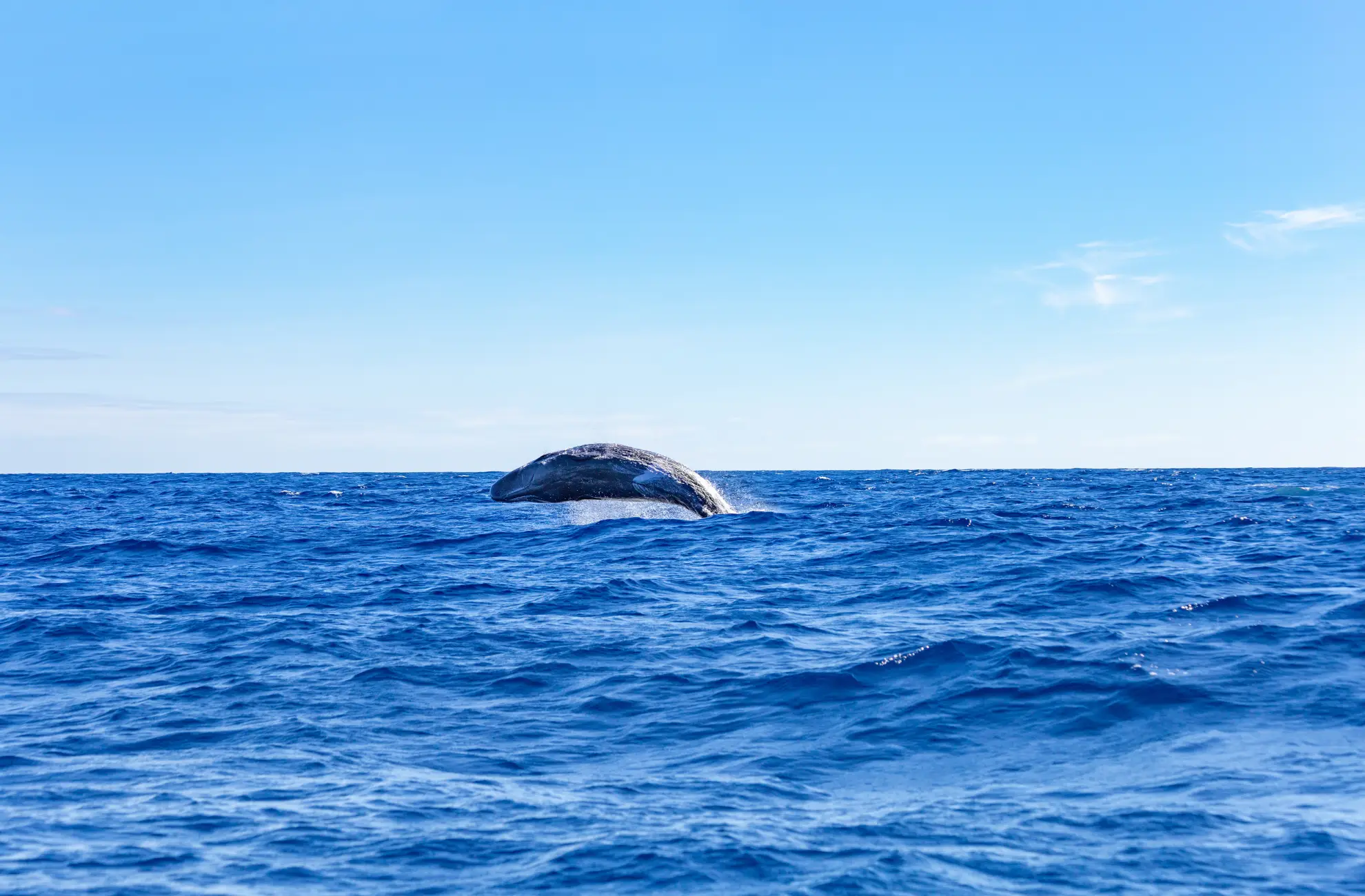
The fluke. Blue whales do not typically raise their flukes (tail fins) dramatically above the surface when diving, unlike humpbacks. Instead, the animal arches its back, shows a small, inconspicuous dorsal fin set far back toward the tail, and then the enormous body simply slides below the surface. This shallow sounding behaviour means that after a spout, you may have only 10 to 20 seconds of surface visibility before the animal descends for a dive lasting 10 to 20 minutes at depths exceeding 200 metres.
Heart and scale. To contextualise the encounter: a blue whale's heart is roughly the size of a small car and pumps approximately 220 litres of blood per beat. Its tongue alone can weigh as much as an adult elephant. Licensed naturalists aboard Azores whale watching tours routinely use these comparisons to help passengers recalibrate their spatial perception when the animal first surfaces alongside the boat.
Conservation Status and the Ethics of WatchingBlue whales were hunted to near-extinction during industrial whaling before international protection. The former whaling industry of the Azores is now documented in island museums.
Today, blue whales remain endangered, and population estimates depend on the survey area and period. The species' slow reproductive rate — females give birth to a single calf roughly every two to three years after an 11-month gestation — means recovery is a multi-generational process. Researchers use methods including photo-identification to study individual whales and resightings; not every whale encountered has necessarily been catalogued.
Responsible whale watching in the Azores is regulated by Azorean Regional Legislative Decree 9/99/A, as amended, requiring operators to maintain minimum approach distances, limit engine noise, and restrict vessel numbers around individual animals. Accredited operators contribute directly to photo-identification catalogues and population monitoring, meaning that a booking with a certified tour provider is also a contribution to the long-term data record that informs conservation decisions. Choose an operator holding the required regional whale-watching licence.
Whale Watching Tours Departing from the AzoresBook early. Certified operators on Pico and São Miguel run limited vessel capacity, typically 8 to 12 passengers per rigid inflatable or 20 to 30 on larger semi-rigid boats. April and May departures sell out weeks in advance, particularly over Portuguese public holidays including Freedom Day (25 April) and Labour Day (1 May).
Dress for ocean conditions. Mid-Atlantic April temperatures at sea level average 15 to 17 degrees Celsius, with wind chill reducing effective temperature by 4 to 6 degrees. Most operators provide waterproof suits or ponchos, but a thermal mid-layer underneath improves comfort substantially during the two to four hours on open water.
Manage expectations honestly. Spring can bring blue whale encounters, but these are wild animals whose presence and movements vary. No sighting is guaranteed. Most reputable operators offer a complimentary rebooking on a subsequent departure if no cetaceans are sighted, subject to availability.
Motion sickness. The Atlantic swell around the Azores is real, particularly on north-coast departures. If you are susceptible, ask a pharmacist about suitable medication and follow the product instructions and choose a morning departure when sea conditions are generally calmer.
Photography. A 400mm equivalent lens or longer is useful for close-up blow shots. For full-body surface images, 200mm is often sufficient given how close Azorean operators can legally approach. Waterproof housing or a dry bag is essential — spray is frequent on RIB-style vessels.
Confirm the operator's regional whale-watching licence, departure point, language options and current availability before booking.
Spring can offer opportunities to see blue whales in the Azores, where research has documented feeding during migration. Sightings also occur into summer, and the best window varies by island and year. Ask about recent observations near your departure point.
Pico Island, specifically departures from Madalena, is widely considered the best base because the seabed drops from shallow inter-island shallows to over 1,000 metres within five kilometres of the south coast, bringing blue whales close to shore. São Miguel (departing from Ponta Delgada) is a strong alternative thanks to its extensive network of land-based vigia spotters who radio whale locations to boat crews in real time.
A blue whale produces a near-vertical blow reaching up to nine metres — roughly three times the height of a standard room ceiling. It is distinctly narrow and pencil-straight compared to the bushy, angled spouts of humpback whales. On a calm April morning in the Azores, this spout can be spotted from several kilometres away, often before the whale's body becomes visible.
No sighting can be guaranteed with wild animals. Ask about recent blue whale observations and confirm the selected operator's rebooking policy, including what counts as a qualifying no-sighting trip.
Most half-day departures run three to four hours on the water. Full itineraries, including boarding and briefing, typically require four to five hours from meeting point to return. Departures usually leave in the morning when Atlantic swell is lower. Some operators offer afternoon slots in May when weather windows are longer and sea conditions remain favourable.
Azorean whale watching is subject to regional licensing and cetacean protection rules, including approach distances and limits on observation. Researchers use photo-identification and other methods to study whales. The islands' former whaling industry is now interpreted in local museums.