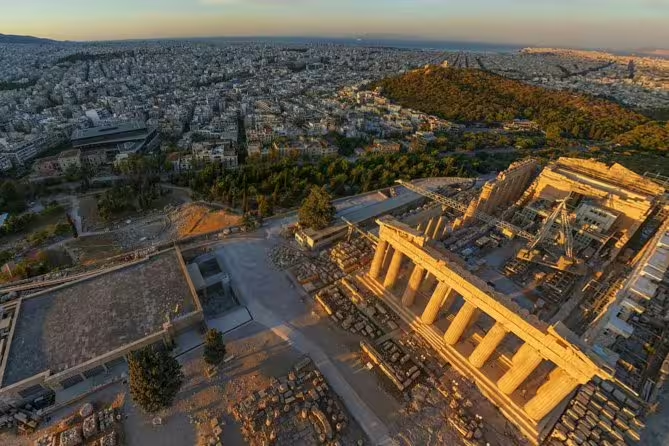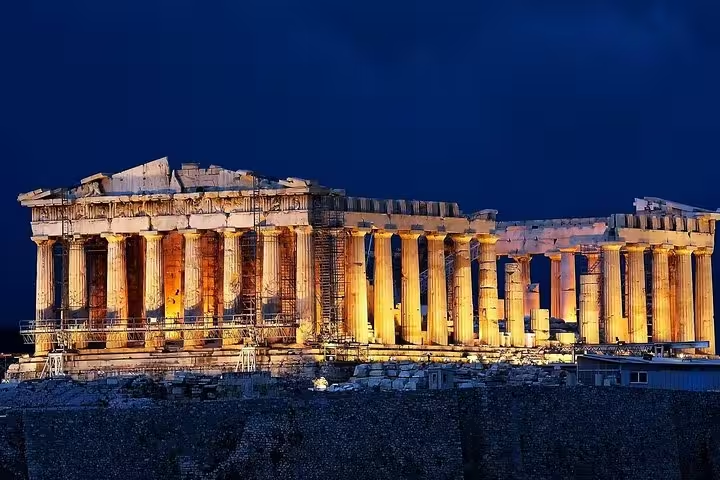
A practical breakdown of both ways to visit Athens’ most iconic monument — so you can choose the experience that’s right for you.
Standing at the foot of the Acropolis for the first time, with 2,500 years of history looming above you and a stream of fellow visitors heading toward the gate, one question settles in: will you understand what you’re looking at when you get to the top? The answer to that question is, essentially, the whole debate between guided and self-guided.
The Acropolis is one of those sites that looks impressive regardless of your preparation — the scale and the position above Athens guarantee a reaction. But the Parthenon, the Erechtheion, the Propylaea, and the Temple of Athena Nike each carry stories that the stones alone do not tell. A guide tells them. A ticket does not.
That said, self-guided visits are not second-rate experiences. For well-prepared travellers, the freedom to linger, to photograph without a group schedule, and to arrive exactly when the light is right can make independent exploration the more satisfying choice. The difference is in what you put in before you arrive.
This comparison breaks down cost, experience quality, flexibility, and which type of visitor each option serves best — so you can book the right version for your trip.
| Category | 🏭 Guided Tour | 📍 Self-Guided |
|---|---|---|
| Price | From €5–€75 | From €20–€40 |
| Duration | 2 – 3.5 hours (fixed) | 1.5 – 3 hours (flexible) |
| Expert commentary | Included | Not included |
| Entry ticket | Usually included | Buy separately |
| Skip-the-line | Included | Add-on available |
| Flexibility | Limited | Full |
| Language options | English, FR, DE, ES, IT | Self-select |
| Best for | First-timers & history lovers | Independent travellers |
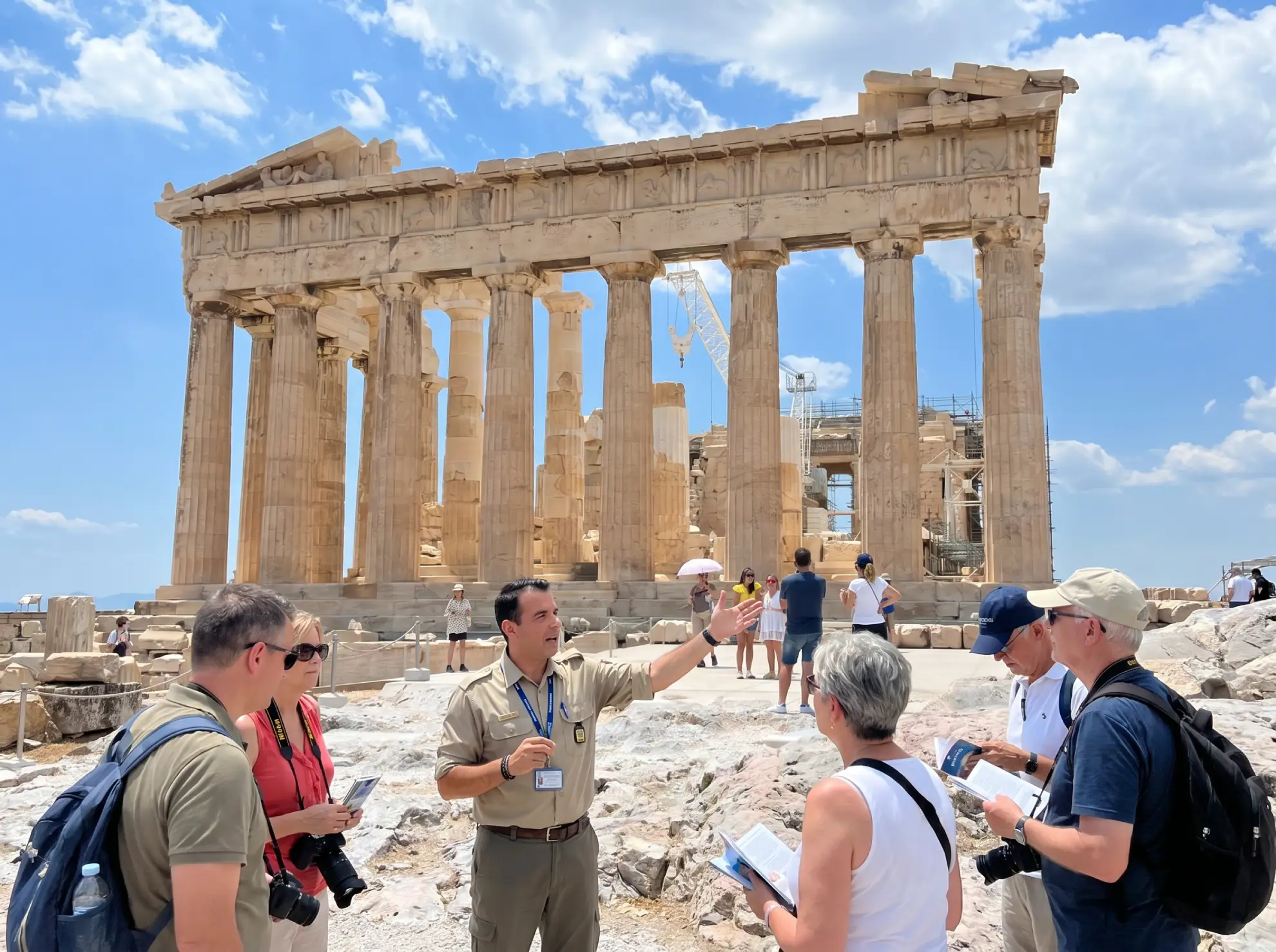
A guided tour of the Acropolis pairs skip-the-line access with a licensed local guide who does the interpretation work for you. The format ranges from intimate small groups of six to ten people to larger tours, with private options available for families or those who want the commentary tailored entirely to their interests.
The value proposition is clear: the Acropolis is dense with architectural, religious, political, and mythological layers that simply are not visible to the untrained eye. Without context, the Erechtheion can look like an ornate ruin. With a guide who explains that its Caryatid porch represents captive women from a rival city, it becomes something charged with meaning. The same is true for the Propylaea, the Theatre of Dionysus on the south slope, and the marble cuttings on the sacred rock that predate the Parthenon itself.
Most Athens guided tours also extend beyond the Acropolis hill — covering Plaka, the Roman Agora, the Temple of Olympian Zeus, and Syntagma Square — giving the Acropolis visit a geographic and historical context that makes the whole city make more sense.
✓ Deep historical and mythological context on every monument
✓ Skip-the-line entry pre-arranged — no queuing
✓ Small group or private formats available
✓ Guide adapts the commentary to your questions
✓ Best vantage points and photo spots shared
✓ Extends into the surrounding historic neighborhoods
✗ Fixed start time and group pace
✗ Less spontaneity — you move when the group moves
✗ Premium cost, especially for private tours
✗ Less time to linger at personal points of interest
✗ Photography pauses depend on the group dynamic
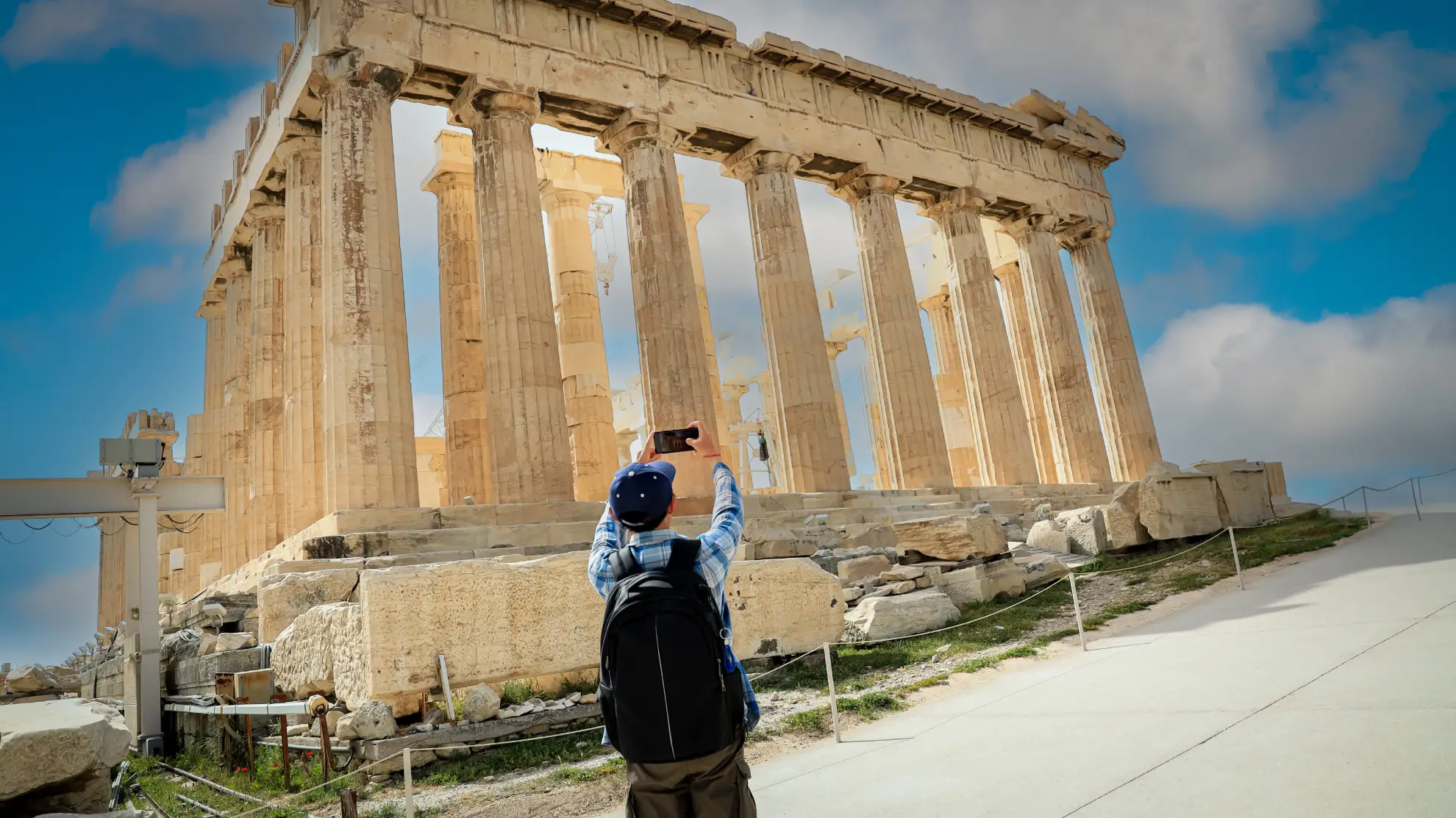
A self-guided visit to the Acropolis means purchasing an entry ticket — with or without skip-the-line access — and exploring the hill at your own pace. You set the schedule, you decide how long to spend at the Parthenon, and you can return to a favourite vantage point without feeling like you’re holding anyone up.
The tradeoff is information. The on-site signage is informative but brief. An optional audio guide is available to hire at the entrance and covers the main monuments reasonably well. For visitors who have done reading beforehand — or who have listened to a decent podcast about ancient Athens en route — this is genuinely sufficient. For visitors arriving cold, the site can feel beautiful but opaque: a collection of ruins rather than a narrative.
The practical side of self-guided visits also rewards preparation. Booking a skip-the-line ticket in advance eliminates the queue at the gate, which in summer can run to 45 minutes or more. Arriving before 9am or after 4pm makes the site feel like a different place entirely — cooler, quieter, and photographically far more rewarding.
✓ Complete freedom over pace, timing, and route
✓ Lower overall cost
✓ Linger as long as you like at each monument
✓ Can schedule for early morning or golden hour
✓ No group to keep up with
✓ Combine with the Acropolis Museum at your own pace
✗ No expert context — monuments can feel like unmarked stones
✗ Queue at the gate can be long without skip-the-line
✗ Easy to miss lesser-known details and hidden spots
✗ Audio guide is adequate but not comparable to a live guide
✗ Requires preparation to get full value from the visit
This is your first time in Athens — or Greece altogether. You want to understand the mythology, architecture, and history behind every monument. You’re travelling with children, parents, or a group with mixed levels of background knowledge. You want skip-the-line access and logistics handled for you. You enjoy asking questions and getting answers in the moment.
You have read up on ancient Greek history or know the key stories. You want to set your own pace and spend as long as you like at the Parthenon. You’re budget-conscious and comfortable navigating independently. You plan to arrive at first light or at sunset for quieter, more atmospheric conditions. You enjoy the discovery process without a prescribed route.
The Acropolis sells out regularly between April and October. Whether you are booking a guided tour or a standalone entry ticket, securing your spot at least three to five days ahead is the single most important step you can take. Walk-up availability at the gate is not guaranteed during peak season.
Visiting before 9am or after 4pm changes the experience dramatically. Fewer people, lower temperatures in summer, and far better light for photography. If you are doing a self-guided visit, this timing flexibility is one of your biggest advantages over a group tour, which typically runs at fixed morning slots.
Flat, closed-toe shoes with good grip are essential. The ancient marble paving on the Acropolis hill is uneven and can be slippery, especially in the heat. Bring at least a litre of water and sun protection — there is virtually no shade once you reach the plateau. A light hat is worth it from May through September.
The Acropolis Museum, located directly below the hill at the south entrance, is one of the finest archaeological museums in Europe. It holds the original Caryatids and vast quantities of sculpture from the site. Budget at least two to three hours for the museum and treat it as a separate half-day, not an afterthought appended to the hilltop visit.
If you plan to visit more than one ancient site during your time in Athens — the Ancient Agora, the Temple of Olympian Zeus, Hadrian’s Library, and Kerameikos are all within walking distance — the multi-site ticket offers significantly better value than individual admissions. Ask about it when booking your entry ticket or guided tour.