



Ancient Naples Buried Path: Entrance Ticket
Walk through 2,500 years of layered history beneath the streets of Naples
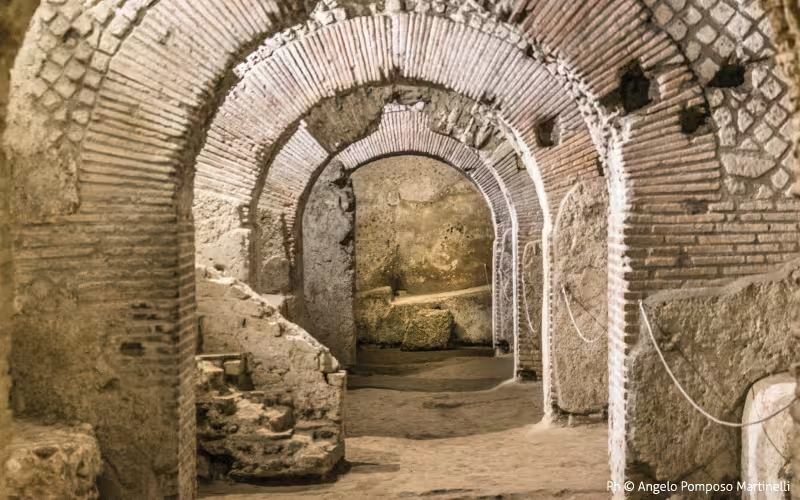
Descend 10 meters beneath Piazza San Gaetano to explore the Ancient Buried Naples, a remarkably preserved archaeological site that traces the city's evolution from a Greek colony in the 5th century BC to its transformation into the medieval city visible above ground today.
Few archaeological sites in southern Italy can match the depth and continuity of what lies beneath the Complex of San Lorenzo Maggiore. Here, the physical layers of urban life — Greek, Roman, late antique, and medieval — have been preserved in sequence, offering a rare and tangible record of how a city reinvents itself over centuries.
The visit takes you through the remains of the ancient Forum of Neapolis, identified as both the Roman forum and the earlier Greek agora. This open civic space, once the political and religious heart of the city, gives context to the streets, markets, and structures that gradually disappeared beneath alluvial deposits from the 5th century AD onward.
The 18th-century cloister of the convent frames the entrance to the underground area, where the macellum — the Roman food market — stands as one of the most intact commercial structures from antiquity in the entire region. The experience requires no specialist knowledge; the site is clearly organized and accessible to visitors of all backgrounds.
Tour Highlights
Explore 2,500 years of continuous urban history compressed into a single underground site.
Walk through the remains of the Roman macellum, one of the best-preserved ancient food markets in Italy.
Follow the ancient stenopos cardo, the Greek-age road that defined the original street grid of Neapolis.
Stand in what was once the agora of the Greek city and the forum of the Roman city — the civic heart of ancient Naples.
Discover how alluvial deposits sealed and preserved the ancient city beneath the medieval convent and Gothic basilica above.
Understand the topographical connection between the underground ruins and the historic center of Naples as it exists today.
Itinerary
The visit begins at the entrance to the complex on Piazza San Gaetano, historically positioned at the center of ancient Neapolis. The square itself marks the perimeter of the ancient open civic space shared by both the Greek and Roman cities.
Passing through the cloister, visitors transition from the early modern period into the deeper layers of the site. Visible from this level are the first structural remains, orienting visitors before the descent underground.
The path descends approximately 10 meters below street level, where the archaeological area extends beneath the church of San Lorenzo Maggiore. The scale of preservation becomes immediately apparent at this depth.
A rectangular porticoed marketplace from the 1st century AD, the macellum includes rows of shops and an interior courtyard centered on a tholos — a circular structure used for the sale of food. This section represents the commercial life of Roman Neapolis with exceptional clarity.
The layout of a Greek-era road — a stenopos serving as the cardo of Neapolis — remains visible, illustrating the urban planning principles that predated the Roman city. The alignment of this road continued to influence the city's street pattern for centuries.
The final section of the underground path covers the remains associated with the Roman forum, built over the earlier Greek agora. The site's archaeological investigations have confirmed the layered relationship between these two civic centers spanning several centuries.
What Is Included
Included
- Entrance ticket to the Complex of San Lorenzo Maggiore
- Access to the underground archaeological area
- Access to the 18th-century cloister
- Self-guided visit to all visible archaeological remains
Not Included
- Guided commentary or audio guide
- Transport to and from the site
- Entry to the Gothic basilica of San Lorenzo Maggiore
- Gratuities
Important Information
Reserve Your Place
Secure your entrance ticket to the underground archaeological site of San Lorenzo Maggiore and explore one of the most layered historical sites in the Mediterranean. Availability is limited and advance booking is advised.
Book Now