



The White Emigration in Serbia: Belgrade in the Wake of the Russian Revolution
Tracing the lasting imprint of a hundred thousand Russian exiles on a small Balkan capital
This Belgrade Russian emigration walking tour explores one of the 20th century's most extraordinary refugee stories — the mass exodus of up to two million Russians following the Bolshevik revolution, and how tens of thousands of them shaped the streets, institutions, and culture of a young Balkan kingdom.
Between 1919 and 1922, the Kingdom of Serbs, Croats and Slovenes made a decision that larger and more powerful nations refused: it welcomed a fully trained, partially armed foreign military force as guests. How that was managed without catastrophe is one of history's quiet diplomatic achievements.
Walking through Belgrade's historic core, the traces left by Russian architects, artists, scientists, and officers are visible in plain sight — yet rarely acknowledged in the way the story deserves. This tour sets the record straight, building context step by step across three thoughtful hours.
From the Nansen passport system that gave stateless emigrants a legal identity, to the choreographers who shaped Serbian ballet and the scientists who joined Belgrade's Academy of Arts and Sciences, the Russian presence here was far more than a footnote. It changed the city permanently.
Tour Highlights
Discover Russian architectural contributions to Belgrade's Parliament, General Staff, ministries, and post office buildings — a legacy rarely discussed openly.
Enjoy coffee and the famous "Moskva" and "Aurora" cakes inside Hotel Moskva, prepared to a recipe dating back more than half a century.
Learn what Nansen passports were, why they were created, and why this 1920s humanitarian document is being referenced again in today's world.
Visit the Russian church where Baron Wrangel is buried and reflect on the fate of the White Army's last commander in exile.
Find out who deserves credit every time you hear a choir singing in Serbia — a connection rooted directly in the Russian emigrant community.
Pass by the Royal Palaces and the monument to Tsar Nicholas II, and explore the deep dynastic bond between the Serbian and Russian royal families.
Learn about emigrant scientists at Belgrade University and the Academy of Sciences, and the complex fate of intellectual refugees far from home.
Itinerary
The tour begins at the Russian Orthodox church where the commander of the White Army, Baron Pyotr Wrangel, was laid to rest. The story of his final years in exile sets the tone for the whole walk.
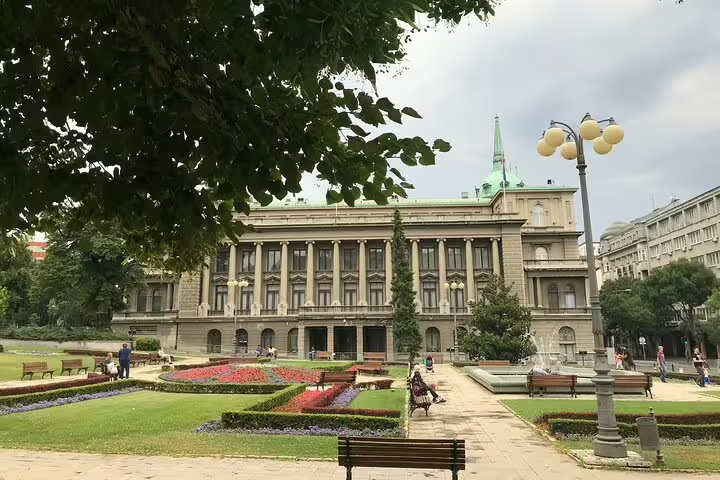
Walking through what was once a royal park, the group examines key civic buildings — the Serbian Parliament, the General Staff headquarters, the central post office, and several ministries — designed in whole or in part by Russian emigrant architects.
A stop at the Royal Palaces provides context for the Serbian-Russian dynastic relationship. The nearby monument to Tsar Nicholas II prompts a broader discussion about loyalty, exile, and political memory.
Inside the grand interiors of Hotel Moskva, the group takes a break with coffee and the storied "Moskva" and "Aurora" cakes. The hotel itself is a living fragment of the emigre world, and it still draws Belgrade's social elite.
The route continues to the National Theatre — where Russian ballerinas, choreographers, and set designers left a permanent mark on Serbian performing arts — then on to Belgrade University and the Academy of Sciences to discuss the fate of emigrant intellectuals.
The tour closes at Gavrilo Princip Square, connecting the dots between the assassination that triggered the First World War, the war's aftermath, and the chain of events that ultimately drove so many Russians to Belgrade's streets.
What Is Included
Included
- Professional guided walking tour (3 hours)
- Coffee at Hotel Moskva
- Moskva and Aurora cake tasting
- Entry to all walking route locations
Not Included
- Personal expenses and additional food or drinks
- Gratuities for the guide
- Transport to and from the meeting point
Important Information
Reserve Your Spot
Walk through a chapter of history that shaped a city and connected two nations across one of Europe's most turbulent centuries. Spaces are limited to keep the group experience meaningful.
Book Now