



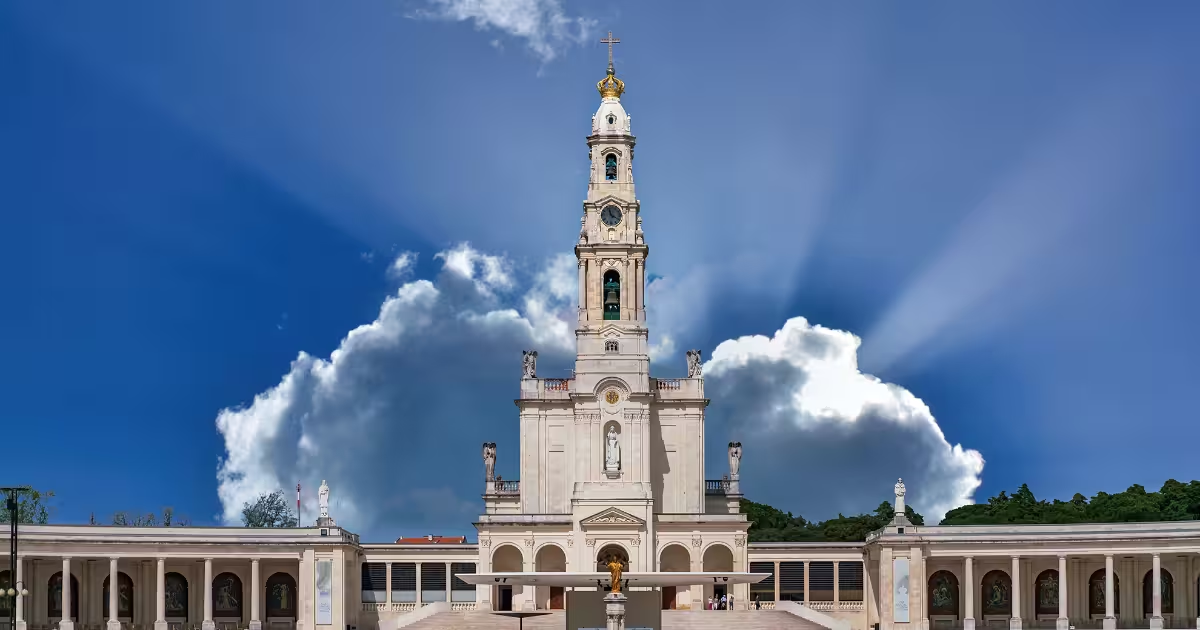
The Sanctuary esplanade at Fátima, capable of holding over a million pilgrims, stretches between the two basilicas in a hush that defies its scale.
The Altar of the World
Echoes of Devotion: A Guide to the Sacred Sanctuary of Fátima
Where flickering candlelight meets architectural grandeur, and a small Portuguese hillside became one of the most visited pilgrimage sites on earth.
A little over a hundred years ago, three shepherd children from the village of Aljustrel reported a series of apparitions in the Cova da Iria, a rocky hollow in the highlands of central Portugal. What followed turned a quiet farming community into a site of global significance — one that now receives between six and eight million visitors each year, pilgrims and curious travelers alike, all arriving in search of something that resists easy description.
Fátima occupies a specific latitude on the map — roughly midway between Lisbon and Porto, in the hilly Serra de Aire region — but its coordinates on the human interior are harder to fix. The sanctuary complex that has grown around the original apparition site is not a single monument but an entire sacred precinct: two contrasting basilicas, a chapel at the precise point where the visions occurred, broad marble esplanades, a Via Sacra threading through ancient olive groves, and the preserved homes of three children whose names — Lúcia, Francisco, and Jacinta — are now inscribed in the memory of the Catholic world. Visitors who arrive without religious conviction often leave surprised by what they find: not spectacle, but a quality of silence that the place seems to generate even on its busiest days.
That silence is, in many ways, the most remarkable architectural achievement of the Sanctuary. The main esplanade — wider than St. Peter's Square in Rome — was designed to absorb crowds without diminishing the sense of interior space. On ordinary afternoons, the square's pale limestone surface reflects the sky with a luminous calm. During the great candlelight processions of May 12–13 and October 12–13, when pilgrims carry flame across the darkness in a river of light, even seasoned travelers tend to pause and simply look.
"There is a kind of sacred silence here that does not depend on emptiness — it persists even when the esplanade holds a million people, a silence beneath the sound."
Two Basilicas, One Esplanade
The architectural tension at the heart of the Sanctuary is productive rather than jarring. At the northern end of the esplanade stands the Basilica of Our Lady of the Rosary, completed in 1953 in a restrained Baroque-revival style, its white facade topped by a 65-meter tower bearing a bronze crown. The interior holds the tombs of the three shepherd seers — Francisco and Jacinta Marto, canonized in 2017, lie beneath side chapels; Sister Lúcia dos Santos, who survived until 2005, is buried here as well. At the opposite end rises the Basilica of the Most Holy Trinity, consecrated in 2007 and designed by the Greek architect Alexandros Tombazis. A low, circular structure clad in granite and concrete, it can accommodate 8,500 worshippers in a single open nave flooded by natural light from a ring of high windows. The two buildings do not argue with each other; they frame a shared intention.
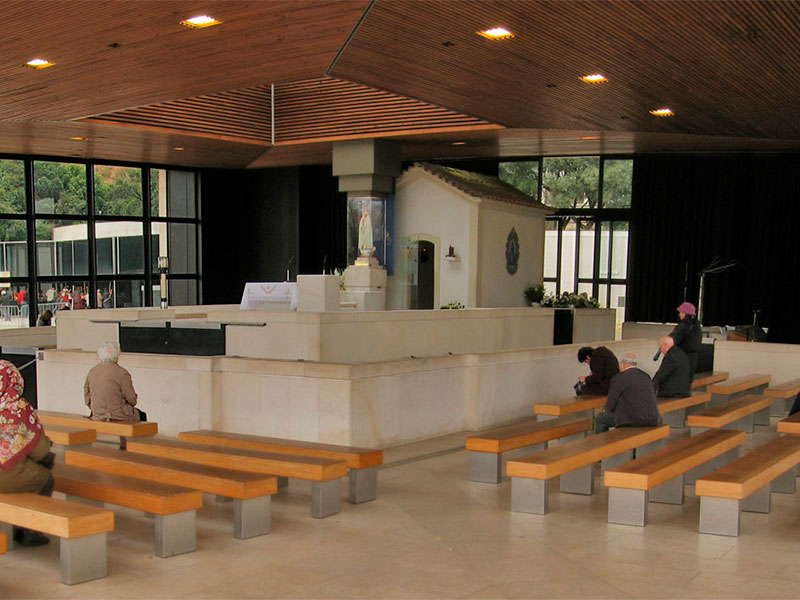
The Chapel of the Apparitions marks the exact holm oak tree where the three children reported seeing the Lady in 1917. The original tree was destroyed by early pilgrims taking relics.
The Chapel of Apparitions and the Via Sacra
Between the two basilicas, sheltered beneath an open metal canopy, stands the Chapel of the Apparitions — a small, almost provisional structure erected at the precise location of a holm oak tree where the first apparition was reported on May 13, 1917. A statue of Our Lady of Fátima stands where the tree once grew; the original was dismembered by early pilgrims taking branches as relics. Despite its modest scale, the chapel functions as the emotional center of the entire complex. Pilgrims kneel on the stone floor here, or shuffle toward it on their knees across the open esplanade in a practice of penitential approach that can seem, to the uninitiated observer, both austere and quietly dignified. The iron grill around the chapel is perpetually layered with burning candles — a low, constant fire that produces the specific scent that anyone who has visited Fátima carries in memory for years afterward.
To the south of the Sanctuary, a eucalyptus-lined path leads to the Via Sacra — the Way of the Cross — a sequence of stone chapels marking the fourteen stations, set among olive trees and low scrubland. The path connects the main complex to the Chapel of the Calvary, and its relatively uncrowded character makes it one of the more contemplative corners of the site. Early morning is the ideal hour: the light through the olive groves is soft and horizontal, and the stones of the chapels hold the cool of the night.
"Walking the Via Sacra at first light, through olive trees older than the apparitions themselves, one understands why silence became Fátima's defining quality."
Aljustrel: The Village Behind the Vision
Two kilometers from the Sanctuary, the village of Aljustrel offers a different register entirely. This is where the three seer children were born and raised — where Lúcia Santos and her cousins Francisco and Jacinta Marto spent their childhood tending sheep in the Cova da Iria. The family homes have been preserved as modest museums: stone-walled, low-ceilinged rooms furnished with the material culture of rural central Portugal in the early twentieth century — earthenware jugs, wooden furniture, agricultural tools. The homes are not grand, and that is precisely their value. They provide a human scale against which the immensity of the Sanctuary's history can be measured. Many guided tours from Lisbon now include Aljustrel as a scheduled stop, and it consistently proves to be one of the most absorbing parts of the day.
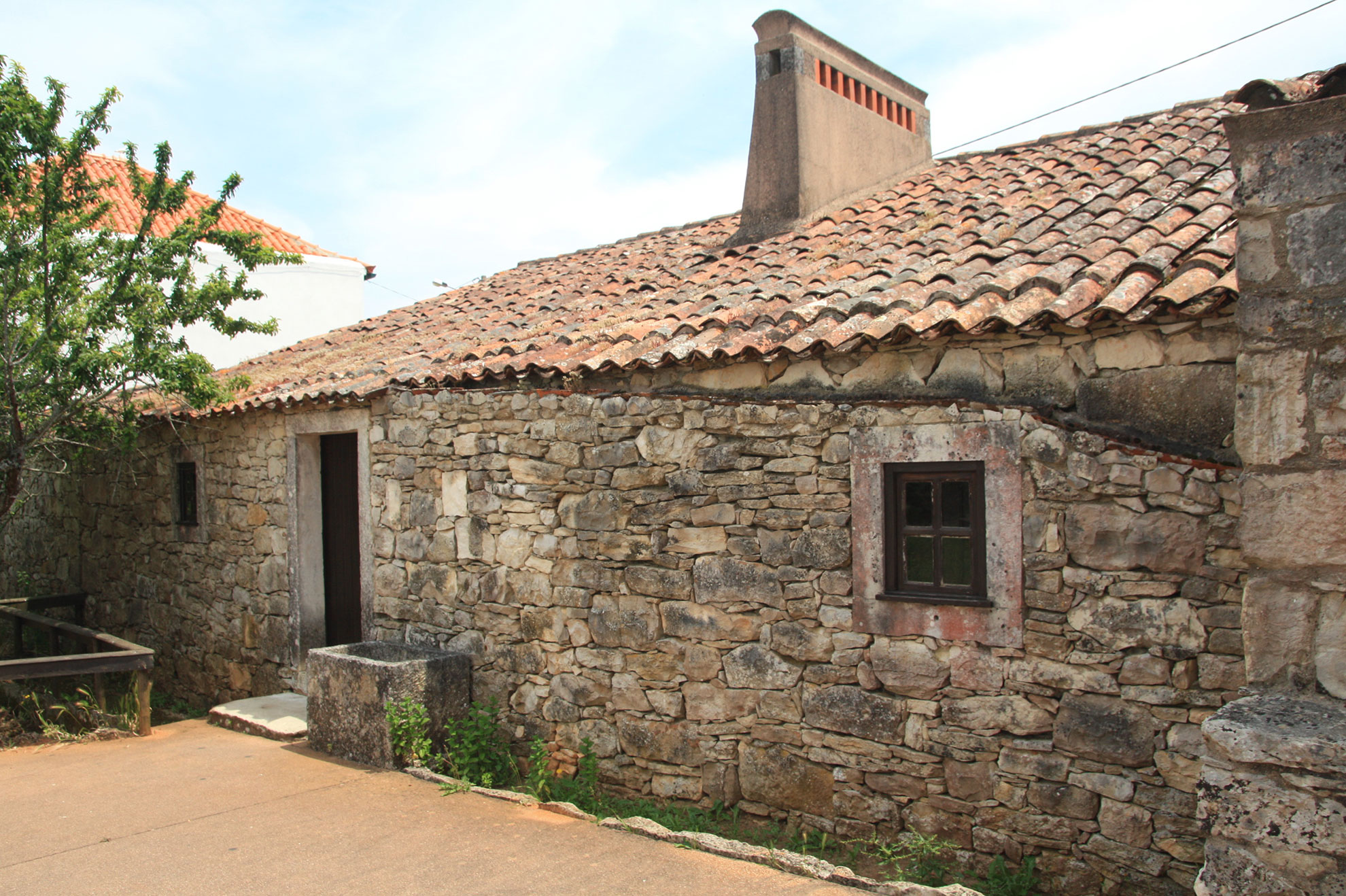
Aljustrel, a ten-minute drive from the Sanctuary, preserves the homes of Lúcia, Francisco, and Jacinta much as they appeared in 1917.
Day Trips & Guided Tours from Lisbon
Multi-Destination Tours Including Fátima from Lisbon
Fátima is easily reached from Lisbon — under 90 minutes by road — and all tours depart with door-to-door pickup from central Lisbon hotels. Browse the full selection of Fátima tours and departure options.
See all Fátima tours →Tours to Fátima from Porto & Extended Itineraries
Planning Your Visit: Practical Notes
The Sanctuary is open year-round and entry to the precinct is free; the interior of both basilicas and the Chapel of the Apparitions can be visited without charge. Guided tours from Lisbon typically depart between 7:30 and 9:00 am, arriving at the Sanctuary by mid-morning, which allows time at the site before the afternoon coach-tour crowds peak. From Porto, the drive is approximately two hours. The site does not impose a dress code at the outer esplanade, but modest clothing — covered shoulders and knees — is standard practice and expected inside the chapels and basilicas. Photography is permitted throughout the grounds but restricted inside certain chapels during active services.
The climate of the Serra de Aire is continental in character — warm and dry from June through September, with the possibility of cold winds and rain from October through March. The granite esplanade reflects both heat and light intensely in summer; comfortable shoes, water, and sun protection are practical necessities for summer visits. The candlelight processions of May and October take place in the evening and can run until midnight; tours that include these events require overnight stays in the town.
Fátima Beyond Faith: A Cultural Heritage Site
Whatever one's relation to the religious narrative at the center of Fátima's story, the site functions as a document of twentieth-century history, popular devotion, and architectural ambition that is worth encountering on its own terms. The construction of the Sanctuary spans over a century and reflects the changing priorities of the Catholic Church, the political shifts of the Portuguese state, and the evolving expectations of a global pilgrimage audience. The Basilica of Our Lady of the Rosary was built during the Estado Novo period under Salazar, and its formal restraint carries the imprint of that era. The Basilica of the Most Holy Trinity, by contrast, is a product of post-Vatican II theology made concrete — open, horizontal, and flooded with natural light. Reading the two buildings side by side is a small seminar in twentieth-century ecclesiastical history. UNESCO recognized the outstanding universal value of the site, and the Sanctuary of Fátima was inscribed on the World Heritage tentative list in 2021, a designation that acknowledges what pilgrims have known for a century: that this place belongs to the human story in ways that exceed any single tradition.
Whether you are approaching Fátima as a pilgrim, a cultural traveler, or simply someone curious about one of Portugal's defining places, a guided tour remains the most efficient and informative way to navigate the Sanctuary and its surroundings. View all available departures from Lisbon, Porto, and beyond.
Browse all Fátima tours →Frequently Asked Questions
How far is Fátima from Lisbon, and how long does the drive take?
Fátima is approximately 130 kilometers north of Lisbon, and the drive via the A1 motorway takes between 80 and 100 minutes depending on traffic. Guided tours from central Lisbon typically arrive at the Sanctuary by mid-morning after an early departure.
Is a half-day tour sufficient to see the main sites?
A half-day tour covers the essential elements of the Sanctuary — the Chapel of Apparitions, the two basilicas, and the main esplanade — adequately. A full-day tour is recommended if you want to also visit the village of Aljustrel, walk a portion of the Via Sacra, or spend unhurried time inside the basilicas.
Do I need to have a religious faith to visit Fátima?
No. A significant portion of visitors arrive as cultural travelers, architecture enthusiasts, or curious tourists. The site's historical significance, its remarkable architecture spanning a century, and the observable human drama of collective pilgrimage are of interest well beyond the specific religious context.
What is the best time of year to visit without the peak pilgrimage crowds?
Visits in September, early October (before the 13th), February, and March typically offer the least crowded conditions. Mid-May and mid-October — around the 13th of each month — are the most attended dates, with May and October 13th drawing the largest gatherings of the year.
What is included in the village of Aljustrel?
Aljustrel, two kilometers from the Sanctuary, preserves the childhood homes of the three seer children as small house museums. The interiors are furnished as they would have appeared in the early twentieth century, and the surrounding streets retain the scale and character of a traditional rural Portuguese village.
Can Fátima be combined with other Central Portugal destinations in a single day?
Yes, and several tours are designed exactly for this purpose. Common combinations include Fátima with Batalha and Tomar (three UNESCO-adjacent monuments in central Portugal), Fátima with Nazaré and Óbidos (inland sanctuary plus Atlantic coast), or Fátima with the Mira de Aire caves. Travel distances between these sites are modest, making multi-stop days practical.