





Top 12 Things to Do in Sintra, Portugal: Castles, Gardens & Hidden Corners
From the neoclassical splendor of Pena Palace to moss-covered convents and esoteric wells, Sintra rewards every kind of traveller willing to look beyond the obvious.
Perched on the Serra de Sintra, roughly 28 kilometres northwest of Lisbon, this UNESCO World Heritage town packs an extraordinary density of royal palaces, Moorish ruins, esoteric gardens, and Atlantic clifftops into a compact mountain landscape. Visitor numbers surpassed 4.5 million in 2023, making advance planning essential. The twelve experiences below cover the iconic, the overlooked, and the genuinely practical.
Why Is Sintra Considered a UNESCO World Heritage Site?
Sintra received UNESCO World Heritage status in 1995 under the designation Cultural Landscape of Sintra. The classification recognises an exceptional blend of Romanticist architecture, royal patronage dating to the 15th century, and an Atlantic forest ecosystem that supports species such as Quercus robur (pedunculate oak) and Arbutus unedo (strawberry tree). The Serra de Sintra rises to 528 metres at Cruz Alta, creating a microclimate of persistent Atlantic mist that shaped the aesthetic ambitions of the Portuguese monarchy and European Romantic movement alike.
King Ferdinand II of Portugal, who acquired and transformed Pena Palace between 1842 and 1854, is credited with establishing the Romantic vision that defines the town. His interventions introduced exotic species from Brazil, Japan, and Australia into what became the Pena Natural Park, covering approximately 200 hectares of protected forest. The landscape today is inseparable from the architecture: palaces appear to grow from granite outcrops, and walls are colonised by fern and lichen in equal measure.
"Sintra is not merely a place to visit — it is a sequence of overlapping histories, each palace a chapter written by a different hand across five centuries of Portuguese ambition and imagination." — ToursXplorer Editorial Team
What Are the Top 12 Things to Do in Sintra?
1. Pena Palace (Palácio da Pena): The unmistakable silhouette of Pena Palace, with its polychrome towers and Moorish-meets-Manueline detailing, sits at 538 metres above sea level. Constructed on the ruins of a 16th-century monastery, the palace was remodelled by King Ferdinand II from 1842 onward. Entry tickets routinely sell out weeks in advance during summer, so booking Pena Palace Sintra tickets at least 21 days ahead is strongly recommended for visits between May and September 2026. The palace interior contains the preserved royal apartments of Queen Maria II, furnished largely as they were in the late 19th century.
2. Quinta da Regaleira: Built between 1904 and 1910 by António Augusto Carvalho Monteiro, a wealthy Brazilian-Portuguese eccentric, Regaleira is best known for its Initiation Well (Poço Iniciático). The well descends 27 metres through nine spiral landings linked to Tarot symbolism and Masonic ritual. The 4-hectare estate also contains hidden grottoes, a chapel in the Manueline style, and a network of tunnels. Arrive before 9:30 AM or after 4:30 PM to navigate with some ease.
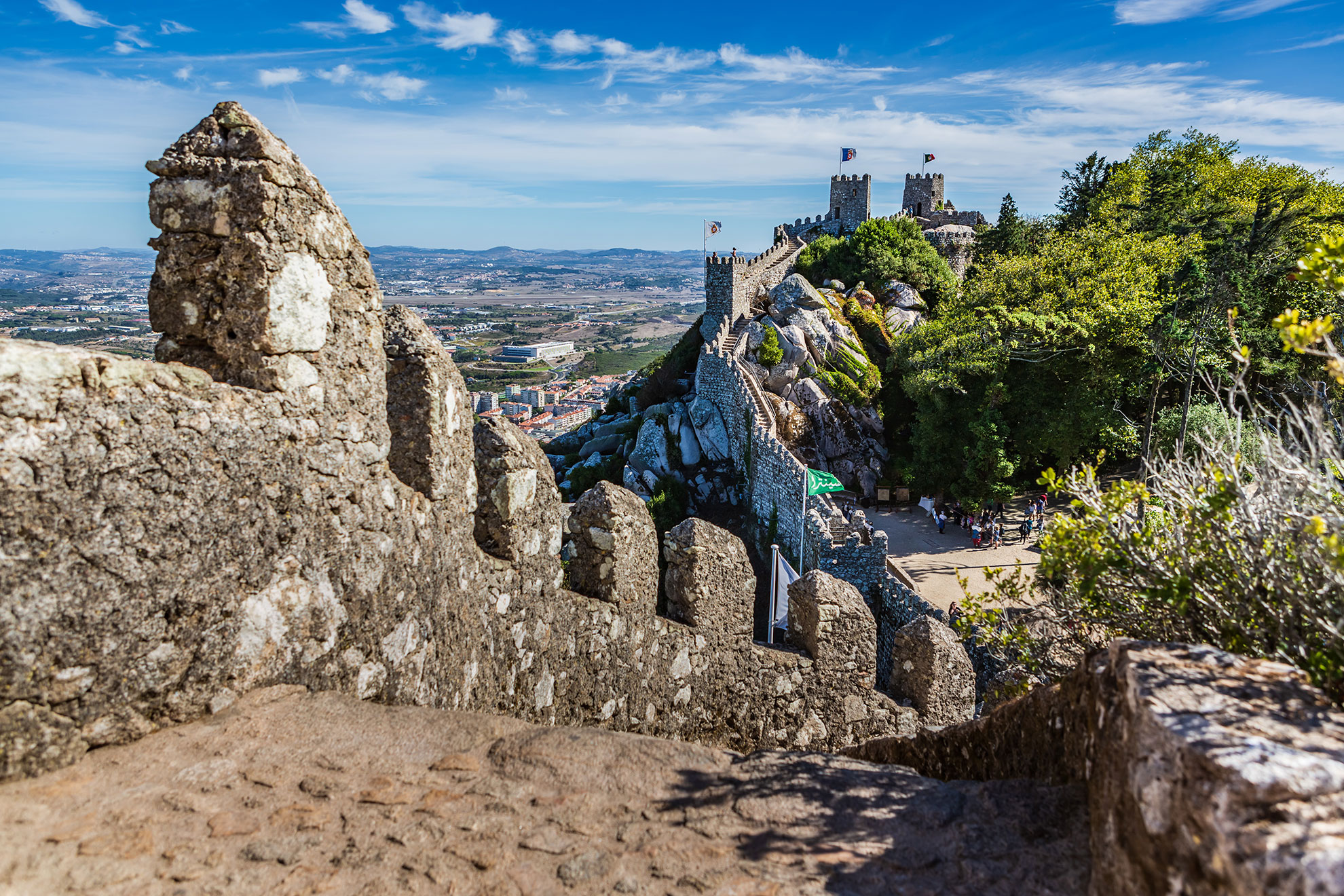
3. Moorish Castle (Castelo dos Mouros): The castle's ramparts date to the 8th and 9th centuries, constructed during the period of Moorish occupation of the Iberian Peninsula. Climbing its granite walls rewards visitors with the clearest panoramic views available anywhere in the Sintra region, encompassing the Atlantic to the west, the Tagus estuary to the south, and Pena Palace crowning the ridge above. The 1-kilometre walk from the Sintra historic centre takes approximately 40 minutes on foot, with significant elevation gain.
4. Monserrate Palace and Gardens: Often bypassed by visitors focused on Pena Palace, Monserrate is arguably more architecturally coherent. The current structure was commissioned by Sir Francis Cook in 1858 and designed in an Indo-Moorish style blending Gothic arches, Hindu carvings, and Italian marble. Its surrounding botanical garden spans 30 hectares and contains over 3,000 plant species, including specimens of Araucaria bidwillii (bunya pine) and Mexican fan palms. Visitor numbers here run at roughly one-fifth those of Pena Palace.
5. Convent of the Capuchos (Convento dos Capuchos): Known locally as the Cork Convent, this Franciscan hermitage was founded in 1560 and inhabited by monks until 1834. Every corridor, doorframe, and sleeping cell is lined with cork harvested from the surrounding forest, providing insulation in the damp mountain climate. The convent sits 8 kilometres from Sintra village and requires either a car or a dedicated tour, but its isolation is precisely what makes it worth the detour.
6. National Palace of Sintra (Palácio Nacional de Sintra): The twin conical chimneys of the National Palace are the defining landmark of Sintra's historic centre. The palace served as a royal residence from the 14th century through to the early 20th century. Its interior contains the Sala dos Brasões, a room decorated with azulejo tile panels depicting 72 noble coats of arms, completed around 1515 during the reign of King Manuel I.
7. The Initiation Well at Regaleira (second visit perspective): Many visitors treat Regaleira as a single sweep, but the grounds reward slower exploration. The lake, the Leda grotto, and the Torre da Regaleira chapel each contain symbolic details rooted in Rosicrucian and Templar iconography. A guided visit clarifies the esoteric programme that Monteiro designed in collaboration with Italian opera set designer Luigi Manini.
8. Cabo da Roca: Located 16 kilometres west of Sintra, Cabo da Roca is the westernmost point of mainland Europe, sitting at coordinates 38°47'N, 9°30'W. The clifftop lighthouse was built in 1772. The views across the Atlantic require clear weather to appreciate fully, and afternoon light is generally preferable for photographs. Most full-day Sintra tours from Lisbon include a stop here.
9. Sintra Village and the Centro Histórico: The old town around Rua das Padarias and Praça da República is compact and walkable. Eating a Travesseiro (a flaky pastry filled with almond and egg cream) at Casa Piriquita, which has operated at its current address since 1862, qualifies as a legitimate cultural experience. The equally classic Queijada de Sintra, a small tart of fresh cheese, sugar, and cinnamon, has been produced in the town since at least the 13th century according to municipal records.
10. Palácio de Seteais: Now operating as a luxury hotel, the neoclassical Seteais Palace was built in 1787 for the Dutch consul Daniel Gildemeester. Its symmetrical facade and formal gardens sit directly on the road between Sintra village and Monserrate, making it easily combined with either destination. Non-guests can visit the gardens and terrace cafe.
11. Hiking the Sintra Hills: The Parque Natural de Sintra-Cascais maintains marked trails connecting the major monuments. Trail PR2 SIN runs approximately 11 kilometres from Sintra station through Pena Natural Park to Cabo da Roca. Hiking offers an alternative to the congested shuttle bus (Scotturb bus 434) and provides access to viewpoints not reachable by road.
12. Wine and Food Experiences: The Sintra region sits within the DOC Colares appellation, one of Portugal's most distinctive wine zones, producing red wines from ungrafted Ramisco vines growing in coastal sand. Local wine producers offer tastings by appointment. Combining this with a guided food tour of Sintra village provides a grounded counterpoint to the palace circuits.
"The Serra de Sintra can absorb a lifetime of visits. Each palace exists in its own atmospheric register, and the forest between them is dense enough to lose a morning in without arriving anywhere at all." — ToursXplorer Editorial Team

How Do You Get to Sintra from Lisbon and When Should You Book?
The most practical route from Lisbon to Sintra is the Comboios de Portugal (CP) Sintra Line, which departs from Lisboa Rossio station every 20 minutes throughout the day. The journey takes approximately 40 minutes and costs under €3 each way (2025 pricing). The train arrives directly at Sintra station, from which Scotturb bus 434 connects to Pena Palace, the Moorish Castle, and the National Palace of Sintra on a circular route.
For 2026, the key logistics to understand are as follows. Pena Palace entry tickets must be booked online through the Parques de Sintra portal, and time slots frequently sell out 2 to 3 weeks in advance for weekend dates between April and October. Quinta da Regaleira and Monserrate Palace operate a similar timed-entry system. Visitors who arrive without pre-booked tickets risk being turned away at the gate during peak months.
Arriving at Sintra station before 9:00 AM substantially reduces queuing time for bus 434. Alternatively, tuk-tuks operating from the station square offer a more flexible, if more expensive, way to move between sites. A private guided tour departing from Lisbon remains the least stressful option for first-time visitors, as transport, ticket queues, and sequencing are handled in advance. ToursXplorer lists multiple departure options covering all these logistics across its Sintra tour catalogue.
Best Guided & Group Tours of Sintra from Lisbon
Private Tours of Sintra: Palaces, Coast & Custom Itineraries
Ready to explore Sintra without the logistical headaches? Browse all Sintra tours on ToursXplorer, with ticket inclusion, private departures, and full-day coastal circuits available for 2026.
Click herePractical Tips for Visiting Sintra in 2026
Sintra's popularity creates predictable pressure points. The Scotturb bus 434 circular route, which connects Sintra station to the Moorish Castle, Pena Palace, and the National Palace of Sintra, operates every 15 to 20 minutes but frequently runs at standing capacity between 10:00 AM and 3:00 PM from April through October. Positioning yourself at Sintra station before 9:00 AM is the single most effective way to avoid significant queuing.
Entry tickets for Pena Palace, Quinta da Regaleira, Monserrate Palace, and the Moorish Castle are all sold through the Parques de Sintra online portal. The combined ticket (Passe Geral) covers multiple sites and represents a saving over individual entry prices. For 2026, Parques de Sintra has signalled a continued expansion of timed-entry windows to manage capacity. Weekend slots in July and August should be treated as essential advance purchases rather than optional bookings.
The Convent of the Capuchos, located 8 kilometres from the historic centre along the CM1149 road, is rarely accessible by public transport and requires a car rental, taxi, or inclusion in a guided tour itinerary. ToursXplorer's private tour options can incorporate the Cork Convent alongside the main palace circuit, which is not always possible on standard group departures with fixed schedules.
Footwear choice is more consequential in Sintra than in most Portuguese destinations. The paths between monuments involve sustained gradients on uneven granite cobblestones, particularly between the Moorish Castle and Pena Palace, where the ascent covers approximately 80 metres of elevation over 600 metres of path. Comfortable walking shoes with grip are functional requirements, not optional.
How ToursXplorer Covers the Sintra Experience
ToursXplorer's Sintra catalogue covers the full range of visitor needs, from independent travellers joining small group departures from Lisbon to families and couples requiring private transport with a specialist guide. The tours listed on this page span half-day and full-day formats, include wine-tasting extensions, tuk-tuk experiences, and food-focused itineraries through the historic centre.
Every tour in the ToursXplorer Sintra portfolio includes either pre-booked monument tickets or a guide who manages ticket sequencing on the day, addressing the most common source of frustration for independent visitors. Departure points are primarily from central Lisbon, with journey times to Sintra accounting for standard morning traffic conditions on the A37 and IC19 routes.
For visitors spending more than one day in the region, the Atlantic coast extension tours add Cascais and Cabo da Roca to the Sintra circuit, creating a coherent geographical arc from the Serra to the westernmost point of mainland Europe. The DOC Colares wine-tasting tour offers a distinctly local dimension rarely available through larger operators.
Frequently Asked Questions
In a single day, prioritise Pena Palace (arrive before 10:00 AM with pre-booked tickets), Quinta da Regaleira (book an entry slot for late morning), and the Moorish Castle for panoramic views. Finish in Sintra village with a Travesseiro at Casa Piriquita. This circuit covers approximately 5 kilometres on foot and fills 7 to 8 hours comfortably.
From Sintra station, take Scotturb bus 434 toward Pena Palace, a journey of approximately 10 minutes. The bus runs every 15 to 20 minutes but fills quickly between 10:00 AM and 3:00 PM in peak months. Walking from the station to the palace gate takes roughly 45 minutes on a steep uphill path through the Pena Natural Park forest.
For first-time visitors, a guided tour removes the most common friction points: pre-booked monument tickets, transport sequencing between hilltop sites, and contextual information about the Romanticist history of each palace. Independent travel is feasible but requires careful advance booking of timed entry slots, which sell out 2 to 3 weeks ahead during summer.
Yes. Pena Palace Sintra tickets operate on a timed-entry system through the Parques de Sintra portal. Weekend slots between May and September sell out 2 to 3 weeks in advance. Weekday slots in peak summer can also sell out 7 to 10 days ahead. Booking immediately upon finalising travel dates is strongly recommended for visits in 2026.
The Convent of the Capuchos (Cork Convent), 8 kilometres from Sintra village, is visited by a fraction of Pena Palace's crowds and offers a compelling contrast to the palatial grandeur elsewhere. Monserrate Palace, with its Indo-Moorish architecture and 30-hectare botanical garden containing over 3,000 plant species, is another frequently overlooked alternative.
Yes, though it requires an early start and efficient transport, making a private or guided tour the most practical format. Cascais is 30 kilometres from Sintra and Cabo da Roca sits 16 kilometres west of Sintra, at 38°47'N the westernmost point of mainland Europe. Several full-day tours from Lisbon link all three destinations in a single itinerary.