




Sete Cidades by Kayak: Paddling One of the Azores' Most Beautiful Crater Lakes
A meditative guide to crossing the twin lakes of a volcanic caldera, from the first paddle stroke to the legend written in the water itself
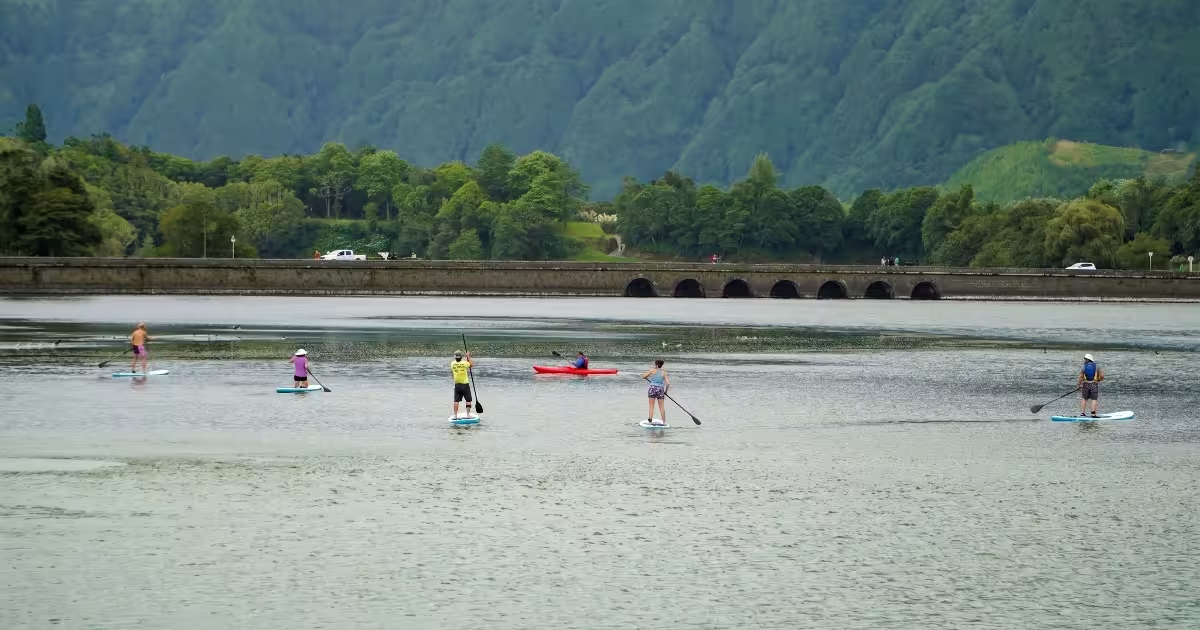
Sete Cidades sits inside a caldera roughly 5 kilometres wide on the western end of São Miguel Island. Two lakes, one visibly greener and one decidedly bluer, share the same volcanic basin and are separated by a narrow stone bridge built in 1897. Paddling across both by kayak takes between two and four hours depending on pace, and it remains one of the most distinctive water experiences the Azores offers.
What is the legend of Sete Cidades, and why does it matter on the water?
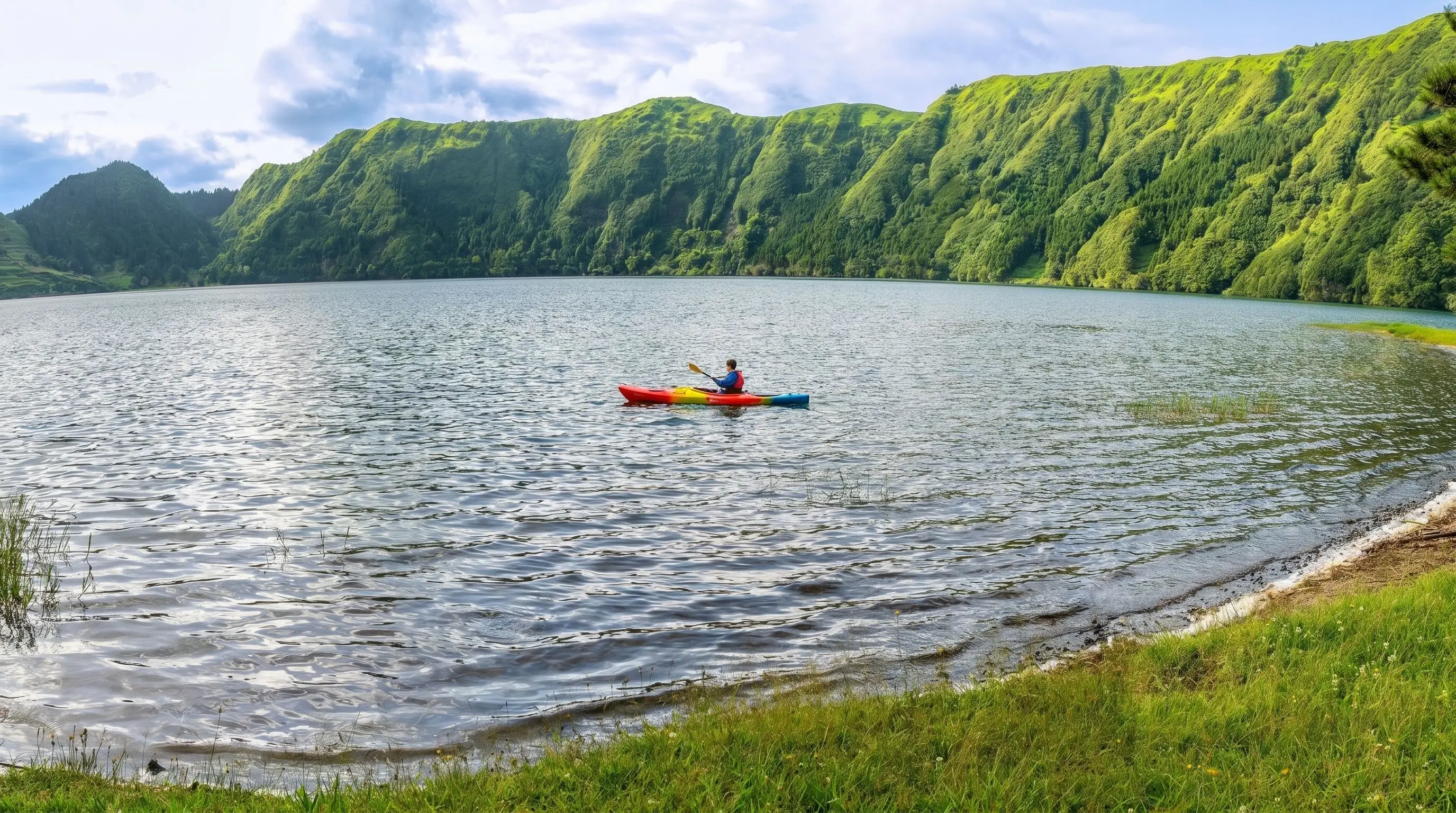
The most widely told version of the Sete Cidades legend involves a princess and a shepherd who fell in love despite the king's prohibition. When they said their final farewell, they wept so long and so deeply that their tears formed the two lakes: green from the princess's eyes, blue from the shepherd's. The colour difference between Lagoa Verde and Lagoa Azul is, in scientific terms, largely a product of the angle of light, the depth of the water column, and the surrounding vegetation reflected on the surface. But paddling across both basins with that story in mind shifts the experience from physical activity to something closer to a ritual crossing.
"Kayaking Sete Cidades is one of the few ways to feel both the scale of the caldera and the intimacy of the water simultaneously. From the surface, the volcanic walls look genuinely immense." — ToursXplorer Editorial Team
The caldera formed approximately 22,000 years ago through a series of explosive volcanic eruptions. The lakes themselves sit at roughly 184 metres above sea level. The terrain around the water is classified as a Natura 2000 protected habitat, which explains why motorboats are prohibited on both lagoons. That prohibition is not incidental: it is the reason the aquatic silence here feels so complete.
What does paddling under the bridge actually feel like?
The Ponte das Sete Cidades, the arched stone bridge separating the two lakes, was constructed in 1897 and stands roughly 8 metres above the water. From the road above, tourists photograph the two-toned surface of the lakes from a classic viewpoint. From a kayak beneath the bridge, the transition reads differently. You can watch the emerald ripples of Lagoa Verde give way to the cooler, steel-blue hues of Lagoa Azul as you pass through the single arch, a shift that happens over no more than 20 metres of water.
The channel connecting the two lakes is narrow, approximately 4 to 6 metres wide, and the basaltic stone walls on either side are close enough to touch. Guides on organised tours typically pause here to explain why the colours differ: Lagoa Verde is shallower (reaching a maximum depth of about 29 metres), while Lagoa Azul descends to approximately 33 metres. The greater depth absorbs more red and yellow wavelengths, scattering blue light back toward the eye. The slightly acidic chemistry of each lake also contributes to the tonal difference.
"The bridge passage is the axis of the whole paddling experience. Two lakes, one volcanic basin, one narrow channel, and a stone arch built before the 20th century: the geometry of the place is exact." — ToursXplorer Editorial Team
Once through the arch, paddlers typically circle the perimeter of Lagoa Azul, where the basaltic amphitheatre of the crater walls rises to a maximum elevation of 858 metres at Pico da Cruz. Hydrangea-lined slopes and patches of Japanese cedar (Cryptomeria japonica) line the lower walls. The silence is punctuated only by the call of the Azores bullfinch (Pyrrhula murina), a critically endangered species found only on São Miguel.
What should you know before renting a kayak in Sete Cidades?
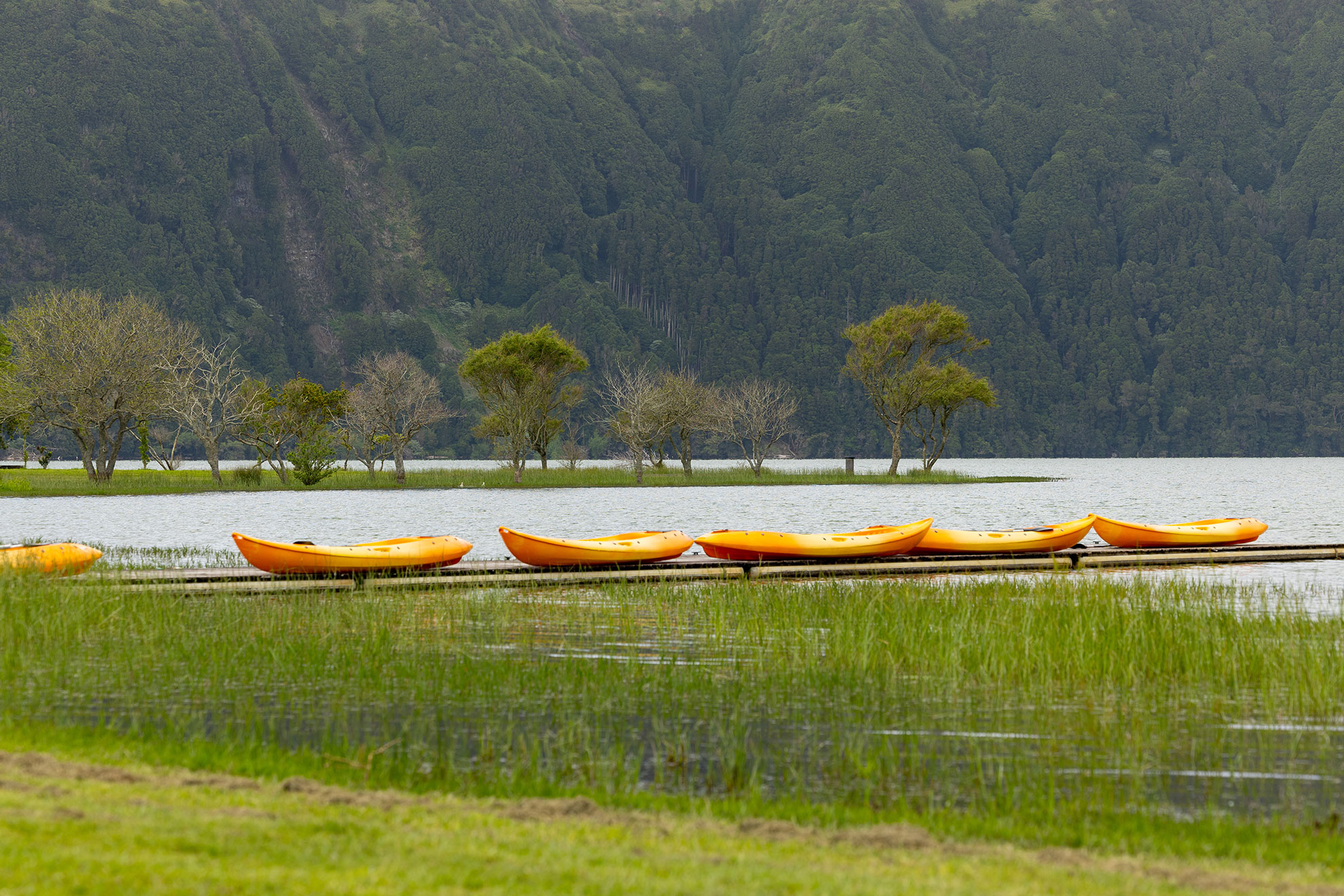
Kayak rental options are typically concentrated near the Canal das Sete Cidades, the narrow waterway between the two lakes, and in the village of Sete Cidades itself. Rental sessions generally run in 1-hour, 2-hour, and half-day blocks. For independent paddlers who already have experience, a self-guided rental allows full freedom to set pace and direction. Single kayaks and double kayaks (canoes for two) are the standard options available.
The distinction between a standalone rental and a guided kayak tour Azores operators offer is meaningful. A guide narrates the geological history of the caldera, identifies endemic plant species along the shoreline, and knows which sections of the lake are most sheltered when the crater microclimate turns. Sete Cidades has its own weather system: the rim of the caldera traps cloud and mist independently of conditions at sea level. It can be clear and warm in Ponta Delgada, 25 kilometres to the east, while the lakes sit inside a low cloud that reduces visibility to the nearest shoreline. This is not a drawback. For many paddlers, the mist adds a quality that is difficult to replicate anywhere else in the Azores.
Beginners are well accommodated on the lakes. There is no current, no tidal influence, and no motorboat traffic. The water temperature in summer averages around 18 to 20 degrees Celsius. Most operators require participants to wear a life jacket and provide a brief safety orientation before departure. Children above a certain weight threshold (usually 15 kilograms) can paddle in tandem kayaks with an adult. ToursXplorer lists both the full-day and half-day jeep-and-kayak combinations that include transport from Ponta Delgada, removing the logistical complexity of reaching the caldera independently.
What happens after the paddling is done?
The village of Sete Cidades, population roughly 800, sits at the western edge of Lagoa Verde. The local café serves caldo de feijão and fresh bread, and a short walk from the waterfront leads to the abandoned Vila Joya palace, a neo-Moorish structure built in the early 20th century that now sits roofless inside the caldera. It is not formally open to visitors but is visible from the perimeter road.
For those whose arms need recovery, Ferraria, a coastal geothermal area on the northwestern tip of São Miguel, lies approximately 12 kilometres from Sete Cidades by road. Natural hot springs bubble up where the lava met the Atlantic, and the tidal pool temperature can reach 40 degrees Celsius at low tide. The EN1-1A road along the island's north coast connects both locations. Alternatively, the thermal baths at Caldas da Rainha in Furnas, on the eastern end of the island, are a longer drive (roughly 60 kilometres) but offer more structured spa facilities. Both options are legitimate post-kayak destinations depending on how much of the island a visitor wants to cover in a single day.
Kayak and Jeep Tours in Sete Cidades
Ready to paddle between the green and the blue? Browse all kayak and jeep-kayak tours on São Miguel through ToursXplorer and book directly with local operators.
Click herePlanning your Sete Cidades kayak day in 2026
The caldera is accessible year-round, but the most stable paddling conditions on São Miguel fall between May and October. July and August bring the warmest water temperatures (18 to 22 degrees Celsius) and the longest daylight hours, with sunset after 21:00. Spring visits (April to June) offer a lower chance of encountering tour groups and a higher chance of the dramatic mist-and-sun interplay the crater is known for.
Ponta Delgada, the island's capital, lies approximately 25 kilometres east of Sete Cidades by the EN1-1A coastal route. The drive takes roughly 35 minutes by car. Public transport to the caldera is limited, which is why jeep-and-kayak combination tours from Ponta Delgada represent a practical choice for visitors without a hire car. ToursXplorer lists both half-day and full-day versions, and the booking pages include specific meeting point details and cancellation terms.
There is no entrance fee to access the caldera or the lakeside paths. Kayak rentals from independent providers in the village typically start around 10 to 15 euros per hour for a single kayak. Guided tours with transport from Ponta Delgada are priced higher and include equipment, safety briefing, and geological commentary. Participants should bring waterproof sunscreen, a change of clothes, and water. The caldera can be 3 to 5 degrees cooler than the coast, so a light windproof layer is worth carrying even in summer.
Why this experience matters beyond the activity itself
Sete Cidades is not a theme park version of a volcano. It is an active geologic system inside a Natura 2000 protected zone on an island that has been inhabited since 1432. The absence of motorboat traffic on the lakes is enforced, not aesthetic. The endemic species along the shoreline, including the Azores bullfinch and several subspecies of Erica azorica (a native heather), exist in a fragile relationship with their habitat. Paddling here carries a corresponding responsibility: no littering, no disturbing the shoreline vegetation, and no launching from undesignated points.
The meditative quality of the experience, the repetitive stroke, the enclosure of the crater walls, the acoustic dampening effect of open water, is a genuine byproduct of the geography, not a marketing construction. Visitors who approach the lakes expecting a workout may find something quieter and more lasting. The ToursXplorer editorial team consistently finds that the Sete Cidades kayak experience ranks among the highest in visitor recall precisely because it engages geology, legend, and physical effort in a single, unhurried morning or afternoon.
Frequently Asked Questions
Yes. Both Lagoa Verde and Lagoa Azul are calm, enclosed lakes with no current, no tidal influence, and no motorboat traffic. Water temperature in summer averages 18 to 22 degrees Celsius. Life jackets are provided on guided tours, and guides offer a safety briefing before departure. The lakes are widely considered suitable for first-time kayakers.
A paddle covering both Lagoa Verde and Lagoa Azul, including the narrow channel beneath the 1897 bridge, typically takes between two and four hours depending on pace and the number of stops. Guided half-day tours allocate roughly two hours on the water. Full-day tours allow more time to circle the perimeter of each lake.
Kayak rentals are available from operators near the Canal das Sete Cidades and in the village of Sete Cidades itself. Sessions typically run in one-hour or two-hour blocks, starting around 10 to 15 euros per hour for a single kayak. Guided tours with transport from Ponta Delgada, listed on ToursXplorer, include equipment and safety instruction in the price.
May to October offers the most stable conditions, with water temperatures between 18 and 22 degrees Celsius and the longest daylight hours. Spring visits from April to June tend to see fewer crowds and more frequent mist-and-sun conditions inside the caldera. The crater has its own microclimate and can be overcast when the coast is clear, regardless of season.
Yes, the colour difference is real and has a physical explanation. Lagoa Verde reaches a maximum depth of approximately 29 metres, while Lagoa Azul descends to about 33 metres. The greater depth of Lagoa Azul absorbs more red and yellow light wavelengths, scattering blue back to the eye. The angle of light, surrounding vegetation reflection, and the lakes' differing chemistry also contribute to the tonal variation.
Sete Cidades lies approximately 25 kilometres west of Ponta Delgada by the EN1-1A coastal road, a drive of roughly 35 minutes by car. Public transport options to the caldera are limited. Jeep-and-kayak guided tours listed on ToursXplorer depart from Ponta Delgada and include return transport, removing the need for a hire car.