




Best Time to Visit the Azores: A Month-by-Month Guide for 2026
From blue whale migrations in April to hydrangea-lined crater lakes in July, the Azores rewards every kind of traveller willing to read the season.
Nine volcanic islands rising from the mid-Atlantic, roughly 1,500 kilometres west of Lisbon, the Azores are governed by weather patterns that shift within the hour. Rain arrives and departs without warning, geothermal steam rises through fern-covered hillsides, and the sea changes colour from slate to sapphire in the space of an afternoon. Knowing when to go depends entirely on what you intend to do when you get there.
Why Does the Azores Weather Defy Simple Forecasts?
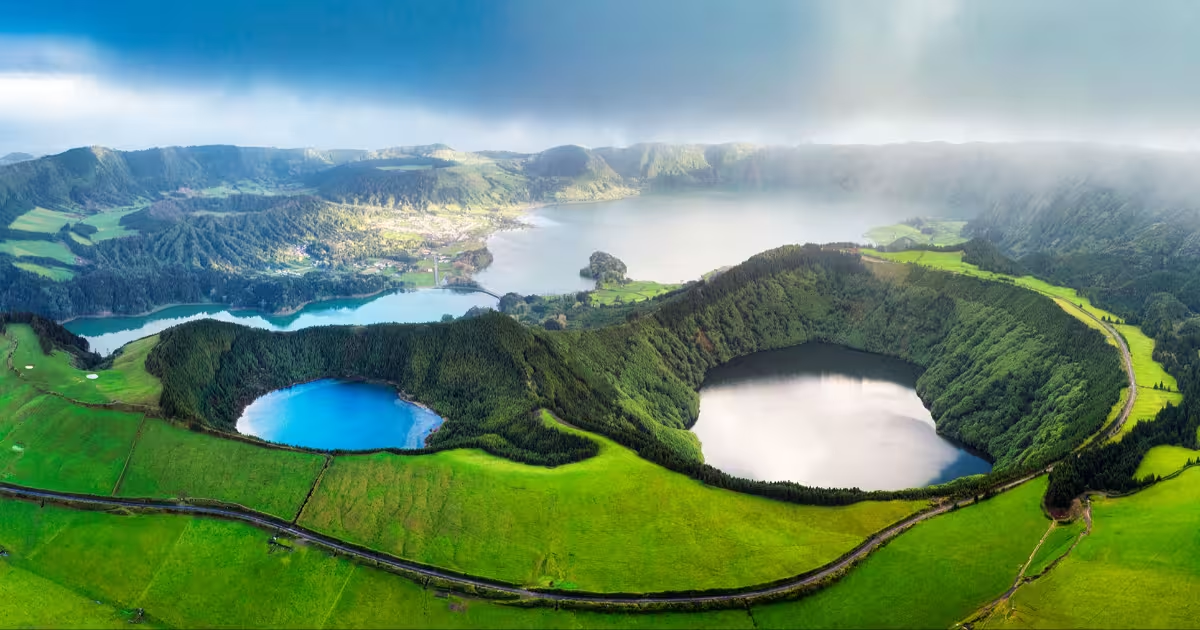
The Azores sit at the confluence of the North Atlantic subtropical high-pressure system and the polar front, producing what locals call "quatro estações num dia" — four seasons in a single day. On São Miguel, temperatures range from roughly 14°C in February to 26°C in August, but those averages obscure the reality: a morning of dense fog over the Sete Cidades caldera can give way to sharp afternoon sunshine within ninety minutes.
The archipelago spans more than 600 kilometres from Corvo in the northwest to Santa Maria in the southeast, and the micro-climates across that distance vary considerably. Santa Maria, the southernmost island, records the most sunshine hours — roughly 2,100 per year — while Flores, in the western group, can receive upwards of 1,800 millimetres of rain annually. Packing in layers is not a suggestion; it is the fundamental logistics of Azorean travel.
"The Azores do not promise you good weather. They promise you dramatic weather, and that turns out to be far more interesting." — a recurring sentiment among repeat visitors to the archipelago.
For hikers, the practical consequence is that trails such as the Lagoa do Fogo route on São Miguel are most safely walked between May and October, when visibility is reliable for most of the morning. The island's interior, rising to 947 metres at Pico da Vara, can generate its own cloud cover regardless of the coastal forecast.
What Is the Best Month for Whale Watching and Hiking in the Azores?
The answer depends on which species you are hoping to encounter. Resident cetaceans — including common dolphins (Delphinus delphis), bottlenose dolphins (Tursiops truncatus), and sperm whales (Physeter macrocephalus) — are present in Azorean waters year-round. The sperm whale population is semi-resident, sustained by the deep submarine canyons south of Pico and Faial where they hunt squid at depths exceeding 1,000 metres.
Blue whales (Balaenoptera musculus), the largest animals on Earth, pass through the Azores primarily between March and May as they migrate northward following dense concentrations of krill. April is statistically the most productive month for blue whale sightings, with research conducted by the Espaço Talassa research group on Pico documenting consistent presence from late March through mid-May. Sei whales (Balaenoptera borealis) follow a similar pattern, while fin whales (Balaenoptera physalus) are more frequently observed in winter.
Whale watching in the Azores operates under strict national regulations: vessels must maintain a minimum distance of 100 metres from cetaceans, and swim-with-dolphin experiences require certified guides and defined entry protocols.
For hiking, May and June offer the most consistent conditions: trails are not yet compressed by summer visitor numbers, wildflowers are in bloom across the levada paths of Flores, and the summit views from Montanha do Pico — at 2,351 metres, Portugal's highest peak — are clearest in early morning before convective cloud builds. September is the second-best window, with warm temperatures, lower humidity than August, and the added benefit of the Atlantic still warm enough for swimming at Santa Maria's Praia Formosa beach.
When Do the Hydrangeas Bloom in the Azores in 2026?
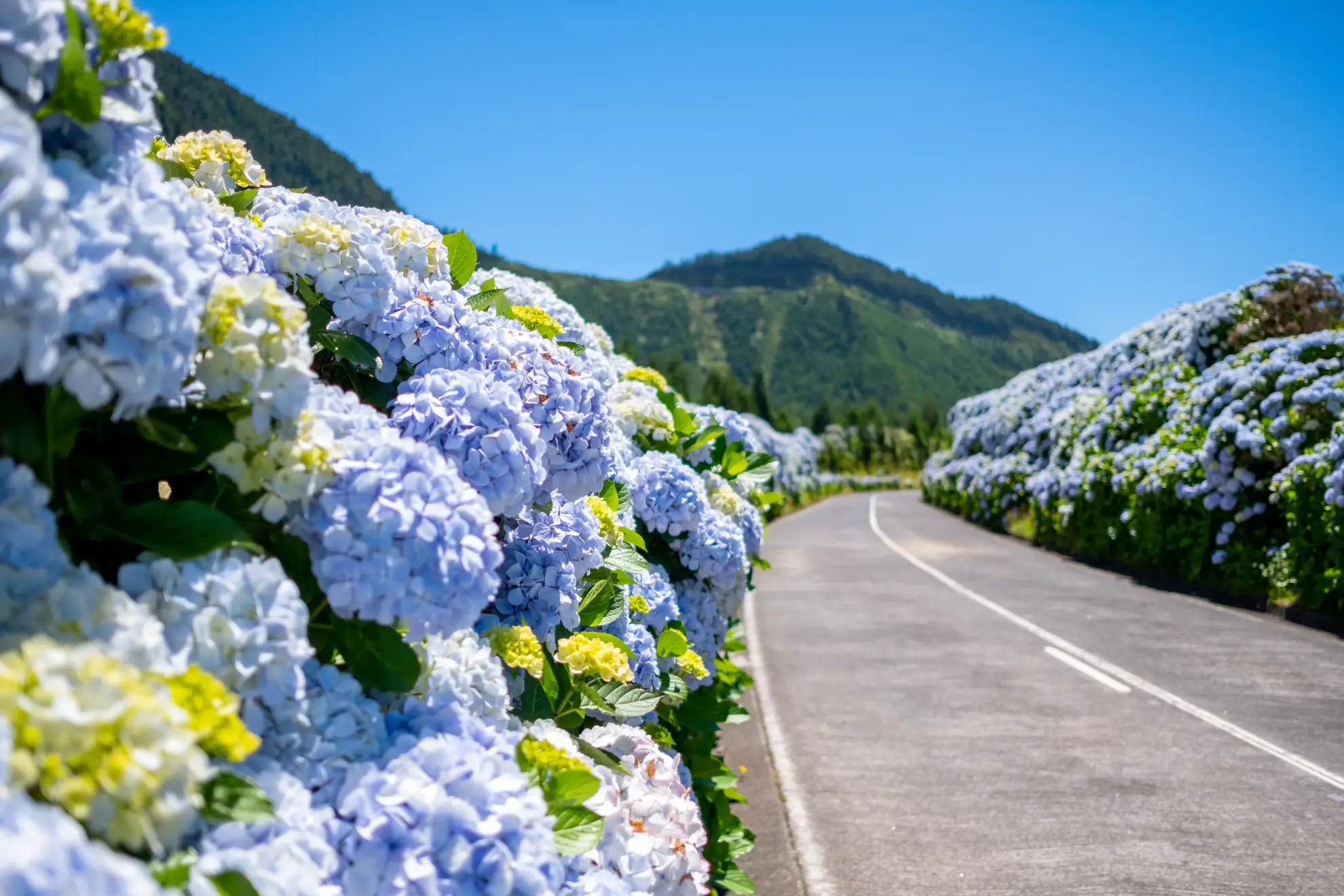
The blue hydrangeas (Hydrangea macrophylla) that line the roads and field boundaries of São Miguel, Faial, and Flores typically begin flowering in late June and reach full bloom through July and into mid-August. In 2026, given average temperature progressions, peak bloom is projected for the second and third weeks of July — though the exact timing shifts with winter rainfall totals and spring temperatures.
The phenomenon is particularly dramatic on the roads approaching Sete Cidades from the south, where hydrangea hedges form continuous walls of cobalt blue for several kilometres. On Faial, the entire island centre is dotted with these flowers, which is why Faial is sometimes called the "Blue Island." The flowers are not native — introduced from Asia in the nineteenth century — but they have naturalised so thoroughly that they have become the de facto symbol of Azorean summer.
July and August are also the peak season for beach travel, particularly to Santa Maria, which has the warmest and sunniest climate in the archipelago. Praia Formosa and Maia beach draw visitors from across the islands. This is also the period when accommodation across São Miguel fills quickly; booking where to stay in Azores Portugal at least four months in advance is advisable for July travel.
Are the Shoulder Seasons the Best Choice for an Azores Honeymoon?
May, June, September, and October present conditions that are well-suited to slower, more intimate travel. Crowds are measurably lower than in July and August — visitor numbers to São Miguel in June are roughly 30 to 40 percent lower than in peak summer — and accommodation rates reflect that reduction. The light in these months has a softer quality: the sun sits lower on the horizon for longer each evening, and morning mist over calderas like Lagoa das Furnas tends to lift gradually rather than burning off instantly, producing extended windows of layered atmospheric light.
For an Azores Portugal honeymoon, the combination of geothermal landscapes, coastal isolation, and manageable logistics makes the shoulder seasons particularly practical. The nine islands are connected by SATA Air Açores inter-island flights, with São Miguel's João Paulo II Airport (PDL) serving as the main hub. Flight times between islands range from 25 minutes (São Miguel to Terceira) to approximately 90 minutes for the western group.
Terceira's historic centre of Angra do Heroísmo, a UNESCO World Heritage Site since 1983, is best explored outside of August when the Sanjoaninas festival brings large crowds. Flores, the westernmost island, is particularly isolated and atmospheric in September when Atlantic swells have calmed from their winter heights and the waterfalls feeding into the crater lakes are still full from the previous rainy season.
Is It Worth Visiting the Azores in Winter?
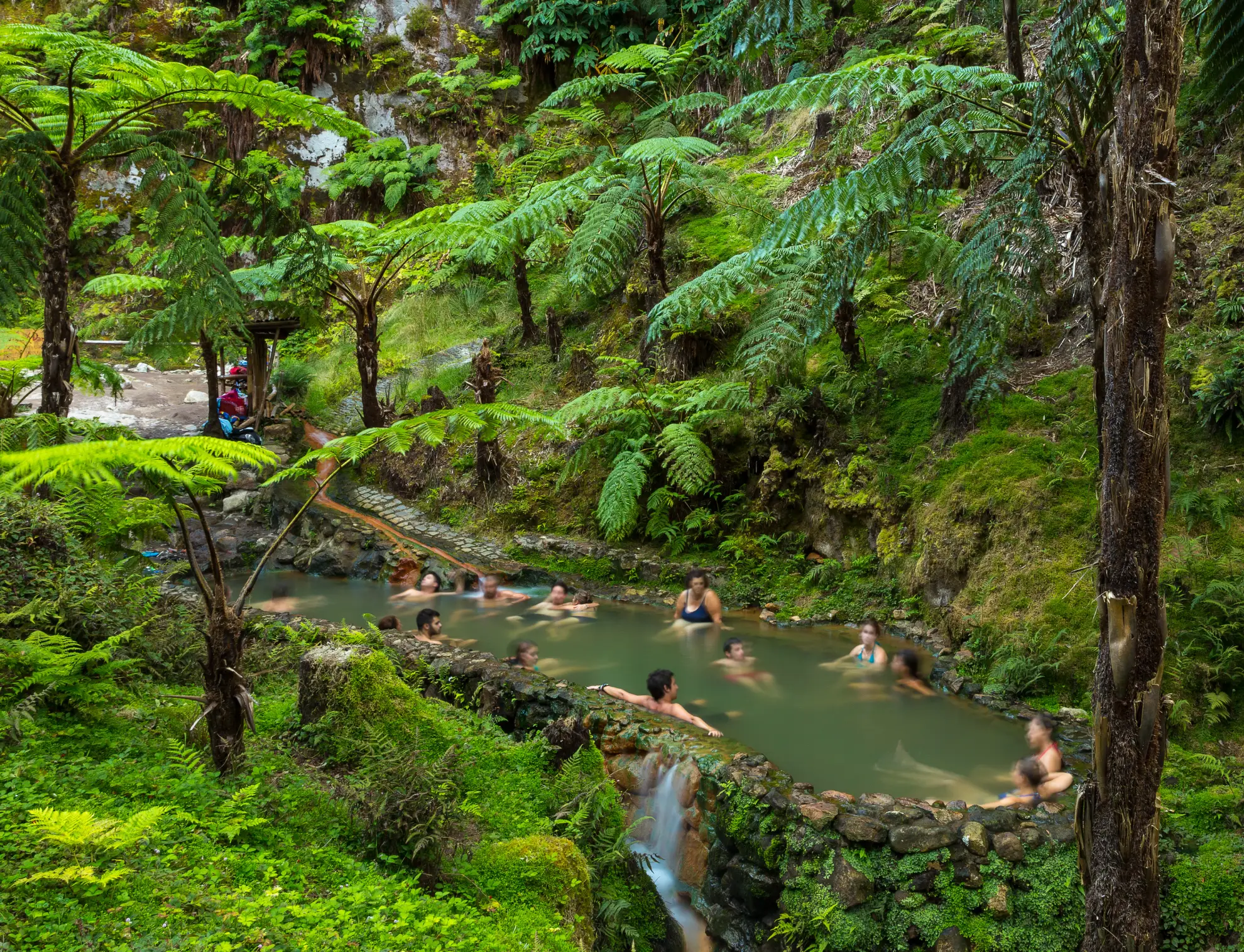
November through March is the off-season by visitor statistics, but it offers experiences that summer cannot. The thermal pools of Furnas on São Miguel operate year-round, and the contrast of soaking in 40°C geothermal water while Atlantic rain sweeps across Lagoa das Furnas is one of the more distinctive sensory experiences available in the North Atlantic. The Caldeira Velha thermal waterfalls, located within a protected forest reserve, remain accessible and are far less congested than in summer.
Winter is also when the Azorean kitchen is at its most expressive: caldo verde, cozido das Furnas (meat and vegetables slow-cooked in geothermal heat underground), and alcatra (a beef stew specific to Terceira) appear on restaurant menus with their full traditional character. Temperatures in Furnas rarely drop below 10°C even in January, and snowfall is extremely rare below 600 metres altitude.
Budget-conscious travellers will find that return flights from Lisbon to Ponta Delgada drop significantly between November and February, and hotel rates across the islands follow. The trade-off is wind: the Azores can experience sustained Atlantic gales between December and February, with gusts exceeding 80 km/h on exposed northern coastlines. Ferries between islands are frequently suspended during these periods, so inter-island itineraries require flexibility. Those travelling primarily to São Miguel will be minimally affected by ferry disruptions.
How to Get to the Azores in 2026
Access to the Azores has expanded considerably in recent years. SATA International (Azores Airlines) operates transatlantic routes from Boston (BOS) and Toronto (YYZ) to Ponta Delgada (PDL), with seasonal frequency increasing in 2025 and 2026. Ryanair, easyJet, TAP Air Portugal, and Iberia all serve Ponta Delgada from multiple European hubs including Lisbon, Porto, London Gatwick, Barcelona, and Frankfurt. Terceira's Lajes Airport (TER) receives direct flights from Boston and from several European cities, offering an alternative entry point for those planning to island-hop westward.
From Ponta Delgada, SATA Air Açores connects all nine inhabited islands, with Horta (Faial) and Angra do Heroísmo (Terceira) serving as secondary hubs. Interisland ferry service is operated by Atlânticoline, covering routes across the central group (Faial, Pico, São Jorge, Graciosa, Terceira) with crossings ranging from 45 minutes between Faial and Pico to several hours for longer routes. Ferry service to the western group (Flores and Corvo) is limited and weather-dependent.
For travellers planning structured experiences across the islands, ToursXplorer consolidates guided options across São Miguel and the wider archipelago, making it straightforward to arrange activities at each stop without coordinating with multiple local operators.
Recommended Azores Tours for Every Season
Ready to plan your Azores trip for 2026? Browse all available guided tours across São Miguel and the wider archipelago on ToursXplorer and filter by season, activity type, and group size.
Click herePlanning Your 2026 Azores Itinerary: A Purpose-First Approach
Rather than selecting dates based on weather probability alone, the most useful framework for planning a trip to the Azores is to identify your primary purpose first. The following outline gives a starting point for four distinct travel profiles.
For whale watchers: Target mid-April for the highest probability of blue whale sightings. Book accommodation in Ponta Delgada or on Pico at least three months ahead, as the spring migration window coincides with growing demand. The Guided Whale Watching and Dolphin Swim Tour listed on ToursXplorer operates with shore-based vigia spotters — a method dating to the archipelago's whaling era that ends in 1987 — and provides the most reliable cetacean location service available.
For hikers: May or early June gives the best combination of manageable crowds, full waterfalls, and clear summit windows. The Lagoa do Fogo full-day walking tour covers terrain that becomes dusty and congested by late July. The canyoning experience at Ribeira dos Caldeirões is most dramatic when water flows are high, making late spring the optimal window.
For honeymooners and photographers: September is consistently underrated. The Atlantic remains warm at roughly 23°C, the hydrangeas are fading but the light is golden for longer each evening, and the restaurants and hotels of São Miguel operate at a pace that allows genuine interaction rather than high-season efficiency. Accommodation rates begin dropping after the first week of September.
For budget and thermal travellers: January and February offer the lowest flight prices and hotel rates of the year, and the thermal pools of Furnas are most evocative in cold, misty conditions. Restrict your itinerary to São Miguel to avoid weather-related inter-island transport disruptions. ToursXplorer lists a range of guided thermal and cultural experiences in Furnas and Ponta Delgada that operate year-round, making it easy to fill a winter week with structured activity even when outdoor conditions limit independent exploration.
Azores Travel Logistics at a Glance for 2026
Entry requirements: Citizens of EU member states, the United States, Canada, the United Kingdom, and most other countries with visa-free access to Portugal may enter the Azores under the same conditions as mainland Portugal. The Azores are an outermost region of the European Union.
Currency: Euro (EUR). ATMs are widely available in Ponta Delgada, Horta, and Angra do Heroísmo. Smaller islands have limited banking facilities; carry cash when visiting Flores, Corvo, or Graciosa.
Time zone: Azores Standard Time (AZOT) is UTC-1, one hour behind mainland Portugal and the United Kingdom in winter, and UTC-0 in summer (Azores Summer Time).
Driving: Roads on all islands are on the right-hand side. São Miguel's EN1-1A ring road provides access to most major sites. The roads approaching Sete Cidades and Lagoa do Fogo include steep gradients; a small SUV is recommended over a standard city car for flexibility.
Protected areas: Significant portions of each island are classified as nature reserves or Natura 2000 sites. Trail access requires sticking to marked routes; off-trail movement is prohibited in Lagoa do Fogo Nature Reserve and Sete Cidades volcanic complex. All guided tours booked through ToursXplorer include certified local guides who are familiar with current access regulations.
Frequently Asked Questions
April and May offer the best combination for both activities. Blue whales pass through Azorean waters primarily from late March to mid-May, while hiking trails on São Miguel and Pico are clear and not yet crowded. May also brings wildflowers to the levada paths on Flores and Faial. Temperatures in May average around 17 to 19°C, suitable for both ocean excursions and multi-hour walks.
Based on typical seasonal patterns, hydrangeas on São Miguel, Faial, and Flores are expected to peak in early to mid-July 2026. They begin opening in late June and remain in bloom through mid-August. The most photogenic stretches are along the roads approaching Sete Cidades on São Miguel and across the interior of Faial, where they grow in continuous field-boundary hedges.
Yes, particularly for travellers focused on São Miguel. The thermal pools at Furnas, including Caldeira Velha and Poça da Dona Beija, operate year-round and are most atmospheric in misty winter conditions. Flights and hotels are significantly cheaper from November to February. The main limitation is wind: inter-island ferries are frequently cancelled during Atlantic gales, so restrict winter itineraries to a single island.
Azores Airlines (SATA International) operates direct flights from Boston Logan (BOS) and Toronto Pearson (YYZ) to Ponta Delgada (PDL) on São Miguel. Flight time from Boston is approximately 5 hours 30 minutes. Terceira's Lajes Airport (TER) also receives transatlantic service. Seasonal frequencies increase in spring and summer; booking several months ahead secures better fares for peak travel windows.
First-time visitors to São Miguel typically prioritise whale watching, volcanic lake walking, and off-road exploration. The Lagoa do Fogo full-day walking tour gives the clearest overview of the island's geothermal interior. The whale watching and dolphin swim tour combines cetacean observation with an in-water dolphin encounter. For active travellers, the canyoning tour at Ribeira dos Caldeirões and the Sete Cidades buggy tour cover terrain not accessible by standard road vehicles.
Yes, island-hopping is practical if you allow at least 7 to 10 days. SATA Air Açores connects all nine islands from São Miguel, with flights ranging from 25 to 90 minutes. The central group (Faial, Pico, São Jorge) is well-connected by Atlânticoline ferries in calm weather. A typical multi-island itinerary covers São Miguel (3 to 4 nights) plus Faial and Pico (2 nights each), using Horta as the central hub for the western cluster.