




Madeira Jeep Tour: Off-Road Routes Through Mountains, Forests and Hidden Villages
Why the island's most dramatic landscapes, ancient forests, and forgotten villages are only reachable by 4x4 with a local guide who knows every track.
Madeira's road network ends long before the island's most compelling terrain begins. The ancient caminhos reais, steep volcanic ridges, and mist-covered forest plateaus that define the interior are inaccessible by standard vehicle and impractical on foot without serious hiking experience. A 4x4 jeep tour bridges that gap, placing visitors inside remote landscapes within hours of leaving their hotel, guided by drivers who know each track's history as well as its gradient.
Why does Madeira need a jeep tour rather than a standard bus tour?
Madeira's topography is not gradual. The island rises from sea level to 1,862 metres at Pico Ruivo across a horizontal distance of roughly 22 kilometres, creating terrain so compressed and vertical that conventional coaches cannot navigate the old stone paths connecting coastal villages to mountain plateaus. The caminhos reais, literally "royal roads," were built by hand centuries ago to link farming communities separated by deep ravines, and their gradients, hairpin turns, and uneven surfaces were designed for ox carts, not modern buses.
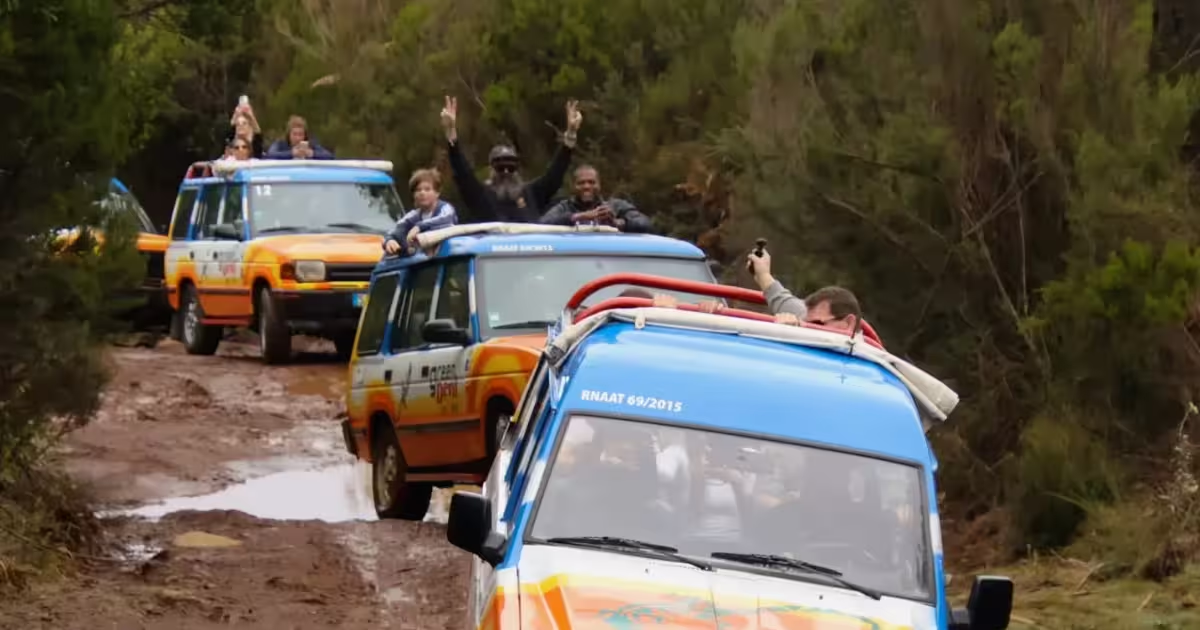
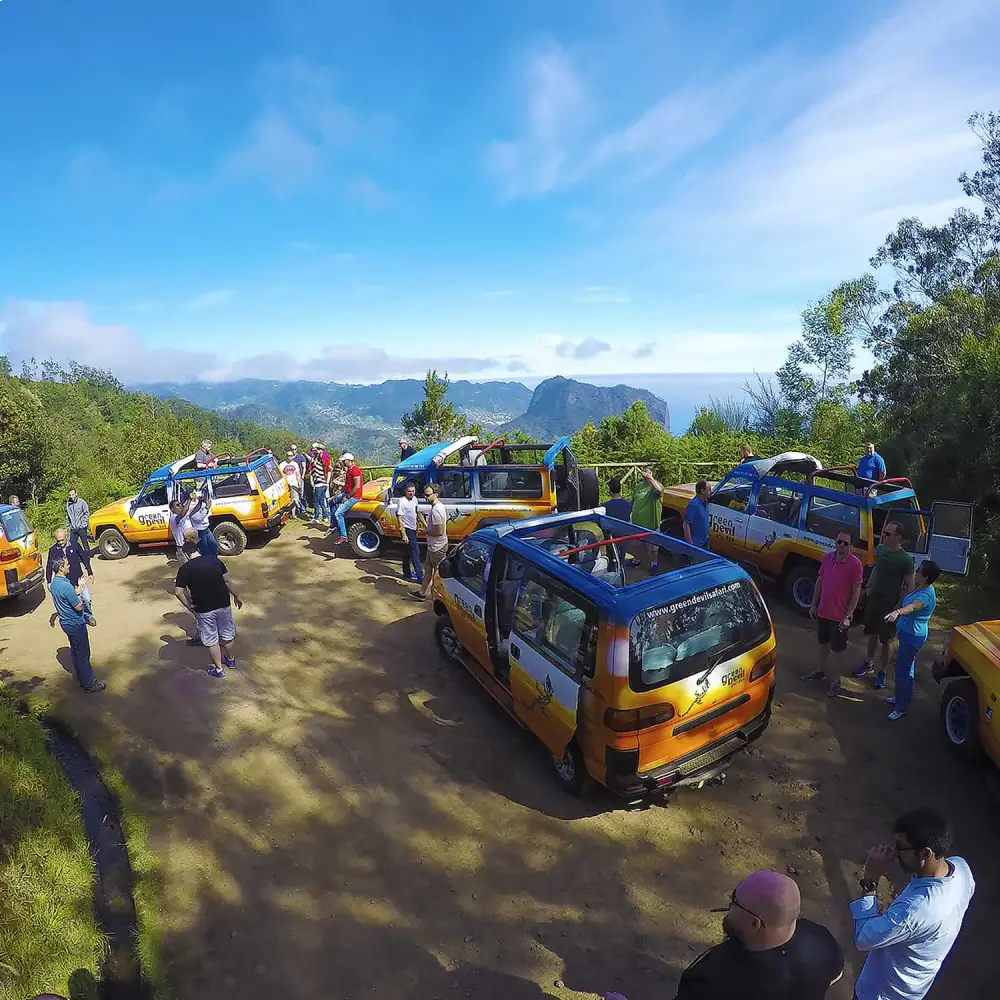
A purpose-built 4x4, typically a Land Rover Defender or Toyota Land Cruiser with an open roof section, can climb these tracks at angles that would leave a minibus stranded. The mechanical clearance alone makes the difference between a viewpoint glimpsed from a car park and standing on a ridge 1,500 metres above the Atlantic with the village of São Vicente visible as a white cluster far below.
"The road you cannot see on Google Maps is usually the road worth taking. In Madeira, those roads are everywhere, and a jeep is your only real key." — Recurring observation from local drivers on the northwest circuit.
Bus tours in Madeira are efficient for the Funchal waterfront, the Cabo Girão cable car, and the Monte toboggan run. They are structurally unable to access Fanal's ancient til trees, the volcanic pools below Seixal, or the high pastoral plateaus above Prazeres. For those destinations, the 4x4 is not a luxury upgrade. It is the only viable option.
What are the best off-road routes for a jeep tour in Madeira?
Three primary circuits define the madeira 4x4 tour landscape, each covering distinct ecological zones and historical communities. Most full-day tours focus on one circuit, which is why route selection matters more than it might initially appear.
The Northwest: Fanal and Seixal
The northwest route is the most photographed and, among experienced travellers, the most requested. The centrepiece is the Fanal forest plateau, located at approximately 1,150 metres altitude in the Paul da Serra upland. Fanal is part of the Laurisilva of Madeira, a UNESCO World Heritage Site since 1999 covering roughly 15,000 hectares. The ancient til trees (Ocotea foetens) here are estimated to be between 500 and 800 years old, their trunks thickened by cloud moisture, their canopies permanently draped in bryophytes and ferns. Arriving by jeep through the forest track rather than the main EN204 road means approaching the plateau from below, watching the vegetation shift from eucalyptus scrub to closed-canopy laurisilva within a few kilometres.
From Fanal, northwest routes typically descend to Seixal on the coast, where the village sits above basalt rock pools filled by Atlantic waves. The road between the plateau and the coast drops roughly 1,100 metres in under 8 kilometres, a gradient that demonstrates exactly why open-roof 4x4 vehicles with low-range gearing are the appropriate tool for this terrain.
The Northeast: Santana and Pico do Arieiro
The northeast circuit reaches into Madeira's highest accessible terrain. Pico do Arieiro, at 1,818 metres, is the island's third highest peak and the only summit reachable by road. The drive to the summit via the VE4 involves sustained switchbacks above the cloud line, with views opening over the central massif toward Pico Ruivo. On clear mornings, the cloud layer sits at roughly 1,400 metres, meaning the upper 400 metres of the drive is conducted in full sunlight above a white blanket covering the valleys.
Below, the northeast circuit includes Santana, a municipality known for its traditional A-frame thatched houses called palheiros, the oldest examples of which date to the 17th century. The deep valleys (ribeiras) carved by volcanic activity create drainage systems that are dramatic from above and intimate at track level. Jeep routes access viewpoints along these valley walls that no footpath reaches efficiently.
The Secret South: Prazeres and the Hidden Plateaus
Less documented but equally rewarding, the southern interior circuit explores sun-drenched agricultural plateaus between 400 and 800 metres altitude. The parish of Prazeres, in the municipality of Calheta, sits on a south-facing shelf with views stretching to the Desertas Islands, roughly 26 kilometres southeast of Madeira's main island. The plateau's microclimate supports banana plantations, vineyards, and small flower farms that are the working landscape of rural Madeira rather than its tourist-facing face.
"In Prazeres, the road simply stops. Beyond it, there is a track through somebody's terraced garden, and beyond that, a view that takes about thirty seconds to fully process." — Field notes from a ToursXplorer route assessment, 2024.
Villages on the southern circuit, including Raposeira and Fajã da Ovelha, retain the quiet rhythm of agricultural communities where the main street is also the levada path. Jeep access makes these stops possible within a full-day itinerary that would be impractical on public transport, which requires multiple connections and hours of waiting between services.

What is the open-top jeep experience actually like on the road?
The physical experience of an open-roof 4x4 tour in Madeira is distinct from any other island activity. In the standing position, passengers are exposed to the vegetation at canopy level as the jeep moves through forest sections. The scent profile changes measurably within a few hundred metres: eucalyptus oil in the lower zones gives way to the damp, mineral smell of laurel bark and wet moss as the vehicle climbs into the laurisilva. At Fanal, the air at 1,150 metres carries a temperature roughly 6 to 8 degrees Celsius cooler than Funchal's coastal baseline, which on a summer day when Funchal sits at 26°C creates a genuinely different atmospheric environment.
The standing position also changes the spatial relationship to the landscape. Seated inside a standard vehicle on a mountain road, the door frame and roof pillars interrupt the sightline. Standing in an open roof section, the view is a full 360-degree panorama at the moment the jeep clears a ridge, which is operationally different from stopping at a designated miradouro and looking at the same view from a car park.
Drivers on reputable Madeira jeep tour circuits are typically certificated guides with regional knowledge covering geology, flora, and local history. The driver's role is not limited to navigation. On the northwest circuit, a knowledgeable guide will identify the difference between til and stinkwood laurel (Ocotea foetens versus Apollonias barbujana), explain why the Paul da Serra plateau is geologically younger than the eastern massif, and know which family in a particular village still produces artisanal aguardente for the local poncha. These are not facts available in a guidebook. They come from generational familiarity with the landscape.
Stops at local tascas, small family-run bars and restaurants in villages along the route, are built into most full-day itineraries. Poncha, the traditional Madeiran spirit made from aguardente de cana, honey, and lemon juice, was historically consumed by the island's fishermen and agricultural workers. Tasting it in a village bar in Seixal or Paul do Mar, rather than in a hotel bar in Funchal, is a factually different cultural encounter.
Is a jeep tour in Madeira worth it for non-hikers and first-time visitors?
Madeira's hiking reputation is substantial. The Levada do Caldeirão Verde, the PR1 trail to Pico do Arieiro, and the Vereda da Ponta de São Lourenço are among the most referenced walking routes in the North Atlantic. However, access to the high landscapes these trails traverse requires reasonable physical fitness, appropriate footwear, and several hours of sustained effort. The PR1 trail between Pico do Arieiro and Pico Ruivo covers 9 kilometres each way at altitude, with sections of exposed ridge walking that can be closed by weather at any point in the year.
A full-day madeira 4x4 tour covers comparable geographic ground, reaching altitudes above 1,800 metres and traversing the same ecological zones, with the physical demand limited to sitting, standing in the open section, and walking 200 to 500 metres at selected stops. For travellers with mobility considerations, older visitors, families with young children, or anyone on a short itinerary who wants geographic breadth rather than trail depth, this is a meaningful practical advantage rather than a compromise.
The tour also contextualises what hikers later experience on foot. Several travellers who complete a jeep tour on day one of their visit report that the aerial perspective of the valleys and ridges makes subsequent hiking routes significantly more legible. Understanding that the Ribeira da Metade valley is 600 metres deep before walking down into it changes the experience of the descent.
ToursXplorer lists multiple 4x4 itineraries covering the northwest, west, and full-island circuits, with options for private groups and shared departures. The platform's search filters allow visitors to match route, group size, and inclusion level, which is particularly useful for travellers trying to compare a lunch-included full day against a more flexible half-day format.
Madeira Jeep Tours Available on ToursXplorer
Ready to leave the asphalt behind? Browse all Madeira 4x4 jeep tours on ToursXplorer and filter by route, group size, and inclusions to find the itinerary that fits your visit.
Click hereHow to choose the right Madeira jeep tour for your trip
The four primary variables when selecting a madeira 4x4 tour are route direction, group format, inclusion level, and departure flexibility. Route direction is the most consequential choice. The northwest circuit (Fanal, Seixal, Paul da Serra) and the west circuit (Prazeres, Calheta, Ribeira Brava) cover different terrain and cultural communities. Neither is a substitute for the other, and travellers with more than four days on the island often do both.
Group format divides into shared and private departures. Shared tours typically carry between 6 and 10 passengers in a single vehicle, with a fixed itinerary and set departure times, usually between 09:00 and 09:30 from Funchal or the nearest hotel. Private tours offer the same vehicle and guide with no other passengers, which allows route adjustments mid-day and longer stops at locations that interest the group. The cost difference between shared and private is substantial, but the experiential difference is equally significant for travellers with specific photographic, botanical, or historical interests.
Inclusion level refers primarily to whether lunch is covered. On routes that traverse remote interior plateaus, there are limited food options between departure and return. A tour that includes lunch at a local restaurant removes logistical uncertainty and often provides a cultural encounter that a packed lunch from a hotel cannot replicate. ToursXplorer's listing pages specify inclusions clearly, making direct comparison straightforward before booking.
Departure flexibility matters most for visitors staying outside Funchal. Several operators offer hotel pickup from Calheta, Ribeira Brava, or the north coast, which affects both the start time and the effective distance covered before the first stop. Checking pickup locations before booking prevents the situation where a traveller in Porto Moniz books a Funchal-departure tour and spends 90 minutes in transit before the route actually begins.
Practical information for a Madeira jeep tour in 2026
The Madeiran climate makes 4x4 tours viable year-round, but conditions vary significantly by season and altitude. Summer months (June through September) bring stable weather at sea level, with temperatures in Funchal averaging 26°C, but the high plateaus above 1,000 metres remain cooler and can be overcast. The Fanal forest plateau generates its own microclimate, with cloud formation independent of coastal conditions. A clear morning in Funchal does not guarantee clear skies at Fanal.
Winter months (November through February) bring more precipitation across the island, but this is also when the laurisilva is at its most visually dense, with saturated greens and persistent mist creating the atmospheric conditions that define the forest's ecological character. Road access to Pico do Arieiro can be temporarily restricted by ice between December and February, but this affects fewer than 20 days per year on average.
Clothing for a jeep tour should account for the temperature differential between coastal and high-altitude stops. A 10-degree spread between Funchal and the Paul da Serra plateau is typical in summer. A light layer and windproof outer shell are functional requirements rather than optional additions when standing in the open section of the vehicle at 1,100 metres.
Motion sensitivity is worth considering for passengers prone to car sickness. Mountain routes involve sustained switchback sections, particularly on the descent from Fanal to Seixal and on the approach to Pico do Arieiro. Operators generally advise against heavy meals immediately before departure and recommend front-seat or open-section positions for passengers who are susceptible. Most reputable tour operators on the ToursXplorer platform include this practical guidance in their pre-departure communications.
Frequently Asked Questions
A jeep tour reaches terrain that buses physically cannot access, including the Fanal forest plateau at 1,150 metres, unpaved caminhos reais between coastal villages, and ridge roads above Santana. Bus tours cover Funchal, Cabo Girão, and Monte efficiently but cannot navigate the gradients and track surfaces of the island's interior. For anyone whose primary interest is the mountain landscape, the jeep format is not an upgrade but the only practical option.
Yes. Fanal is the centrepiece of the northwest circuit and is included in several full-day tours on ToursXplorer. The forest sits at approximately 1,150 metres altitude in the Paul da Serra upland and is part of the UNESCO World Heritage Laurisilva of Madeira, designated in 1999. The ancient til trees (Ocotea foetens) in Fanal are estimated to be between 500 and 800 years old. Access via the forest track rather than the main road is only possible in a 4x4.
The three main circuits are the northwest (Fanal forest and Seixal volcanic pools), the northeast (Pico do Arieiro at 1,818 metres and the Santana valleys), and the west or secret south (Prazeres plateau and hidden villages above Calheta). Each covers distinct terrain and cultural communities. The northwest is most frequently cited for dramatic scenery, while the private full-day format allows combinations across circuits.
Most full-day 4x4 tours run between 8 and 10 hours, with departures typically between 09:00 and 09:30 from Funchal. Return times depend on route length and stop duration. Lunch is included in some itineraries and adds roughly 60 to 90 minutes of structured time at a local restaurant. Shorter half-day formats covering a single zone run approximately 4 hours.
No significant physical fitness is required. Most stops involve walking between 200 and 500 metres on uneven ground, and the vehicle covers the elevation changes. This makes the jeep tour a practical alternative for older travellers, families with young children, and visitors with limited mobility who want to reach high-altitude landscapes such as Fanal or Pico do Arieiro without undertaking the PR1 hiking trail, which covers 9 kilometres at altitude.
Wear layered clothing to account for the temperature differential between Funchal's coast and high-altitude stops. In summer, the Paul da Serra plateau at 1,150 metres can be 6 to 8 degrees Celsius cooler than Funchal. A windproof layer is useful when standing in the open-roof section. Closed-toe shoes with grip are recommended for forest and ridge stops. Sunscreen and sunglasses are necessary for open-section travel on clear days.