




First-Time Sea Kayaking in the Algarve: Safety & Preparation
A practical 2026 guide to tides, essential gear, paddling technique, and choosing the right coast for your first kayak adventure.
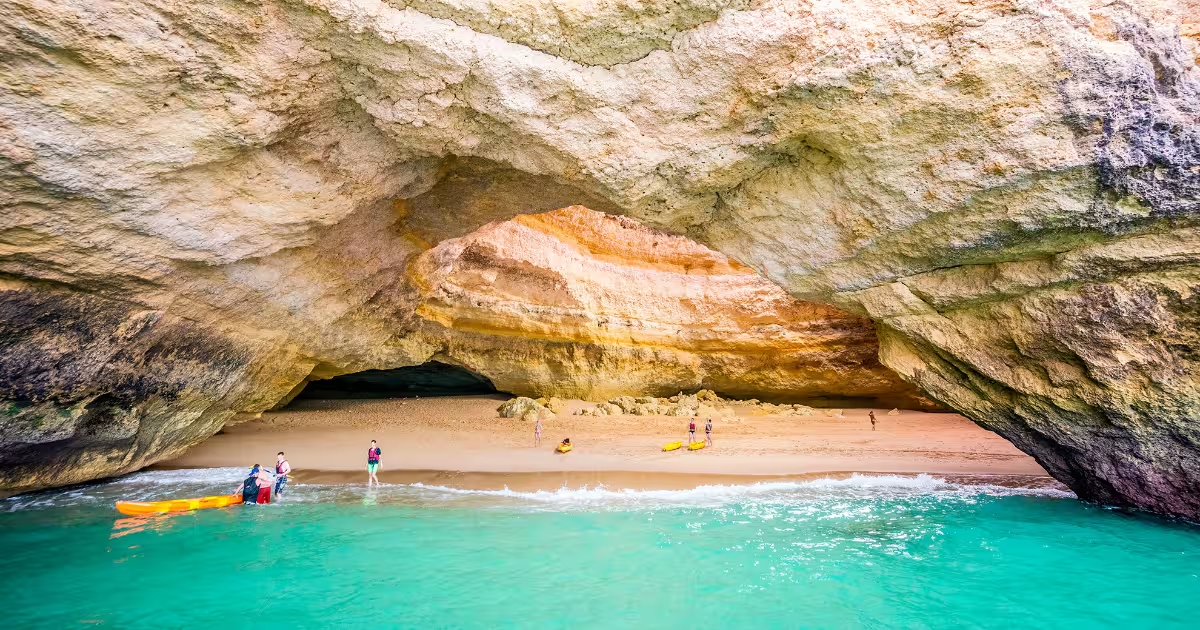
The Algarve's 155 kilometres of Atlantic coastline offer some of Europe's most accessible sea kayaking, from the sheltered lagoons of Ria Formosa near Faro to the sculpted limestone arches of Ponta da Piedade in Lagos and the cathedral-like interior of Benagil Cave near Lagoa. For first-timers, the rewards are real but so are the variables. Understanding a few foundational principles before you paddle can be the difference between a confident morning on the water and a stressful one.
Why Sea Conditions Matter More Than the Weather Forecast
A cloudless sky and a calm beach do not guarantee safe kayaking conditions. Along the Algarve's south-facing coast, Atlantic swell can wrap around headlands and create choppy water even on windless days. The standard metric to watch is significant wave height: anything above 0.5 metres adds meaningful challenge for a beginner, and anything above 1.0 metre is generally unsuitable for an inexperienced paddler in a single sea kayak.
The Portuguese Hydrographic Institute (IH) publishes real-time coastal forecasts at hidrográfico.pt, and WindFinder offers site-specific wind readings for locations including Lagos, Carvoeiro, and Albufeira. Check both at least 24 hours before your session and again the morning of your trip. Onshore winds above 15 knots will push you sideways and exhaust you quickly. Offshore winds above that threshold can carry you away from the coast faster than you can paddle back.
Tidal awareness is equally important. The Algarve operates on a semi-diurnal tidal cycle, meaning two high tides and two low tides every 24 hours, with a typical range of 2 to 3.5 metres. At Benagil Cave, the entrance narrows to roughly 2 metres wide at its floor level, and the water height at that entrance changes by up to 1 metre between high and low tide. Guides time their entry windows precisely. Solo paddlers who miscalculate that window can find themselves waiting outside in open swell for 30 to 45 minutes.
"The sea around Benagil doesn't punish ignorance immediately — it waits until you're committed to the entrance before the swell doubles in size. Experienced guides read that cycle before they leave the beach." — Algarve coastal safety instructor, 2024 maritime briefing notes.
What Gear Do You Actually Need for a Kayak Tour?
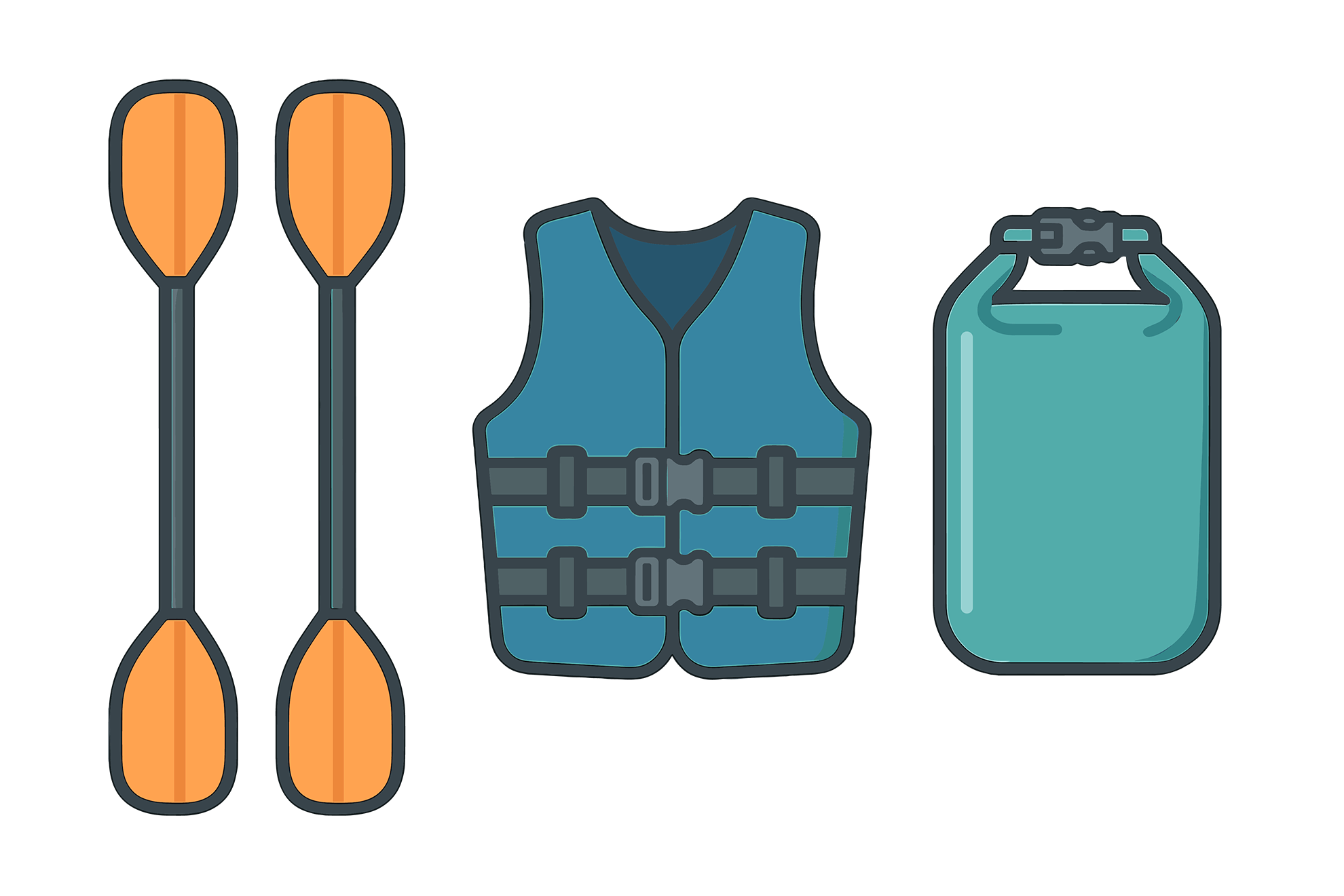
The non-negotiable item is a properly fitted personal flotation device (PFD), also called a buoyancy aid. Unlike a full life jacket, a kayaking PFD allows full arm movement while providing 50 to 70 Newtons of buoyancy, enough to keep an unconscious adult face-up in calm water. All reputable guided operators on the Algarve provide PFDs as standard, but if you are renting independently, confirm the size range available. A PFD worn loose provides significantly less protection than one fitted snugly at the chest.
A dry bag (waterproof roll-top bag) is essential for your phone, wallet, and any medication. Even a stable sit-on-top kayak can take water over the deck in a small wave, and electronic devices submerged in saltwater are rarely recoverable. A 5-litre dry bag costs under €10 at most outdoor retailers in Lagos or Albufeira and fits easily under a deck bungee cord.
A backrest or adjustable seat support makes a considerable difference on tours lasting 90 minutes or more. Most rental kayaks in the Algarve use sit-on-top ocean kayaks with moulded seat wells, and paddlers without core conditioning fatigue quickly without lumbar support. If your tour operator offers a choice of seat type, ask for an adjustable backrest, particularly for tours departing from Marinha Beach or Carvoeiro where paddling distances to the key formations are between 1.5 and 3 kilometres each way.
Other practical items: water shoes or sandals with a heel strap (flip-flops fall off in the water), a rash guard or quick-dry shirt for sun protection (UV reflection off the water is intense between 11:00 and 15:00 in July and August), and 500ml of drinking water per hour of paddling. Sunglasses with a retention strap are useful; polarised lenses reduce glare on the water surface considerably.
Paddling Technique for Beginners: The Basics Before You Launch
The foundational stroke in sea kayaking is the forward power stroke. Grip the paddle so your hands are slightly wider than shoulder-width, with each hand over the blade on its side of the kayak. To execute a power stroke, plant the blade fully in the water level with your feet, rotate your torso (not just your arms), and pull the blade back alongside the hull, exiting the water at your hip. Torso rotation is the key detail: beginners who paddle with arms only tire within 15 minutes, while paddlers using core rotation can sustain effort for two or more hours.
Steering is primarily done through sweep strokes. A forward sweep on your left side turns the kayak to the right; a reverse sweep on your right side turns it left. At narrow cave entrances such as the main arch at Benagil, which measures approximately 6 metres wide at mid-tide, you will need to straighten the kayak precisely before entering. The technique is to make small corrective sweep strokes 5 to 8 metres before the entrance, then switch to short, controlled power strokes to carry momentum through. Avoid bracing the paddle on the rock walls: wet limestone is abrasive and the rebound can capsize an unstable paddler.
"Watch where you want to go, not what you want to avoid. A kayak follows your eyes. Paddlers who stare at the rock wall tend to drift toward it." — standard coaching cue used by guided operators at Carvoeiro and Praia da Marinha.
If you capsize from a sit-on-top kayak (the standard type used on Algarve tours), the recovery is straightforward: stay with the kayak, kick to the stern, use the handle or grab rail to pull yourself back onto the hull, and swing one leg across. Practising this once in knee-deep water before your tour removes the anxiety of doing it in open conditions. Most guided tours include a brief wet exit and remount demonstration at the launch beach.
Which Algarve Location Suits Your Skill Level?
The Algarve coast can be roughly divided into three paddling environments, each suited to a different level of confidence and fitness.
Ria Formosa (Faro area): The Ria Formosa Natural Park is a 60-kilometre coastal lagoon system protected from direct Atlantic swell by a chain of barrier islands. Water inside the lagoon is tidal but rarely produces waves above 0.1 metres. This is the most beginner-friendly kayaking environment in the Algarve, ideal for paddlers who want to focus on technique, observe birdlife (including flamingos and spoonbills resident year-round), and explore shallow channels without open-sea exposure. A 2-hour rental from the park's main access points near Faro covers roughly 5 to 8 kilometres at a relaxed pace.
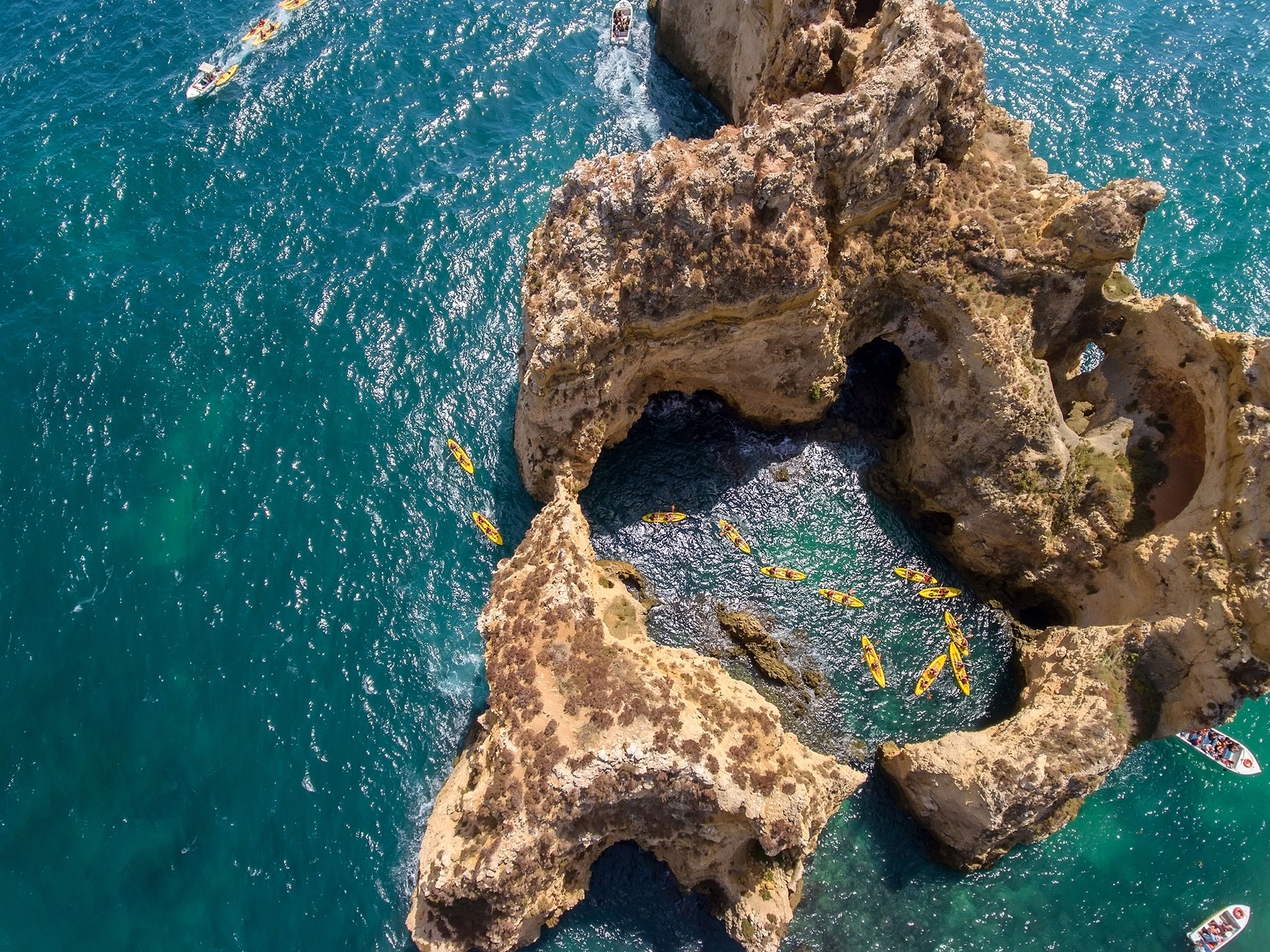
Lagos and Ponta da Piedade: The sea conditions here are moderate. The Ponta da Piedade headland, located 2 kilometres south of Lagos marina, features a dense concentration of sea stacks, arches, and grottoes carved into reddish-orange Mesozoic limestone. Paddling distances from the main launch beach are between 1 and 2.5 kilometres to reach the inner formations. Open-water crossings between rock formations expose paddlers briefly to unobstructed swell. Beginners with a guide in moderate conditions (swell under 0.4 metres) can manage this route comfortably. Some tours from Lagos combine a catamaran segment with a kayak segment, reducing the open-water distance required by paddle.
Benagil and the Carvoeiro coast: This stretch between Carvoeiro and Armação de Pêra is the most demanding of the three. The approach to Benagil Cave involves open coastline with no shelter from westerly swell, and the final 200 metres of approach require precise paddling in water that can surge against limestone cliffs. The cave interior, known formally as Algar de Benagil, features a 50-metre domed ceiling with a natural oculus approximately 5 metres wide at its apex. The visual reward is significant, but the maritime conditions make this a route best undertaken with an experienced guide, not on a rental kayak from the beach. Neighbouring Praia da Marinha, 1.5 kilometres east of Benagil, offers a slightly more sheltered launch for guided tours approaching from the east.
Guided Tour vs. Independent Rental: An Honest Comparison
Independent kayak rental allows flexibility: you choose your own pace, your own route, and your own departure time. For experienced paddlers in sheltered water, such as Ria Formosa, a 2-hour rental is a practical and cost-effective option. Rental operators in Lagos and Albufeira also offer sit-on-top doubles, which are more stable than singles and suitable for two paddlers of mixed ability.
For first-timers approaching exposed coastal environments, however, a guided tour offers several practical advantages that go beyond instruction. Guides employed by licensed Algarve operators carry maritime first-aid certification, VHF marine radio (required by Portuguese maritime authority DGRM for commercial sea kayak operations), and tow lines for assisting a tired or capsized paddler. They also carry current local knowledge that no app replicates: which rock formations are passable today based on this morning's swell, which sections of cliff are currently shedding rock after recent storms, and which tidal window gives the best light inside Benagil Cave (typically 10:00 to 12:00 on south-facing days).
ToursXplorer lists guided sea kayak tours across all three main Algarve paddling zones, each operated by DGRM-licensed companies with a maximum group size of eight to twelve participants depending on the route. Small group sizes are not just a marketing detail: in a narrow cave entrance, a group of twelve paddlers moving in sequence requires precise timing and spacing. Operators running groups larger than twelve in confined coastal environments significantly increase the risk of collisions and congestion at entry points.
A practical note on timing: sunrise tours departing at approximately 07:00 from Benagil beach consistently offer the calmest sea conditions of the day (morning offshore thermal winds have not yet developed) and the lowest foot traffic inside the cave. The tradeoff is a 90-minute alarm call. Most participants describe it as worthwhile.
Benagil Cave Kayak Tours
Lagos Kayak Tours
Albufeira & Ria Formosa Kayak Tours
Ready to get on the water? Browse all guided sea kayak tours across the Algarve on ToursXplorer, from sunrise paddles at Benagil to sheltered lagoon rentals in Ria Formosa. Filter by location, group size, and difficulty level to find the right fit for your first session.
Click hereHow ToursXplorer Selects Algarve Kayak Operators
Every kayak tour listed on ToursXplorer is operated by a company holding a valid licence issued by the Direção-Geral de Recursos Naturais, Segurança e Serviços Marítimos (DGRM), the Portuguese authority responsible for maritime commercial activity. Operators are required to carry third-party liability insurance, maintain VHF radio contact with the local maritime rescue coordination centre (MRCC Lisbon covers the entire Algarve coastline), and enforce maximum group sizes consistent with the route's risk profile.
ToursXplorer does not list operators who exceed those group size limits, use equipment older than five years without documented maintenance records, or have received unresolved safety complaints in the preceding 12 months. The selection criteria prioritise maritime safety compliance above pricing or commission rate.
If you have questions about a specific tour's safety procedures, departure conditions, or cancellation policy in the event of poor sea conditions, each tour page includes a direct contact option for the operator. Portuguese maritime law requires that any guided sea kayak tour be cancelled if significant wave height at the departure location exceeds 1.0 metre at the time of launch. Reputable operators adhere to this threshold even when participants have already arrived at the beach.
When Is the Best Time of Year to Go Sea Kayaking in the Algarve?
The Algarve kayaking season runs effectively year-round due to the region's mild Atlantic climate, but conditions vary considerably by month. May, June, and September are widely considered the optimal months for beginner sea kayaking: air temperatures range from 22 to 28 degrees Celsius, Atlantic swell averages between 0.3 and 0.7 metres on the south coast, and the tourist density at cave entrances is lower than in July and August.
July and August bring the most stable weather but also the highest visitor numbers. At Benagil Cave in particular, the combination of boat tours, paddleboard rentals, and kayak groups creates significant congestion at the cave entrance between 09:00 and 14:00. Sunrise tours departing before 07:30 largely avoid this window. Water temperature in August reaches approximately 21 to 23 degrees Celsius at the surface, reducing the hypothermia risk for swimmers and capsized paddlers significantly compared to February, when surface temperatures drop to around 16 degrees Celsius.
Winter kayaking in the Algarve is practised by experienced paddlers and locals, but swell from North Atlantic storms regularly exceeds 2 metres on the exposed western Algarve coast between November and March. The Ria Formosa lagoon remains sheltered and paddleable year-round, making it the only location where a complete beginner can realistically kayak in January without specialist cold-water training.
Frequently Asked Questions
Yes, if you choose the right location and join a guided tour. Sheltered environments like Ria Formosa near Faro are suitable for all fitness levels. Exposed coastal routes such as Benagil require a licensed guide. All commercial operators listed on ToursXplorer hold DGRM maritime licences and carry VHF radio and first-aid equipment.
No prior kayaking experience is required, but a reasonable level of physical fitness is helpful. Guided tours to Benagil cover between 2 and 4 kilometres of open coastline. Guides provide a technique briefing before departure and assist paddlers throughout. The cave entrance is approximately 6 metres wide at mid-tide and requires basic steering control to navigate safely.
Wear a quick-dry shirt or rash guard, water shoes with heel straps, and a swimsuit or board shorts. Your tour operator provides a buoyancy aid (PFD). Bring polarised sunglasses with a retention strap, sunscreen rated SPF 50, and at least 500ml of water per hour. Avoid cotton clothing, which retains cold water and increases fatigue.
Morning sessions departing between 07:00 and 09:00 offer the calmest sea conditions and the best natural light inside the cave. The cave's natural oculus, roughly 5 metres wide at the apex of its 50-metre dome, projects direct sunlight onto the interior beach between approximately 10:00 and 12:00 on clear days. Sunrise tours also avoid the peak congestion period from boat and paddleboard tours.
Yes. Kayak rentals are available at Ria Formosa Natural Park near Faro and at several beach operators in Lagos and Albufeira. Independent rental is most appropriate in sheltered water. For exposed coastal routes including Benagil and Ponta da Piedade, a guided tour is the safer choice for anyone without prior sea kayaking experience, regardless of general fitness level.
Book at least 3 to 5 days in advance during May, June, and September, and 7 to 14 days ahead in July and August when demand peaks. Sunrise tours and small-group private sessions at Benagil fill fastest. All operators reserve the right to cancel due to adverse sea conditions, typically when significant wave height exceeds 1.0 metre, and will offer a reschedule or full refund.