




Kayaking in São Miguel: 5 Volcanic Lakes and Coastal Routes Worth Paddling
From the circular crater of Vila Franca do Campo to the steaming shores of Furnas, São Miguel rewards every paddle stroke with a perspective no trail can match.
São Miguel, the largest island in the Azores archipelago, sits on a volcanic hotspot roughly 1,500 kilometres west of Lisbon. Its crater lakes, flooded calderas, and basalt-edged coastline create a setting where kayaking is not simply a sport but a method of exploration. Whether you paddle into a centuries-old volcanic ring or glide past fumaroles on a geothermal lake, the island offers five distinct water routes that suit beginners and seasoned paddlers alike.
What makes São Miguel one of Europe's most distinctive kayaking destinations?
São Miguel stretches approximately 65 kilometres from east to west and rises from the Atlantic through a series of overlapping volcanic structures. Three of its crater lakes — Sete Cidades, Furnas, and Lagoa do Fogo — sit above 400 metres in altitude, while the submerged caldera of Vila Franca do Campo lies just offshore at sea level. This geological variety means that a kayaker can experience mirror-still freshwater basins, open ocean swell, and geothermal shorelines within a single island stay.
The waters around São Miguel are unusually clear. Atlantic visibility in the south coast bays regularly reaches 15 to 20 metres, and the freshwater crater lakes carry minimal turbidity because they have no river inflows. For a paddler, this translates into a constant visual engagement with the underwater world below the hull.
Kayaking in São Miguel operates on a different clock. The island moves slowly, the currents are gentle in the sheltered lakes, and the only sounds on Lagoa do Fogo on a Tuesday morning are oar dip and birdcall. That rhythm is the point.
The Azores sit within the Macaronesia biogeographic region, sharing flora and fauna with Madeira and the Canary Islands but maintaining species found nowhere else. The endemic Azores bullfinch (Pyrrhula murina), critically endangered as recently as the early 2000s, inhabits the laurissilva forest above Furnas Lake. Paddling the lake's perimeter in the early morning brings you within earshot of this bird without disturbing its habitat.
Route 1 — Vila Franca do Campo: Can you kayak to the Princess Ring?
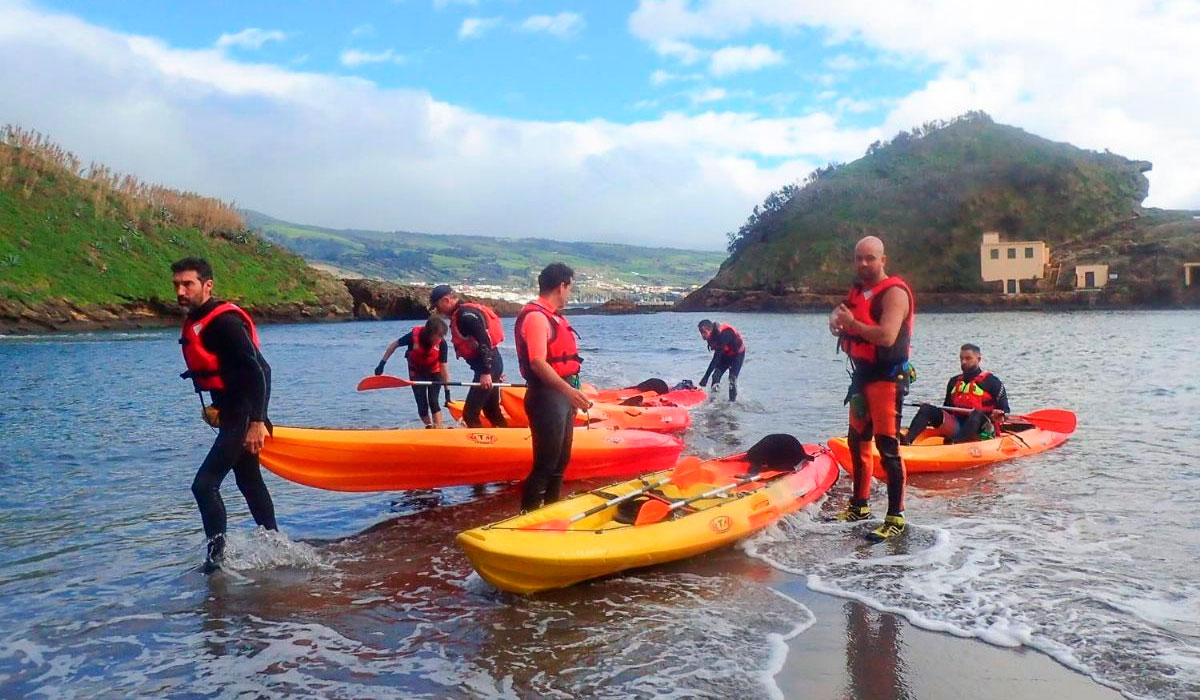
The Vila Franca do Campo islet is a flooded volcanic cone located approximately 800 metres offshore from the village of the same name on São Miguel's south coast. The islet was formed by a Surtseyan eruption and has since eroded into a near-perfect circle, earning its popular name the Princess Ring Azores. The inner lagoon measures roughly 200 metres in diameter and sits behind a low rock breach that allows small watercraft to enter.
Kayaking to the islet from the Vila Franca do Campo marina takes between 15 and 25 minutes depending on sea conditions. The paddle crosses open Atlantic water, so operators assess wind and swell before departure. Once inside the circular lagoon, paddlers can anchor their kayak on the sandy bottom in 1 to 3 metres of water and snorkel among Sparidae species including Diplodus sargus (white seabream) and Oblada melanura (saddled seabream). The combination of snorkeling and kayaking Azores-style is at its most photogenic here.
Access to the islet is regulated by the Azorean regional government. A maximum of 400 visitors per day are permitted entry, and the quota fills quickly between June and September. Guided tours that include kayak transit tend to secure priority access through pre-arranged permits, which is one practical reason to book a structured excursion rather than rely on independent kayak rental São Miguel arrangements for this specific route.
The full-day format suits this route well. After the morning paddle to the islet, operators typically allow time for snorkeling, a lunch break in Vila Franca do Campo town (founded in 1503, it is one of the oldest settlements on the island), and an afternoon coastal exploration of the basaltic sea caves between Ponta do Cintrão and Lagoa dos Covões.
Route 2 — Sete Cidades: What does it feel like to pass under the famous bridge by kayak?
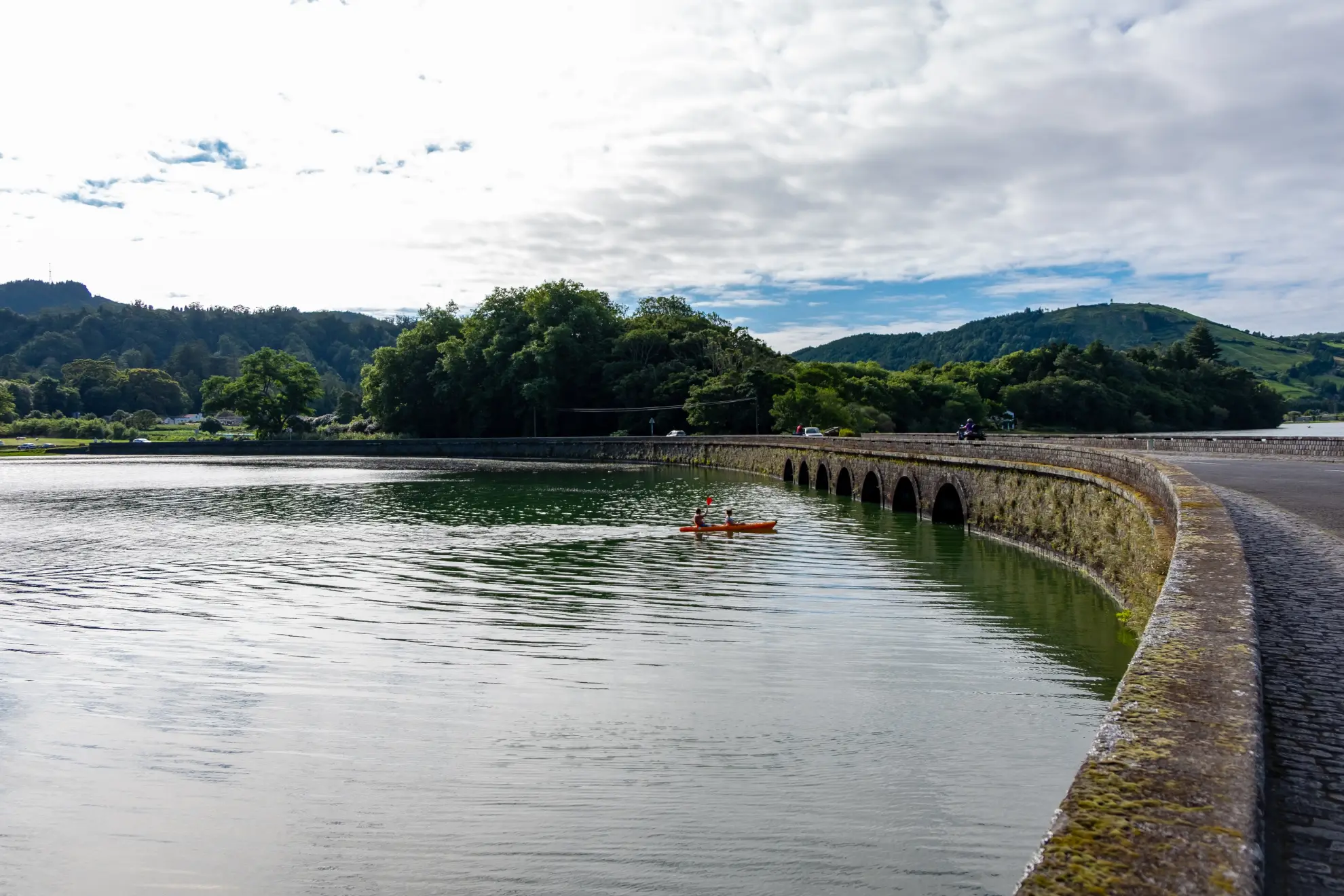
Sete Cidades occupies the westernmost caldera of São Miguel, a volcanic depression approximately 12 kilometres in circumference at the rim. The twin lakes — Lagoa Azul and Lagoa Verde — are separated by a narrow isthmus crossed by the Ponte das Sete Cidades, a stone bridge built in 1928. The two lakes appear in different shades because of their differing orientations to the sky; Lagoa Azul reflects the northern light more directly, while Lagoa Verde sits in partial shadow and takes a greener cast.
Every hiker on the Vista do Rei belvedere sees the bridge from above. The kayaker passes underneath it at water level, watching the stone arch frame a corridor between two entirely different colour fields. It is one of the few perspectives on São Miguel that cannot be replicated on foot.
Sete Cidades is the calmest of the island's kayaking routes. The combined surface area of both lakes exceeds 4.4 square kilometres, and because the caldera walls block coastal winds, the water surface remains flat for the majority of the day. This makes it the most accessible route for first-time paddlers and families.
The lake system sits within the Paisagem Protegida das Lagoas de Sete Cidades, a protected landscape area. Commercial operators running guided kayak tours Azores at this site are required to hold environmental permits issued by the regional government of the Azores. Some visitors question whether a guide is necessary for Sete Cidades. The lake itself presents no navigational hazard, but a guide provides ecological context, identifies the wetland species including Anas platyrhynchos (mallard) and introduced Micropterus salmoides (largemouth bass), and ensures that kayaks do not enter the protected reed-bed margins where water birds nest between April and July.
Routes 3 and 4 — Furnas and Lagoa do Fogo: How do volcanic crater lakes differ as kayaking environments?
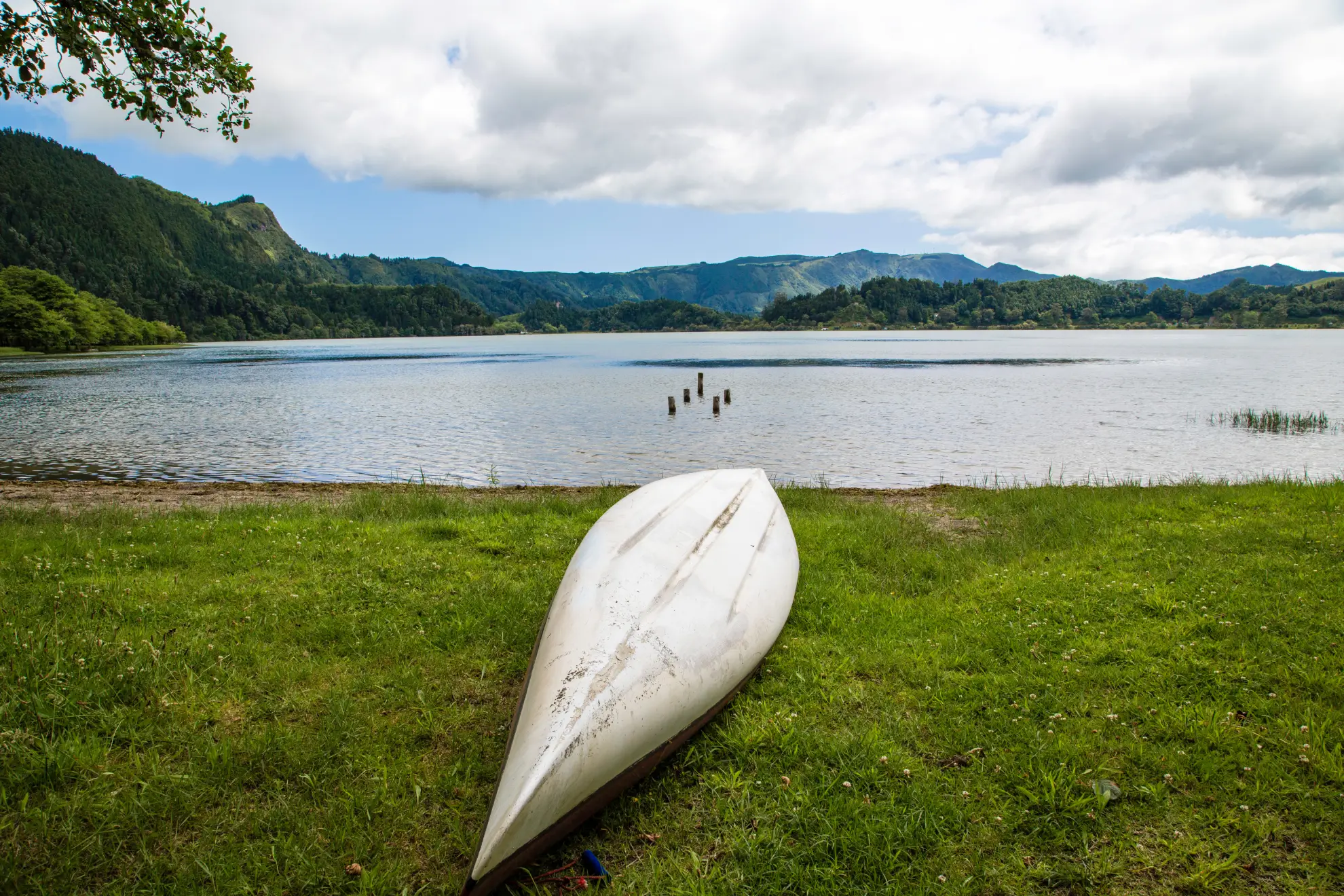
Furnas Lake, located in the eastern caldera of São Miguel at an altitude of 290 metres, offers a kayaking experience shaped by active geothermal processes. The lake covers 1.7 square kilometres and reaches a maximum depth of 10.5 metres. Along its northern shore, a field of fumaroles and boiling mud pools discharges sulfurous gases at temperatures up to 100 degrees Celsius. Paddlers on the lake can approach within 30 to 40 metres of these vents by kayak, observing the steam columns and the yellowed mineral deposits on the shoreline rocks. The smell of hydrogen sulfide is noticeable but not overwhelming at this distance.
The municipality of Furnas has operated a geothermal cooking tradition since at least the 19th century. The cozido das Furnas, a slow-cooked stew, is buried in iron pots near the fumaroles each morning and served by local restaurants at midday. Combining a morning paddle on the lake with lunch in Furnas village creates a half-day itinerary that captures both the volcanic character and the food culture of the region.
Lagoa do Fogo (Lake of Fire) sits higher, at 590 metres, in the Serra Devassa caldera in central São Miguel. It is the island's most strictly protected lake and falls within the Reserva Natural da Lagoa do Fogo, designated a nature reserve in 1980. Independent kayak access is prohibited; all paddling must occur through licensed operators who hold specific concessions from the regional environment authority. The lake covers approximately 1.5 square kilometres, is fed entirely by rainfall and condensation from the surrounding cloud forest, and carries no artificial infrastructure on its shores. Because visitor numbers are capped, Lagoa do Fogo consistently offers the quietest, most undisturbed experience of the five routes covered here.
Route 5 — The South Coast: What should ocean kayakers know before paddling between Ponta Delgada and São Roque?
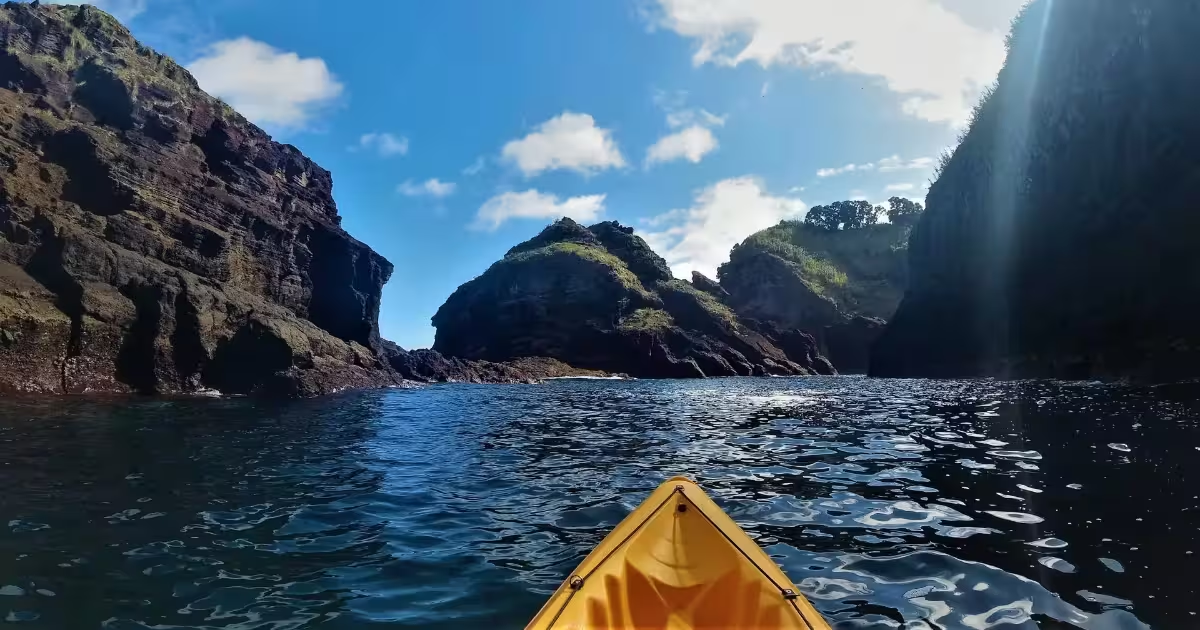
The open Atlantic route along São Miguel's south coast runs approximately 11 kilometres between the marina of Ponta Delgada (the island's capital, population roughly 68,000) and the bay of São Roque. This is the most demanding of the five routes and is suited to paddlers with prior sea kayaking experience. The coastline is composed of layered basalt flows, and wave erosion has carved a sequence of arches, tunnels, and sea caves between Punta Delgada harbour and Ilhéu de São Roque.
Conditions on this stretch are highly variable. The prevailing wind is from the northwest in summer, which means an outbound paddle east is typically assisted but the return is harder. Guided operators monitor IPMA (Portuguese Institute for Sea and Atmosphere) forecasts and will cancel or redirect the route if significant wave height exceeds 0.8 metres. Sea surface temperatures around São Miguel range from approximately 17 degrees Celsius in February to 24 degrees in August and September, which are also the calmest months for ocean kayaking.
The basalt sea caves on this coast are home to nesting Calonectris borealis (Cory's shearwater), the largest seabird breeding colony in the Azores. Paddlers should maintain a minimum distance of 10 metres from cave entrances during the nesting season, which runs from May to October. Responsible operators on ToursXplorer's platform include explicit wildlife distancing guidelines in their pre-departure briefings.
For those combining ocean kayaking with a broader water-sports itinerary, the south coast paddle pairs well with a post-activity soak at the Dona Beija hot springs (Poça da Dona Beija) in Ribeira Grande, located approximately 18 kilometres northeast of Ponta Delgada, or the thermal pools of Terra Nostra Garden in Furnas. Both hot springs in sao miguel azores sit within 45 minutes of the south coast launch points and offer a practical and historically grounded way to decompress after a session on the water. Terra Nostra's thermal pool has been in continuous use since 1780.
Guided Kayaking and Paddling Tours on São Miguel
Ready to paddle São Miguel's volcanic lakes and coastal arches? Browse all guided kayaking and canoeing tours on ToursXplorer and book with confirmed permit access.
Click hereGuided tours vs. kayak rental in São Miguel: which suits your trip?
Independent kayak rental São Miguel is available through several waterfront operators in Ponta Delgada, Vila Franca do Campo, and Sete Cidades, with hourly rates typically ranging from 15 to 25 euros per single kayak in 2026. This option works well for experienced paddlers who want unstructured time on the Sete Cidades lakes or along sheltered coastal sections near Ponta Delgada harbour.
Guided tours carry a higher upfront cost but include permit coordination (essential for Lagoa do Fogo and Vila Franca do Campo islet), safety equipment, transport logistics, and ecological briefings. For visitors unfamiliar with Atlantic sea conditions or the specific regulations governing Azorean protected areas, a guided format removes meaningful uncertainty from the day.
ToursXplorer lists verified operators across both categories, allowing travellers to compare itineraries, group sizes, and included equipment before booking. All operators on the platform are required to carry Azorean regional tourism licences and public liability insurance. For the ocean south coast route in particular, ToursXplorer recommends booking only with operators who provide a pre-departure weather assessment and a named rescue contact protocol.
Whichever format you choose, eco-friendly practices are increasingly codified by Azorean regulation. Since 2022, commercial kayak operators on protected lakes are required to use non-motorised support vessels, restrict group sizes to a maximum of 12 paddlers, and avoid single-use plastics during excursions. These rules apply to all licensed operators and are monitored by the regional Serviço de Proteção da Natureza e do Ambiente (SPEN).
Combining kayaking with hot springs: the practical post-paddle itinerary
The effort of a full day's paddling on São Miguel pairs naturally with the island's geothermal infrastructure. The two most accessible thermal facilities are Terra Nostra Garden in Furnas, whose iron-rich ochre pool has been in use since 1780 and maintains a constant temperature of approximately 39 degrees Celsius, and Poça da Dona Beija in Ribeira Grande, an outdoor pool complex fed by a natural hot spring at around 40 degrees Celsius and open until late evening.
Kayakers finishing a Furnas Lake session in the morning can reach Terra Nostra Garden in under 10 minutes by road. Those completing the south coast ocean route from Ponta Delgada are approximately 45 minutes from both facilities. The sequence of physical exertion followed by thermal recovery is a practical itinerary, not simply a marketing combination. Lactic acid clearance in warm water is supported by physiological evidence, and the mineral content of Azorean thermal waters (high in iron, bicarbonate, and silica) has been associated with skin and musculoskeletal benefit in regional balneology research since at least the late 19th century.
For those building a multi-day São Miguel itinerary, ToursXplorer's search tools allow filtering by activity category and location, making it straightforward to sequence a Sete Cidades kayak day with a Furnas thermal afternoon without duplicating travel across the island's single central highway, the EN1-1A.
Frequently Asked Questions
Yes. The islet sits approximately 800 metres offshore and is reachable by kayak in 15 to 25 minutes from Vila Franca do Campo marina. Access to the inner lagoon is regulated by the Azorean government, with a daily visitor cap of 400 people. Booking through a licensed operator is the most reliable way to secure entry, especially between June and September when the quota fills early.
A guide is not legally required for paddling on Sete Cidades lakes, but all commercial operators must hold environmental permits. Independent kayak rental is available locally. A guide adds value by identifying protected nesting areas along the reed-bed margins (relevant April to July) and providing ecological context for the twin lakes, whose combined surface area exceeds 4.4 square kilometres.
The five main options are Sete Cidades (calmest, most accessible), Furnas Lake (geothermal fumaroles along the shore), Lagoa do Fogo (most protected, guided access only, permits required), and the coastal Vila Franca do Campo islet (ocean paddle to a flooded crater). Each offers a different environment. Sete Cidades suits beginners; Lagoa do Fogo suits those prioritising solitude and wilderness.
July through September offers the calmest sea conditions, warmest water temperatures (up to 24 degrees Celsius), and longest daylight hours. June is a good compromise with fewer crowds. Ocean routes along the south coast are weather-dependent year-round; operators follow IPMA forecasts and may cancel if wave height exceeds 0.8 metres. Crater lake kayaking is viable from April through October.
Yes, and Vila Franca do Campo islet is the primary location for this combination. The inner lagoon's water depth of 1 to 3 metres and high Atlantic clarity (visibility up to 20 metres in the surrounding bay) make it suitable for surface snorkeling. Species commonly encountered include white seabream and saddled seabream. Most full-day kayak tours to the islet include snorkeling equipment in the booking price.
Yes. Terra Nostra Garden in Furnas (pool temperature approximately 39 degrees Celsius, in use since 1780) is within 10 minutes of Furnas Lake kayaking sites. Poça da Dona Beija in Ribeira Grande is approximately 45 minutes from Ponta Delgada and open into the evening. Both are practical post-paddle options and are accessible via the EN1-1A highway that crosses central São Miguel.