




Ilha Berlenga Portugal: The Complete Guide to Beaches, Caves & Boat Trips
Everything you need to plan a day trip or overnight stay on Portugal's most protected Atlantic island, from sea caves to sea birds.
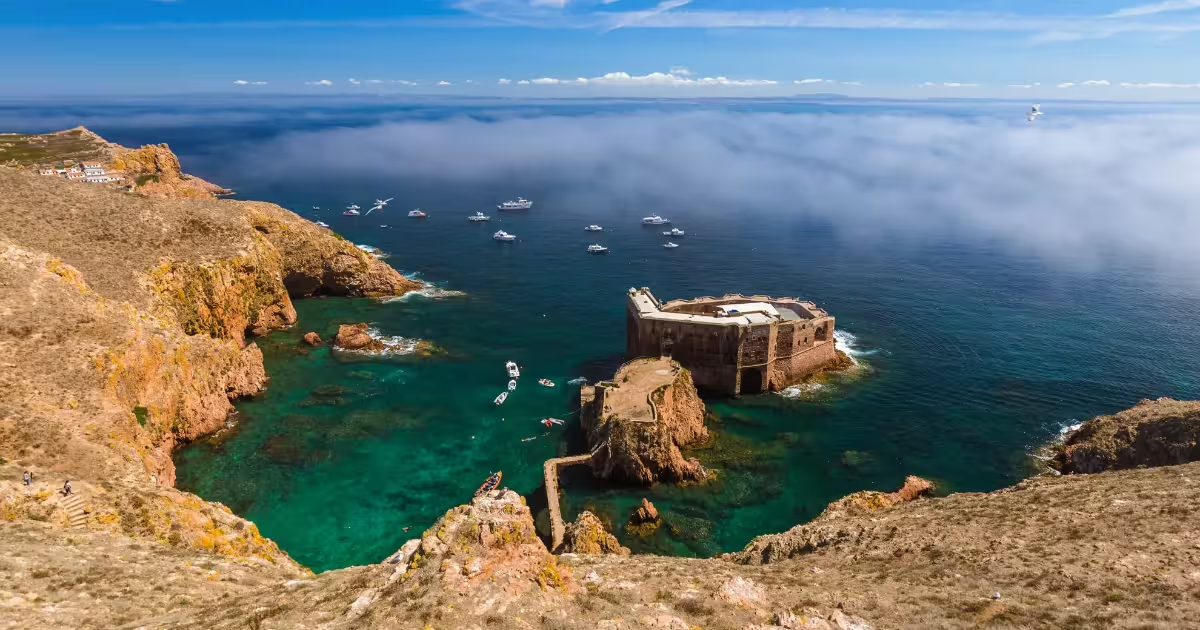
Roughly 12 kilometres off the coast of Peniche, Ilha Berlenga rises from the Atlantic as a block of ancient red granite. It is the largest island in the Berlengas Archipelago, a UNESCO Biosphere Reserve since 1984, and one of the few places along the Portuguese coast where daily visitor numbers are officially capped to protect its marine and terrestrial ecosystems. The island measures just 1.5 kilometres in length, yet it packs in sea caves, a 17th-century fort, clear snorkeling waters, and nesting grounds for endangered seabirds.
Where Is Berlenga Island and What Makes It Special?
Ilha Berlenga sits 12 kilometres west of Peniche, a fishing port roughly 100 kilometres north of Lisbon along the Atlantic coast. The island is the centrepiece of the Berlengas Archipelago, which also includes the smaller Estelas and Farilhões island groups. Together they form the Berlengas Natural Reserve, classified as a UNESCO Biosphere Reserve in 1984 and one of Portugal's most rigorously protected natural areas.
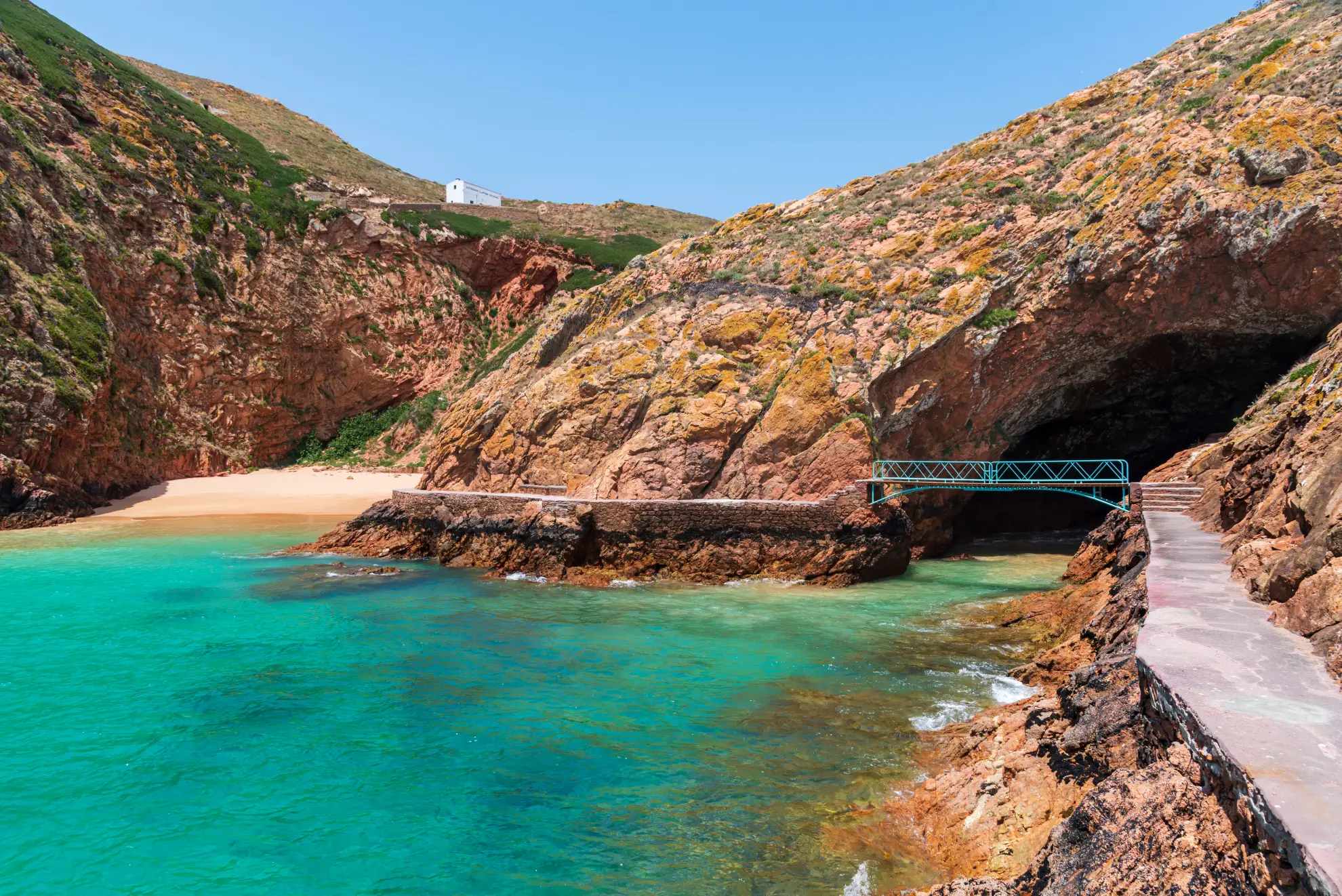
The island's geology is immediately distinctive. Its surface is composed of Hercynian granite formed over 290 million years ago, giving the rock its characteristic rust-orange and pink colouring. At sea level, centuries of Atlantic erosion have carved an elaborate system of tunnels, arches, and sea caves, the most visited of which is the Gruta Azul (Blue Grotto), accessible only by rowing boat or guided kayak.
"Berlenga functions as an ecological island within an island: the reserve's no-take marine zone was established in 1998, creating one of the most productive fish nurseries on the Iberian Atlantic coast."
Unlike the Azores or Madeira, Berlenga demands no long flight. It is a logical half-day extension of a trip to Peniche or a well-structured day trip from Lisbon. What separates it from other short-haul Portuguese islands is the combination of strict visitor limits, the absence of cars, and an underwater visibility that regularly exceeds 15 metres on calm days, making it one of the best snorkeling destinations in mainland Portugal.
How Do You Get to Berlenga Island from Peniche?
The ferry service to Berlenga departs from Porto de Pesca de Peniche, the main fishing harbour in the town of Peniche. The standard crossing takes between 35 and 45 minutes depending on sea conditions. During summer months (June through September) multiple daily departures operate, typically at 09:30 and 11:00, with return boats leaving the island at 16:00 and 18:00. Outside high season the schedule is significantly reduced and crossings are suspended entirely when Atlantic swell exceeds safe limits, which can happen even in spring.
Sea conditions on this stretch of Atlantic are influenced by the exposure to open-ocean swells rolling in from the west. Passengers prone to motion sickness are advised to take medication at least 30 minutes before departure. Sitting on the outer deck and keeping a fixed horizon in view reduces discomfort for many travellers. Swells of 1.5 to 2 metres are not unusual even in July.
Guided boat tours, including options bookable through ToursXplorer, often include a narrated commentary during the crossing, pointing out coastal rock formations, birdlife, and the first views of the fort as the island comes into range. Some operators use fast rigid-hulled inflatable boats while others run catamaran-style vessels with covered seating. Both reach the island's single jetty at Porto das Berlengas.
"Because the reserve caps daily visitor numbers at approximately 1,500 people during peak season, booking ferry or tour tickets well in advance, sometimes six to eight weeks ahead in July and August, is not an exaggeration."
From Lisbon, travellers without a car can reach Peniche by Rodoviária do Oeste bus from Campo Grande station in approximately 1 hour and 20 minutes. Driving the A8 motorway takes around 80 minutes. Organised full-day tours from Lisbon handle all logistics, including ground transport, the boat crossing, and a guided program on the island.
What Are the Best Things to Do on Berlenga Island?
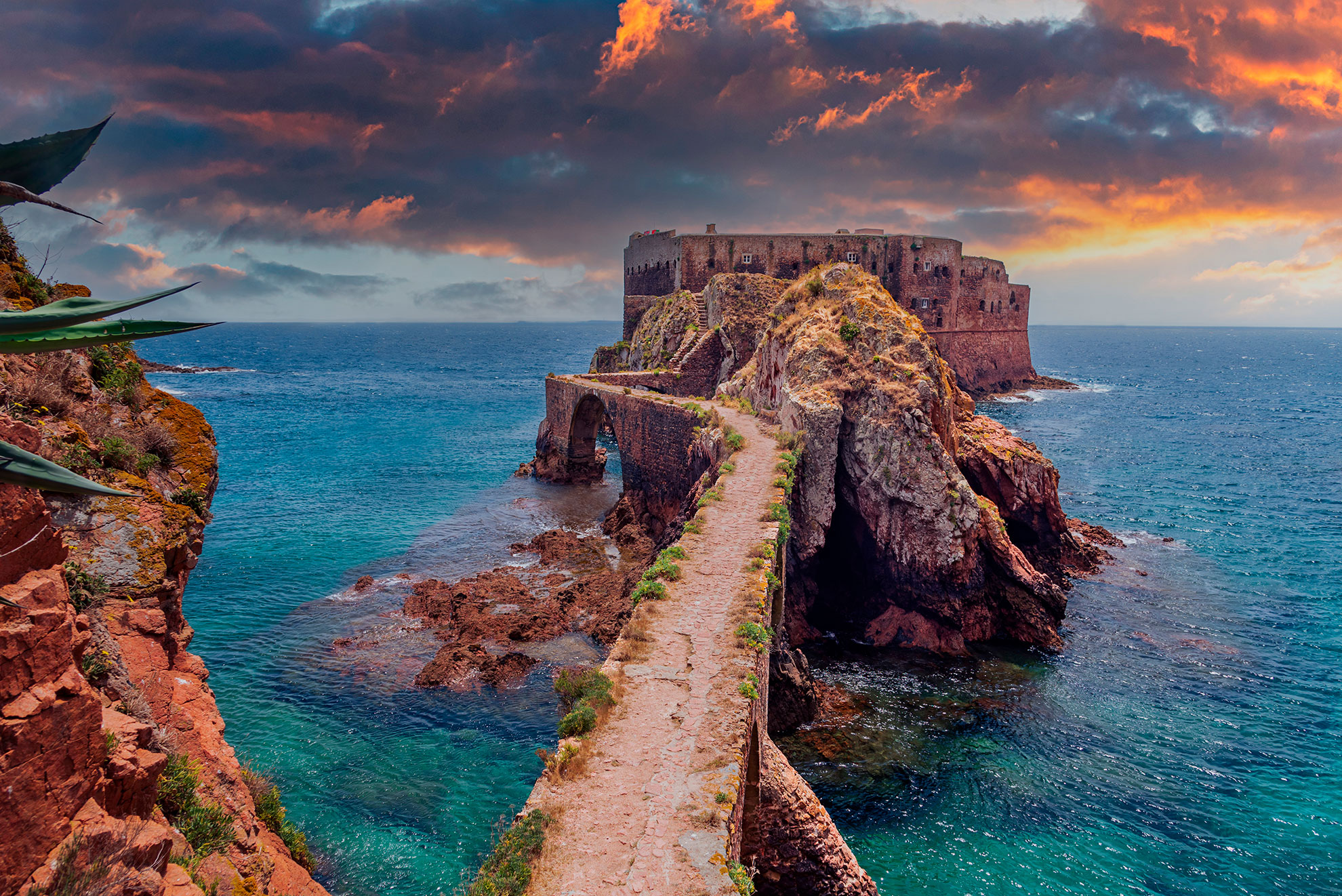
Fort São João Baptista is the island's most recognisable landmark. Construction of the fortification began in 1651 under orders from King João IV, replacing an earlier Hieronymite monastery that had been repeatedly raided by Algerian corsairs and Dutch naval forces in the early 17th century. The fort sits on a small islet connected to the main island by a narrow stone causeway and commands views across the entire western approach. Entry is free and the structure houses a small seasonal café as well as basic overnight accommodation.
Sea cave exploration is the activity most visitors remember longest. The Gruta Azul can be entered only at low tide and on calm days, when the water inside shifts between cobalt and pale green as light reflects off submerged granite. Rowing boats available for hire at the harbour charge by the hour. Guided kayak tours navigate the same tunnel systems and also access Cova do Sonho, a larger cavern on the island's southern coast.
Snorkeling off Praia do Carreiro do Mosteiro, the island's main and only sandy beach, reveals populations of Atlantic wrasse, parrotfish (Sparidae family), and occasional octopus among the kelp. The beach faces east, sheltered from prevailing westerly winds, which keeps the water relatively calm even when the open coast is rougher. Visibility on a clear summer day can reach 10 to 15 metres.
The island's hiking trail network is compact but rewarding. A marked path circumnavigates the main plateau, covering roughly 3 kilometres and passing the lighthouse (Farol da Berlenga, built in 1841), the ruins of the monastery, and several viewpoints over the Farilhões group 8 kilometres to the northwest. Allow 90 minutes for the full loop at a relaxed pace.
Wildlife observation is a significant draw for naturalists. Berlenga supports one of the largest European colonies of Phalacrocorax aristotelis (European shag), along with nesting Larus michahellis (yellow-legged gulls) and seasonal visits from Puffinus puffinus (Manx shearwater). Between June and September, common dolphins (Delphinus delphis) are frequently spotted from the ferry and from the island's western cliffs.
Can You Stay Overnight on Berlenga Island?
Overnight accommodation on Berlenga is limited to two options: the camping ground operated by the Peniche municipality, and a small number of rooms available inside Fort São João Baptista itself. The campsite, located near the harbour, accommodates a maximum of 120 people across designated pitches. Reservations open in April each year and the summer allocation sells out rapidly, often within days.
Staying overnight fundamentally changes the experience. By mid-afternoon most day-trippers have returned to the ferry, and by early evening the island's population drops to the handful of fishermen, wardens, and overnight guests who remain. The silence, broken only by the sound of Atlantic swell and seabird calls, is a significant contrast to the midday activity. Sunsets viewed from the fort causeway, with the Peniche lighthouse blinking on the horizon, are among the most photographed moments on the island.
There is no mains electricity connection to the mainland. Power is supplied by a small diesel generator. Mobile phone signal (primarily NOS and Vodafone networks) is intermittent, particularly on the island's western side. There is no ATM, and the single café-restaurant near the harbour accepts cash only during certain periods. Visitors planning an overnight stay should carry sufficient provisions, cash, and a torch.
What Are the Best Beaches and Swimming Spots on Berlenga?
Praia do Carreiro do Mosteiro is the island's primary beach: a short arc of coarse sand and pebble backed by a low granite ridge. It faces Peniche across the channel and catches morning sun, making it the warmest swimming spot on the island before early afternoon. Water temperatures in August average 18 to 20 degrees Celsius, cooled by Atlantic upwelling. The beach has no lifeguard service.
More experienced swimmers and snorkelers seek out the rocky inlets on the island's southern flank, accessible on foot via the hiking trail. These spots lack sandy entrances but offer richer underwater terrain, including reef walls, overhangs, and the kind of fish diversity that attracts licensed scuba divers. Dive operators based in Peniche run regular excursions to the reserve's no-take zone, where grouper and bream are noticeably larger and less timid than on fished coastlines.
Glass-bottom boat tours, running on fixed schedules from the harbour, provide an accessible view of the seabed for non-swimmers. The route typically passes over the submerged granite platform north of the main jetty, where sea fans, anemones, and schooling fish are visible at depths of 4 to 8 metres.
Berlenga Island Travel Tips: What to Know Before You Go
Pack layers regardless of season. Even in July, the sea wind on exposed sections of the hiking trail can be sharp, and temperatures on the island typically run 3 to 4 degrees Celsius cooler than Peniche town. Sunscreen is essential: UV exposure on open water reflects from both sea surface and light-coloured granite. A refillable water bottle is advisable as the café's supplies are limited and single-use plastic is discouraged by reserve regulations.
The reserve enforces a strict no-littering policy and a prohibition on removing any natural material, including shells, rocks, and marine organisms. Drone flight requires prior authorisation from the Instituto da Conservação da Natureza e das Florestas (ICNF) and is rarely granted for individual visitors. Fires are forbidden across the entire archipelago.
Footwear with grip is necessary for the hiking trail, which crosses uneven granite surfaces and can be slippery near the coast. Sandals are adequate for the beach but inadequate for any exploration beyond it. There are no medical facilities on the island: the nearest hospital is in Peniche town.
Photography conditions are best in the hour after the morning ferry arrives, before the midday haze builds over the Atlantic, and again in the final hour before the last return boat. The fort photographs well in late afternoon light when the granite glows orange and the shadows on the causeway deepen. A polarising filter significantly improves underwater and cave photography by reducing surface glare.
When Is the Best Time to Visit Berlenga Island?
The ferry service operates reliably from June through September, which represents the practical window for most visitors. July and August offer the most stable sea conditions, the warmest water temperatures, and the longest daylight hours, but also the highest visitor numbers and the greatest demand on the island's limited accommodation and dining facilities.
May and October are arguably better months for travellers whose primary interest is wildlife and photography. The island's nesting seabird colonies are most active in May and June, when shags and gulls can be observed at close range from the hiking trail. Boat crossings in shoulder season carry a higher cancellation risk due to swell, but advance booking for a flexible date provides reasonable reliability.
Winter visits are possible but exceptional. The ferry runs sporadically between October and May, and crossings are cancelled without notice when Atlantic storms arrive from the northwest. The island's landscape in winter is undeniably raw, the colony quiet, and the fort at its most atmospheric, but independent access is unreliable and the camping ground is closed. Serious nature photographers and storm-chasers represent the main audience for out-of-season visits.
For most travellers planning a summer trip to the Lisbon coast or Silver Coast, a day trip to Berlenga fits naturally into a Peniche stopover. Browsing the full range of current departure options via ToursXplorer allows travellers to compare boat types, departure times, and guided versus self-guided formats before committing.
Is Berlenga Island Worth Visiting?
Berlenga warrants the trip if the visitor is drawn to raw Atlantic scenery, clear water, and the specific quietness of a place where cars, crowds, and constant connectivity are absent. It is not a beach resort. The single beach is small, the facilities minimal, and the terrain demanding in places. But as a concentrated encounter with one of the best-preserved marine reserves on the Iberian Peninsula, it is genuinely difficult to match within a two-hour radius of Lisbon.
As an alternative to the Azores or Madeira for travellers with limited time, Berlenga is a compelling case. The island delivers much of the same visual drama, including volcanic-scale rock formations, deep blue water, and rare wildlife, without the cost or logistics of a flight. As a complement to a city break in Lisbon, it represents one of the most efficient ways to experience a different dimension of Portuguese natural heritage.
Travellers who are primarily looking for beach infrastructure, dining variety, or nightlife will find Berlenga underequipped. Those who value ecological integrity, historical texture, and the kind of seascape that has changed very little since the 17th-century monks built their first monastery on the rock will find it consistently rewarding.
Guided Boat Tours and Day Trips to Berlenga Island
Ready to explore Ilha Berlenga? Browse all available boat tours and guided day trips on ToursXplorer and secure your spot before the summer allocation fills.
Click herePlanning Your Berlenga Trip: What ToursXplorer Recommends
The three tours listed on this page cover the main formats available for visiting Ilha Berlenga: a guided cave and island tour departing from Peniche, a fully managed full-day excursion from Lisbon, and an independent fast-boat transfer for travellers who prefer to explore without a group. Each suits a different travel style and logistical starting point.
For visitors already based in Peniche or the Silver Coast, the guided boat tour with cave access is the most efficient option, combining the crossing, cave circuit, and island time in a single structured day. For Lisbon-based travellers, the full-day guided tour from Lisbon eliminates the need to navigate onward connections independently and maximises time on the island.
ToursXplorer lists live availability for all three options. Given that peak-season spots are limited by the reserve's daily visitor cap, checking dates and booking at least three to four weeks ahead is advisable for any July or August travel. Shoulder-season travellers in May or September will find more flexibility, though weather-related cancellation policies should be reviewed before booking non-refundable options.
Frequently Asked Questions
Ferries and guided boat tours depart from Porto de Pesca de Peniche, the town's main fishing harbour. The crossing to Ilha Berlenga takes 35 to 45 minutes depending on sea conditions. Multiple daily departures run in summer, typically at 09:30 and 11:00, with return sailings at 16:00 and 18:00. Booking in advance is essential in July and August.
A minimum of four hours ashore is needed to visit Fort São João Baptista, walk the 3-kilometre perimeter trail, swim at Praia do Carreiro do Mosteiro, and join a rowing boat cave tour. Six hours is more comfortable and allows time for snorkeling. Most day-trip operators structure their itineraries around the ferry schedule, providing five to six hours on the island.
Yes, but options are limited to a municipal campsite (maximum 120 pitches) and a small number of rooms inside Fort São João Baptista. Both require advance booking, which opens in April each year and sells out quickly for July and August. There is no mains electricity, no ATM, and mobile signal is intermittent on the island's western side.
Berlenga is known for its sea caves (especially the Gruta Azul), its 17th-century Fort São João Baptista, exceptional underwater visibility for snorkeling and diving, and its status as a UNESCO Biosphere Reserve since 1984. The island also hosts significant seabird colonies including European shag and yellow-legged gull, and its surrounding waters form one of the best-preserved marine reserves on the Iberian Atlantic coast.
Yes, with some caveats. The main beach, Praia do Carreiro do Mosteiro, is calm enough for children on most summer days, and glass-bottom boat tours are accessible for all ages. The ferry crossing can cause seasickness in rough conditions. There are no medical facilities on the island, and the rocky hiking trail requires closed footwear. Children over six generally manage the island's terrain without difficulty.
Boat crossings are frequently cancelled between October and May due to Atlantic swell, sometimes without advance notice. Even in summer, crossings can be suspended on short notice when conditions deteriorate. Visitors with fixed schedules should build in a backup day. Mid-July to late August brings the most reliable crossings but also peak crowds and the highest risk of sold-out tickets.