




Madeira Hiking Guide 2026: 15 Best Levada Walks for Every Skill Level
From the short, family-friendly Vereda dos Balcões to the vertiginous ridge between Pico do Arieiro and Pico Ruivo, these trails reveal an island no viewpoint can replicate.
Madeira's network of levadas, irrigation channels built primarily between the 16th and 20th centuries, stretches approximately 2,500 kilometres across the island. Converted into walking trails, they form one of Europe's most accessible and ecologically rich hiking systems. Whether you have two hours or a full day, whether you are a first-time hiker or a seasoned trail runner, there is a route calibrated to your pace and ambition.
What exactly is a levada, and why do they make such good trails?
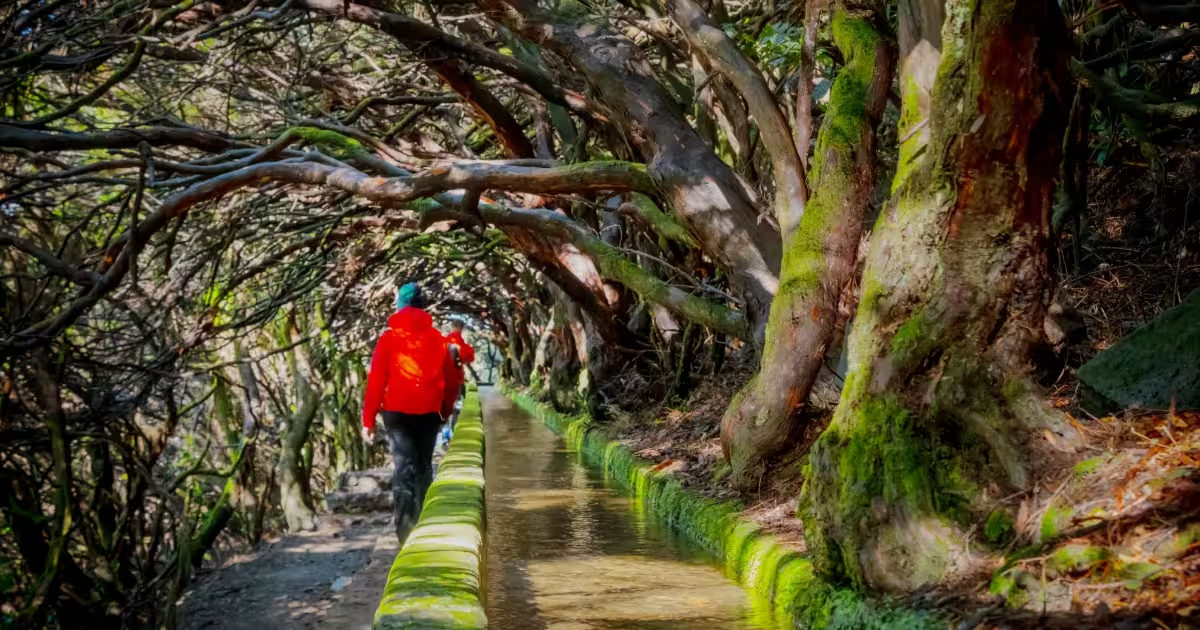
A levada is an engineered water channel, typically 40 to 60 centimetres wide, designed to carry water from the rain-soaked interior of Madeira down to the drier agricultural zones on the coast. Construction began in earnest under Portuguese settlement in the 15th century, with major expansion during the 19th and 20th centuries. Today, approximately 200 individual levada channels remain active, and the paths that maintenance workers once used to inspect them have been formalised into a trail network spanning the entire island.
The engineering logic of a levada is also what makes it perfect for hiking: because water must flow on a near-level gradient, levada paths rarely gain or lose more than a few metres of altitude per kilometre. The result is a trail that cuts horizontally across volcanic ridges and canyon walls, offering continuous viewpoints that would be impossible to reach by road. The paths pass through the Laurissilva forest, a UNESCO World Heritage Site since 1999 covering roughly 15,000 hectares of the island's interior. This is one of the last surviving examples of the subtropical laurel forest that once blanketed much of southern Europe before the last Ice Age.
Walking a levada is not simply hiking. It is tracing a working artery of the island, one that has sustained agriculture, shaped settlement patterns, and preserved an ecosystem found nowhere else in Europe at this scale.
Not all paths are benign, however. Several levada routes pass through unlit tunnels ranging from 30 metres to over 1,000 metres in length, traverse exposed ledges above vertiginous drops, and cross unstable terrain that becomes treacherous when wet. The Levada do Rei (PR18), for example, passes through 11 tunnels over its 12-kilometre length. Knowing your route's specific conditions before you lace up your boots is non-negotiable.
Which are the 15 best levada walks in Madeira, organised by difficulty?
Beginner and Easy (under 10 km, minimal elevation change)
1. Vereda dos Balcões (PR11): At just 3.4 kilometres return, this is Madeira's most popular introductory walk. Starting at Ribeiro Frio at 860 metres altitude, the path follows a levada through tree heather and laurel to a miradouro overlooking the Metade valley. On clear days, the central peaks of Pico Ruivo (1,862 m) and Pico do Arieiro (1,818 m) are visible. Duration: approximately 1.5 hours return.
2. Levada do Alecrim (PR18 partial): A 7-kilometre out-and-back route in the Paúl da Serra plateau at around 1,300 metres altitude. The terrain is open heath, giving wide views across the western highlands. Suitable for children aged 6 and above.
3. Levada dos Tornos (PR23): A 16.8-kilometre linear route from Choupana to Camacha, largely through banana plantations and eucalyptus stands at mid-altitude. Mostly flat, with no tunnels.
4. Levada da Central da Serra (PR17): A 10-kilometre loop near Ribeira Funda, passing through mixed forest with several viewpoints over the north coast cliffs.
5. Levada do Castelejo (PR7): A 5.8-kilometre walk near Porto Moniz, following the northern coast at low altitude through dense vegetation, ending at the village of Seixal.
Moderate (10 to 20 km, some elevation gain, possible tunnels)
6. Levada do Furado — Ribeiro Frio to Portela (PR10): One of the island's definitive linear walks, covering 11 kilometres from Ribeiro Frio at 860 metres to Portela at 662 metres. The path follows the Levada da Serra do Faial through dense Laurissilva canopy, passing multiple cascading tributaries. Duration: 3.5 to 4.5 hours one way. One short tunnel of approximately 100 metres is encountered; a headlamp is essential.
7. Levada do Caldeirão Verde (PR9): A 13.4-kilometre return route starting at Queimadas in the Santana municipality. The path passes through four tunnels (the longest is 1,050 metres) before reaching a 100-metre waterfall in a crater-like amphitheatre. This is the walk locals often call the island's most cinematic. Duration: 4 to 5 hours return. Headlamp mandatory.
8. Levada do Norte — Câmara de Lobos to Ribeira Brava: A coastal-to-rural transect of approximately 14 kilometres, descending through the vineyards above Câmara de Lobos (the fishing village famously painted by Winston Churchill in 1950) and finishing at the seafront of Ribeira Brava. Moderate gradient, no tunnels.
9. Levada da Rocha Vermelha (PR14): An 11.8-kilometre route from Boca da Corrida overlooking the Curral das Freiras valley, with panoramic views across the caldera.
10. Vereda do Pico Grande (PR5): A 14-kilometre circuit from Boca da Corrida gaining approximately 500 metres to the 1,657-metre summit of Pico Grande. Moderate fitness required.
Challenging (vertigo risk, long distance, or technical terrain)
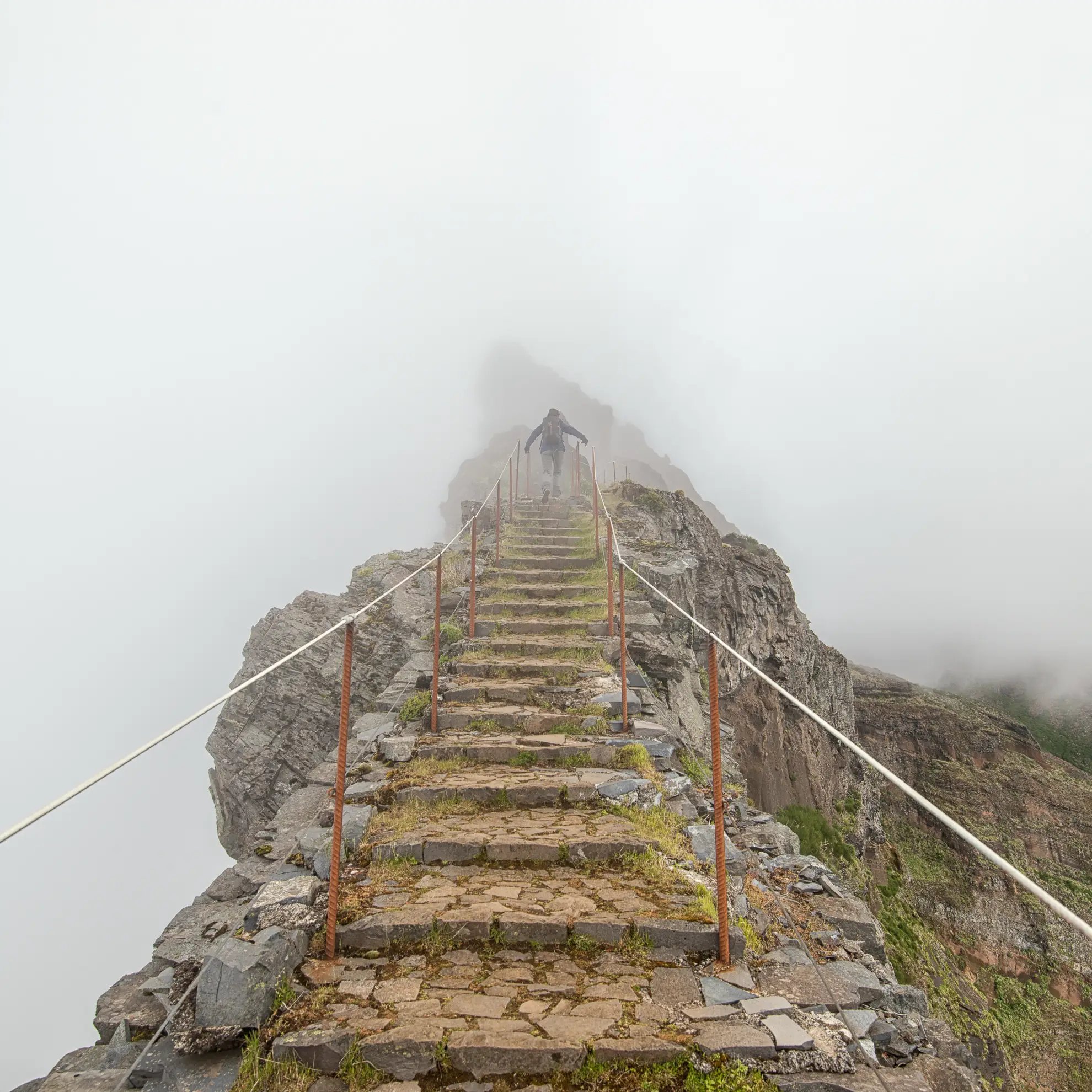
11. Vereda do Areeiro — Pico do Arieiro to Pico Ruivo (PR1): The island's most celebrated ridge walk, covering 11.7 kilometres one way between Madeira's third and highest peaks. The trail crosses exposed ridgelines, passes through seven tunnels, and includes a bypass path above the main route for those comfortable on open ledges. Duration: 4 to 6 hours one way. Altitude gain and loss combined: approximately 1,100 metres.
12. Levada do Rei (PR18): 12 kilometres through 11 tunnels in the São Jorge valley on the north coast. The final stretch enters a narrow gorge with walls draped in Adiantum reniforme (kidney fern) and Dryopteris maderensis (Madeiran wood fern). Duration: 4 to 5 hours return.
13. Vereda da Ponta de São Lourenço (PR8): A 9.4-kilometre return walk along the eastern peninsula, exposed and windswept, with views of the Desertas Islands 26 kilometres to the southeast. No forest cover. Very exposed in wind. Duration: 3 to 4 hours.
14. Levada do Risco (PR6) combined with Levada das 25 Fontes: Two interconnected trails near Rabaçal on the Paúl da Serra plateau. The 25 Fontes loop is 8 kilometres; the Risco extension adds 2.4 kilometres to a 100-metre waterfall. Combined duration: 3.5 to 5 hours.
The 25 Fontes basin, fed by 25 natural spring outlets along the rock face, supports a population of the endemic Lacerta dugesii (Madeiran wall lizard) that is noticeably habituated to hikers — a sign of how long this corridor has been traversed on foot.
15. Old Levada — Pico do Arieiro Area Full-Day Circuit: A curated full-day combination route linking the high-altitude Arieiro plateau with lower-elevation levada channels, covering 18 to 22 kilometres depending on the specific itinerary chosen. Recommended only with a guide who can navigate variable conditions in the central massif.
What are the 2026 permit rules for hiking PR routes in Madeira?
From January 2026, hikers using any of Madeira's officially designated PR (Percurso Recomendado) routes are required to pay a trail access fee of 4.50 euros per person per route. The regulation was introduced by the Secretaria Regional de Turismo e Cultura to fund path maintenance and manage visitor numbers on the most popular corridors.
Permits must be purchased in advance through the SIMplifica platform, accessible via the official Madeira tourism portal. Each booking is time-stamped and tied to a specific entry point and date. Warden checks are in place at key trailheads including Queimadas, Ribeiro Frio, and Boca da Corrida. Children under 12 are exempt from the fee. Residents of Madeira and Porto Santo are also exempt with valid ID.
The following PR routes require a permit as of January 2026: PR1 (Vereda do Areeiro), PR9 (Caldeirão Verde), PR10 (Levada do Furado), PR11 (Vereda dos Balcões), and PR8 (Ponta de São Lourenço), among others. The full updated list is published on the SIMplifica platform and is revised seasonally. Always confirm your specific route's status at least 48 hours before departure.
Failure to present a valid booking confirmation at warden checkpoints may result in refusal of entry to the trail. No on-site payment is accepted at trailheads.
What gear do you actually need for a levada walk in Madeira?
The single most important piece of equipment is footwear. Levada paths range from compacted dirt to wet stone slabs with algae growth, and the Laurissilva microclimate keeps many sections perpetually damp. Waterproof hiking boots with a lugged sole (Vibram or equivalent) are the baseline. Trail running shoes are adequate only on dry, lower-altitude routes like Ponta de São Lourenço.
For any walk that includes tunnel passages, a headlamp with fresh batteries is mandatory, not optional. The tunnels on PR9 (Caldeirão Verde) and PR18 (Levada do Rei) are unlit and can be completely dark for 10 to 15 minutes of walking. A clip-on headlamp with at least 200 lumens is sufficient; 400 lumens is more comfortable.
Waterproof outer layers are equally essential. Madeira's microclimate is famously localised: a trail in Funchal's south-facing suburbs can begin under clear skies while the north coast, 15 kilometres away, receives 30 millimetres of rain in a single afternoon. In the central massif, fog can reduce visibility to under 10 metres within minutes. A lightweight packable rain jacket (under 400 grams) takes up minimal space and can be the difference between a manageable detour and a dangerous retreat.
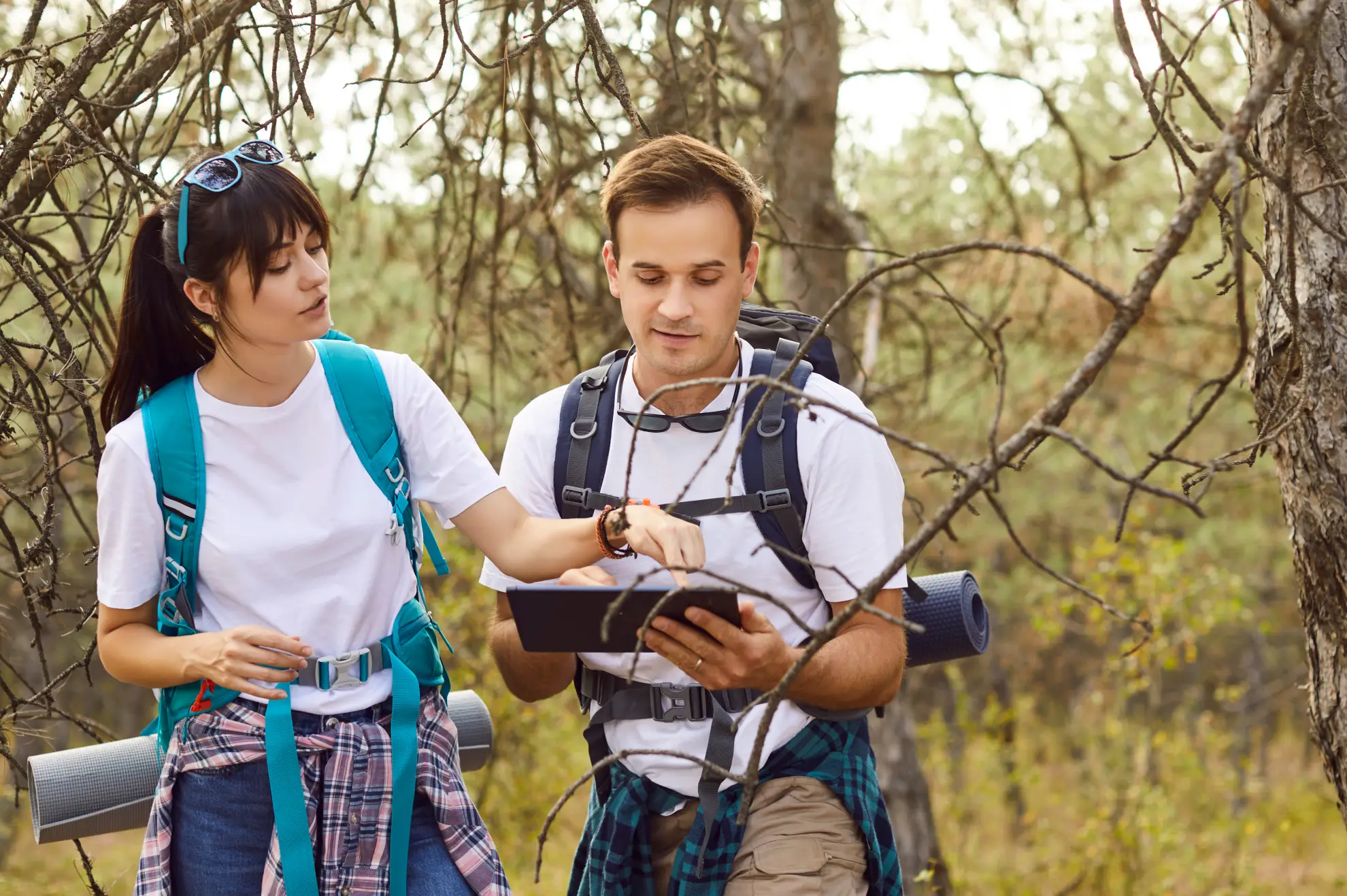
Navigation tools: Download the relevant trail on AllTrails, Wikiloc, or purchase a physical Madeira hiking map published by Freytag and Berndt (1:35,000 scale) before departure. Mobile signal is unreliable in the central massif and on the north coast above 600 metres. Offline maps are not a luxury — they are standard practice.
Additional checklist items: 1.5 litres of water minimum for walks over 3 hours (no safe natural sources on most routes), a basic first-aid kit including blister treatment, high-SPF sun protection for exposed ridge walks, and trekking poles for descents on steep lateral trails.
Is a guided hiking tour worth it, or can you go self-guided?
Self-guided hiking is entirely feasible on Madeira's shorter and well-signposted routes. The Vereda dos Balcões, Levada dos Tornos, and Ponta de São Lourenço are straightforward, with clear waymarking and defined trailheads accessible by public bus from Funchal.
However, several factors tilt the balance toward a guided option. First, logistics: the island's best long walks are linear, meaning you start at one point and finish at another 11 to 14 kilometres away. Arranging a two-car solution or navigating Madeira's public bus timetable (which serves trailheads with limited frequency, sometimes once daily) can consume more time than the walk itself. Guided tours typically include transport from Funchal hotels and return drop-off, removing this friction entirely.
Second, ecological context: the Laurissilva is home to the endemic Columba trocaz (Trocaz pigeon), Regulus madeirensis (Madeira firecrest), and over 50 species of endemic flora. A guide with botanical training can identify these species in real time and explain the ecological significance of the forest in ways that a trail marker cannot.
Third, safety on complex terrain: on the Pico do Arieiro to Pico Ruivo ridge walk and on the Caldeirão Verde approach, route-finding errors in fog are genuinely hazardous. Guides familiar with the microclimatic patterns of the central massif can make informed decisions about turnaround points. ToursXplorer lists several curated guided walking tours departing from Funchal, all of which include transport logistics and local expertise.
For first-time visitors to Madeira, or those with no prior experience of mountain hiking, a guided half-day or full-day tour is the most practical introduction to the levada system. Experienced hikers who have researched their route thoroughly can approach most moderate trails with confidence.
Guided Levada Walking Tours on ToursXplorer
Ready to walk one of Europe's most distinctive trail networks? Browse ToursXplorer's full selection of guided levada walks in Madeira, with transport, small groups, and local expert guides included.
Click hereHow to choose between Madeira's guided walking tours
The four guided options currently available through ToursXplorer cover complementary sections of the levada network, allowing hikers to combine tours across multiple days without repeating terrain.
The Ribeiro Frio to Portela guided walk (PR10) is the most ecologically rich option, passing through the densest section of UNESCO-protected Laurissilva on a well-graded descent. It is the recommended first guided experience for visitors with a general interest in the island's natural history. The one tunnel crossing, with headlamps provided, introduces participants to underground levada passage without the extended dark sections found on more demanding routes.
The Levada do Norte tour from Câmara de Lobos is the most culturally layered option, passing through one of Madeira's most historically significant fishing and wine-producing villages before ascending into terraced vineyards and then descending to the Ribeira Brava coast. This is the most appropriate choice for walkers who want social and agricultural context alongside the natural scenery.
The Old Levada full-day tour and Cardinal full-day hike both provide extended coverage of the interior, suited to participants who prefer immersive, slow-paced exploration of the island's central zone rather than a point-to-point linear experience. Both tours include Funchal hotel pickup, eliminating the logistical complexity that makes self-guided linear routes challenging for first-time visitors.
ToursXplorer recommends booking all guided walks at least 72 hours in advance during the peak season of March to May and September to November, when trail permits on popular PR routes and guide availability fill quickly. January and February offer quieter trails but increase the probability of rain in the central massif above 800 metres.
Frequently Asked Questions
The Vereda dos Balcões (PR11) at 3.4 kilometres return from Ribeiro Frio is the most accessible starting point, gaining minimal altitude and requiring no tunnel passage. The Levada do Alecrim on the Paúl da Serra plateau and the Levada do Castelejo near Porto Moniz are also suitable for beginners. All three are well-signposted and completable in under 3 hours.
Yes. From January 2026, all officially designated PR (Percurso Recomendado) routes in Madeira require a permit costing 4.50 euros per person per route. Permits must be booked in advance through the SIMplifica platform on the official Madeira tourism portal. Children under 12 and Madeira residents with valid ID are exempt. No on-site payment is accepted at trailheads.
Essential items include waterproof hiking boots, a headlamp with at least 200 lumens for tunnel crossings, a packable waterproof jacket, 1.5 litres of water for any walk over 3 hours, offline maps downloaded via AllTrails or Wikiloc, sun protection for exposed ridge sections, and a basic first-aid kit. Trekking poles are recommended for any trail with significant descent.
Madeira's microclimate is highly localised. The south coast near Funchal can be sunny while the north coast and central massif above 800 metres receive heavy rain or dense fog simultaneously. Conditions can shift within minutes. Always check the weather forecast specifically for your trailhead altitude zone before departure and carry waterproofs regardless of the morning forecast.
Self-guided hiking is practical on short, well-signposted routes like Balcões and Ponta de São Lourenço. Guided tours are strongly recommended for linear walks (which require vehicle logistics), tunnel-heavy routes like Caldeirão Verde, and any trail in the central massif where fog can disorient inexperienced hikers. Guides also provide real-time identification of endemic flora and fauna.
March to May and September to November offer the most stable conditions for levada walking, with lower rainfall probability at altitude and moderate temperatures between 16 and 22 degrees Celsius. Summer (June to August) is warm but can be hazy in the interior. January and February have the highest rainfall but also the quietest trails and a higher chance of snow above 1,600 metres on the central peaks.