




Chasing Wonder: The Most Soul-Stirring Experiences in Portugal
Where silence, ocean light, and centuries of culture combine to leave travelers genuinely changed
Portugal occupies a particular position in the European imagination — westernmost, Atlantic-facing, and shaped by a long relationship with departure and return. But what draws a growing number of travelers is not only its coastlines or its monuments. It is the quality of its silence, the weight of its music, and the frequency with which ordinary moments become ones you find yourself still thinking about months later.
Why do modern travelers crave wonder more than sightseeing?
Something shifted in how people think about travel. The itinerary-first, landmark-to-landmark approach that defined tourism for decades has gradually given way to a quieter question: how do I want to feel when I get there? Psychologists studying awe have found that encounters with vastness — a mountain ridge, a night sky, an ocean horizon — alter the way people experience time. They slow down. They become more present. They stop composing captions and start actually looking.
Portugal offers this at a remarkable density. Within a single country, you can stand on the clifftops of Cabo de São Vicente, Europe's southwestern tip, and watch Atlantic waves that have traveled uninterrupted from the coast of North America. You can sit in a candlelit Lisbon restaurant and hear a singer hold a note until the room forgets to breathe. You can hike through mist-filled laurisilva forest on Madeira — a relic ecosystem dating back to the Tertiary period, roughly 15 to 65 million years ago — and feel genuinely small in the oldest and most grounding sense of the word.
"Travel is not about escaping life. It is about finding the parts of it that feel most real."
The experiences explored in this guide were chosen not for their popularity but for their capacity to produce that specific feeling: the one that arrives when you suddenly stop thinking about everything else.
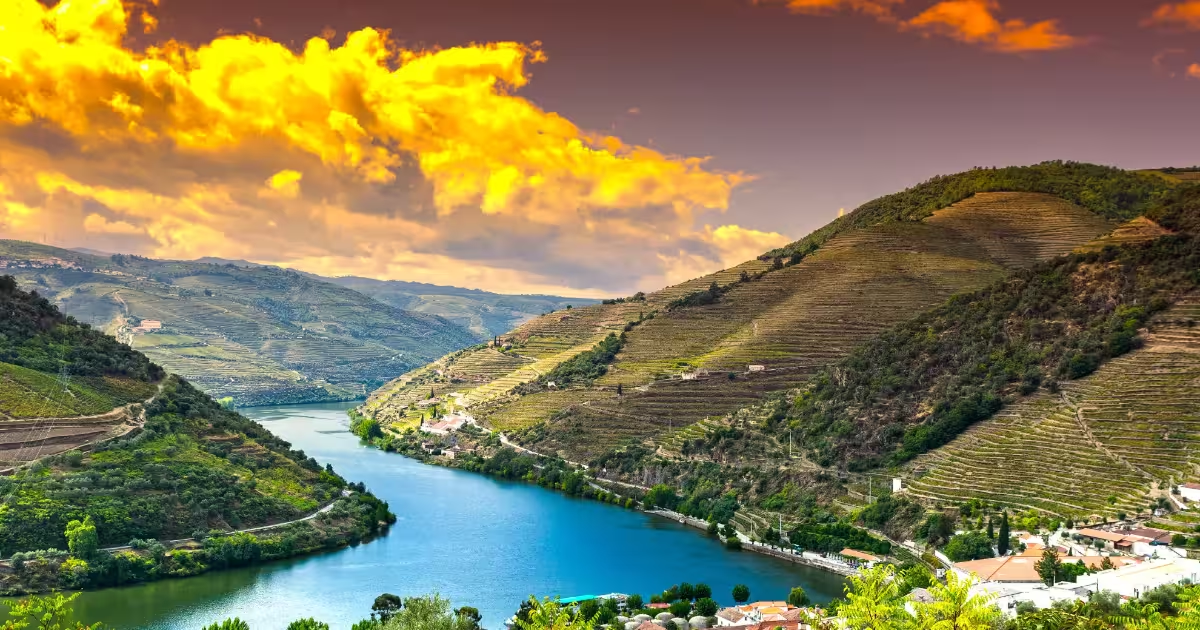
What makes the Alentejo and Douro Valley feel so quietly extraordinary?
Portugal's interior landscapes operate at a different frequency from its coasts. In the Alentejo, the land rolls open in long golden plains punctuated by cork oaks (Quercus suber), whitewashed villages, and an enormous sky. The region covers roughly one-third of Portugal's total land area yet holds less than 8 percent of its population. That ratio produces a silence that is almost architectural.
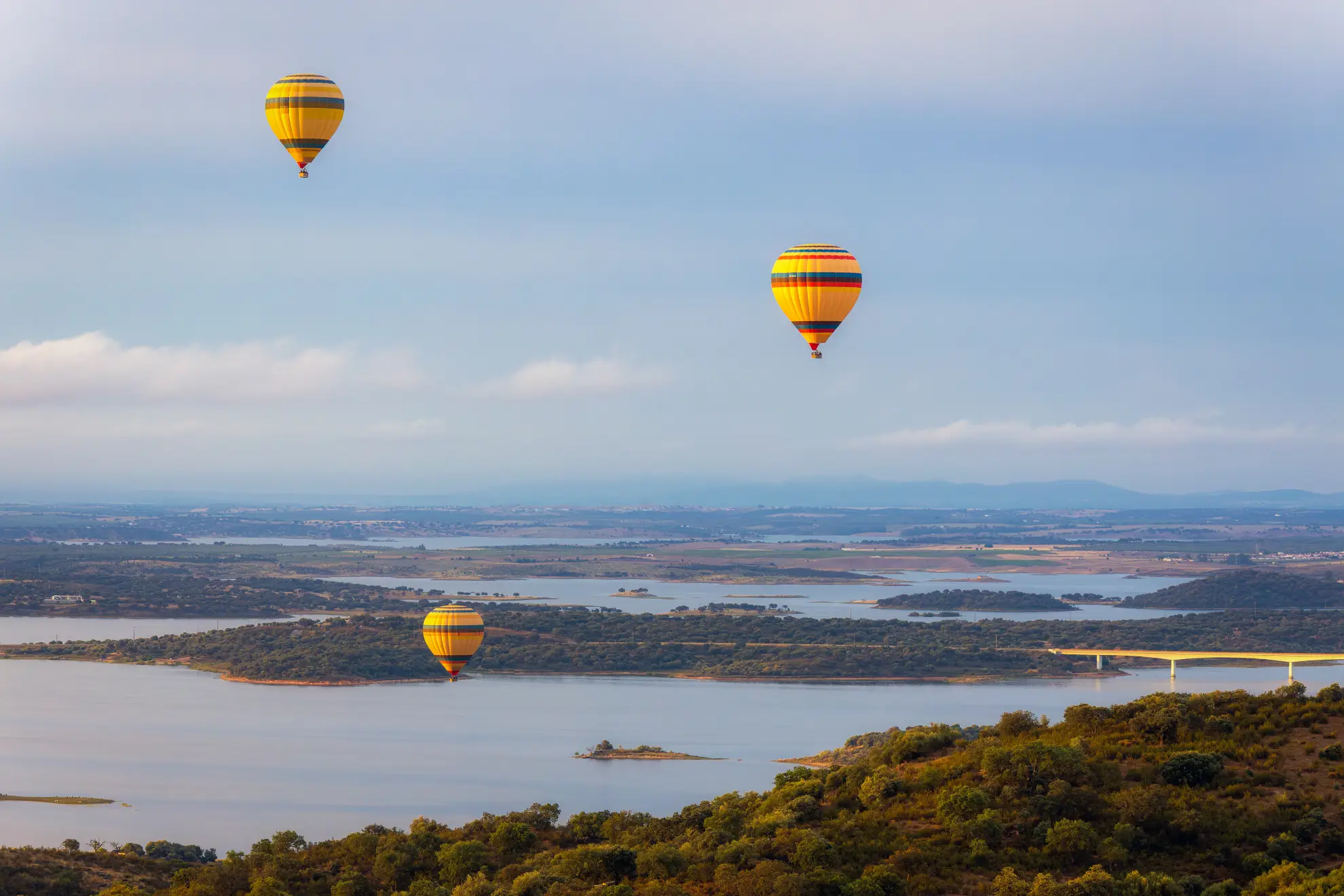
A sunrise hot air balloon flight over the Alentejo or the Douro Valley is one of the more disorienting experiences Portugal offers — disorienting in a useful way. You lift off in near-darkness, the burner above you the only sound, and within minutes the landscape resolves itself from shadow into color: the amber geometry of Douro terraces, the silver thread of the river 500 meters below, the first horizontal light touching the hilltop quintas. Flights typically last 60 to 90 minutes and depart from towns including Reguengos de Monsaraz in the Alentejo and Pinhão in the Douro Valley. The sensation most passengers report is not excitement. It is something closer to relief.
The Alqueva Dark Sky Reserve, centered on the Alqueva reservoir near Mourão, is Europe's first certified Starlight Tourism destination, receiving that designation in 2011. On a clear night, with no artificial light for 30 to 40 kilometers in any direction, the Milky Way is visible to the naked eye. Astronomers have recorded over 4,000 individual stars visible from this reserve. The experience of lying on your back in an Alentejo field and looking at that sky does something to your sense of scale that is difficult to achieve any other way.
How do Portugal's oceans and islands produce moments of genuine awe?
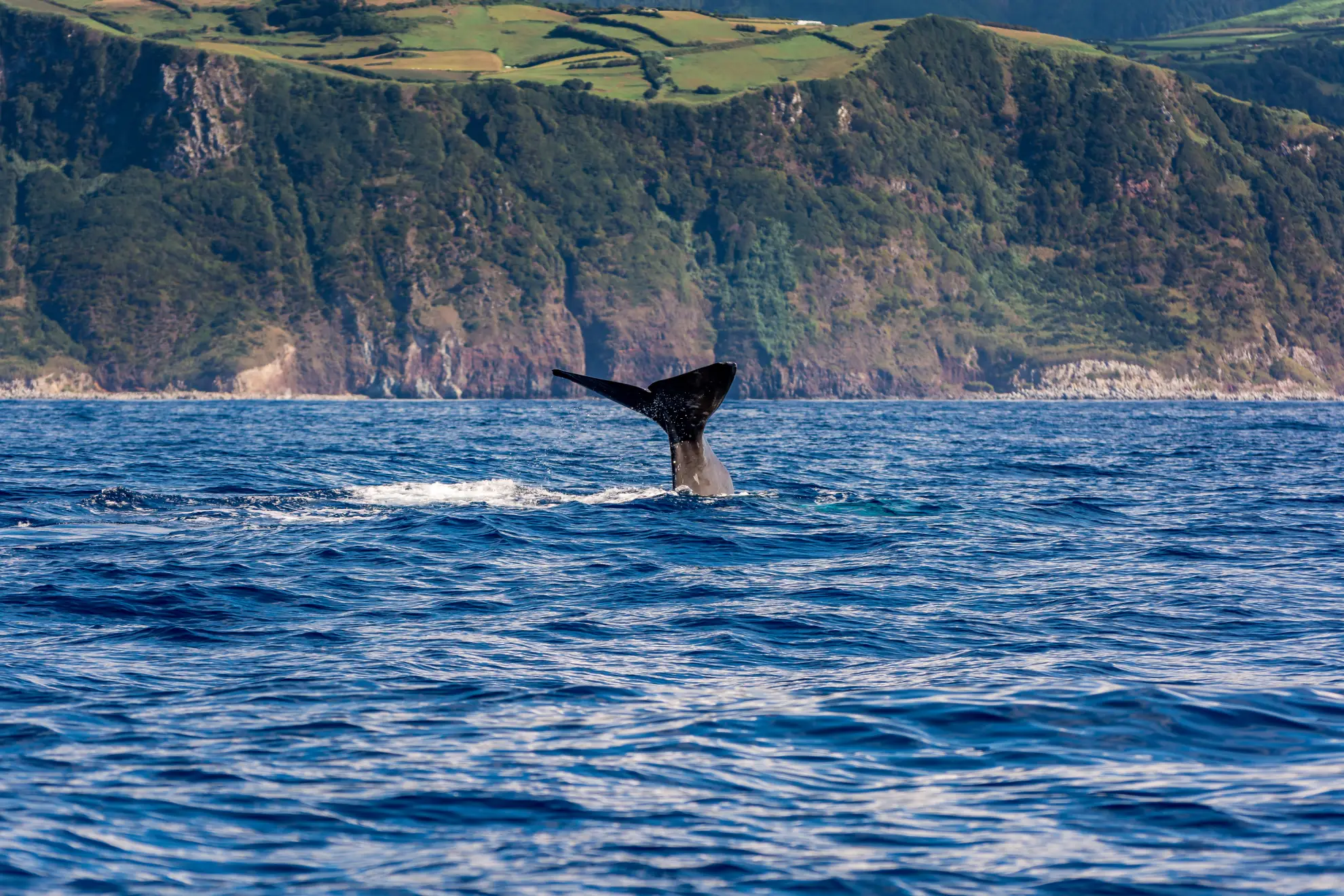
The Azores archipelago sits approximately 1,500 kilometers west of Lisbon in the mid-Atlantic, which places it directly beneath one of the most productive whale migration corridors on the planet. The waters surrounding São Miguel, Pico Island, and Faial host year-round populations of sperm whales (Physeter macrocephalus) and common dolphins (Delphinus delphis), with blue whales (Balaenoptera musculus) and fin whales passing through seasonally between April and June. The experience of watching a sperm whale surface 40 meters from the boat — exhaling, fluking, descending — belongs to a category of encounter that does not require embellishment.
Madeira's waters offer similar encounters. The island lies 978 kilometers southwest of Lisbon and sits above deep mid-Atlantic channels that attract common bottlenose dolphins (Tursiops truncatus), Atlantic spotted dolphins (Stenella frontalis), and occasional pods of pilot whales (Globicephala melas). Tour operators depart from Funchal marina, usually at 09:00 or 14:00, for excursions of three to four hours. Regulations enforced by the ICNF (Institute for Nature Conservation and Forests) require boats to maintain a minimum distance of 50 meters from cetaceans and prohibit swimming with whales.
"When the whale surfaces and the whole boat goes silent, that silence says something no travel brochure ever could."
For those drawn to volcanic geology, the Azores provides a landscape that is genuinely unlike anything on mainland Europe. Sete Cidades on São Miguel Island is a twin lake — one green, one blue — sitting inside a dormant caldera 12 kilometers wide. The crater lake of Lagoa do Fogo, also on São Miguel, sits at 590 meters above sea level and is accessible via a 4-kilometer trail from the road at Pico da Barrosa. On Pico Island, the Montanha do Pico — at 2,351 meters, Portugal's highest peak — rises directly from the sea with almost no transition, creating a visual drama that is difficult to comprehend until you are standing at its base.
What can a night of Fado in Lisbon actually do to a person?
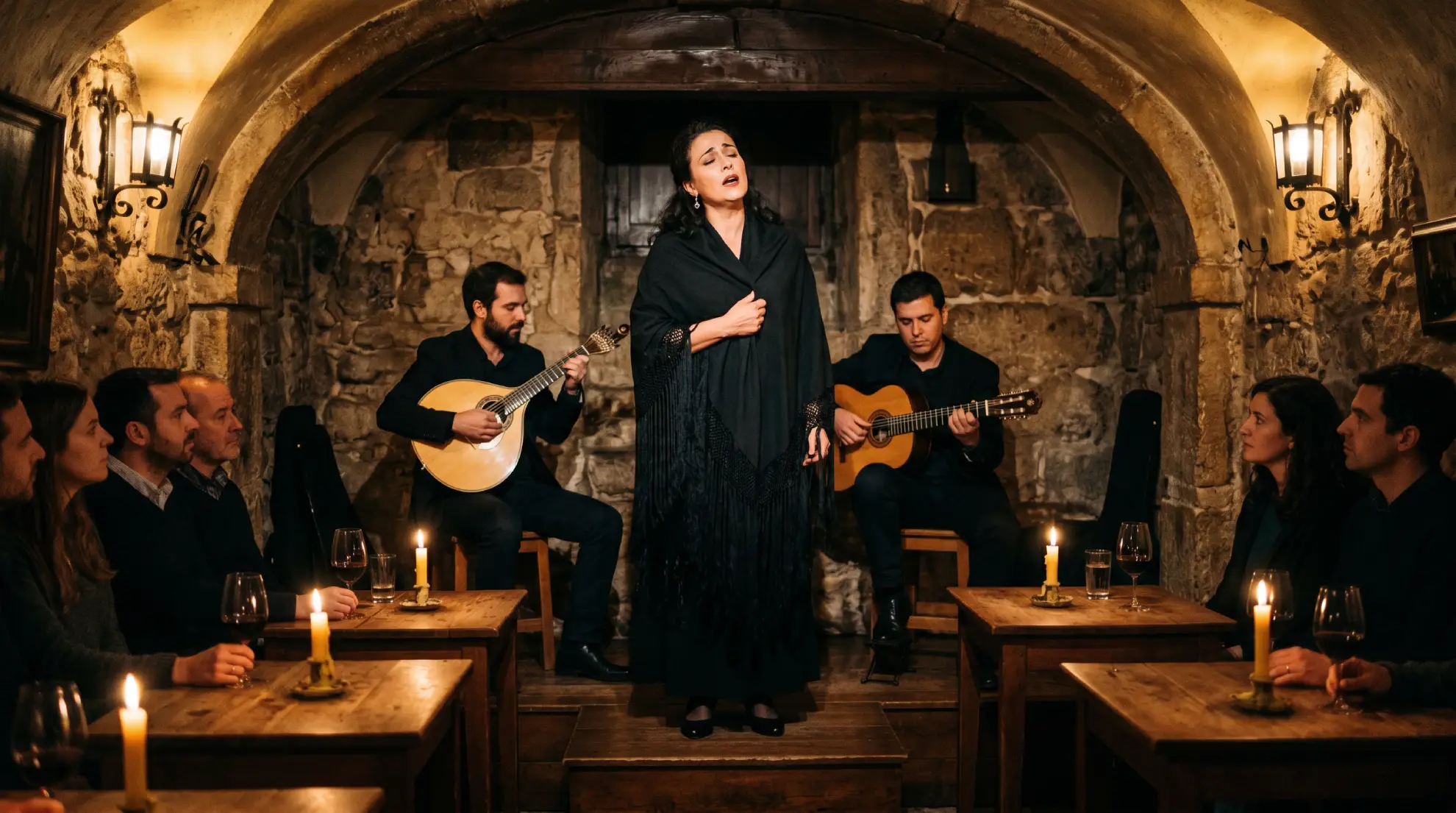
Fado is not background music. In its traditional form, performed in the casas de fado of Alfama and Mouraria — two of Lisbon's oldest neighborhoods, both located on the slopes east of the city center — it is an event that requires the audience to participate through silence. The Portuguese have a specific word, silêncio, that is spoken before a performance begins. It is not a polite request. It is an instruction.
The music itself is built around the concept of saudade: an untranslatable Portuguese word describing a longing for something lost, distant, or perhaps never fully possessed. Musicologists trace Fado's origins to the early 19th century in Lisbon's port districts, though its roots draw from Moorish musical traditions, African rhythms brought back by sailors, and the earlier Portuguese troubadour tradition. In 2011, UNESCO inscribed Fado on the Representative List of the Intangible Cultural Heritage of Humanity.
A typical Fado dinner at an established casa involves three performers alternating sets between courses. The fadista (vocalist) is accompanied by a Portuguese guitar (guitarra portuguesa, a twelve-string instrument with a distinctive pear-shaped body) and a viola baixo (classical guitar providing bass). What happens in the room — the stillness, the occasional tears from Portuguese guests who grew up with this music, the way a well-executed mágoa can stop a conversation in its tracks — is one of the more culturally intimate experiences available to a visitor anywhere in Europe.
Where does physical movement become emotional transformation in Portugal?
Hiking in Portugal occupies a specific emotional register that is distinct from hiking elsewhere. On Madeira, the levadas — a network of narrow irrigation channels constructed beginning in the 15th century to carry water from the island's wet north to its drier south — have been converted into 2,500 kilometers of walking paths. The Levada do Caldeirão Verde trail, approximately 13 kilometers round-trip from Queimadas, passes through laurisilva forest so old and dense that it blocks most of the daylight. The trail dates from the 16th century in its original form.
On the mainland, the Rota Vicentina is a 450-kilometer coastal and inland trail running from Santiago do Cacém in the Alentejo coast down to Cabo de São Vicente in the Algarve. It passes through Vicentina Coast Natural Park, established in 1995 and home to nesting populations of white storks (Ciconia ciconia), Bonelli's eagles (Aquila fasciata), and one of Europe's largest sea lavender habitats. Sections of the trail run along cliffs 80 meters above the Atlantic with no buildings in sight in either direction.
The Algarve and the Azores have also become significant destinations for wellness travel. Oceanfront yoga retreats operating near Lagos and Sagres typically run five to seven-day programs combining morning practice with coastal walks, nutritional guidance, and afternoon rest. The Azores, particularly São Miguel and Flores Island (the westernmost island in the European Union), are increasingly attracting visitors seeking digital detox and nature immersion. Flores Island has a resident population of approximately 3,800 people and no traffic lights. The pace of life there is not an amenity. It is the point.
Curated Experiences on ToursXplorer: Portugal Tours That Deliver Something Real
Portugal's most memorable experiences are not found by rushing between landmarks. Browse ToursXplorer's curated Portugal tours and find the one that matches the way you want to feel when you arrive home.
Click hereHow to cultivate wonder rather than simply encounter it
Wonder is not a passive condition. The travelers who return from Portugal with the experiences described in this guide are, almost without exception, the ones who made specific choices: they woke up before sunrise, they put their phones away during a Fado performance, they sat on a clifftop for an extra half hour after taking the photograph they came for.
ToursXplorer's approach to curating Portugal experiences starts from the same premise. The tours listed here are not selected by volume of bookings or star ratings alone. They are selected because they create the conditions for genuine engagement: small groups, knowledgeable guides, itineraries designed around experience quality rather than efficiency.
Practical steps that consistently produce stronger travel experiences in Portugal: arrive in Sintra before 09:00 (the main car parks fill by 10:30 and the atmosphere shifts completely), book a Fado dinner for a weeknight when tourist traffic is lower and the room feels more like a casa and less like a venue, and give the Alentejo at least two nights rather than one. The landscape does not reveal itself immediately. It requires the kind of time that most itineraries do not allow.
One of the more useful reframes for traveling Portugal intentionally is to think of each region as having a tempo. Lisbon moves at 120 beats per minute. The Douro Valley, especially off-season between October and March, runs at about 40. Flores Island in the Azores barely registers on the scale. Matching your itinerary to that tempo, rather than imposing your own pace on the landscape, is how travelers return from Portugal having experienced something they cannot quite explain but cannot stop talking about.
Portugal's geography of wonder: where to go and why
Portugal's emotional geography is more varied than its compact size suggests. The country covers 92,212 square kilometers on the mainland, with the addition of the Azores (2,346 square kilometers across nine islands) and Madeira (801 square kilometers including the Desertas and Selvagens groups) extending its reach far into the Atlantic.
For first-time visitors seeking a diversity of experience within a single trip, ToursXplorer recommends a structure that moves from Lisbon south through the Alentejo to the Algarve, with a separate island extension to Madeira or the Azores. This routing combines urban cultural intensity (Alfama, Mouraria, Belém), the vast interior silence of the Alentejo plateau, the geological drama of the Algarve coast, and the Atlantic wilderness of the islands — four completely different emotional registers within a single journey.
For repeat visitors, the less-traveled destinations often produce the strongest responses: the Peneda-Gerês National Park in the north, Portugal's only national park, covering 70,290 hectares of granite mountains and ancient Roman roads; the Castro Laboreiro plateau at 1,000 meters elevation, where a local dog breed (the Castro Laboreiro dog) has been used for centuries to guard livestock from wolves (Canis lupus signatus, the Iberian wolf subspecies, still present in the park); and the Côa Valley, home to the largest open-air Paleolithic rock art site in the world, UNESCO-listed since 1998, where engravings of horses, aurochs, and ibex date back 22,000 years.
Ready to trade a sightseeing checklist for something that stays with you? Explore the full Portugal collection on ToursXplorer and plan a journey built around experiences rather than attractions.
Frequently Asked Questions
Portugal's most distinctive experiences include whale watching off the Azores and Madeira (sperm whales, common dolphins, and blue whales in season), hiking Madeira's levada trails through 15-million-year-old laurisilva forest, stargazing at the Alqueva Dark Sky Reserve in the Alentejo, attending a traditional Fado performance in Lisbon's Alfama neighborhood, and sunrise hot air balloon flights over the Douro Valley. Each offers something genuinely unavailable elsewhere in Europe.
Year-round whale watching is possible off Madeira and the Azores, but the optimal window for large whale species — including blue whales (Balaenoptera musculus) and fin whales — is April through June, when these animals pass through Atlantic migration corridors. Sperm whales (Physeter macrocephalus) are present around the Azores throughout the year. Common dolphins and bottlenose dolphins are encountered in any season.
Traditional Fado is performed in casas de fado in the Alfama and Mouraria neighborhoods of Lisbon, both located on the eastern hillside of the city. Authentic houses feature a fadista accompanied by a guitarra portuguesa (twelve-string pear-shaped instrument) and a viola baixo. Performances typically run with dinner across three-hour sessions. Reservations are recommended, especially on weekends. UNESCO inscribed Fado on its Intangible Cultural Heritage list in 2011.
Portugal has become a leading European destination for wellness travel, with concentrated offerings in the Algarve coast near Lagos and Sagres, on the Azores islands of São Miguel and Flores, and in the Alentejo interior. Programs typically combine oceanfront yoga, nature walks, and digital detox frameworks running five to seven days. The combination of mild Atlantic climate, low population density outside major cities, and culturally relaxed pace makes it well-suited to mindful travel.
The Alqueva Dark Sky Reserve is centered on the Alqueva reservoir near the town of Mourão in the Alentejo, approximately 50 kilometers southeast of Évora. It was designated Europe's first Starlight Tourism destination in 2011. With no significant artificial light for 30 to 40 kilometers in most directions, over 4,000 stars are visible to the naked eye on clear nights. Guided stargazing sessions are available through local operators, typically running 2 hours beginning after 21:00.
Sintra, 28 kilometers northwest of Lisbon and classified as a UNESCO Cultural Landscape since 1995, is best visited on weekday mornings arriving before 09:00. The main sites — Pena Palace (completed 1854), Regaleira Gardens with their 27-meter initiation wells, and Monserrate Palace (completed 1858) — are heavily visited by midday. A private tour allows deeper engagement with the history and symbolism of each site compared to standard group tours.