




Sunrise Kayak at Benagil: The Experience Nobody Talks About
How paddling to Benagil Cave at dawn transforms a world-famous landmark into something rare, quiet, and entirely your own.
Every day, hundreds of boats queue outside Benagil Cave on the Algarve coast, waiting to ferry passengers through for a 90-second glimpse. But for a narrow window beginning around 7:00 AM, the cave belongs to almost no one. The sea is flat, the light is entering the 50-metre-wide oculus at its most direct angle, and the only sounds are water dripping from limestone and the soft pull of a paddle stroke.
Why does the time of day matter so much at Benagil Cave?
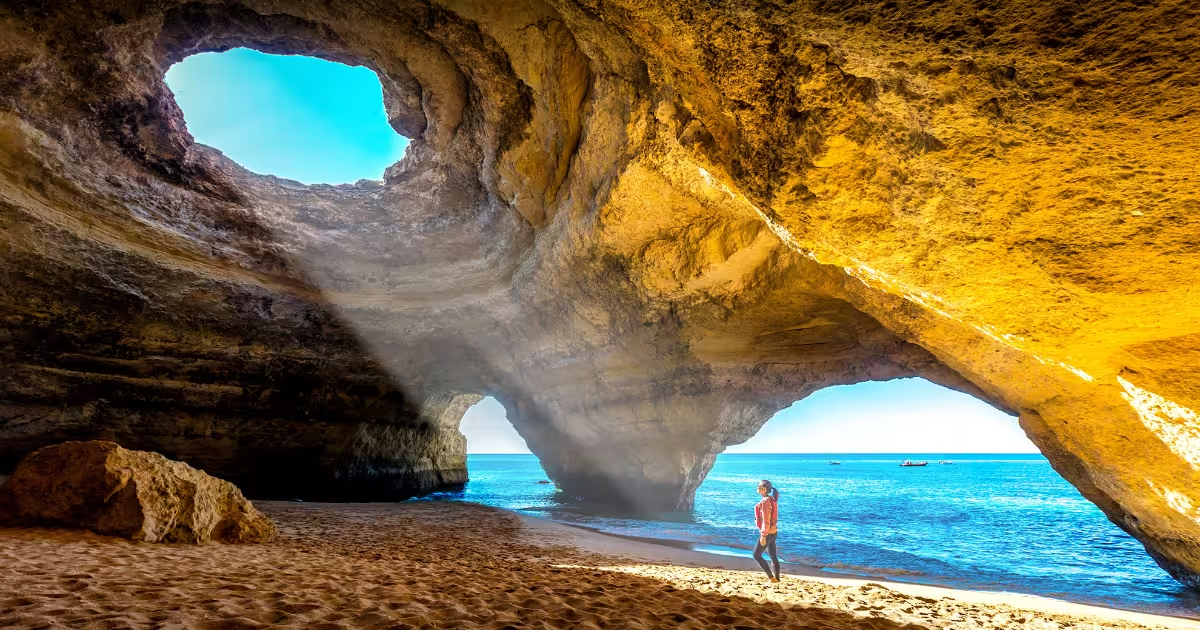
Benagil Cave, known locally as Gruta de Benagil, sits roughly 200 metres from Praia de Benagil along the Algarve's Barlavento coastline. It was carved by Atlantic wave action into the Cenomanian limestone cliffs that define this stretch of the Costa Vicentina hinterland, and its most distinctive feature is a circular opening in the cave roof, approximately 10 metres in diameter, that functions like a natural skylight.
That opening is the entire reason timing matters. Between approximately 7:15 AM and 9:00 AM in summer (late May through September), the rising sun tracks at an angle that sends a direct column of amber light down through the oculus and onto the interior beach, a crescent of pale sand roughly 15 metres wide. By 10:30 AM, the sun has shifted, the quality of light inside the cave softens and flattens, and the boat traffic from Portimão, Lagos, and Albufeira has already begun to build. By midday, the cave receives upward of 1,000 visitors per hour across multiple tour operators.
"The cave at sunrise is a different geological object from the cave at noon. The same rock, the same water, but the light turns the interior into something that looks deliberately constructed." — a guide who has led kayak tours along the Algarve coast for over a decade.
For anyone who has only seen Benagil Cave in photographs taken during peak hours, with dozens of inflatable boats and stand-up paddleboards crowding the interior, the dawn version requires a genuine recalibration of expectations. The interior beach, which measures roughly 15 by 8 metres, is accessible only by sea. At sunrise, with two or three kayaks pulled up on the sand and the cave otherwise silent, the scale of the space becomes apparent in a way that midday visits simply do not allow.
What are sea conditions like at dawn, and is it safe for beginners?
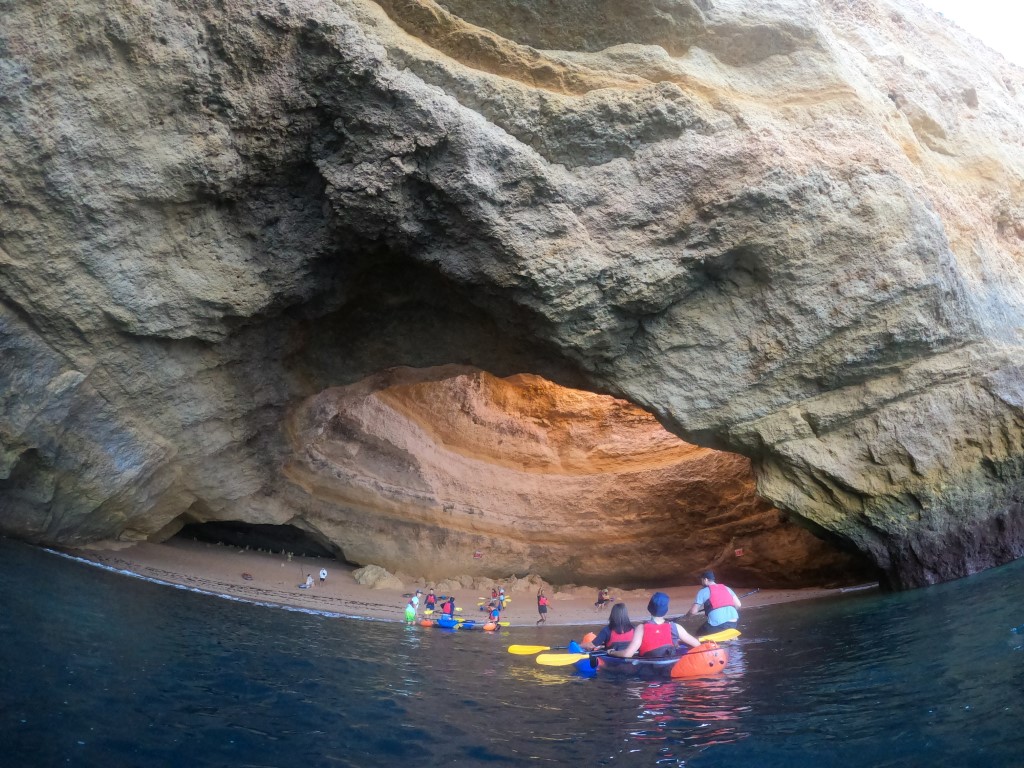
The Atlantic swell that reaches the Algarve coast originates far out in the North Atlantic, and by the time it arrives at Praia de Benagil, it has typically lost much of its energy. Even so, the paddle from the beach to the cave entrance involves navigating a low limestone arch, roughly 3 metres high at mean tide, and requires passing through breaking waves. Sea state is the primary variable that determines whether that passage is straightforward or genuinely difficult.
In the early morning, before the sea breeze develops (the Nortada, a persistent northerly thermal wind, typically strengthens between 11:00 AM and 4:00 PM along the Algarve), the surface is measurably calmer. Conditions described by guides as "mirror-like" are a meteorological reality, not a marketing phrase. The coastal wind gradient is weakest in the two hours after sunrise, and the residual swell is typically under 0.5 metres during summer months. This makes the 200-metre paddle from Benagil Beach to the cave entrance manageable for paddlers with no prior kayak experience, provided they receive a briefing on wave timing and bow-first entry technique.
Guided sunrise tours from ToursXplorer typically include a 15-minute safety and technique briefing on the beach before departure. Group sizes are deliberately kept small, most often between 6 and 10 participants, which also improves the experience inside the cave itself. The kayaks used are sit-on-top doubles, stable enough for beginners and buoyant enough to carry a camera bag sealed in a dry pouch.
"The difference between a 7:30 AM departure and a 10:00 AM departure is not just the crowd. It is the sea itself. In the morning, the water cooperates." — excerpt from a post-tour review submitted via ToursXplorer.
It is worth noting that entry to the cave is never guaranteed. If the swell exceeds 1.5 metres or the coast guard issues a maritime alert, responsible operators will redirect to alternative caves along the same coastline, including Gruta do Algar and several unnamed chambers near Marinha Beach (Praia da Marinha), located approximately 3 kilometres east of Benagil.
What does the sunrise experience inside the cave actually look like?
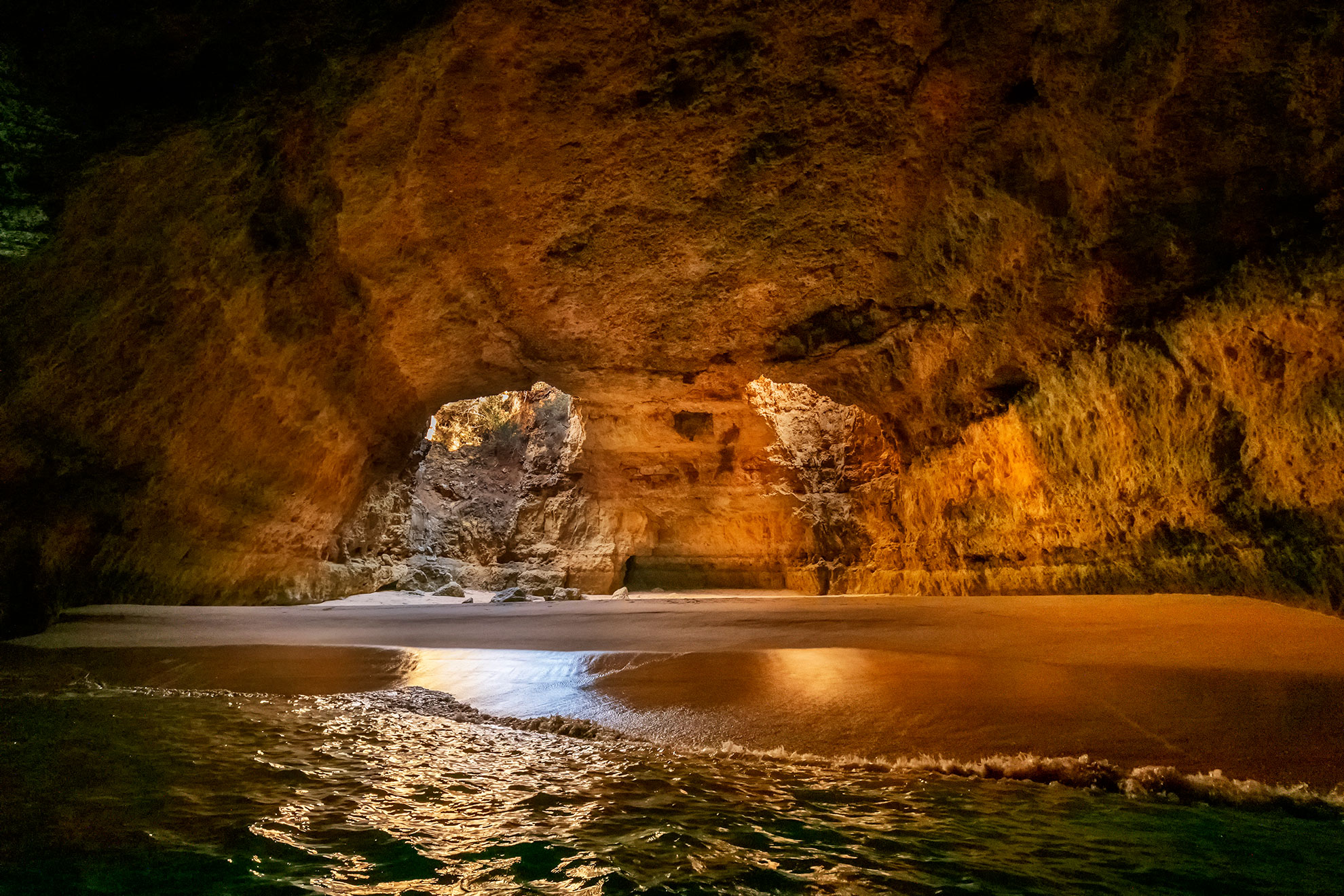
Benagil Cave's interior is roughly 35 metres deep, 50 metres wide at its broadest point, and rises to a maximum vault height of approximately 20 metres. The dome is porous and sea-sculpted, with stalactite formations visible above the tide line. The interior beach is composed of fine white calcareous sand, and it sits roughly 0.5 metres above the waterline at low tide.
When the sun clears the horizon and its angle aligns with the cave's orientation, approximately east-northeast, the light entering through the oculus travels the full depth of the interior. The limestone walls, which contain veins of iron oxide, respond to this direct illumination with a range of ochre, rust, and pale gold tones that are entirely absent in diffuse midday light. The cave floor's wet sand reflects this upward. The effect lasts between 40 and 75 minutes depending on the season and cloud cover.
From a photography standpoint, the conditions at sunrise are structurally different from any other time of day. The interior beach photograph, framed by the cave arch with the oculus above and the kayak on the sand, is achievable without a single other person in the frame. By 9:30 AM, that same composition requires either patient waiting or deliberate cropping to remove boat traffic. Photographers should bring a wide-angle lens (16-24mm equivalent on full-frame) and consider the low ISO performance of their camera body, as the contrast between direct sunlight through the oculus and the shaded cave walls is high.
Beyond photography, the sensory environment at dawn is defined by what is absent. There are no engine sounds from the tour boats that run from Portimão marina (approximately 12 kilometres west) and from the beach landings at Armação de Pêra (9 kilometres east). The interior acoustics of the cave amplify the sounds that remain: the subterranean drip of water from the vault, the resonant slap of small waves against the interior walls, and occasionally the call of yellow-legged gulls (Larus michahellis) nesting in the cliff face above the exterior arch.
Sunrise and Early-Morning Kayak Tours from Benagil
Boat-Based Alternatives for Visiting Benagil Cave
The sunrise slot fills faster than any other departure at Benagil. If you are planning a visit between June and September, book the early-morning kayak at least 5 to 7 days in advance through ToursXplorer to secure your place before the window closes.
Click herePlanning your sunrise kayak: what to know before you book
Tours depart from Praia de Benagil, a small cove beach accessible by the N125 road via Lagoa municipality, then the EM1264 road down to the coast. Parking near the beach is limited to approximately 30 spaces at the top of the cliff path, and during summer (July and August) these fill by 7:00 AM. Arriving 20 minutes before your departure time is sufficient for briefing, gear fitting, and a short walk down the 60-metre cliff path to the water's edge.
What to bring: a swimsuit under quick-dry clothing, reef-safe sunscreen (standard sunscreen is discouraged near the cave due to the enclosed water circulation), a small waterproof pouch for a phone or camera, and water. Guides provide the kayak, paddle, buoyancy aid, and a dry bag for valuables. Water shoes or sandals with ankle straps are recommended given the rocky beach entry.
The tour duration from briefing to return is typically 2 to 2.5 hours. For the sunrise departure, this means finishing back at the beach by approximately 9:30 AM, early enough to continue to Carvoeiro village (5 kilometres west) for breakfast or to drive on to Silves (20 kilometres north) before the day heats up.
ToursXplorer lists all available departure times and real-time availability for each tour. The private kayak option allows you to select a specific time slot, which is useful for photographers who want to align the tour with a specific tide or forecast. For general visitors, the standard guided sunrise group tour provides the same cave access at a lower price point, with the added context of a bilingual guide commentary on the marine geology of the Algarve coastline.
How Benagil Cave compares to other sea caves along the Algarve
The Algarve coastline between Lagos and Faro contains over 200 identified sea caves and rock arches, according to surveys conducted by the Universidade do Algarve. Of these, Benagil is the most visited by a significant margin, largely due to the interior beach, an extremely rare feature in sea caves globally. Most sea caves accessible by kayak contain only rock ledges or remain entirely submerged at mid-tide.
The nearest comparable interior beach cave is Gruta do Algar, approximately 1.5 kilometres west of Benagil. It is smaller (roughly 12 metres wide at its broadest point), receives less direct sunlight, and is visited by far fewer people. Experienced kayakers and guides who know the coast well often include it as a secondary stop on extended routes.
Praia da Marinha, the beach included in one of the kayak routes listed on ToursXplorer, sits within a dense cluster of arches, stacks, and tunnels that can occupy a full morning of paddling. The rock formations here are composed of the same Mesozoic limestone as Benagil, but the coastal orientation is more westerly, meaning afternoon light is more favourable for photography at Marinha while morning light favours Benagil.
Further west, the sea caves near Ponta da Piedade (Lagos) are deeper and more dramatic in vertical scale, rising to vault heights of over 30 metres, but they lack interior beaches and are subject to stronger oceanic swell due to their more exposed position on the southwest-facing coast.
Frequently Asked Questions
Arriving before 9:00 AM is the most reliable way to experience Benagil Cave with minimal crowds. Guided kayak tours departing at 7:00 AM or 7:30 AM from Praia de Benagil typically reach the cave interior before commercial boat tours from Portimão and Albufeira begin their first runs, which usually launch between 9:30 AM and 10:00 AM.
Most participants who have done both a midday and a sunrise visit rate the early departure significantly higher. The reasons are consistent: calmer sea conditions (typically under 0.5 metre swell), direct sunlight through the cave's 10-metre ceiling oculus between approximately 7:15 AM and 9:00 AM, and the interior beach entirely free of other visitors, which is impossible to replicate later in the day.
The cave's entrance faces generally northwest, so the actual sun rising above the horizon is not visible from inside. However, the effect of sunrise is strongly present: between roughly 7:15 AM and 9:00 AM, the rising sun tracks into alignment with the ceiling oculus and sends direct amber light into the cave interior, illuminating the limestone walls and sand beach in a way that does not occur at any other time of day.
The distance from Praia de Benagil to the cave entrance is approximately 200 metres. The main challenge is timing the paddle through the low entrance arch (roughly 3 metres high at mean tide) to avoid breaking waves. In early morning, when the sea surface is at its calmest and the coastal Nortada wind has not yet developed, this passage is manageable for beginners following a guide's instructions. All guided tours include a beach briefing before departure.
During the peak summer season (July and August), sunrise departure slots at Benagil fill 7 to 14 days in advance. In June and September, 3 to 5 days is usually sufficient. Private tour slots can sometimes be arranged with 48 hours' notice outside peak season. Booking through ToursXplorer shows real-time availability for all departure times and group sizes.
When the Atlantic swell exceeds approximately 1.5 metres or a maritime authority alert is in effect, responsible operators will not attempt entry through the Benagil Cave arch. In these cases, guides typically redirect to alternative sea caves and rock formations in the same area, including chambers near Praia da Marinha, 3 kilometres east. Most operators offer a rescheduling option if the experience is significantly altered by conditions.