




Best Azores Island for Whale Watching: São Miguel vs. Pico vs. Faial
A 2026 comparative guide to the Azores' three main cetacean hubs, from Ponta Delgada's accessible marinas to Pico's deep-water canyon edges.
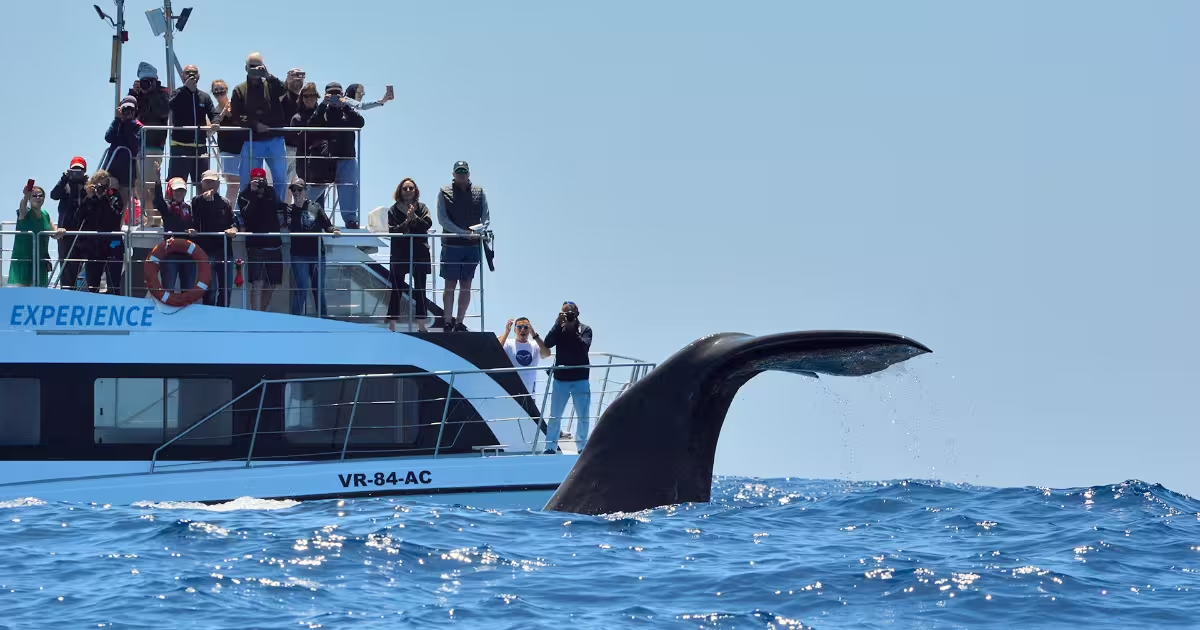
The Azores archipelago sits above one of the Atlantic's most productive deep-water systems, placing it among the world's most reliable cetacean destinations. More than 28 species of whale and dolphin have been recorded in these waters. Three islands dominate the conversation for whale watching: São Miguel, Pico, and Faial. Each offers a genuinely different experience, shaped by geography, maritime heritage, and the depth of the ocean floor beneath the hull.
Why does the Azores work so well for whale watching?
The Azores is a mid-Atlantic archipelago situated roughly 1,500 kilometres west of mainland Portugal. The islands rise from the Mid-Atlantic Ridge, a tectonic boundary that creates dramatic underwater topography: submarine canyons, volcanic drop-offs, and seamounts that plunge to depths exceeding 1,000 metres within a few nautical miles of the shoreline. This proximity of deep water to land is the foundation of everything. Pelagic species — sperm whales (Physeter macrocephalus), blue whales (Balaenoptera musculus), fin whales (Balaenoptera physalus), and common dolphins (Delphinus delphis) — do not need to travel far from shore to feed, which means short boat rides and high sighting consistency.
The Azores also benefits from an ancient tradition called the vigia system. Former whaling lookout posts positioned on high coastal points are staffed by trained spotters who radio coordinates to boats in real time. This network, particularly dense in the Central Group triangle formed by São Miguel, Pico, Faial, Terceira, and their neighbouring islands, gives operators a significant logistical advantage over destinations that rely solely on onboard sonar.
"The vigia tradition transforms whale watching here into something closer to a coordinated science operation. The spotter on the cliff and the skipper on the water are working the same problem from different altitudes." — field note from the ToursXplorer editorial team, Faial, 2024
The result is a sighting success rate that most operators in the Azores quote at 95 percent or above across the main season, which runs from April through October. Year-round operations are common on São Miguel, where sperm whales are a permanent fixture of the waters south of Ponta Delgada.
São Miguel: the introduction to the ocean
São Miguel is the largest island in the archipelago at approximately 747 square kilometres, and its capital, Ponta Delgada, is the main entry point for international travellers arriving at João Paulo II Airport. The marina at Ponta Delgada hosts the highest concentration of whale watching operators in the Azores, offering a wide range of vessels from large catamaran-style boats suitable for families to smaller rigid inflatable boats (RIBs) for a more direct encounter.
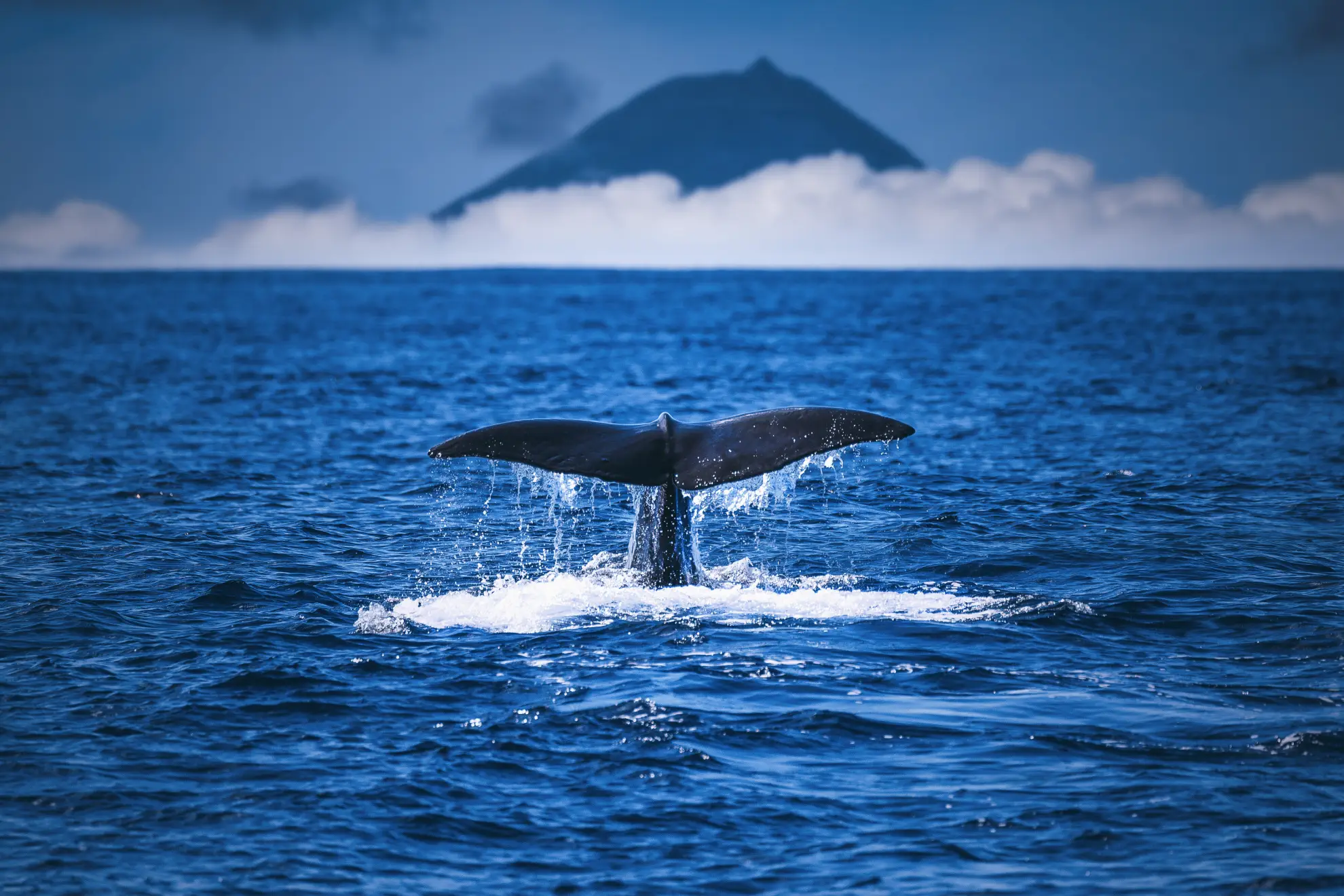
The waters south of Ponta Delgada drop quickly toward submarine canyons that provide year-round habitat for resident sperm whale groups. Sperm whale bulls, which can reach 18 metres in length, are regularly sighted, as are mixed nursery groups of females and calves. Common dolphins and bottlenose dolphins (Tursiops truncatus) are frequent companions on most departures. The north coast of São Miguel adds further variety, with exposed Atlantic conditions that attract different cetacean assemblages depending on the season.
The practical argument for São Miguel is hard to dismiss. The island has the most direct flight connections from Europe and North America, a dense network of accommodation, and the ability to combine whale watching with terrestrial experiences: the twin crater lakes of Sete Cidades, the thermal pools at Caldeira Velha, and the tea plantations of Gorreana. For first-time visitors or families with mixed interests, São Miguel functions as the complete Azorean itinerary without requiring inter-island logistics.
"Ponta Delgada is where the Azores opens its door to the world. The whale watching here is accessible by design, and that is not a criticism — it is a considered product built around a genuinely wild ocean." — ToursXplorer editorial team
Pico Island: the specialist's choice
Pico is the most geographically dramatic island in the archipelago. Its eponymous volcano, Ponta do Pico, rises to 2,351 metres above sea level, making it the highest point in Portugal. Beneath the surface, the western and southern flanks of Pico descend to depths of over 1,000 metres within 1 to 2 nautical miles of the coastline. This is the key advantage: the deep-water feeding grounds for sperm whales are essentially adjacent to the shore at Madalena and Lajes do Pico.
Operators on Pico have historically worked with smaller RIBs and Zodiac-style vessels, a legacy of the island's scientific whale watching culture. Pico was a commercial whaling island until 1987, when Portugal's last shore-based whaling station at Lajes do Pico closed. The transition from hunting to observation was not incidental — it was managed deliberately, and a number of former whalers became the first whale watching guides. The Museu dos Baleeiros in Lajes do Pico documents this transition in detail.
The Pico-Faial channel, the strait of approximately 8 kilometres separating the two islands, is one of the most productive cetacean corridors in the entire Atlantic basin. During the spring migration, typically from March through May, blue whales use this channel as a feeding corridor, drawn by the upwelling of nutrients along the ridge system. Sightings of blue whales — the largest animal on Earth at up to 30 metres — are more consistently reported from Pico and Faial than from São Miguel during this window.
Pico also operates as a base for collaborative data collection with marine biology research programs. Several operators contribute sighting data to long-term cetacean databases, giving departures from Lajes and Madalena a scientific dimension that appeals to travellers with a deeper interest in ocean ecology.
Faial Island: the cosmopolitan maritime hub
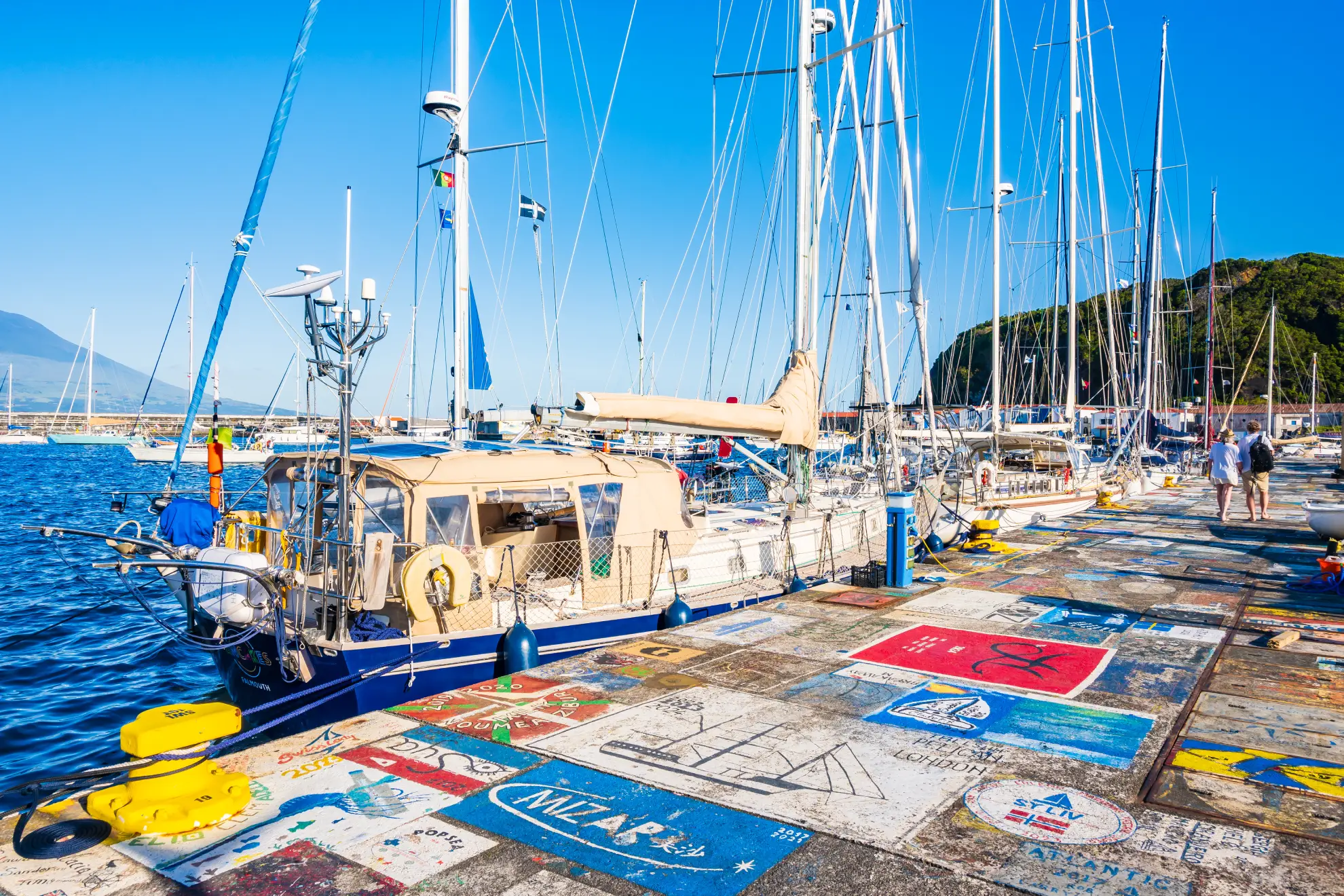
Faial is the westernmost major island in the Central Group and its capital, Horta, holds a specific place in global sailing history. The marina at Horta has been a transatlantic waypoint since the age of sail, and the walls of Peter's Bar near the harbour are covered in thousands of boat murals painted by yachts crews as a maritime ritual before crossing the Atlantic. This culture permeates the whale watching experience here: Faial departures often carry a more international, ocean-literate crowd.
Cetacean access from Horta benefits directly from proximity to the Pico-Faial channel. The same deep-water corridor that attracts blue whales in spring is navigable from Faial in under 15 minutes by RIB. Sperm whales, fin whales, and sei whales (Balaenoptera borealis) are regularly encountered. Faial also provides a convenient base for travellers who want to island-hop between Pico and São Jorge (approximately 20 kilometres to the northeast), creating a Central Group circuit that covers the broadest possible range of cetacean environments.
For 2026, the inter-island logistics from São Miguel to Faial or Pico remain straightforward. SATA Air Açores operates regular flights between Ponta Delgada (PDL) and Horta (HOR) or Pico (PIX), with flight times of approximately 30 to 45 minutes. Alternatively, the ferry network operated by Atlanticoline connects the Central Group islands, with crossing times of roughly 1 hour between Faial and Pico. A practical two-island itinerary — 3 nights on São Miguel, 3 nights on Pico or Faial — allows travellers to experience both the accessible introduction of Ponta Delgada and the specialist depth of the Central Group.
Which island has the highest sighting success rate?
The honest answer is that all three islands report strong sighting consistency during the core season, and all three use the vigia network to locate cetaceans before boats leave the marina. The differences are more about species composition and encounter quality than raw success rates.
São Miguel offers the greatest year-round reliability for sperm whales and resident dolphin species. Pico and Faial offer a higher probability of blue whale encounters during the spring migration window and a more intimate encounter format due to smaller vessel sizes. For travellers whose primary goal is to see a blue whale, March to May from Pico or Faial is the specific recommendation. For travellers whose primary goal is a guaranteed cetacean encounter on a family-friendly vessel with no complex logistics, São Miguel in any month from May to September is the practical answer.
The species list expands across the full season. Summer months (June to August) bring higher densities of common dolphins, bottlenose dolphins, and Risso's dolphins (Grampus griseus). Autumn departures from all three islands frequently encounter pilot whales (Globicephala macrorhynchus) in large, slow-moving pods. False killer whales (Pseudorca crassidens) are recorded periodically throughout the year.
Whale and Dolphin Watching Tours in the Azores
Ready to book your Azores whale watching departure? Browse all available tours across São Miguel and the Central Group on ToursXplorer and filter by date, vessel type, and species focus.
Click hereHow to choose the right island for your 2026 trip
The decision between São Miguel, Pico, and Faial ultimately comes down to three variables: your species priorities, your tolerance for inter-island travel, and how you want to spend the hours before and after you board the boat.
If you are travelling with children, arriving on an international flight, or combining whale watching with other Azorean highlights such as Furnas geothermal area or the Sete Cidades lakes, São Miguel is the logical base. The tour infrastructure at Ponta Delgada is the most developed in the archipelago, and ToursXplorer lists multiple departure formats from half-day options to full-day combined itineraries that include dolphin swims and lunch.
If blue whales are your primary target and you are travelling between March and May, organise at least two or three nights on Pico or Faial. The deep-water access from Lajes do Pico and the Pico-Faial channel geometry give these islands a structural advantage for the spring migration period. The smaller RIBs used by many Central Group operators bring you closer to the water surface, which changes the sensory quality of the encounter.
For travellers who want to cover the full spectrum, a combined itinerary remains the best option. Fly into Ponta Delgada, spend three to four nights on São Miguel, then take a 35-minute SATA flight to Horta or Pico for the remainder of the trip. ToursXplorer's search tool allows you to filter whale watching tours across all Azorean islands simultaneously, so you can lock in departures on both legs of the journey before you travel.
One practical note for 2026: Portuguese marine wildlife regulations require all whale watching vessels to maintain minimum approach distances of 50 metres for baleen whales and 30 metres for sperm whales and dolphins. These rules apply uniformly across all islands. Responsible operators across São Miguel, Pico, and Faial follow these guidelines as a matter of professional practice, and departures from reputable companies will include a briefing on observation protocols before leaving the marina.
Frequently Asked Questions
São Miguel offers better year-round logistics and reliable sperm whale sightings from Ponta Delgada, making it ideal for first-timers and families. Pico has deeper water closer to shore and is the preferred base for blue whale encounters during the spring migration, typically March to May. For most travellers, the answer depends on travel dates and species priorities.
All three main islands report sighting success rates above 95 percent during the core season from April to October, supported by the vigia land-based spotter network. The difference lies in species composition: São Miguel sees more consistent sperm whale sightings year-round, while Pico and Faial offer better access to the Pico-Faial channel blue whale migration corridor in spring.
Yes. Faial is one of the most reliable bases for blue whale sightings, particularly between March and May when blue whales migrate through the Pico-Faial channel, a strait of approximately 8 kilometres between Faial and Pico. Operators in Horta can reach the channel's productive feeding zones in under 15 minutes from the marina.
The Azores has recorded over 28 cetacean species. Year-round residents include sperm whales and common dolphins. Seasonal visitors include blue whales and fin whales in spring, bottlenose dolphins and Risso's dolphins in summer, and pilot whales frequently in autumn. False killer whales and sei whales are also periodically encountered across all islands.
April through October is the primary season, with May to August offering the most consistent conditions for mixed species encounters. For blue whales specifically, March to May is the optimal window, coinciding with their spring migration through the Central Group. Sperm whales are present year-round in the waters south of Ponta Delgada on São Miguel.
SATA Air Açores operates regular inter-island flights from Ponta Delgada (PDL) to Horta on Faial (HOR) and to Pico Airport (PIX), with flight times of approximately 30 to 45 minutes. The Atlanticoline ferry connects Faial and Pico in roughly 1 hour. A combined itinerary of 3 nights on São Miguel followed by 3 nights on Pico or Faial is a practical two-island structure for 2026.