




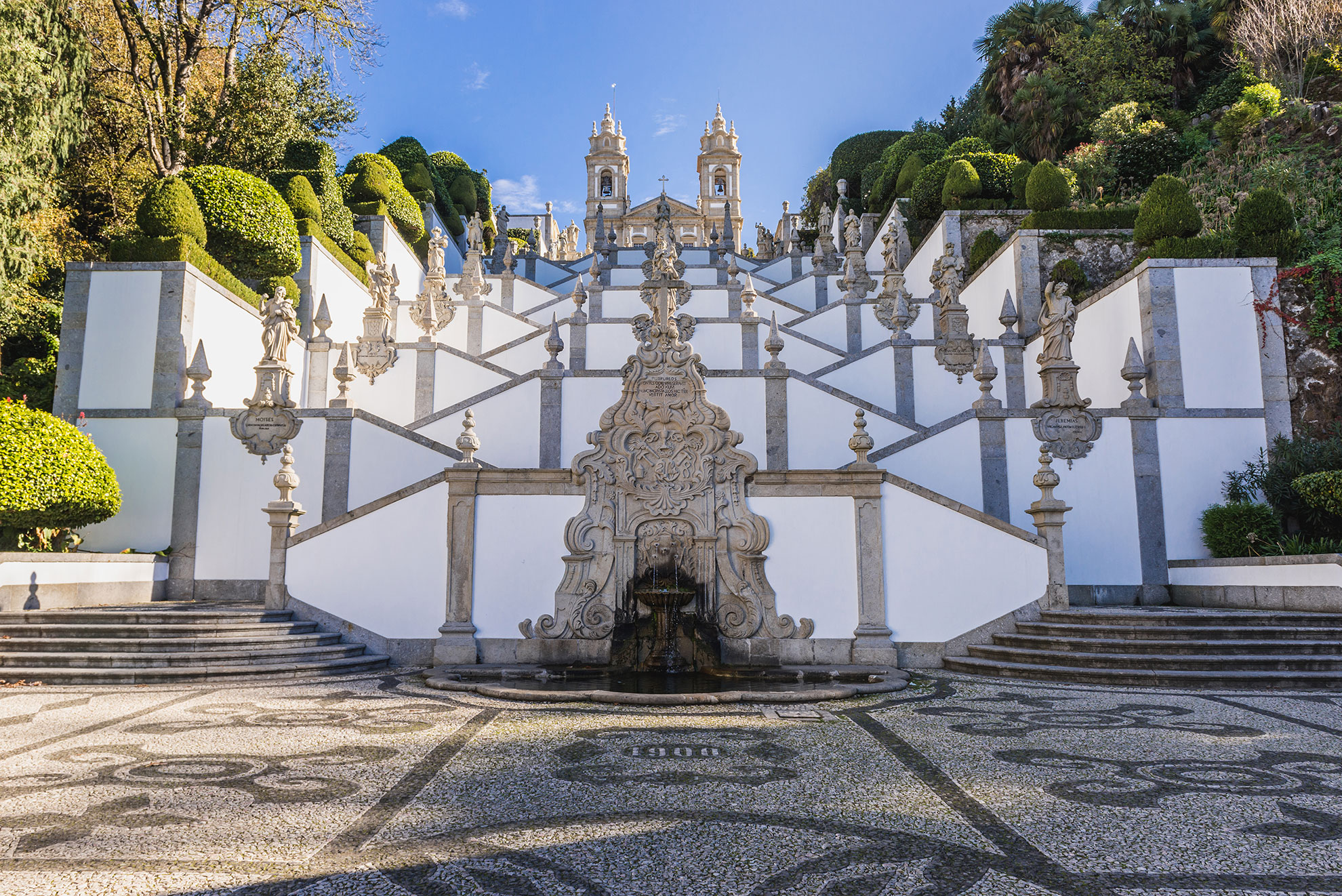
The tiered baroque stairway of Bom Jesus do Monte, Braga's most iconic silhouette against the Minho sky.
Ancient Roots, Young Soul
More Than Faith: Exploring the Timeless Beauty and Vibrant Streets of Braga
Where a thousand-year-old cathedral shares a street with specialty coffee shops, and sacred stairways lead to panoramic views over one of Portugal's most energetic cities.
Braga is a city that refuses to be filed under a single category. It is the ecclesiastical capital of Portugal, home to a cathedral older than the nation itself, a Roman settlement that once ranked among Hispania's most significant cities, and — perhaps unexpectedly — one of the country's most dynamic university towns, with a nightlife and café culture to match.
Founded as Bracara Augusta by the Romans around 16 BC, the city's layered identity has accumulated across two millennia. Walking its pedestrian streets, you move through time without quite realizing it: a mosaic fragment from ancient thermae beneath your feet, an ornate baroque façade rising above you, and the aroma of freshly brewed coffee drifting from a doorway filled with students. This is Braga's particular genius — it holds its history lightly, wearing stately architecture and youthful energy with equal ease.
"There is a Portuguese saying: 'Older than the See of Braga' — used to describe anything ancient beyond measure. Standing before the Sé, its foundation stones laid in 1070, the phrase earns its weight."
The Sé de Braga, consecrated in the 11th century and continuously modified across the centuries that followed, is an architectural autobiography of Portugal's history. Its façade carries Gothic, Manueline, and baroque elements in the same breath. The cathedral treasury houses one of the finest sacred art collections in the country, and the choir stalls, carved in the 16th century, reward slow, deliberate attention. A visit here sets the tone for everything that follows in Braga: grandeur worn with a degree of modesty.
The Sacred Stairway: Bom Jesus do Monte
No structure in Braga is more immediately recognizable than the monumental stairway of Bom Jesus do Monte. Ascending the forested hillside above the city, its zigzagging baroque staircase — completed across the 18th and 19th centuries — is composed of 577 granite steps divided into themed landings representing the five senses, the three virtues, and the Stations of the Cross. The pilgrims who climb it on their knees still share the path with tourists descending by funicular, a machine installed in 1882 that operates on a water-counterbalance system and holds the distinction of being the oldest funicular of its type still in service anywhere in the world.
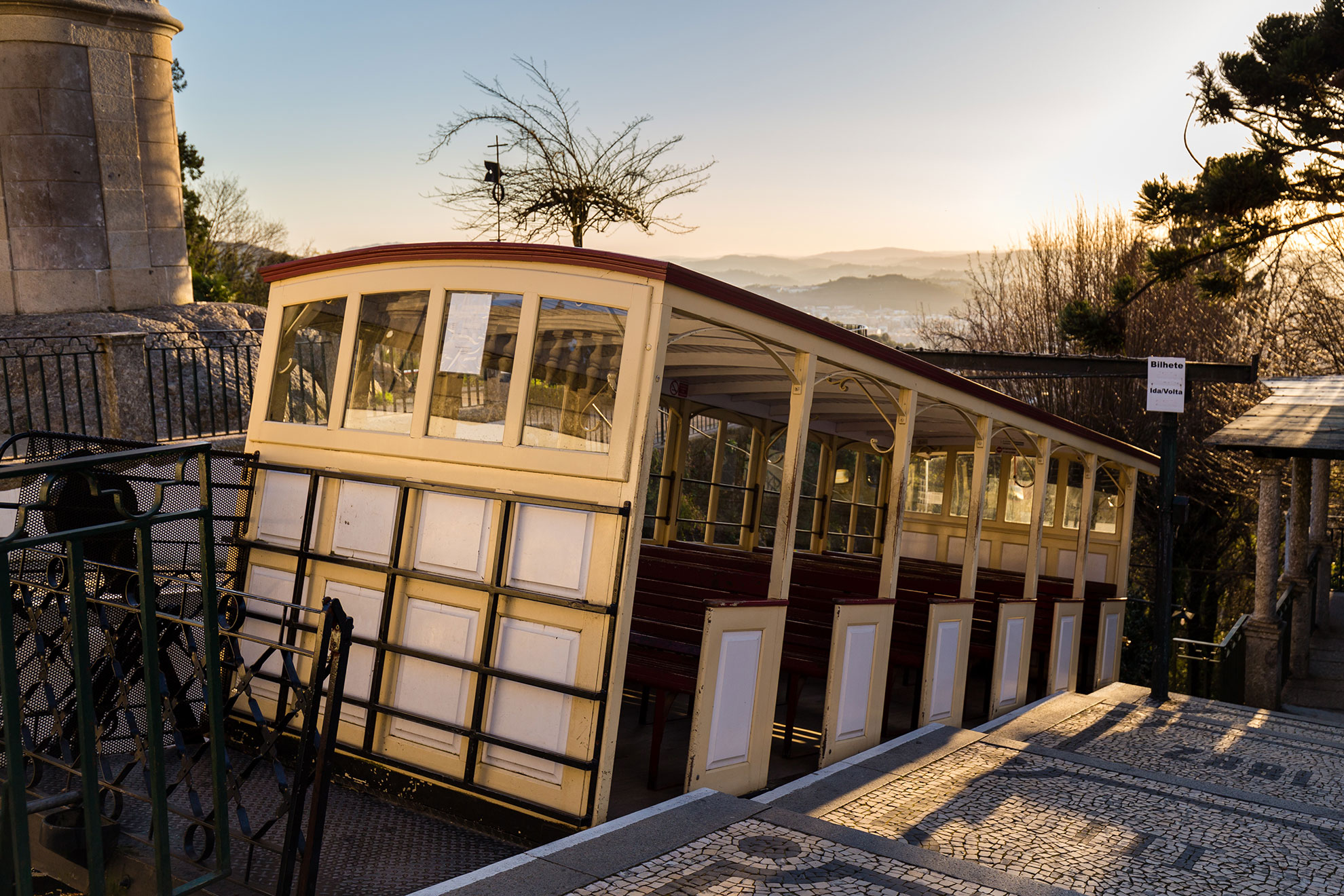
The 1882 funicular at Bom Jesus operates on a water-counterbalance mechanism — a curiosity as much as a convenience.
In 2019, the sanctuary complex and its forested surroundings were inscribed on the UNESCO World Heritage List as part of the «Sanctuary of Bom Jesus do Monte in Braga» designation, recognizing its exceptional baroque landscape design. The church at the summit is flanked by a formal garden and hotel dating from the same period, offering a quiet terrace with views over the rooftops of the city below. The approach on foot is recommended for at least the lower sections, where the sculptural fountains and allegorical figures are most concentrated.
Guided & Private Tours of Braga and Guimarães
Walking Tours & Local Experiences in Braga
From the baroque splendor of Bom Jesus to the medieval echoes of Guimarães, Braga rewards those who explore it with proper context. Browse the full selection of guided tours, walking routes, and day trips available from Braga.
View All Braga Tours →Roman Foundations Beneath the Baroque
Braga's baroque splendor sits atop a much older city. Bracara Augusta, established under Emperor Augustus and later the capital of the Roman province of Gallaecia, left behind a considerable archaeological footprint. The Roman Thermae, uncovered beneath the modern city center, can be visited through a dedicated museum space, offering a rare opportunity to descend beneath street level and walk the perimeter of a well-preserved ancient bathing complex. Elsewhere, fragments of the Roman road network and sections of the original city walls have been incorporated into public spaces, noted with explanatory panels rather than roped off behind barriers. Braga treats its Roman past as a living companion to its present, not a museological abstraction.
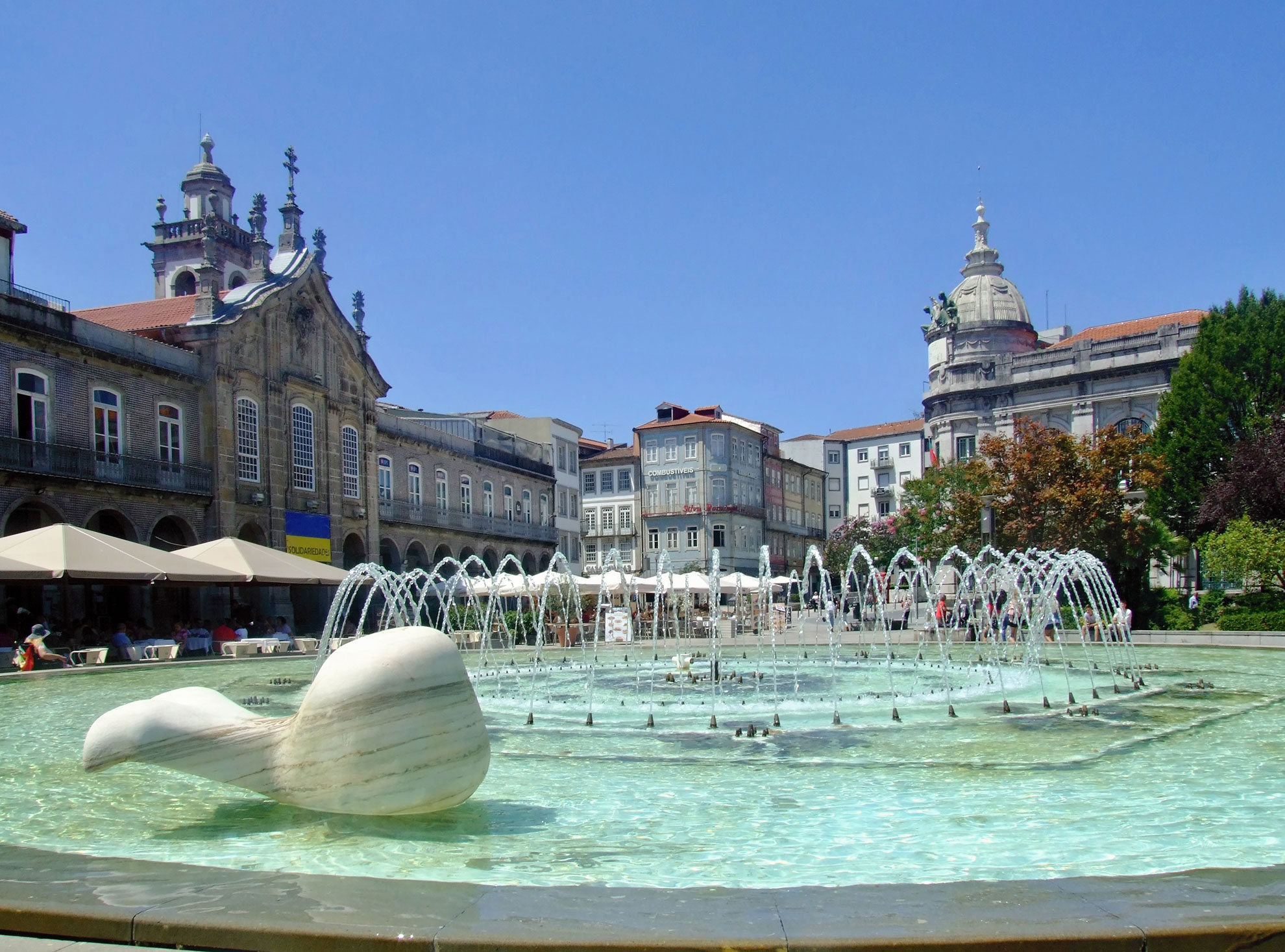
The Praça da República — locally called the Arcada — anchors Braga's pedestrian-friendly historic center.
City Life: The Arcada, the Streets, and the Minho Table
The Praça da República, known colloquially as the Arcada for its ground-floor porticos, functions as the social nucleus of central Braga. The square's café terraces fill steadily from mid-morning onwards, and the surrounding pedestrian lanes — Rua do Souto, Rua Dom Diogo de Sousa — are threaded with traditional shops selling linen goods and regional ceramics alongside newer independent boutiques and specialty coffee establishments. The street life here carries genuine variety: elderly residents taking the same route they have walked for decades, university students cycling between lectures, and visitors pausing to read carved inscriptions above 18th-century doorways.
The gastronomy of the Minho region is direct and substantial. Bacalhau à Braga — salt cod prepared with thinly sliced fried potatoes and vinegared onions — is the dish most closely associated with the city, though the broader regional table includes caldo verde, roasted veal, and the area's characteristic vinho verde wines. The dessert most worth seeking out is Pudim Abade de Priscos, a dense caramel pudding made with bacon fat and port wine, developed in the 19th century by a local abbot and still prepared according to the original recipe in several traditional restaurants.
"The Minho table does not apologize for its richness. Pudim Abade de Priscos — caramel, port, and the faintest trace of bacon — is a dessert that rewards curiosity and resists easy description."
Between the Sanctuary and the Plaza: How to Read Braga in a Day
The most rewarding way to experience Braga is to begin at the Sé and work outward through the historic center in the morning, reaching Bom Jesus do Monte by midday — the stairway is most photogenic in the softer afternoon light, but the midday crowds at the summit are manageable and the funicular queue shorter before tourist buses arrive after lunch. An afternoon return to the city for a meal in one of the tascas near the Praça da República, followed by a slow walk through the illuminated baroque facades in the early evening, gives the day a natural rhythm. Those combining Braga with Guimarães — the two cities are a 25-minute drive apart — will need a full day and an early start, but the pairing is logical: one city shaped by the Church, the other by the medieval royal court that founded a nation.
Whether you are arriving from Porto for a day or planning a longer stay in northern Portugal, Braga has a tour format to match your pace — private, small-group, food-focused, or self-guided. Find the right experience below.
Explore All Braga Tours →Frequently Asked Questions About Braga
How far is Braga from Porto, and is it easy to reach?
Braga is approximately 55 km north of Porto. By train from Porto's Campanhã station, the journey takes between 35 and 55 minutes depending on the service. By car, the trip is around 45 minutes via the A3 motorway. Most organized day tours from Porto include hotel pickup, making independent transport arrangements unnecessary.
Is Bom Jesus do Monte worth the visit, and how do you get there?
Yes — the site earns its UNESCO designation through the quality of its baroque landscape design and the unusual combination of the stairway, sculptural programme, forested park, and historic funicular. From central Braga, city bus No. 2 runs to the base of the stairway. The funicular operates year-round and covers the steepest section. Walking the full stairway takes 20–30 minutes depending on pace.
Can Braga and Guimarães be covered in a single day?
Yes, though it requires an early start and a willingness to prioritize. Most organized day tours from Porto cover the highlights of both cities — including the Sé de Braga, Bom Jesus, and Guimarães' Palace of the Dukes and castle — within an 8–9 hour itinerary. Travelers with a particular interest in either city may prefer to dedicate a separate day to each.
What is the best time of year to visit Braga?
Spring (April–June) and early autumn (September–October) offer mild temperatures and manageable tourist numbers. Braga is also renowned for its Semana Santa (Holy Week) celebrations, which take place in late March or April and are among the most elaborate in Portugal, drawing visitors from across the country. Summer is busy but fully operational across all sites.
What local dishes should I try in Braga?
Bacalhau à Braga is the city's signature dish — salt cod served with thinly sliced fried potatoes and pickled onions. For dessert, Pudim Abade de Priscos is the regional specialty, a caramel pudding made with port wine and bacon fat according to a 19th-century recipe. Pair either with a local vinho verde for an authentic Minho meal.
Are there self-guided options for exploring Braga, or is a guide necessary?
Braga's historic center is compact and walkable, with good signage and several free interpretive panels at major sites. A self-guided visit is entirely feasible, and the scavenger-hunt walking tour format available through ToursXplorer provides structure without requiring a fixed schedule. That said, a local guide adds considerable depth to the Roman and medieval history layers that are not immediately legible from the architecture alone.