



Best Time to Visit Cape Verde: Month-by-Month Guide for 2026/2027
From the trade-wind swells of Sal to turtle-nesting beaches in Boa Vista, here is how to match your passion to the perfect Cape Verde season.
Cape Verde sits roughly 570 kilometres off the coast of Senegal, close enough to Africa to catch Saharan dust on the breeze yet far enough into the Atlantic to earn its own personality. Temperatures hover between 24°C and 30°C year-round, but that stability masks a layered seasonal calendar shaped by trade winds, volcanic topography, and a cultural life that pulses between February carnival and August full-moon festivals.
Does Cape Verde really have seasons, or is every month the same?
The short answer is: yes, seasons exist, and they matter. The archipelago's ten inhabited islands split neatly into two climatic groups. The flat, low-lying islands of Sal, Boa Vista, and Maio sit exposed to the Northeast Trade Winds (locally called alísios) and receive almost no rain across the entire year. Santiago, Santo Antão, São Nicolau, and Fogo are mountainous; their peaks catch Atlantic moisture and generate microclimates that can shift from arid coastal lowlands to verdant valleys within a single hour's drive.
The conventional calendar breaks into three periods. The Dry Season runs from November to June, offering clear skies, low humidity, and reliable sunshine. The Windy Season, which overlaps the dry period from December to March, brings sustained North-East Trade Winds that can exceed 30 knots across Sal and Boa Vista — a specific condition that attracts kitesurfers and windsurfers from across Europe. The Green Season (August to October) sees brief, intense rainfall on the mountainous islands; the arid dunes stay dry while the volcanic slopes around Ribeira Grande on Santo Antão and the Serra Malagueta range on Santiago flush an unlikely green.
"The same week that a kite-surfer is riding 40-knot gusts at Santa Maria Beach on Sal, a hiker on Santo Antão is walking through cloud forest above 1,300 metres. Cape Verde is not one destination — it is an archipelago of parallel climates."
One phenomenon that catches visitors off guard is the Bruma Seca, a Saharan dust haze that drifts in on easterly winds between January and February. It softens the light to a cinematic amber and makes for atmospheric photography, but it can reduce in-flight visibility between islands and occasionally delays or diverts inter-island flights operated by Bestfly and TACV. Travellers with tight inter-island connections in January and February should build buffer days into their itinerary.
What is the best month for a beach holiday in Cape Verde?
For classic beach conditions — calm water, minimal wind, consistent sunshine — the window from May to July stands out. The Trade Winds ease noticeably by late April, the Atlantic surface temperature around Sal and Boa Vista sits at approximately 23°C to 25°C, and the notorious afternoon gusts that pepper Santa Maria Beach with sand from November onward lose their edge. June and July are particularly valued by families and snorkelling enthusiasts because the sea surface is glassy by morning and visibility underwater around the natural pools of Pedra de Lume and Buracona on Sal reaches 15 to 20 metres.
The natural pools at Buracona, on the northwest coast of Sal, are fed directly by Atlantic swells and are best visited at low tide between May and August. At Pedra de Lume, a saltwater crater lagoon some 8 kilometres from Espargos, the mineral-rich waters allow visitors to float effortlessly — an experience that works in almost any month but is most comfortable between May and September when daytime temperatures reach 28°C to 30°C.
"May on Boa Vista feels like the Atlantic has been ironed flat. The dunes behind Santa Monica Beach — a 55-kilometre stretch of uninterrupted sand — glow amber in the late afternoon while the ocean sits completely still."
Santa Monica Beach on Boa Vista is consistently ranked among the longest uninterrupted beaches in Africa. Reaching it requires either a quad-bike crossing through the interior dunes or a 4x4 excursion, since no sealed road connects it to the main resort area of Sal Rei. The journey itself, through a landscape of volcanic rock and shifting sand, is as much a part of the experience as the beach.
When is the windy season in Sal and Boa Vista, and is it right for kitesurfing?
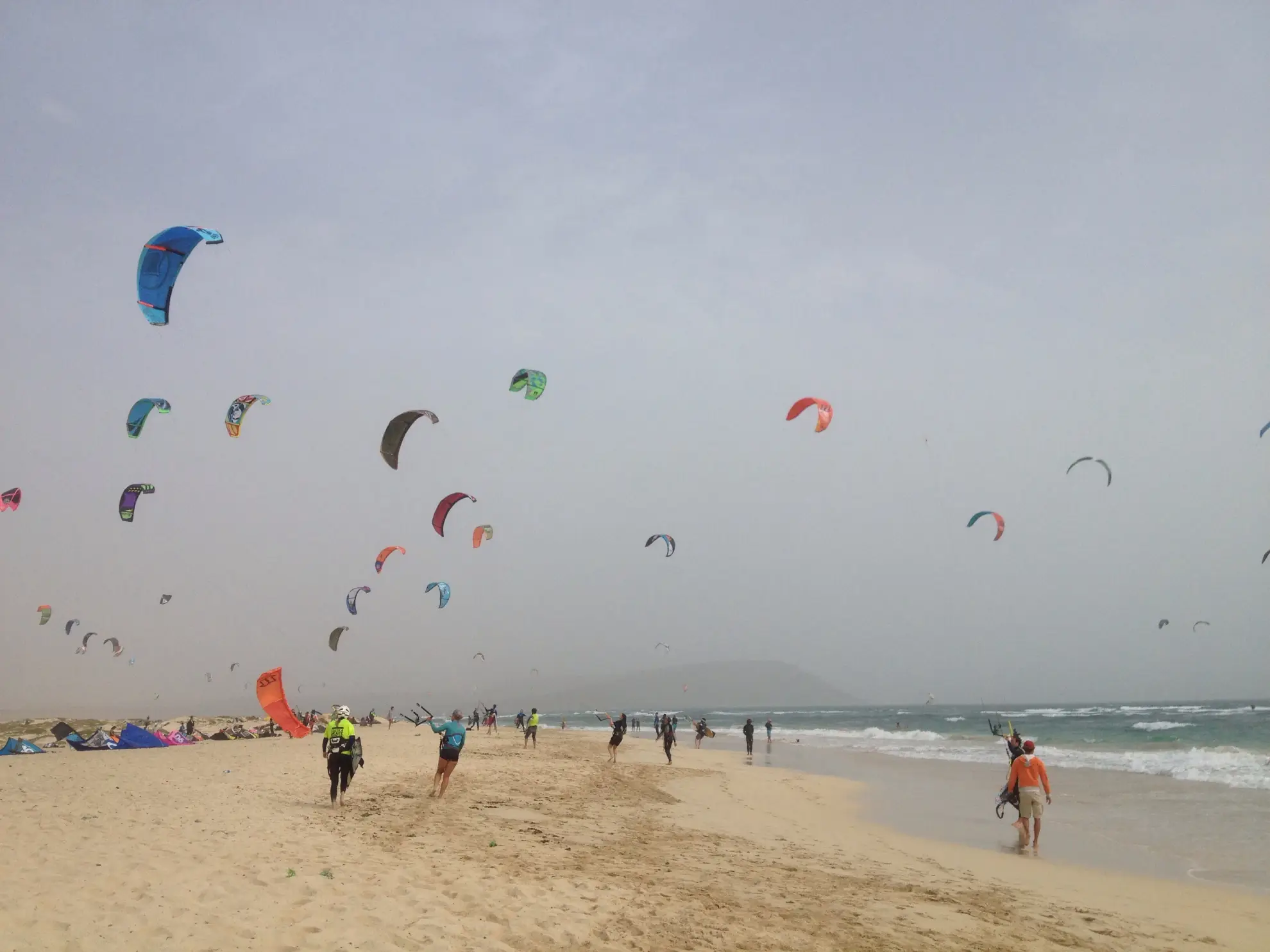
The answer is precise: December to March is the prime window, with January and February delivering the most consistent gusts. At Kite Beach (Praia do Kite) near Santa Maria on Sal, wind speeds average between 20 and 35 knots during this period, and the shallow, flat-water lagoon created by an offshore reef makes it suitable for beginners and advanced riders alike. Several IKO-certified kite schools operate on the beach year-round, but their high-season schedules run from December to April.
Boa Vista's equivalent is the stretch of coast north of Sal Rei, near the village of Rabil, where a consistent side-onshore wind makes it safer for learners. The island also hosts informal competitions during February, coinciding with lower tourist numbers than Sal. Windsurf conditions follow a similar pattern, with rental equipment available through operators based in both Sal Rei and Santa Maria.
One practical note: April and November act as shoulder months when the wind is unpredictable. Dedicated water-sports travellers are advised to avoid these transition months if reliable conditions are the primary goal. October can deliver good wind on the southern coast of Sal, but forecasts vary week to week. For current wind data, the website Windguru provides historical percentile charts specific to each island and is the tool most local instructors reference.
What are the dates for turtle watching and whale watching in 2026?
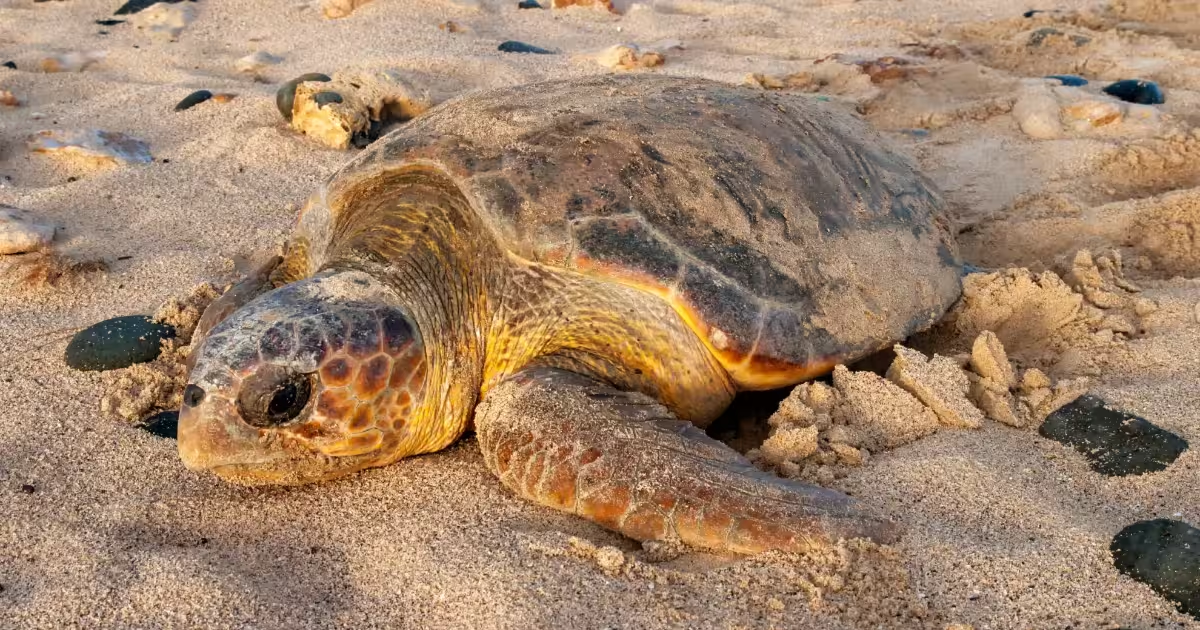
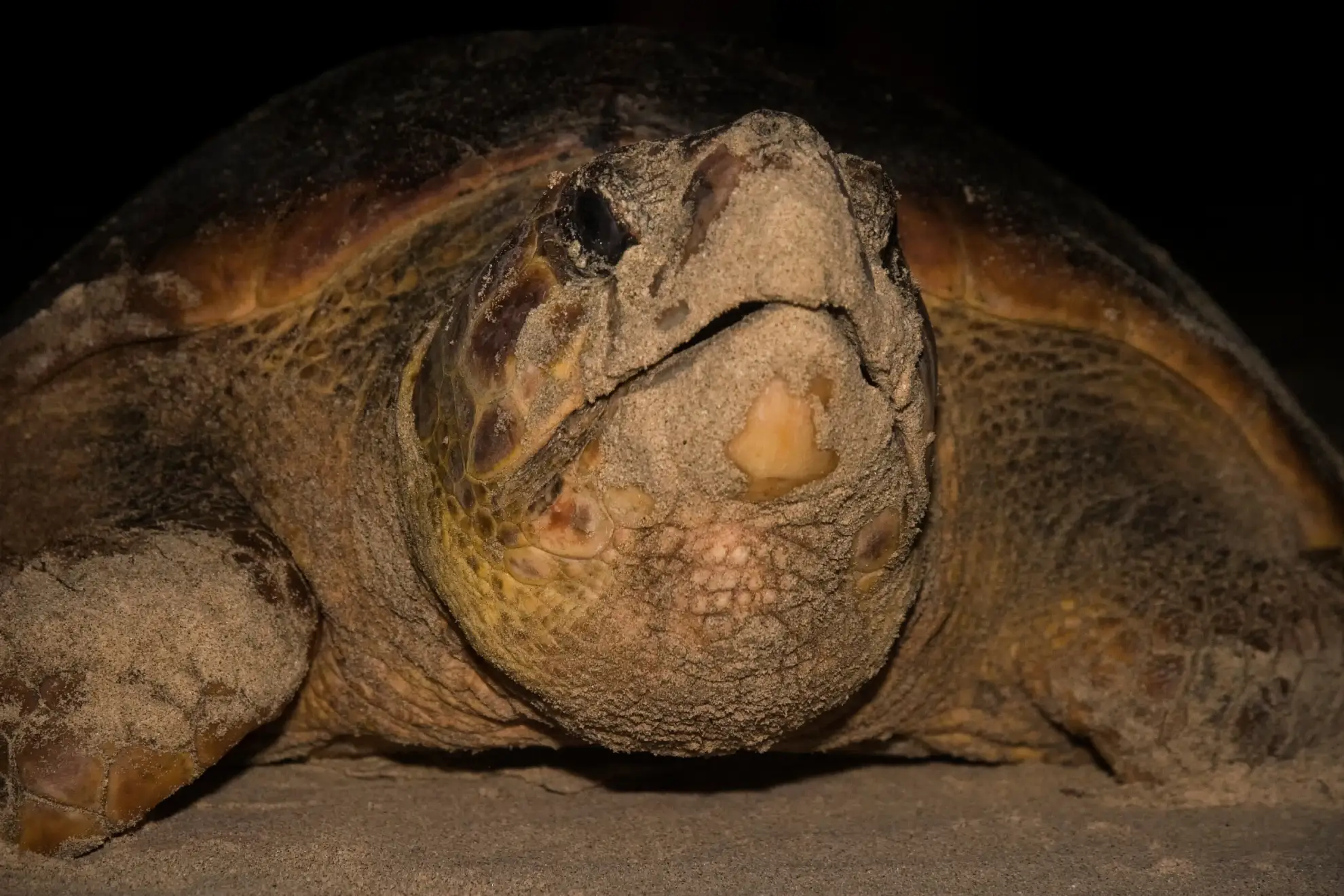
Cape Verde hosts one of the largest Caretta caretta (loggerhead sea turtle) nesting populations in the world, second in the North Atlantic only to Florida. Females come ashore to nest between late June and late October, with the peak nesting and hatching period running from July to September. Boa Vista is the epicentre; the beaches of Curral Velho, Ervatão, and João Barrosa on the island's eastern and southern coastlines collectively record tens of thousands of nests per season. The NGO Turtle Foundation has operated a protection programme on Boa Vista since 2007 and coordinates guided night walks from July to October. Participation requires advance booking and adherence to strict protocols: no white-light torches, no flash photography, and a minimum distance of five metres from nesting females.
For 2026 specifically, peak hatching on Boa Vista is projected for mid-August to late September. Travellers who visit during the Baía das Gatas Music Festival on São Vicente (held annually on the full-moon weekend of August, in 2026 falling around August 7-9) can combine a cultural weekend with a ferry crossing to Boa Vista for turtle watching during the same trip.
Humpback whales (Megaptera novaeangliae) migrate through Cape Verdean waters between March and May, with Boa Vista and the channel between Sal and Boa Vista being the most reliable sighting zones. Several operators in Sal Rei offer three-hour boat excursions from late February through May. Sighting rates during March and April typically exceed 80 percent according to local operators. Spinner dolphins (Stenella longirostris) are present year-round in the deeper channels between islands.
When is the Mindelo Carnival in 2026, and how far ahead should you book?
The Mindelo Carnival on São Vicente is held annually in the days leading up to Ash Wednesday. In 2026, the main parade falls on Sunday, 15 February, with street parties and neighbourhood blocos beginning from Friday 13 February through to Shrove Tuesday on 17 February. The event draws parallels to Rio de Janeiro for its organisation and spectacle: competing groups (called grupos carnavalescos) spend the entire year preparing costumes and choreography, and the main avenue through Mindelo's historic centre fills with tens of thousands of spectators and participants.
Accommodation in Mindelo sells out months in advance for Carnival week. Hotels on the seafront Avenida Marginal and in the old colonial district around Praça Nova are fully booked by October of the preceding year in a typical season. Travellers planning to attend the 2026 Carnival should secure accommodation by September 2025 at the latest. TACV and Binter Canarias operate flights from Lisbon, Amsterdam, and Las Palmas to São Vicente's Cesária Évora Airport (VXE), named after the island's most celebrated musical daughter, the singer who brought morna to global audiences in the 1990s.
Beyond Carnival, Mindelo offers one of the most architecturally coherent colonial streetscapes in the archipelago, with Portuguese-era pastel-painted buildings, a covered market, and a bar and live-music scene centred on Rua Lisboa. The city sits at the base of Monte Verde, the island's highest point at 750 metres above sea level, which frames every photograph of the bay.
Which months are best for hiking on Santo Antão and São Nicolau?
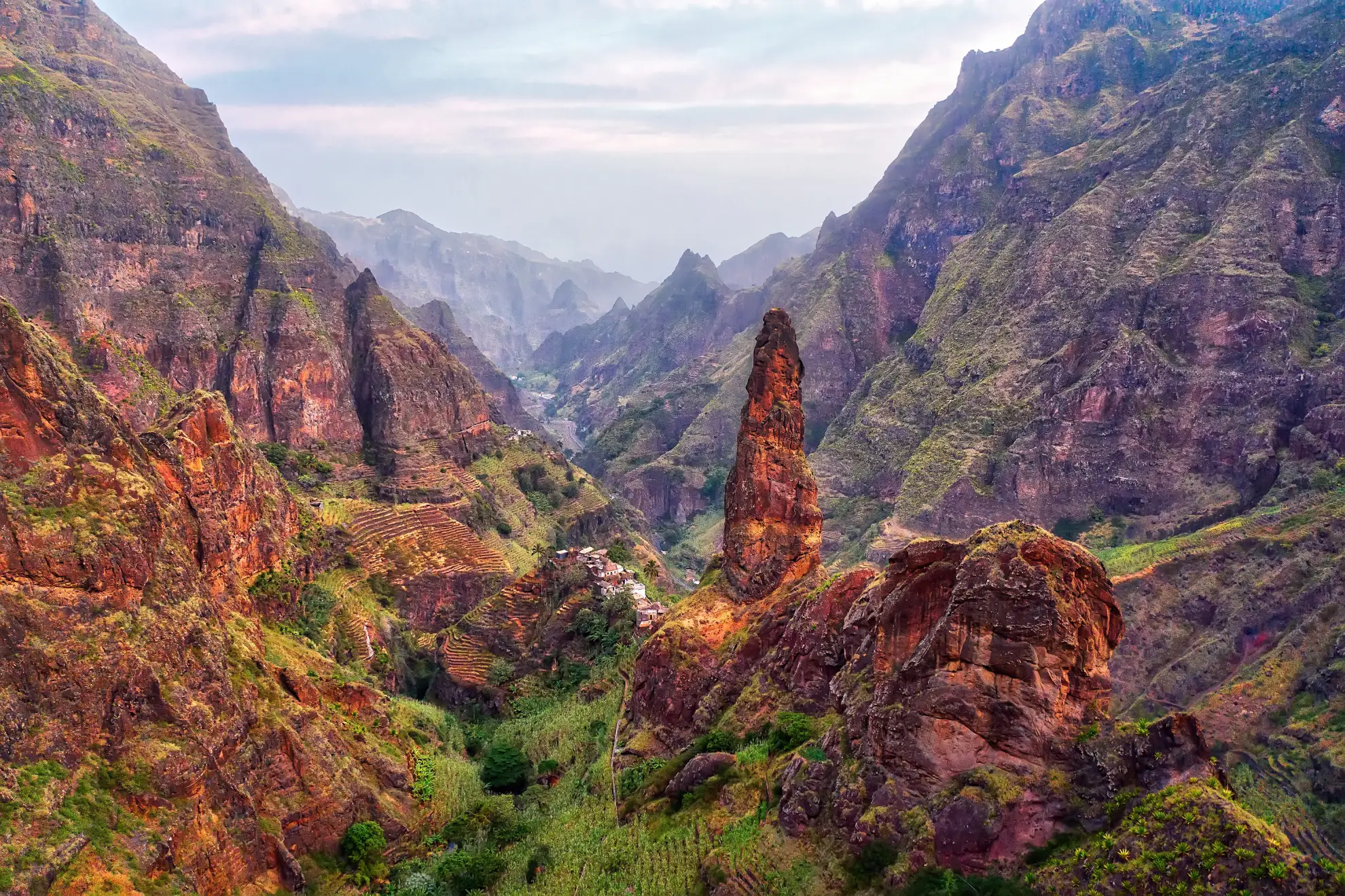
The hiking season on Cape Verde's mountainous islands runs from October to April, when skies above the valleys are clearest, temperatures at altitude drop to a manageable 18°C to 22°C, and the post-rainy-season vegetation on Santo Antão is still lush. The main trekking route on Santo Antão follows the Ribeira do Paul valley, a 12-kilometre walk from the village of Eito down to Porto Novo that descends through terraced sugarcane fields, coffee plantations, and banana groves. The path is well-marked and takes approximately four to five hours at a moderate pace.
São Nicolau, smaller and less visited than Santo Antão, offers a network of trails across its central mountain ridge that peaks at Monte Gordo (1,312 metres). The Praia Branca to Carbeirinho walk on the island's western coast is considered one of the more technical coastal trails in the archipelago, combining cliff-edge paths with descent into hidden coves. It is best attempted from November to March when the northern trade winds have not yet raised sea spray to uncomfortable levels on exposed ridgelines.
On Fogo, the Chã das Caldeiras — the settlement inside the caldera of Pico do Fogo, an active stratovolcano that last erupted in November 2014 — can be visited year-round, but the summit hike to 2,829 metres (the highest point in Cape Verde) is most reliably completed between November and March when visibility is sharpest. The ascent takes five to six hours from the caldera floor and should only be attempted with a licensed local guide.
Explore Cape Verde: Guided Tours for Every Season
Ready to match your travel dates to Cape Verde's seasons? Browse all available tours on ToursXplorer and secure your spot before the high season fills up.
Click hereHow ToursXplorer can help you plan your Cape Verde trip by season
Cape Verde rewards travellers who plan around a specific motivation rather than a generic holiday window. ToursXplorer has curated a selection of guided experiences across six islands — from the off-road dune crossings of Boa Vista and Sal to the high-altitude coastal trails of São Nicolau — to help visitors align their itinerary with the archipelago's natural and cultural calendar.
If your priority is water sports, the December-to-March window on Sal is the target and the Sal Island Off-Road Quad Bike Tour pairs well with a morning kite lesson. If turtle watching drives the trip, Boa Vista in August combines the Half-Day Quad Tour to Santa Monica Beach with an evening Turtle Foundation walk. For cultural travellers, São Vicente in February ties the Monte Verde Hiking Tour to the Mindelo Carnival — one of the most distinctive street festivals in the Atlantic world.
All tours listed on ToursXplorer include English-speaking guides, pick-up from main resort areas, and detailed briefings on local environmental regulations, including the marine protected area rules that apply around Sal's shark nursery and Boa Vista's turtle nesting beaches. Booking at least four to six weeks before your travel date is recommended for peak-season departures between December and March and during the Carnival and festival weeks.
A practical month-by-month summary for 2026
January: Peak Windy Season on Sal and Boa Vista. Bruma Seca (Saharan dust haze) possible. Excellent for kitesurfing and windsurf. Build buffer days into inter-island flights.
February: Mindelo Carnival (main parade: 15 February 2026). Strongest trade winds of the year. Bruma Seca risk continues. Book accommodation in São Vicente by September 2025.
March: Humpback whale watching season begins around Boa Vista. Wind eases slightly. Hiking on Santo Antão and São Nicolau at its best.
April: Transition month. Wind declining. Water temperature rising toward 23°C. Shoulder season pricing on most islands.
May: Optimal beach conditions begin. Calm seas, low wind. Snorkelling visibility peaks at Buracona and the natural pools.
June: First loggerhead turtles arrive to nest on Boa Vista. Sea temperature 24°C. Quiet, low-season atmosphere. Good value flights from Europe.
July: Turtle nesting intensifies. Calm seas continue. Hottest month on low-lying islands, reaching 30°C to 32°C in the afternoons.
August: Peak turtle nesting and hatching. Baía das Gatas Music Festival on São Vicente (circa 7-9 August 2026). Brief rain possible on mountainous islands. Green Season begins on Santiago and Santo Antão.
September: Peak turtle hatching on Boa Vista. Highest rain probability on Santiago and Fogo. Trade winds begin returning by late month.
October: Green Season at its visual peak on Santo Antão and Santiago. Hiking season opens. Last turtles nesting. Transition winds on Sal.
November: Wind building again on Sal and Boa Vista. Hiking excellent across all mountainous islands. Shoulder season with good availability.
December: Full Windy Season resumes. Christmas and New Year demand pushes prices up across Sal. Monte Verde on São Vicente offers cool, clear-sky summit views.
Planning around the 2026 Mindelo Carnival or the August turtle-hatching peak? Check real-time availability on ToursXplorer — popular dates book out months in advance.
Frequently Asked Questions
May, June, and July offer the calmest conditions for a beach holiday in Cape Verde. Trade winds ease by late April, the Atlantic surface temperature around Sal and Boa Vista reaches 23°C to 25°C, and afternoon gusts that disturb Santa Maria Beach in winter are minimal. Underwater visibility at the natural pools of Buracona peaks at 15 to 20 metres during this window.
The prime kitesurfing window is December to March, with January and February delivering the most consistent winds averaging 20 to 35 knots at Kite Beach near Santa Maria on Sal. Boa Vista's coast north of Sal Rei also provides reliable side-onshore conditions during this period. IKO-certified kite schools on both islands operate high-season programmes from December through April.
The main Mindelo Carnival parade on São Vicente falls on Sunday, 15 February 2026, with street celebrations running from Friday 13 February through Shrove Tuesday on 17 February. Accommodation in Mindelo sells out months in advance; travellers should book hotels around Avenida Marginal by September 2025 at the latest. TACV and Binter Canarias operate flights to São Vicente's Cesária Évora Airport (VXE).
Loggerhead turtles (Caretta caretta) come ashore to nest on Boa Vista from late June through October, with peak nesting and hatching between July and September. The Turtle Foundation NGO organises guided night walks from July to October on beaches including Curral Velho and Ervatão. Participants must book in advance and follow strict protocols: no flash photography and a minimum five-metre distance from nesting females.
Yes, the mountainous islands of Santo Antão, São Nicolau, Santiago, and Fogo offer well-established hiking trails. The best season is October to April when skies above the valleys are clear, altitude temperatures sit at 18°C to 22°C, and vegetation on Santo Antão is lush after the brief rainy season. The Ribeira do Paul valley trail on Santo Antão is 12 kilometres long and takes four to five hours at a moderate pace.
Bruma Seca is a Saharan dust haze carried on easterly winds, most common between January and February. It creates an amber, diffused light that can produce atmospheric photographs but reduces aerial visibility, occasionally causing delays or diversions on inter-island flights operated by Bestfly and TACV. Travellers with tight inter-island connections during January and February should allow buffer days in their itinerary.