




Blue Whales in the Azores: When and Where to See the Largest Animal on Earth
A specialist 2026 guide to the spring migration window, the best departure islands, and what to look for when the ocean's titan surfaces.
Every April, the North Atlantic becomes a corridor for the largest animal ever to have lived on Earth. Balaenoptera musculus, the blue whale, pauses its transoceanic marathon in the waters around the Azores, drawn by cold, nutrient-rich upwellings that support explosive spring blooms of krill and plankton. The resulting congregation gives travellers a narrow but remarkably reliable window to witness a creature whose heart alone weighs roughly 180 kilograms.
Why Do Blue Whales Stop in the Azores at All?
The Azores sit at a biogeographic crossroads in the mid-Atlantic, approximately 1,500 kilometres west of Lisbon. The archipelago's nine islands rise from submarine ridges and seamounts that force cold, deep water upward toward the surface — a process oceanographers call coastal upwelling. Each spring, these nutrient-rich corridors trigger blooms of phytoplankton, which in turn sustain dense concentrations of euphausiid shrimp (krill) and copepods. For a blue whale consuming up to four tonnes of krill daily, this stretch of ocean functions as a critical fuelling station.
Think of it as the world's largest drive-through, positioned midway along the blue whale's annual migratory marathon between its winter breeding grounds near the Canary Islands and its summer feeding territories off Iceland and Norway. The whales do not simply pass through the Azores. They linger, sometimes for weeks, in abyssal waters that plunge to more than 2,000 metres just a few kilometres from the islands of Pico and Faial.
"The Azorean waters represent one of the last places on Earth where you can observe blue whales from land-based lookouts and from the water simultaneously — a tradition that descends directly from the archipelago's whaling past." — Marine biologist perspective shared during a 2024 cetacean monitoring survey cited by the Azores Whale Watching Association
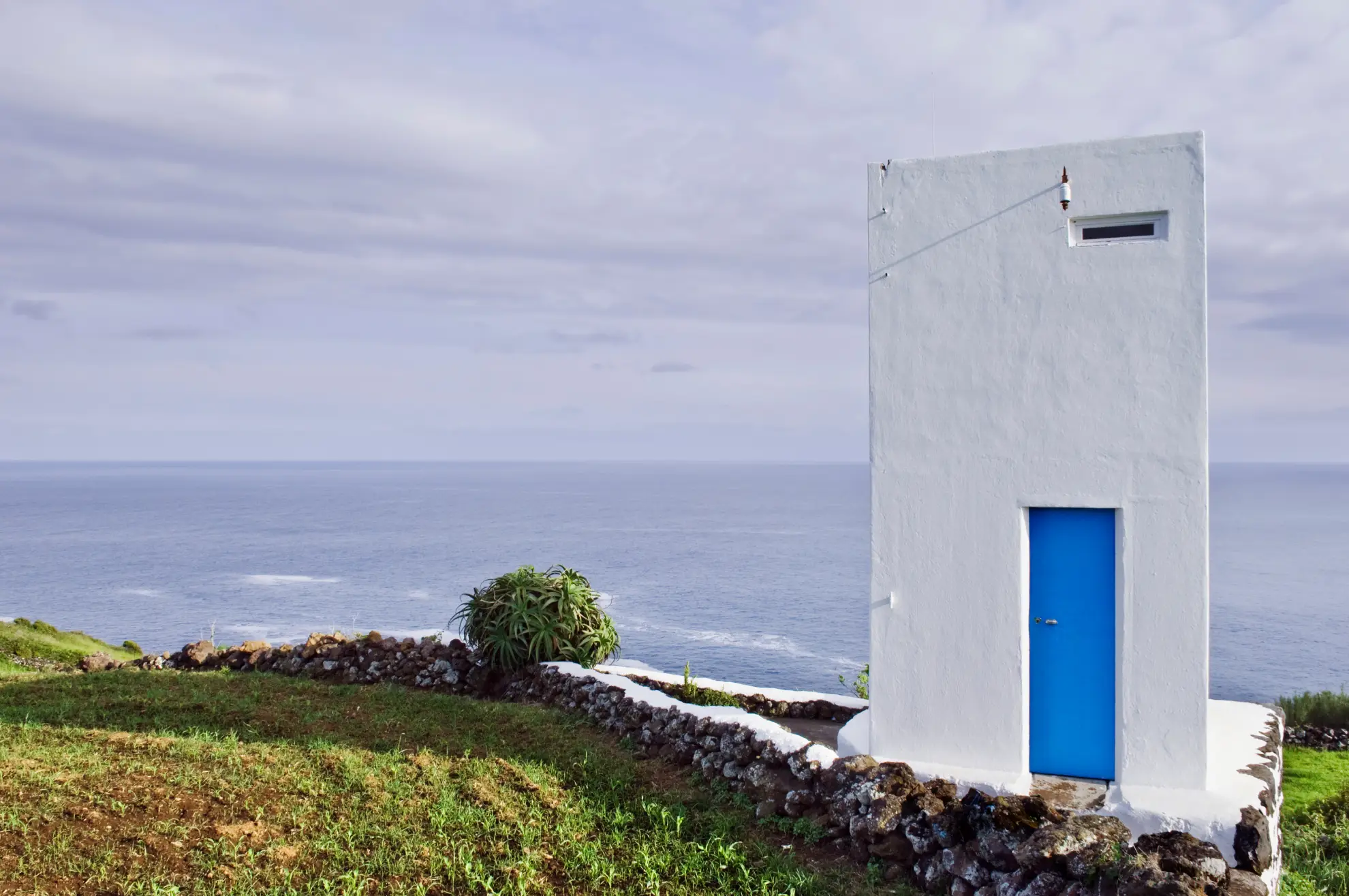
Those land-based lookouts, known locally as vigias, were originally constructed in the eighteenth and nineteenth centuries by sperm-whale hunters who needed elevated vantage points to spot distant spouts. Today the same stone huts serve a very different purpose: trained vigia spotters radio precise GPS coordinates to boat crews below, dramatically improving sighting success rates. On São Miguel, this network of coastal vigias means whale watching tours departing from Ponta Delgada can navigate directly to an animal rather than searching open water.
When Is the Best Time to See Blue Whales in the Azores?
The Azores whale watching season for blue whales is short and specific. Based on decades of sighting records compiled by organisations including IMAR (Institute of Marine Research, Horta) and the non-profit Futurismo, the reliable window runs from approximately the first week of April through the last week of May. April and May consistently produce the highest sighting frequencies, with some departure operators on Pico Island reporting blue whale encounters on more than 80 percent of April outings in recent years.
By early June, the majority of blue whales have continued north toward subarctic feeding grounds. A smaller number of late-season individuals may still appear in June, particularly in cooler-than-average years when the krill blooms persist, but sightings become unpredictable. Outside this window, sperm whales (Physeter macrocephalus) are present year-round in deep Azorean waters, and at least nine other cetacean species, including common dolphins (Delphinus delphis), striped dolphins (Stenella coeruleoalba), and Risso's dolphins (Grampus griseus), visit across all seasons.
"April mornings off Madalena are often glassy calm. That stillness is exactly what you need to spot a spout from two kilometres away before the whale sounds again." — Observation from a licensed marine naturalist based on Pico Island
For 2026 planning purposes, ToursXplorer recommends booking whale watching tours azores departures for mid-April through mid-May. This central portion of the season captures the statistical peak of blue whale density while offering more weather stability than early April, which can still produce significant Atlantic swell.
Where Are the Best Departure Points for Blue Whale Sightings?
Not all Azorean islands offer equal access to blue whale habitat, and choosing the right base matters considerably.
Pico and Faial: The Triangle Zone. The waters between Pico, Faial, and São Jorge form what cetacean researchers informally call "the Triangle," an area of exceptional bathymetric complexity. The seabed drops from less than 100 metres in the inter-island channel to more than 1,000 metres within a 5-kilometre radius of Pico's south coast. This abrupt topographic plunge concentrates krill and draws blue whales closer to shore than almost anywhere else in the Atlantic. Departures from Madalena (Pico's main ferry and boat terminal) can reach productive blue whale habitat in under 20 minutes. Horta, on Faial, offers similarly rapid access.
São Miguel: Ponta Delgada and the Vigia Network. São Miguel is the archipelago's largest and most accessible island, with direct international flights from Lisbon, London, and Boston. Whale watching tours Ponta Delgada benefit from the densest concentration of operational vigias on any Azorean island. The lookout at Ferraria, on São Miguel's northwest tip, has an unobstructed 180-degree ocean view and has documented blue whale spouts as close as three kilometres offshore during peak season. Sighting rates from São Miguel are competitive with those from Pico, making it a practical choice for travellers with limited island-hopping time.
Terceira. Less frequently cited than Pico or São Miguel for blue whales specifically, Terceira nonetheless lies within reach of the same migratory corridor. Its deeper offshore waters can produce sightings, particularly in May when the whales begin dispersing northward and may pass closer to Terceira's latitude.
ToursXplorer lists departures from multiple islands, allowing travellers to compare schedules and select the option that fits their itinerary without compromising on access to blue whale habitat.
How Do You Identify a Blue Whale at Sea?
Encounter probability means nothing without preparation. Blue whales are visually distinctive, but the ocean offers few reference points for scale, and the animal's behaviour can be subtle despite its colossal dimensions.
The blow. The single most reliable identification feature is the spout. Blue whales produce a near-vertical columnar blow reaching up to nine metres in height — roughly three times the height of a standard room ceiling. The blow is narrow and pencil-straight compared to the bushy, angled spouts of humpback whales (Megaptera novaeangliae) or the forward-angled blow of sperm whales. In calm April conditions, a blue whale blow is visible from several kilometres.
Body length and skin pattern. Adult blue whales in the North Atlantic measure between 24 and 27 metres in length, the equivalent of roughly three articulated buses placed end to end. The dorsal surface shows mottled blue-grey pigmentation, a pattern as individual as a fingerprint and used by researchers for photo-identification. When the animal is close to the surface and sunlight penetrates clearly, the skin takes on a luminous turquoise quality in the surrounding water — a visual effect caused by light refraction rather than the animal's actual coloration.
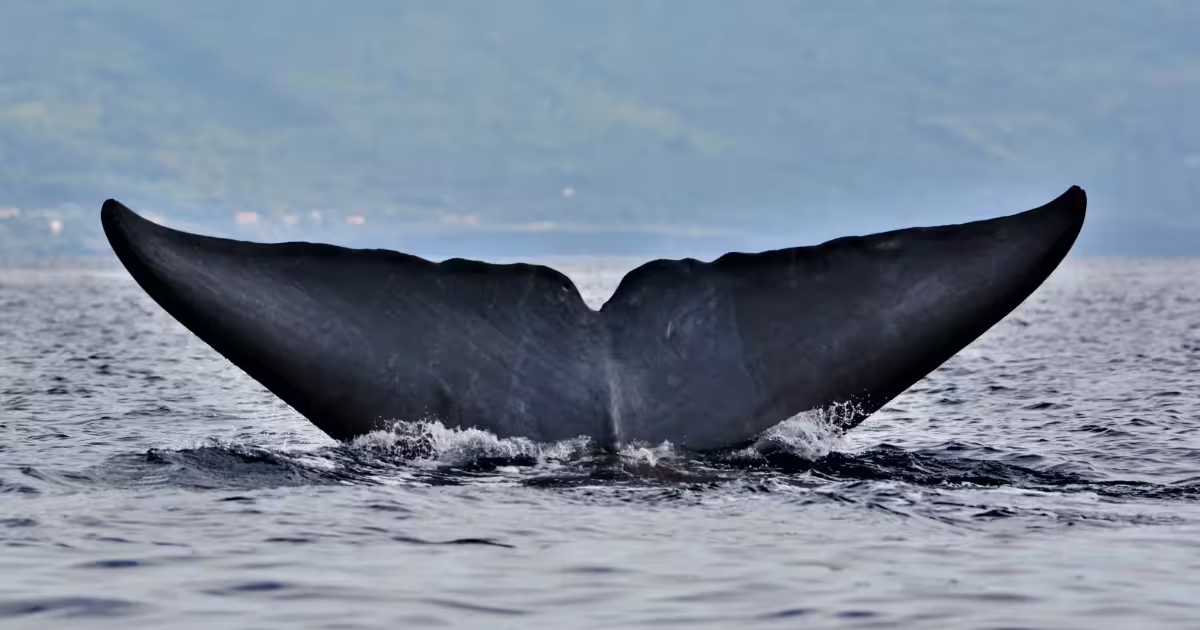
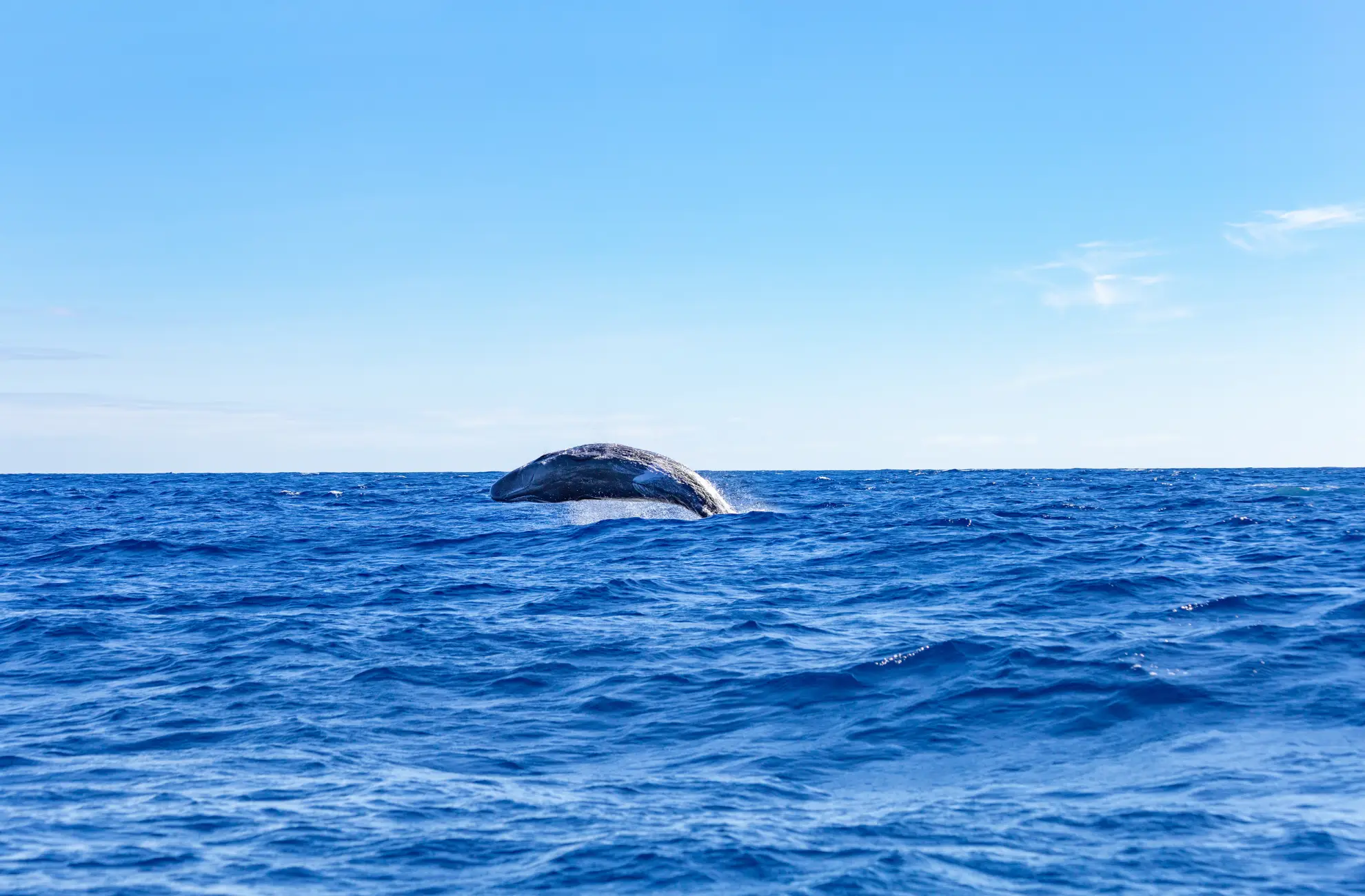
The fluke. Blue whales do not typically raise their flukes (tail fins) dramatically above the surface when diving, unlike humpbacks. Instead, the animal arches its back, shows a small, inconspicuous dorsal fin set far back toward the tail, and then the enormous body simply slides below the surface. This shallow sounding behaviour means that after a spout, you may have only 10 to 20 seconds of surface visibility before the animal descends for a dive lasting 10 to 20 minutes at depths exceeding 200 metres.
Heart and scale. To contextualise the encounter: a blue whale's heart is roughly the size of a small car and pumps approximately 220 litres of blood per beat. Its tongue alone can weigh as much as an adult elephant. Licensed naturalists aboard Azores whale watching tours routinely use these comparisons to help passengers recalibrate their spatial perception when the animal first surfaces alongside the boat.
Conservation Status and the Ethics of Watching
Blue whales were hunted to near-extinction during the industrial whaling era. Between 1900 and 1967, an estimated 360,000 blue whales were killed globally, reducing the world population from perhaps 350,000 individuals to fewer than 10,000 by the time the International Whaling Commission enacted protective measures. The Azores were among the last operational whaling stations in the North Atlantic: the Madalena station on Pico Island processed its final sperm whale in 1984, and the industry formally ended in the archipelago that year.
Today, the North Atlantic blue whale population is estimated at between 1,000 and 2,000 individuals, classified as Endangered on the IUCN Red List. The species' slow reproductive rate — females give birth to a single calf roughly every two to three years after an 11-month gestation — means recovery is a multi-generational process. Each blue whale observed in the Azores is a named, catalogued individual in research databases maintained by institutions such as the American Cetacean Society and the Portuguese Institute for Sea and Atmosphere (IPMA).
Responsible whale watching in the Azores operates under Regulation (EC) No 1380/2013 on the Common Fisheries Policy and national Portuguese decree-law provisions requiring operators to maintain minimum approach distances, limit engine noise, and restrict vessel numbers around individual animals. Accredited operators contribute directly to photo-identification catalogues and population monitoring, meaning that a booking with a certified tour provider is also a contribution to the long-term data record that informs conservation decisions. ToursXplorer works exclusively with operators holding valid SREA (Regional Secretariat for the Environment) certification.
Whale Watching Tours Departing from the Azores
The April–May window for blue whales in the Azores is narrow and departures fill quickly. Browse certified tours on ToursXplorer and secure your place before the season opens.
Click herePractical Notes for 2026 Blue Whale Departures
Book early. Certified operators on Pico and São Miguel run limited vessel capacity, typically 8 to 12 passengers per rigid inflatable or 20 to 30 on larger semi-rigid boats. April and May departures sell out weeks in advance, particularly over Portuguese public holidays including Freedom Day (25 April) and Labour Day (1 May).
Dress for ocean conditions. Mid-Atlantic April temperatures at sea level average 15 to 17 degrees Celsius, with wind chill reducing effective temperature by 4 to 6 degrees. Most operators provide waterproof suits or ponchos, but a thermal mid-layer underneath improves comfort substantially during the two to four hours on open water.
Manage expectations honestly. While sighting rates in April and May are high — some operators report blue whale encounters on 75 to 85 percent of spring departures — these are wild animals completing a transoceanic journey of several thousand kilometres. No sighting is guaranteed. Most reputable operators offer a complimentary rebooking on a subsequent departure if no cetaceans are sighted, subject to availability.
Motion sickness. The Atlantic swell around the Azores is real, particularly on north-coast departures. If you are susceptible, take appropriate medication at least one hour before boarding and choose a morning departure when sea conditions are generally calmer.
Photography. A 400mm equivalent lens or longer is useful for close-up blow shots. For full-body surface images, 200mm is often sufficient given how close Azorean operators can legally approach. Waterproof housing or a dry bag is essential — spray is frequent on RIB-style vessels.
All tours listed on ToursXplorer link directly to SREA-certified operators and include departure point details, language options, and confirmed availability for 2026 dates.
Frequently Asked Questions
April and May are the peak months for blue whale sightings in the Azores. The whales arrive in early April, drawn by spring krill blooms in the archipelago's nutrient-rich upwellings, and most have moved north toward Iceland and Norway by early June. Mid-April to mid-May offers the highest combination of sighting frequency and favourable sea conditions.
Pico Island, specifically departures from Madalena, is widely considered the best base because the seabed drops from shallow inter-island shallows to over 1,000 metres within five kilometres of the south coast, bringing blue whales close to shore. São Miguel (departing from Ponta Delgada) is a strong alternative thanks to its extensive network of land-based vigia spotters who radio whale locations to boat crews in real time.
A blue whale produces a near-vertical blow reaching up to nine metres — roughly three times the height of a standard room ceiling. It is distinctly narrow and pencil-straight compared to the bushy, angled spouts of humpback whales. On a calm April morning in the Azores, this spout can be spotted from several kilometres away, often before the whale's body becomes visible.
No sighting can be guaranteed with wild animals. However, certified Azores operators report blue whale encounter rates of 75 to 85 percent on spring departures in April and May. Most reputable operators offer a complimentary rebooking if no cetaceans are spotted at all. Booking mid-April to mid-May maximises your statistical probability of a sighting.
Most half-day departures run three to four hours on the water. Full itineraries, including boarding and briefing, typically require four to five hours from meeting point to return. Departures usually leave in the morning when Atlantic swell is lower. Some operators offer afternoon slots in May when weather windows are longer and sea conditions remain favourable.
Azorean whale watching operates under Portuguese national regulations and EU fisheries law, requiring minimum approach distances and limits on vessel numbers around individual animals. Certified operators contribute photo-identification data to international research databases maintained by institutions including IPMA. The industry replaced commercial whaling, which ended on Pico Island in 1984, and now funds ongoing cetacean population monitoring in the region.