




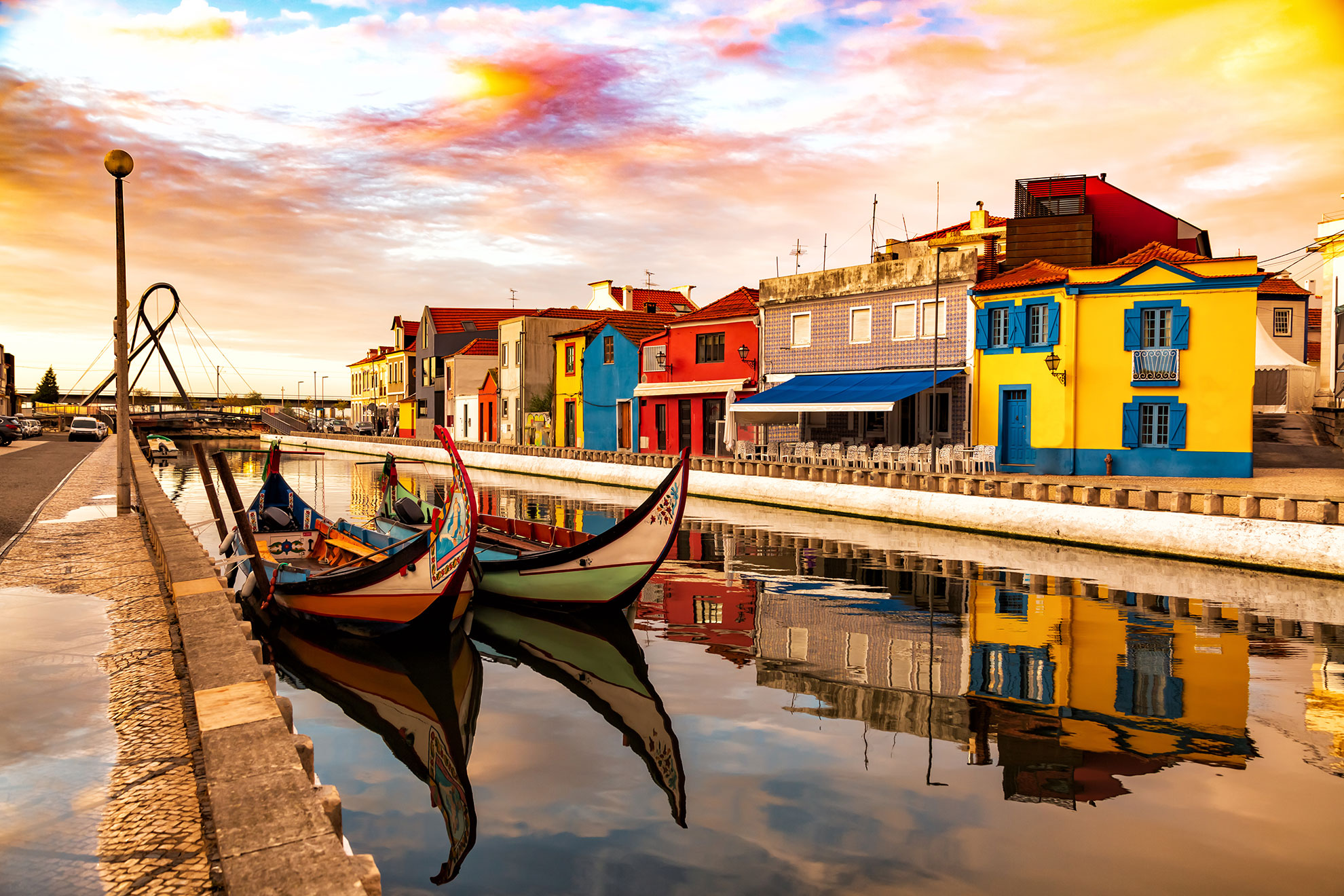
Moliceiro boats on the Ria de Aveiro — cobalt-hulled, hand-painted, and still very much in daily use.
Channels of Tradition
Aveiro, Unhurried: A City That Moves at the Pace of Its Canals
From Art Nouveau façades and lagoon-drifting Moliceiros to candy-striped fishing cottages and egg-yolk pastries — Aveiro rewards those who slow down long enough to notice it.
There is a particular quality of light in Aveiro on a still morning — the kind that bounces off the salt-white lagoon and finds its way into the decorated tiles of a bakery front, where the scent of Ovos Moles drifts out to meet you before you've decided where to walk next. This is a city that has always lived beside water, shaped by tides and salt and the painted prows of wooden boats. It is also, quietly, one of the most visually composed places in Portugal.
Aveiro sits at the edge of the Ria — a shallow, tidal lagoon network that stretches between the city and the Atlantic — and the relationship between the two has defined everything here, from the architecture to the economy to the pastries. The Moliceiro boats, once used to harvest seaweed from the lagoon floor, now carry visitors along the central canals, past wrought-iron bridges and the polychrome tilework of Art Nouveau buildings that line the waterfront like a painted gallery. The early 20th century left its mark here generously, and the result is a city center that feels singular: ornate without being excessive, coastal without the usual pier-town noise.
Aveiro is not a scaled-down Porto, nor a footnote on the way to Lisbon. It has its own cadence — quieter, saltier, and considerably more decorated.
The urban core is compact enough to navigate on foot in a morning, though that would mean missing the texture. The Praça do Peixe — the old fish market square — anchors the western edge, flanked by a seminary-turned-museum and the kind of café terraces where the coffee comes strong and the conversation runs long. The canal network fans out from here in several directions, and the old salt pans along the southern lagoon, now largely inactive, give the air a faint mineral quality that is not unpleasant. This is not a city that shouts. It murmurs, in tile and in water.
What to See: The Urban Core and the Lagoon
The architecture alone justifies a deliberate stroll through the streets around the Rossio canal and the Cais dos Botirões. Aveiro's Art Nouveau heritage is concentrated here — the Museu Arte Nova on Rua Dr. Barbosa de Magalhães contains one of the most detailed collections of the style in Portugal, including the jaw-dropping Casa Major Pessoa with its exterior of deep cobalt-blue and amber tilework. The buildings are not fenced off or kept behind ropes; they are simply the buildings of the street, which is part of what makes them worth seeing. Elsewhere, the Aveiro Cathedral and the Convent of Jesus — where the body of Princess St. Joana has rested since 1490 — give the city a quieter, devotional register to counterbalance the decorative exuberance outdoors.
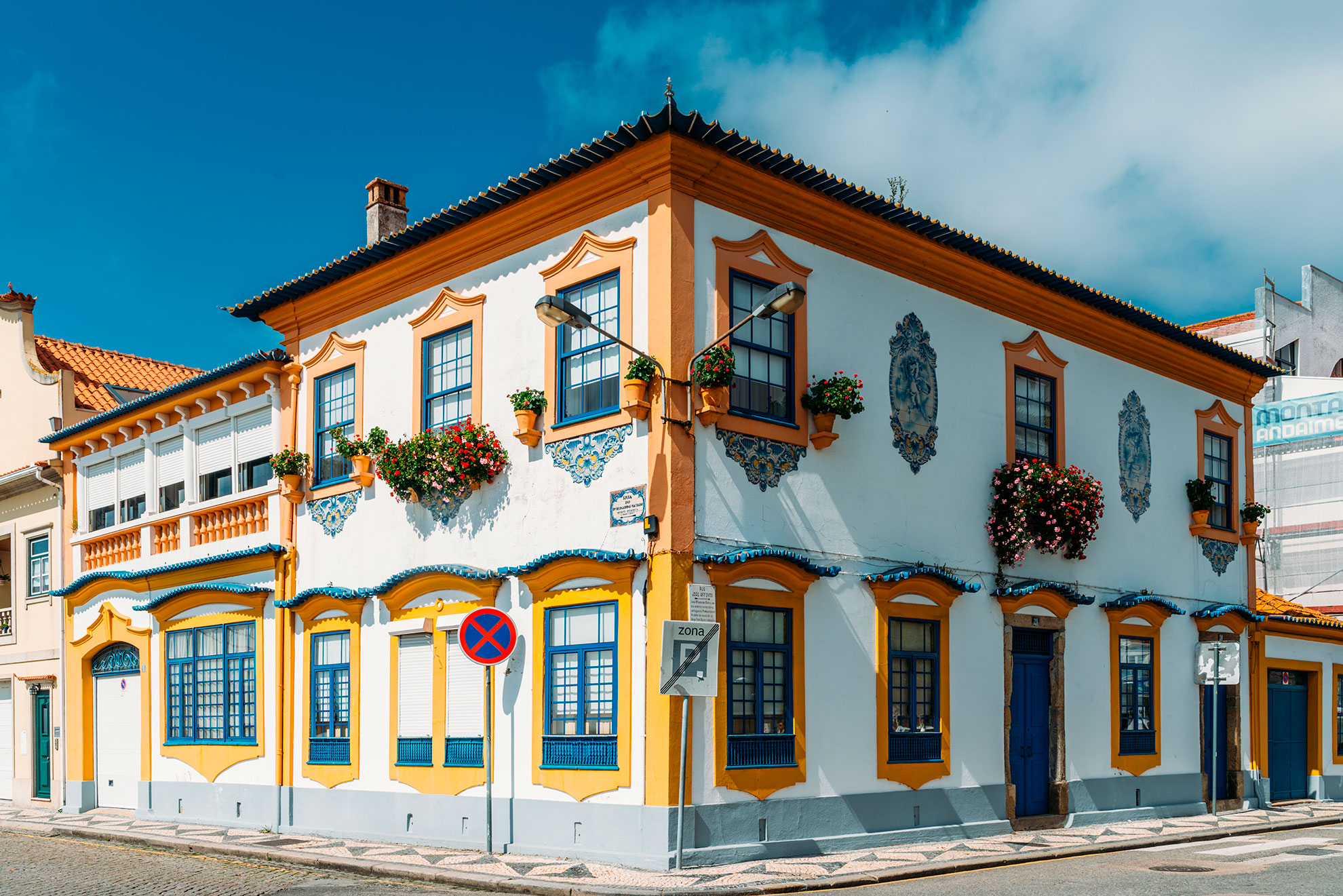
The ornate tilework of Aveiro's Art Nouveau district — cobalt blue and cream, applied with no apparent restraint.
Guided Tours: Canal City & Beyond
Costa Nova: The Striped Coast
Eight kilometers west of Aveiro's center, where the lagoon narrows to a thin strip of sand before the Atlantic takes over entirely, sits Costa Nova do Prado. The village is best known for its Palheiros — the candy-striped wooden cottages that line the seafront in bold verticals of red, white, green, navy, and ochre. Originally built as seasonal shelters for fishing families, the structures were elevated off the sand on stilts and painted in strong colors so that fishermen could identify their own from the water. The practical has since become the iconic: these are among the most photographed façades in Portugal, and they earn the attention. The stripes are not decorative in the tourist-brochure sense — they carry a working history, and that legibility of origin makes them more interesting to look at, not less.
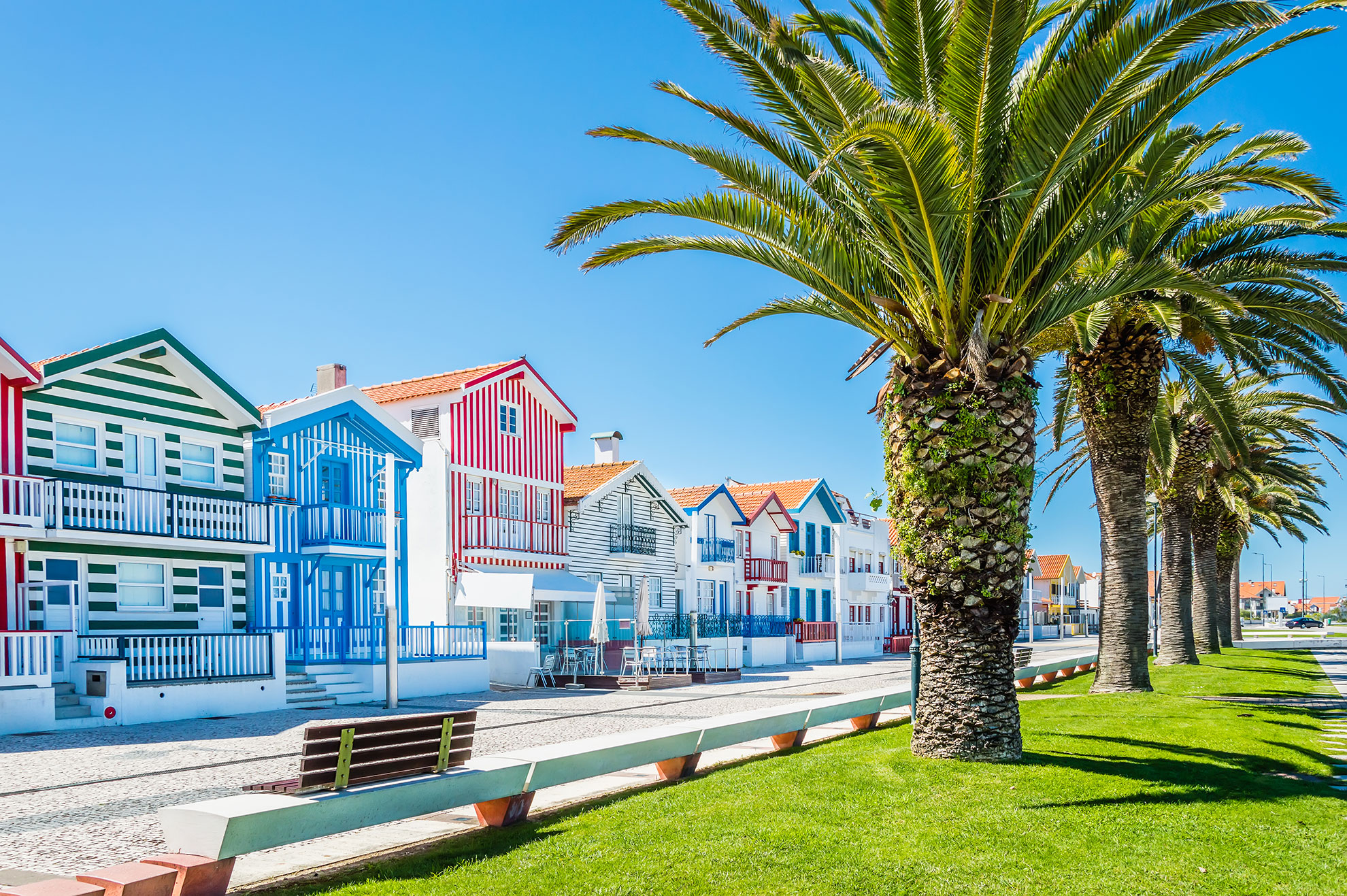
The Palheiros of Costa Nova — originally practical, now iconic. The Atlantic runs close behind them.
The wind at Costa Nova arrives with the full weight of the open ocean behind it. Stand at the waterline and the striped houses seem like the only fixed point in the landscape.
Tours Including Costa Nova
Ready to explore Aveiro's canals, coastline, and surrounding landscapes? Browse all available guided tours, boat experiences, and day trips from Porto or Lisbon.
Browse All Aveiro Tours →The Wilder Edge: Paiva Walkways and Arouca
Aveiro's surrounding region offers a sharp and rewarding contrast to the city's composed, tilework-and-canal character. An hour inland, the Paiva Walkways thread along a 9-kilometer riverside route through one of the most ecologically intact river valleys in central Portugal. The path is built largely of wooden boardwalks pinned into the canyon walls above the Paiva River, which runs clear and cold over granite boulders below. At the northern end, the 516 Arouca suspension bridge stretches 516 meters across the gorge — currently one of the longest pedestrian suspension bridges in the world — and offers an unobstructed view of the river and forest below that rewards the walk considerably. This is not a gentle stroll; the route involves a meaningful elevation gain, and the bridge sways noticeably underfoot, which is by design.
The town of Arouca itself, a few kilometers from the trailhead, sits in a quieter register — a small market town with a Benedictine monastery at its center and a local food culture that runs to farm-raised meats and cheese. Several tours in this region include a working farm lunch near Arouca, which provides context that the walkways alone cannot — this is a part of Portugal where agriculture and landscape are still closely connected, and eating at a farm table makes that connection felt rather than merely noted.
Adventure & Nature Tours Near Aveiro
On Ovos Moles and the Business of Sugar
No account of Aveiro is complete without a word on Ovos Moles — the city's most distinctive culinary export. These are small, shell-shaped wafers filled with a paste of egg yolks and sugar, their recipe rooted in the convent kitchens of the 17th century. Portuguese nuns were historically the custodians of elaborate egg-yolk confectionery (the whites were used to starch religious habits, leaving the yolks to be creatively employed), and Aveiro's version is one of the country's most distinctive results. The wafers are molded into the shapes of river clams, barrels, and fish — a nod to the lagoon economy outside. They are sold in tins and in bakeries throughout the city center, and they are worth eating on-site rather than saving for later; the shell softens quickly. Look for the protected designation of origin seal — Ovos Moles de Aveiro received IGP status in 2015, which means what you buy in the city is subject to specific production standards.
Whether you're coming from Porto, Lisbon, or arriving in Aveiro directly, there's a tour format here that fits your schedule — from private full-day itineraries to small-group canal experiences.
See All Available Tours →Frequently Asked Questions
Is Aveiro worth visiting as a standalone destination, or only as a day trip?
Aveiro has its own accommodation, restaurant scene, and enough architectural and natural interest to justify one or two nights. That said, its compact size also makes it manageable as a day trip from Porto (about 60 km south) or as a stop en route from Porto to Lisbon. Overnight stays allow you to experience the canals in the early morning and evening light, which has a notably different quality from midday.
What is a Moliceiro boat and how long does a ride typically take?
Moliceiros are flat-bottomed wooden boats traditionally used to harvest moliço — the algae and seaweed from the lagoon floor, which was used as agricultural fertilizer. Today they carry visitors along the main canal network. A standard tourist ride covers the central channels and lasts approximately 45 minutes. The boats are decorated with panels of hand-painted scenes, often humorous or local in character, and each boat's imagery is unique.
How far is Costa Nova from central Aveiro, and how do you get there?
Costa Nova is approximately 8 km west of Aveiro's historic center, following the lagoon road. By car or taxi it takes around 15 minutes. There is also a local bus service. Several guided tours include Costa Nova as part of a wider Aveiro itinerary, which removes the need for independent transport arrangements.
Are the Paiva Walkways suitable for all fitness levels?
The full Paiva Walkways route covers approximately 9 kilometers with a total elevation gain of around 500 meters, including descents. It is classified as moderate-to-demanding. The path surface is mostly wooden boardwalk and stone, with some steep sections. The 516 Arouca bridge can be accessed from the northern end of the route. Most guided tours that include the walkways will indicate the level of physical effort required.
When is the best time of year to visit Aveiro?
Late spring (May–June) and early autumn (September–October) offer the most comfortable conditions — warm enough for the lagoon and coast, cooler than peak summer, and with fewer visitors than July and August. The salt pans are particularly active in summer. Winter brings quiet streets and occasional Atlantic storms, but the city remains open and the museum circuit is unaffected by weather.
Can I combine Aveiro with Coimbra in a single day trip from Lisbon?
Yes, though it is a long day. Coimbra sits roughly midway between Lisbon and Aveiro, making a combined itinerary logistically sensible. A private tour allows for a more flexible pace than a group option on a route this length. Allow at least 2–3 hours per city to go beyond a superficial visit — Coimbra's old university and Aveiro's canal district both reward time spent on foot.